
Preferences
Privacy is important to us, so you have the option of disabling certain types of storage that may not be necessary for the basic functioning of the website. Blocking categories may impact your experience on the website. More information

Privacy is important to us, so you have the option of disabling certain types of storage that may not be necessary for the basic functioning of the website. Blocking categories may impact your experience on the website. More information

What is digital marketing? A beginner's guide to the main channels (SEO, GEO, ads, social, email, affiliate), owned vs paid vs earned media and how to start.
Tools


In short
Digital marketing is the set of online channels a business uses to attract, convert and keep customers: search engines (SEO), AI assistants (GEO), paid ads, social media, email, content and affiliate partnerships. These channels fall into three families: owned media you control (website, email list), paid media you rent (ads) and earned media others give you (mentions, reviews, citations). A beginner should start with one owned channel that compounds, usually a website with useful content, and add one paid or social channel to test demand quickly.
Want to go further? Ask
Digital marketing can look like an endless list of platforms, tools and acronyms. In practice it rests on a few simple questions: where do your future customers look for answers, which of those places can you reach with your budget, and how will you know what works? This guide explains the main channels, how they differ, how to choose your first one and how to think about budget.
Digital marketing is every action a business takes online to be found, chosen and remembered by the people it serves. It covers appearing when someone searches Google or asks ChatGPT a question, reaching people on social networks, sending emails to subscribers and paying for ads that put an offer in front of a targeted audience.
What separates it from traditional marketing is measurement. A billboard gives you a rough estimate of who saw it. A web page, an email or an ad tells you how many people saw it, clicked, signed up or bought. That feedback lets small teams compete with larger ones, provided they track the right numbers and act on them.
Seven channels cover most of digital marketing, and each one fits a different goal.
| Channel | How it works | Best for | Time to first results |
|---|---|---|---|
| SEO | Ranking your pages in Google's organic results | Steady traffic from people actively searching | Usually a few months |
| GEO | Being cited in ChatGPT, Gemini, Perplexity, Claude and AI Overviews | Recommendations at the moment of decision | Usually a few months |
| Paid search and social ads | Paying per click or per view on Google, Meta, LinkedIn and others | Fast tests, launches, seasonal offers | Days |
| Social media | Publishing and engaging on platforms where your audience spends time | Awareness, community, brand recall | Weeks to months |
| Sending newsletters and automated sequences to subscribers | Turning visitors into repeat customers | As soon as you have a list | |
| Content marketing | Guides, videos and resources that answer real questions | Feeding SEO, GEO, social and email | Months, then compounding |
| Affiliate and partners | Paying a commission to others who send you customers | Reaching audiences you do not own | Weeks, once partners are active |
SEO and content are closely linked: the content is what ranks. If you are new to search, our guide to SEO basics explains how Google finds and ranks pages, and our guide to content marketing covers how to plan what you publish.
Owned media belongs to you, paid media is rented, and earned media is given to you by others. This distinction matters more than the list of platforms, because it tells you what you keep when you stop spending.
The three reinforce each other. A strong page on your site (owned) is what earns links and AI citations (earned), and an ad (paid) can push that page to the people most likely to share it. Mature strategies shift the balance over time toward owned and earned media, which cost less per visitor as they grow.
Pick the channel where your customers already look for what you sell, then check that you can sustain it for at least three months. Spreading a small budget across six channels usually produces six weak signals and no clear lesson.
For most small businesses, the solid default is a website with content that answers buyers' questions, plus an email list to keep the visitors it brings. Paid ads then serve to test offers and messages quickly.
Start from the value of a customer, not from a percentage copied from another company. Estimate what a new customer brings you over time, decide the maximum you can pay to acquire one, then give a single channel a fixed budget and a fixed period to prove itself.
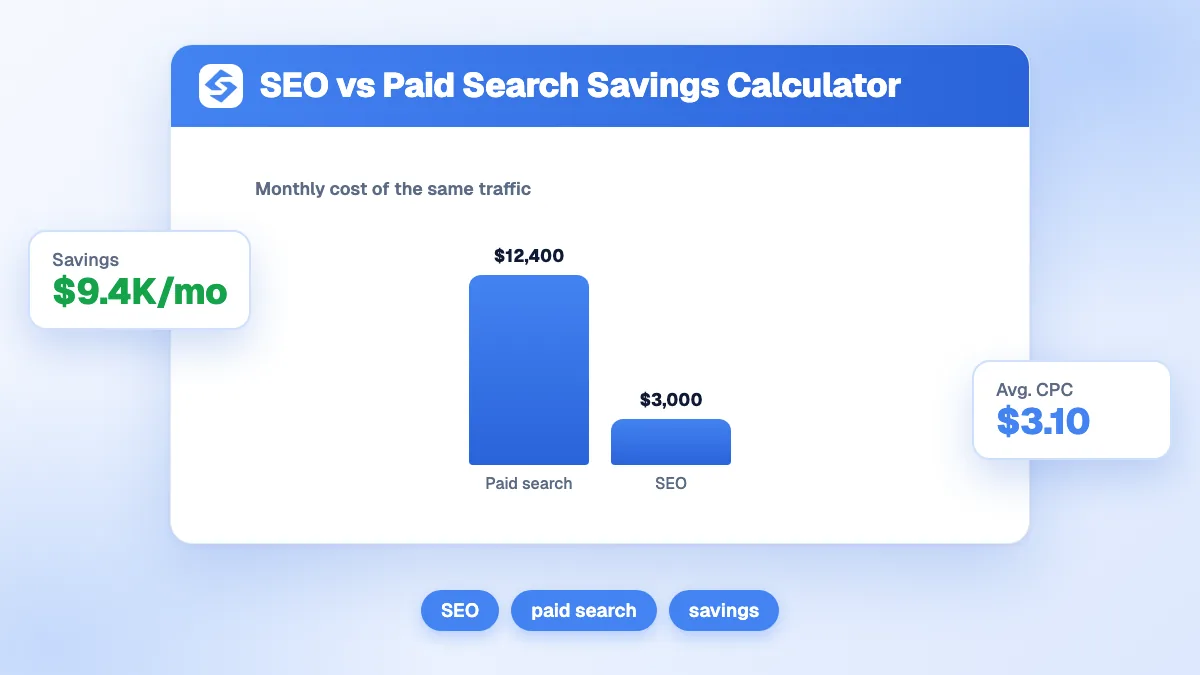
The cost structure differs by channel. Paid ads have a direct cost per click, so spend scales with traffic and stops producing the day you stop paying. SEO and content have an upfront cost in time or production, then keep bringing visits without paying per click. To compare the two for your own keywords, our SEO vs paid savings calculator estimates what your organic traffic would cost if you bought it as ads.
Whatever the channel, track three numbers from day one: cost per lead or sale, conversion rate, and the share of revenue each channel brings. They tell you where to put the next euro or dollar.
A growing share of research now starts with a question to an AI assistant, so being cited in those answers is becoming a channel of its own. When someone asks ChatGPT, Gemini, Perplexity or Claude for the best tool, agency or product for their situation, the assistant names a few brands and often links its sources. Brands that are not mentioned are not considered.
This discipline is called GEO (generative engine optimization). It builds on SEO: the AIs draw on pages they can retrieve and on what is said about you across the web. Clear pages that answer questions directly, consistent information about your business and mentions on trusted third-party sites all increase the chances of being cited. For a beginner, the practical step is to list the ten questions your customers would ask an assistant and check, regularly, who gets named.
Digital marketing is choosing a few channels where your customers already are, measuring what each one brings, and building assets that keep working. Start with an owned base (a website with useful content and an email list), test demand with a small paid budget, and add channels only when the first one works. Keep the AI assistants in view: being cited there is becoming as important as ranking in Google.
If you want the owned part to run on autopilot, Sorank finds your keywords, writes and publishes an SEO and GEO article every day and tracks whether ChatGPT and the other AIs cite your brand. See the plans and start a 3-day free trial.

Digital marketing is every way a business uses the internet to be found, chosen and remembered by customers. It includes appearing in Google and in AI assistants, running ads, posting on social networks, sending emails and working with partners. Its advantage over traditional marketing is that almost every action can be measured, from the first visit to the sale.
The main types are search engine optimization (SEO), visibility in AI assistants (GEO), paid advertising on search and social platforms, social media marketing, email marketing, content marketing and affiliate or partner marketing. Most businesses combine two or three of them rather than trying to run every channel at once.
There is no universal figure. Start from what a customer is worth to you and what you can afford to pay to acquire one, then test one channel with a fixed budget for a defined period. Paid channels need ongoing spend to keep working, while SEO and content need time and regular publishing but keep producing traffic after the work is done.
 AI Content Brief Generator
 FAQ Schema Generator
 AI Blog Post Ideas Generator
 Structured Data Validator
 Alt Text Checker
 Internal Link Analyzer
 Backlink Challenge
 AI Meta Description Generator
 AI Blog Title Generator
 Google Indexability Checker
 AI Blog Outline Generator
 UTM Link Builder
 Keyword Clustering Tool
 Canonical Tag Checker
 XML Sitemap Generator
 Broken Link Checker
 AI SEO Title Generator
 Headline Analyzer
 SERP Preview Tool
 Redirect Checker
 Hreflang Tag Generator
 Heading Structure Analyzer
 HTTP Headers Checker
 Favicon Extractor
 SERP CTR Calculator
 SEO vs Paid Search Savings Calculator
 SEO Share of Voice Calculator
 SEO ROI Calculator
 SEO Traffic and Revenue Forecast Calculator
 SEO Budget Calculator
 SEO Break-Even Calculator
 SaaS SEO ROI Calculator
 ROAS Calculator
 Reading Time Calculator
 Ranking Gain Simulator
 Organic Traffic Value Calculator
 Organic Traffic Estimator
 LTV to CAC Ratio Calculator
 Local SEO ROI Calculator
 Link Building Cost Calculator
 Keyword Value Calculator
 Keyword Opportunity Score Calculator
 Keyword Density Calculator
 GEO ROI Calculator
 GEO Content Investment Calculator
 Ecommerce SEO ROI Calculator
 Customer Lifetime Value Calculator
 Customer Acquisition Cost Calculator
 CTR Calculator
 Cost Per Article Calculator
 Conversion Rate Calculator
 Content Marketing ROI Calculator
 ChatGPT Referral Traffic Estimator
 Bounce Rate Calculator
 Backlink ROI Calculator
 AI Visibility Score Calculator
 AI Traffic Value Calculator
 AI Share of Voice Calculator
 Cost of AI Invisibility Calculator
 AI Citation Rate Calculator
 llms.txt Validator
 AI Overview Checker
 Robots.txt Checker
 AI SEO Audit
 LLM Readability Checker
 SearchGPT Readiness Checker
 Structured Data LLM Audit
 Website Crawlability AI Audit
 Why ChatGPT Is Not Recommending My Website
 Gemini Ranking Tool
 Perplexity Ranking Checker
 LLM Citation Checker
 Answer Engine Optimization Audit
 GEO Audit
 AI Search Visibility Test
 ChatGPT Visibility Checker
 llms.txt Generator
 URL Extractor
 Webpage to Markdown
 Sitemap Checker
 SERP Volatility Sensor
 Page Size Checker
 Word Counter
 Slug Generator
 Schema Generator
 Robots Generator
 OG Preview
 Meta Tags Generator
 Image Compressor
 Favicon Generator
 On-Page SEO Audit
 Backlink Analysis Tool
 Keyword Research Tool
 Domain Authority Checker
THEY TRIED SORANK BEFORE YOU
 “I tested Sorank on a real client site and it's insane. It does everything an agency would bill you $1500 a month for. It's going into production on that client now.”

 Guillaume Guersanguersanguillaume.com“We are an Ads agency and we wanted to get our SEO back on track once and for all. Sorank gave us a clear view of our site, helped us prioritize optimizations, and properly structure our content. The tool is easy to use, well designed for a team, and very practical for centralizing tracking without having to juggle multiple platforms. A very solid foundation to start fresh with our SEO.”
 Gaspard MadouiAds Agency
 “I just let the Sorank software do its thing, and now my DR is 25 and my page is ranking higher.”
 Lucas Flandrefoundertrace.fr“I specialized in GEO thanks to Sorank. The GEO Leaderboard allows me to show my clients their position vs competitors on ChatGPT. It’s a real commercial differentiator.”
 MélanieSEO Freelance“Great service, works well for our website and helps us understand how to improve it to rank better on Google and elsewhere. Congrats, keep going, I recommend it.”
 Hugo T.E-commerce merchant
























