Preferences
Privacy is important to us, so you have the option of disabling certain types of storage that may not be necessary for the basic functioning of the website. Blocking categories may impact your experience on the website. More information
Privacy is important to us, so you have the option of disabling certain types of storage that may not be necessary for the basic functioning of the website. Blocking categories may impact your experience on the website. More information

Start a digital marketing agency step by step: pick a niche, register the business, price for profit, win first clients and avoid costly mistakes.


In short
A digital marketing agency is a business that sells SEO, paid ads, content, email or social work to clients on a monthly retainer or a project fee. To start one, pick a niche and one core offer, register the business, price on cost plus margin, and win your first clients through your network and direct outreach.
Want to go further? Ask
Quick quiz
Which way of finding customers online fits you best?
Sorank matches your answers


Test it for 3 days on your own site and see where you stand on Google, ChatGPT and the other AIs.
Start 3-day free trial3 days free, then stop whenever you want. 90-day results guarantee, conditions apply.
Choose one service line first, because it sets your pricing, your hires and your sales pitch. You can start as a full-service agency, but a specialist with one service is usually easier to sell in the first year. The table below lists the common models.
| Agency type | What you deliver | Usual client payment | Good first choice when |
|---|---|---|---|
| Full-service | SEO, ads, social, content and email under one roof | Monthly retainer | You already have a team and a client base |
| SEO | Keyword research, technical audits, content and links | Monthly retainer or project | You know organic search well and can show results |
| Paid search (PPC) | Google Ads and Microsoft Ads setup, management and reporting | Percentage of ad spend or flat fee | You can prove return on ad spend quickly |
| Social media | Content calendars, community management and paid social | Monthly retainer | You have a strong creative eye and local clients |
| Content marketing | Strategy, articles, case studies and distribution | Monthly retainer | You can write, or manage writers, to a high standard |
| Email marketing | Lists, automated flows and newsletters | Monthly retainer or project | Your clients already have email lists to work with |
Three questions matter more than the label. Can you deliver the service well with the team you can afford in year one? Can you show a result a buyer will recognize, such as more qualified leads or better rankings for buying keywords? Do buyers in your market already search for and pay for that service? You can check the last point with a keyword tool, which the next section covers.
If you want the buyer's side before you pitch, read how to choose an SEO agency without getting burned. The questions buyers ask there are the ones your sales call has to answer.
Pick one service and one type of client before you buy a domain or design a logo. Agencies that try to serve everyone end up competing on price with everyone. In the founder survey that Ahrefs published on December 12, 2023, Glen Allsopp of Detailed said it is "fruitless to try and offer SEO services to anyone and everyone." Nathan Gotch of Gotch SEO recommends one market segment instead of a catch-all agency. The rest of this step shows how to pick that segment and test it.
A niche has to pass three checks: people search for the service, they pay for it, and you can reach them. Start with the search side. List five service phrases, such as "SEO for dentists" or "Shopify SEO agency," and add the industry or city you want. Then read the results. If the top results are small specialists, the demand is real and so is the competition. If they are large generalists, the niche may be open, but check that anyone in it actually buys the service.
A keyword research guide explains how to read volume and difficulty, and that is enough to start. Do not chase exact numbers. Look at the pattern instead: does the phrase bring buyers, or students asking for a definition?
For the buyer side, send short messages to ten businesses in the niche and ask three questions. What do you pay for marketing today? What did the last provider fail to deliver? What would you pay to fix that? Write down the exact words they use, because those words become your headlines and your first email subject lines.
Last, check reach. Can you find a few hundred companies in the niche, each with a named decision maker you can contact? If you cannot, the niche is too small to build a pipeline on.
Your core offer is the one service you can deliver and explain in a single sentence, with a fixed scope and a price range. For example: "We find and fix the technical SEO problems that stop a Shopify store from ranking." Keep the other services for later. Write a one-page offer with the scope, the deliverables, the timeline and the monthly price. Buyers say yes faster to a clear offer than to a long menu.
Generalist agency vs specialist agency
Sorank publishes a set of agency playbooks, grouped by stage, in its Sorank's SEO agency guide. This article stops at the launch. The guide goes further on offers, delivery, reporting and selling the agency later.


Register your business with your state, get a federal tax number (EIN), open a bank account in the business name and sign a written contract with every client. Each step costs little. Skipping one usually costs far more when a client pays late or a dispute starts. The steps below follow the guidance of the U.S. Small Business Administration. Other countries use other forms and names, so check your local rules before you file.
Business registration in five steps
Source: U.S. Small Business Administration, register your business
A sole proprietor who uses their legal name generally does not need to register the business, according to the SBA. That is the simplest route, but it leaves your personal assets exposed if a client sues. An LLC, corporation or partnership must register with the state, and you must name a registered agent in that state before you file. Some states also require an initial report within 30 to 90 days of registering, so put that date in your calendar.
You need an EIN if you hire workers, run a partnership or corporation, or pay certain taxes. The IRS online application gives you the number in minutes at no cost. Many other websites charge a fee to file the same form for you.
Warning
Apply for your EIN only through the IRS website. A third-party site that charges for the number adds cost and gives you nothing extra.
Every client needs a signed master services agreement, plus a statement of work for each project or retainer. The agreement covers liability, confidentiality, payment terms and how either side can end the work. The statement of work lists the deliverables, the timeline, what is out of scope and what counts as done. Write the templates once, have a lawyer review them, and reuse them. Unclear scope is where unpaid hours come from, so list what is out of scope in every statement of work.
Open a business bank account and card, and send all client payments there. Mixing personal and business money makes taxes harder and weakens the liability protection an LLC gives you. Ask your accountant which software to use for invoices and expenses on day one. A clean ledger from the start saves a painful cleanup at tax time.
Price from your costs, add a realistic margin, and never win a client by undercutting the market. Chris Haines, who wrote the Ahrefs guide, suggests total costs plus about 20% margin. Treat that as a starting point, not a rule. Your real margin depends on how much of your team's time is billable and how long clients stay.
Monthly retainer = (team salaries + contractors + tools + overhead) x 1.2

Example (replace with your own numbers):
team 4000 + tools 600 + overhead 400 = 5000 in costs
5000 x 1.2 = 6000 monthly retainerA retainer gives you predictable cash flow, and that is what lets you hire. A project fits audits, trials and one-off builds, where the scope is clear and the client wants a fast answer. The Ahrefs guide suggests project pricing for exactly those engagements. To price a project, estimate the hours each person needs, multiply by their hourly cost, then add your margin. A proposal template helps you present both options cleanly, and the SEO proposal section by section guide shows what each part should say.
Undercutting vs cost-based pricing
Simon Schnieders of Blue Array told Ahrefs that "over 50% of your costs will be labor." Each hire therefore changes your price more than any software subscription does. Before you hire, check that the new role brings in more than its monthly cost. Over-hiring erodes your margin, and under-hiring hurts both your team and your clients.
Alan Muther of Ardoz Digital advises: "Avoid offering rates lower than other similar agencies." Low prices attract clients who compare everything on price and leave at the first better offer. If you need a lower entry price, reduce the scope, not the hourly rate.
Tip
Before you quote a retainer, check what the client can realistically spend over a year with the free SEO budget calculator. It helps you plan a monthly and annual SEO spend, so you can see whether your price fits.
Your first clients will come from people you already know, then from outreach you run yourself. Plan both from the first week, because referrals arrive slowly and you cannot count on them for a monthly target. The founders in the Ahrefs guide named their own network as the most overlooked source of early clients.
Write a list of every person who runs a business, works in marketing, or might know someone who needs help. Include former colleagues, clients of your past employer, friends with shops and local owners you know. Send each of them a short message that names your niche and your core offer. Ask for introductions, not a sale. A warm introduction usually gets you a call faster than a cold message does.
Joshua George of ClickSlice got his first 20 clients through cold email, pulling contacts from Google results on pages 2 to 7. That works because those businesses already search for the service and rank below their competitors, so you have a clear and honest reason to write. Use the same logic: search your service keyword in your niche, open the sites on pages 2 to 7, and note one specific problem on each. Your first line should name that problem.
Outreach routine for a new agency
Cold email has legal rules in the US, which the cold outreach section below covers in detail. Follow them from the first message.
Liam Quirk of Quirky Digital posted SEO case studies on LinkedIn to attract clients. Brendan Hufford of Growth Sprints published a blog post, a podcast episode and a YouTube video every day for 100 days to get noticed. You do not need to match that run. You do need one or two pieces of proof a buyer can read in five minutes. Start with a case study on your own site, or on a client's site with their permission, and show the before and after. If you have no client work yet, publish a teardown of a public page from a well-known brand and explain what you would change.
Five channels bring in most early clients: referrals, direct outreach, LinkedIn and content, partnerships with complementary agencies, and search traffic to your own agency site. Each has a different speed, cost and risk. Choose two to start, measure them for about 60 days, and drop the weakest before you add a third.
How it works. A person who knows your work recommends you to a buyer. Use it when you have worked for a company, or you know people who sell to your niche. Advantages: the warmest leads, fast trust and low cost. Limits: you cannot schedule referrals, and they dry up once your first circle is used. Example: Sean Begg Flint of Position Digital gets referrals from web development, design and paid ads agencies, where there is little competition for the SEO work.
How it works. You find buyers and contact them one by one by email or LinkedIn. Use it when your niche is clear and you have a standard problem to point at. Advantages: you control the volume and the message, and you can measure every step. Limits: reply rates are low, and the legal rules for email apply. Example: Joshua George's first 20 clients, found through contacts on pages 2 to 7 of Google results.
How it works. You publish case studies and practical posts, and buyers find you and reach out. Use it when you can write about results and at least a few clients approve public credit. Advantages: the leads come to you, and each post keeps working after you publish it. Limits: slow at the start, and it needs steady time every week. Example: Liam Quirk's case studies on LinkedIn, and Brendan Hufford's 100-day publishing run.
How it works. A web design, development or paid ads agency sends you SEO work, and you send them the work outside your scope. Use it when you already know agencies that serve your buyers. Advantages: warm, qualified leads and a shared client base. Limits: you depend on their relationships, so write the referral or return arrangement down. Example: reselling link building under your own brand. For how that works and what it costs, read white label link building.
How it works. Your site ranks for phrases like "digital marketing agency for dentists," and buyers arrive ready to talk. Use it when you can publish a few pages that answer buyer questions and you can wait months for results. Advantages: the cost per lead falls over time. Limits: results are slow, and a page only helps if its offer is specific. Example: one service page for your niche, with one case study, linked from a few helpful articles. Plan those articles with a method for planning posts that rank.
| Channel | Speed to first client | Cost | Predictability | Main risk |
|---|---|---|---|---|
| Referrals | Fast when it works | Low | Low | Running out of contacts |
| Direct outreach | Medium | Mostly your time | Medium | Low reply rates and compliance mistakes |
| LinkedIn and content | Slow at first | Mostly your time | Medium | Posts that get attention but no buyers |
| Partnerships | Medium | Low | Medium | Depending on a single partner |
| Search traffic to your site | Slow | Low cash, steady time | High once rankings hold | Months before results appear |
Use this table to plan your first 90 days. Pick the two channels that fit your skills and your time, and set a weekly target for each one.
In the US, commercial email to businesses is legal when you follow the CAN-SPAM Act. The FTC's compliance guide for business sets the core rules: accurate headers, a clear sign that the message is an ad, a valid postal address, and a working opt-out that you honor within 10 business days. The guide, edited in January 2024, puts the maximum penalty at $53088 for each separate email in violation.
Two numbers from the FTC rules for email
Source: U.S. Federal Trade Commission, CAN-SPAM Act: A Compliance Guide for Business (edited January 2024)
The CAN-SPAM Act covers commercial email, not only bulk sends, and it makes no exception for business-to-business messages. A single message that offers your service counts. Transactional messages, such as a reply to a client who asked for a proposal, are mostly exempt from the opt-out and labeling rules, because their primary purpose is to confirm an existing transaction or relationship. When in doubt, treat the message as commercial and follow every rule.
Every cold email needs an accurate sender name and subject line, a clear identification as an ad where the rules require it, your valid physical postal address, and a working opt-out. The FTC says the address can be a current street address, a registered post office box or a registered private mailbox. Adapt this footer to your own details:
--
[Your full name], [Your agency name]
[Street address, city, state, ZIP]
Not a fit? Reply "unsubscribe" and we will remove you from our list within 10 business days.If you hire an email tool or a freelancer to send for you, the FTC says you cannot contract away your legal responsibility. Before you sign, ask where each address came from, how the unsubscribe process works, and what their complaint rate looks like. Do not buy a list from a broker unless you can name the source of every address.
Your first line should name a fact about the prospect's site, such as a broken title tag or a missing local listing, and the whole email should be short enough to read on a phone. Do not invent case studies, client names or results. If you want to use a testimonial, get written permission first. Fake claims lose you the deal and can create legal risk.
Write down how each service is delivered before you hire anyone, then report results in a format your clients can read. Quality breaks when the founder is the only person who knows how the work gets done. A short set of written procedures lets a new hire start on real work sooner.
Chris Haines advises creating standard operating procedures and templates before you hire, so quality stays consistent. Start with the three tasks you repeat most in your core offer. For a technical audit, a procedure might read: crawl the site, export the errors, group them by page template, fix the ten with the largest traffic impact first, and log each change in your tracker. Each step is one line, with the tool named and an owner assigned.
Clients rarely read a 40-page export. They read a short summary that answers three questions: what changed, what it did for their goals, and what you will do next. Build a monthly template and keep the jargon in an appendix. A SEO reporting template shows the sections buyers find most useful. Once the template works, use automated SEO reporting to pull the data, so your time goes to the analysis.
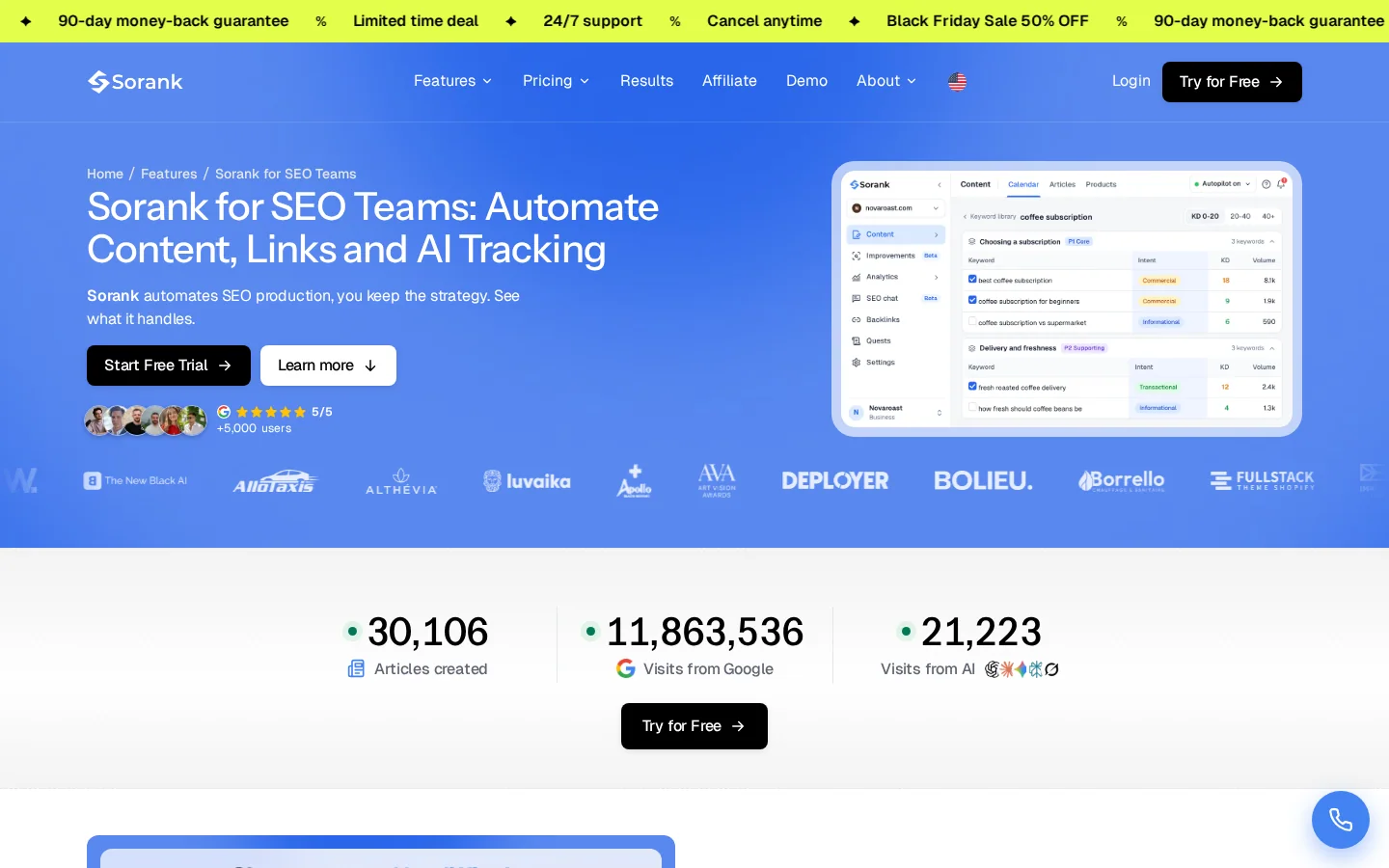
When your delivery runs across many client sites, Sorank for SEO Teams brings content, link building and AI visibility tracking into one place. The page below shows what it covers.
Matt Cayless of Bubblegum Search started with freelancers for flexibility, then moved to full-time employees once the agency was stable, according to the Ahrefs guide. That order protects your cash. Joshua George sets a hiring test: "Only hire someone that's better than you at the role you're hiring for."
First hires: freelancers vs full-time staff
In 90 days you can register the business, test one niche, sign your first clients and deliver the first results. Work through the phases in order, and do not hire anyone until signed revenue covers their cost. The plan assumes you have a few hours a day and no outside funding.
Your first 90 days
Follow the registration steps from the second section. Then write your niche in one sentence and test it with ten short conversations. If those conversations do not reveal a clear pain point, change the niche before you build anything else. Changing a niche in week two costs a few days. Changing it in month six costs clients.
Turn your core offer into a one-page document with scope, deliverables, timeline and price. Build the price from the formula in the pricing section, and write the statement of work from your template. Put the offer on a simple one-page website with a contact form. Add more pages once you have clients to show.
Send outreach in batches, not all at once, so you can fix the message after the first replies. Book calls, and send a proposal within two days of each call, because a late proposal loses the buyer's attention. Keep a log of every objection, since the objections tell you what to change in the offer.
Deliver the first project with your written procedures, and report it in your template. Ask the client for permission to publish the results. A clear before and after, approved by the client, becomes the case study that powers the next month of outreach.
The mistakes that sink new agencies are underpricing, selling everything at once, hiring too early, relying on one channel, promising results you cannot control, and skipping the legal basics. For each one, learn the warning sign and apply the fix. Most of them show up in the first month if you check your numbers every week.
What it is: a rate below your costs, offered to close a deal fast. How to spot it: you win every deal, and after tools and time nothing is left. How to fix it: price new clients from your cost formula, cut scope rather than rate, and put a review date in the contract so the price can rise with results. If an existing client needs a lower fee, move them to a smaller package.
What it is: a pitch that lists twelve services, from SEO to podcast production. How to spot it: none of your services has a case study, and every sales call reopens the scope. How to fix it: sell one core offer until you have three results to show. Add services only when a current client asks for them.
What it is: adding payroll before recurring revenue can carry it. How to spot it: a month where cash falls below payroll, or a team member waiting for work. How to fix it: use freelancers, and set a rule that a full-time hire needs signed retainers that cover their cost plus your margin for at least three months.
What it is: every lead comes from one source, usually a single referral partner. How to spot it: when that source slows down, the pipeline is empty within weeks. How to fix it: run two channels from the comparison table, and track the share of leads by source every month.
What it is: a guarantee of position one on Google or a named recommendation in ChatGPT. How to spot it: the proposal contains a guaranteed outcome and no list of inputs. How to fix it: promise inputs, such as the audit, the content, the links and the reporting, and agree on the metric you will measure. Before you set a target, run a baseline with an AI visibility audit, so both sides know where you start.
What it is: outreach with no postal address, no opt-out, or a purchased list. How to spot it: your template has no footer, or a contact asked to stop and kept receiving messages. How to fix it: use the footer and vendor checks from the cold outreach section, and stop any sequence that has no working unsubscribe path.
What it is: starting client work on the strength of a chat message. How to spot it: you cannot point to a signed scope when the client asks for an extra task. How to fix it: send the agreement and the statement of work before the first hour of work, and invoice on day one.
Before you sign your first client
Your first 90 days decide whether the agency works, so keep the plan small: one niche, one core offer, two client channels and a monthly review. Once the first clients are signed, the playbooks in the agency guide linked earlier cover the stages after launch. Start with the three steps below.
Your next three actions
It depends on your state, whether you hire, and how long you can cover costs before the first invoice is paid. Registration fees are usually modest, and an EIN is free from the IRS. Plan for several months of running costs, and build your price from your own numbers, not from someone else's estimate.
You do not need a degree, but you do need proof that you can get results in at least one channel. Build a case study on your own site, or on a client's site with permission, and sell from that. Start with the one service you already know best.
Start with freelancers or contractors so your fixed costs stay low while you find clients. Hire full-time staff once recurring revenue covers their cost plus your margin. According to the Ahrefs founder guide, Matt Cayless of Bubblegum Search followed that order.
We analyse your competitors, your website and your AI visibility to create a tailored content plan for free.
 AI Content Brief Generator
 FAQ Schema Generator
 AI Blog Post Ideas Generator
 Structured Data Validator (Schema Validator)
 Alt Text Checker
 Internal Link Analyzer
 Backlink Challenge
 AI Meta Description Generator
 AI Blog Title Generator
 Google Indexability Checker
 AI Blog Outline Generator
 UTM Link Builder
 Keyword Clustering Tool
 Canonical Tag Checker
 XML Sitemap Generator
 Broken Link Checker
 AI SEO Title Generator
 Headline Analyzer
 SERP Preview Tool
 Redirect Checker
 Hreflang Tag Generator
 Heading Structure Analyzer
 HTTP Headers Checker
 Favicon Extractor
 SERP CTR Calculator
 SEO vs Paid Search Savings Calculator
 SEO Share of Voice Calculator
 SEO ROI Calculator
 SEO Traffic and Revenue Forecast Calculator
 SEO Budget Calculator
 SEO Break-Even Calculator
 SaaS SEO ROI Calculator
 ROAS Calculator
 Reading Time Calculator
 Ranking Gain Simulator
 Organic Traffic Value Calculator
 Organic Traffic Estimator and Website Traffic Checker
 LTV to CAC Ratio Calculator
 Local SEO ROI Calculator
 Link Building Cost Calculator
 Keyword Value Calculator
 Keyword Opportunity Score Calculator
 Keyword Density Calculator
 GEO ROI Calculator
 GEO Content Investment Calculator
 Ecommerce SEO ROI Calculator
 Customer Lifetime Value Calculator
 Customer Acquisition Cost Calculator
 CTR Calculator
 Cost Per Article Calculator
 Conversion Rate Calculator
 Content Marketing ROI Calculator
 ChatGPT Referral Traffic Estimator
 Bounce Rate Calculator
 Backlink ROI Calculator
 AI Visibility Score Calculator
 AI Traffic Value Calculator
 AI Share of Voice Calculator
 Cost of AI Invisibility Calculator
 AI Citation Rate Calculator
 llms.txt Validator
 AI Overview Checker and AI Overviews Rank Checker
 Robots.txt Checker
 AI SEO Audit
 LLM Readability Checker
 SearchGPT Readiness Checker
 Structured Data LLM Audit
 Website Crawlability AI Audit
 Why ChatGPT Is Not Recommending My Website
 Gemini Ranking Tool
 Perplexity Ranking Checker
 LLM Citation Checker
 Answer Engine Optimization Audit
 GEO Audit
 AI Search Visibility Test
 ChatGPT Visibility Checker
 llms.txt Generator
 URL Extractor
 Webpage to Markdown
 Sitemap Checker
 SERP Volatility Sensor
 Page Size Checker
 Word Counter
 Slug Generator
 Schema Generator
 Robots Generator
 OG Preview
 Meta Tags Generator
 Image Compressor
 Favicon Generator
 On-Page SEO Audit: SEO Checker and SEO Analyzer
 Backlink Analysis Tool
 Keyword Research Tool
 Domain Authority Checker
 “I tested Sorank on a real client site and it's insane. It does everything an agency would bill you $1500 a month for. It's going into production on that client now.”

 Guillaume Guersanguersanguillaume.com“We are an Ads agency and we wanted to get our SEO back on track once and for all. Sorank gave us a clear view of our site, helped us prioritize optimizations, and properly structure our content. The tool is easy to use, well designed for a team, and very practical for centralizing tracking without having to juggle multiple platforms. A very solid foundation to start fresh with our SEO.”
 Gaspard MadouiAds Agency
 “I just let the Sorank software do its thing, and now my DR is 25 and my page is ranking higher.”
 Lucas Flandrefoundertrace.fr“I specialized in GEO thanks to Sorank. The GEO Leaderboard allows me to show my clients their position vs competitors on ChatGPT. It’s a real commercial differentiator.”
 MélanieSEO Freelance“Great service, works well for our website and helps us understand how to improve it to rank better on Google and elsewhere. Congrats, keep going, I recommend it.”
 Hugo T.E-commerce merchant