Preferences
Privacy is important to us, so you have the option of disabling certain types of storage that may not be necessary for the basic functioning of the website. Blocking categories may impact your experience on the website. More information
Privacy is important to us, so you have the option of disabling certain types of storage that may not be necessary for the basic functioning of the website. Blocking categories may impact your experience on the website. More information

 Gemini 4 Hydrogen in Google Search: What Changes in AI Mode and What to Do Now
Google made Gemini 4 Hydrogen available worldwide in Search on November 12, 2026. What it changes for AI Mode and what to check on your pages.

Tools

In short
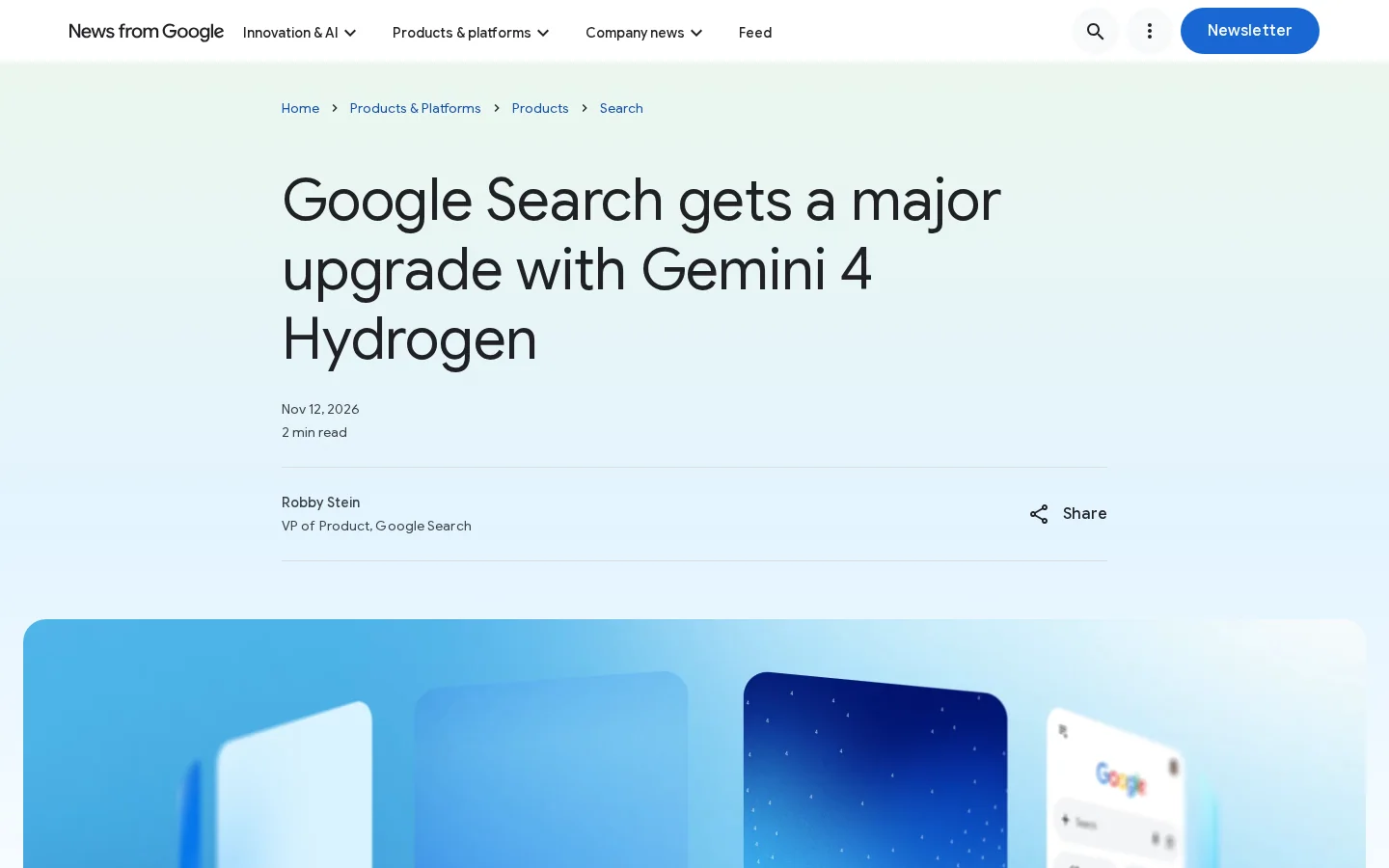
On November 12, 2026, Google announced Gemini 4 Hydrogen and said it is available worldwide in Google Search for all users. Search Engine Journal reports that Hydrogen is now the default model in AI Mode. For your site, the change matters because Google says Hydrogen improves query fan-out, the step where AI Mode decides which pages to cite.
Want to go further? Ask
Google published two posts that day. The Google Search post says Hydrogen is now available globally in Google Search for all users. The model post, signed by Koray Kavukcuoglu, SVP at Google DeepMind and Chief AI Architect, presents Hydrogen as a model designed for speed and efficiency. Google places it next to Carbon and Argon, which it describes as frontier models for deep, long-horizon reasoning.
The default claim needs a closer look. Google's pages do not say Hydrogen is the default in AI Mode. The Search Engine Journal article reports that Hydrogen is now the AI Mode default, after Gemini 3.5 Flash. It also reports that Google uses Hydrogen for the hardest AI Overview questions, quoting a post by Robby Stein, VP of Product for Google Search. Google has not said which questions count as the hardest.
AI Mode does not answer from one search. It splits your question into sub-questions, runs several searches, and writes an answer with links. That step is called query fan-out. Google says Hydrogen's reasoning improves it and connects users to "a broader range of helpful links than before." Google also says Hydrogen handles multi-part questions, typos, highly specific questions and detailed instructions better, and that answers will include more visuals, comparison tables and structured layouts.
| Point | What Google says | What Google does not say |
|---|---|---|
| Query fan-out | Hydrogen's reasoning improves it and connects users to a broader range of helpful links. | How many more links or sites that adds. |
| Multi-part questions | Hydrogen handles them, along with typos, highly specific questions and detailed instructions, better. | Any figure showing how much better. |
| Answer format | Answers will include more visuals, comparison tables and structured layouts. | When each format will appear. |
| AI Mode default | Not stated on the Google pages we read. | Reported only by Search Engine Journal. |
For your site, the main keyword is no longer the only thing that matters. A page that ranks first for a query can be skipped, while a page that answers one sub-question clearly can be cited. Our Google AI Mode SEO guide explains this method. It was published on October 26, 2026, before this announcement, and it does not mention Hydrogen. The method still applies. Start by checking the sub-questions behind your main queries.
The change matters most for sites whose traffic comes from AI Mode, and for pages that answer comparison, price, alternative or how-to questions. These questions usually break into several parts, so they are where sub-searches do the most work. Our comparison of AI Mode and AI Overviews shows how the two surfaces differ, which helps you decide where to look first.
Google now names three Gemini 4 models, and they do not reach the same users. Hydrogen reaches everyone. Carbon is Google's new frontier model in Search. The AI Mode help page says Carbon is limited to Google AI Ultra subscribers aged 18 and above, signed in with a personal Google Account, with daily usage limits. Google's announcement does not give the same availability for Argon, so we do not state it here. Our Gemini page covers the model family in more depth.
Who can use each Gemini 4 model in Search
Sources: Google Search blog, Google AI Mode help page
Google's model post also gives benchmark scores. They measure how capable each model is, not which sites AI Mode will cite, so read them as context only.
Google's benchmark scores at the default high setting
Source: Google DeepMind model post, November 12, 2026
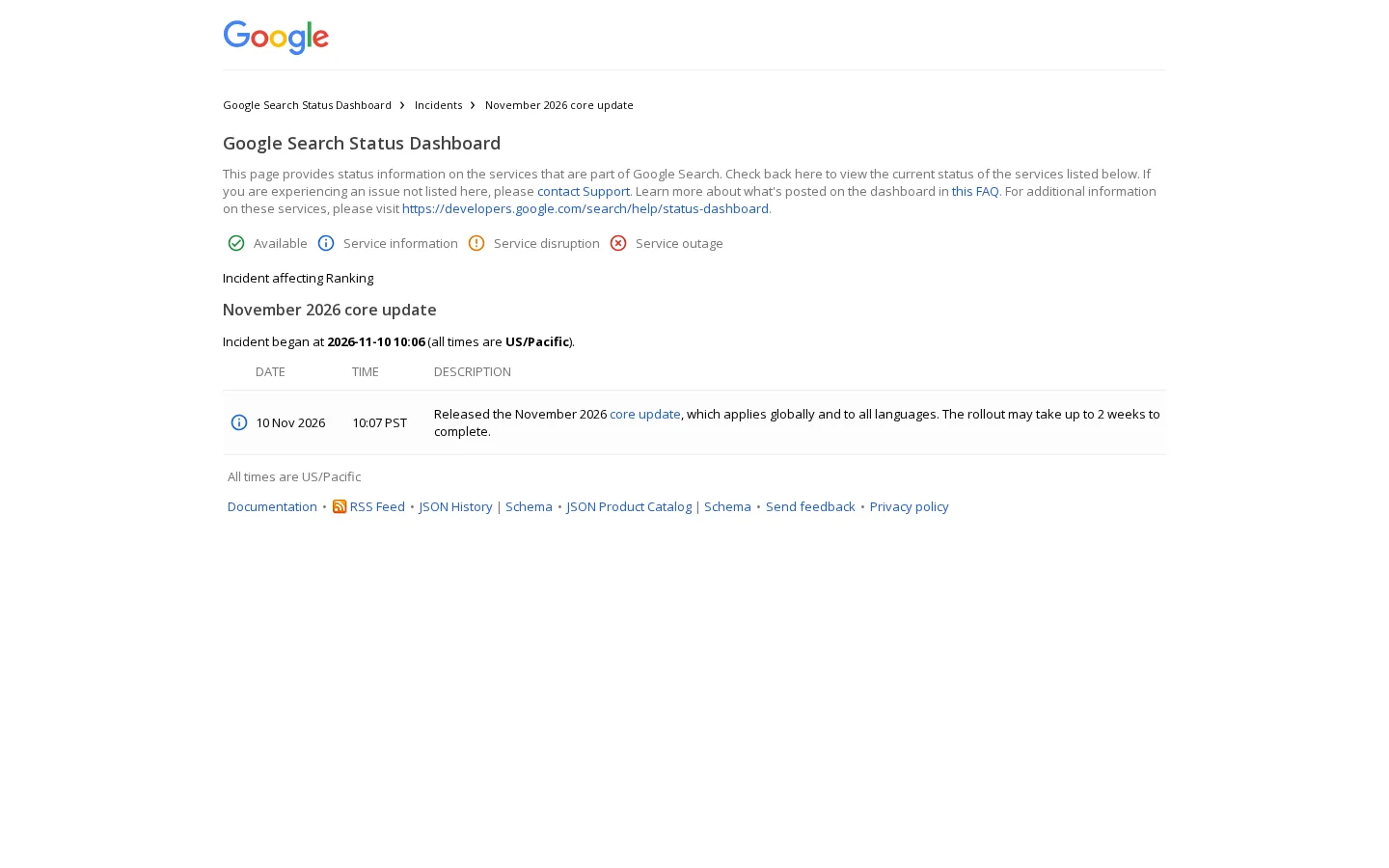
Google started the November 2026 core update on November 10, 2026. Its Search Status Dashboard says the update applies globally and to all languages, and that the rollout may take up to two weeks. The model change on November 12 therefore lands while the core update is still rolling out.
Three dates that shape this change
If your rankings or AI referrals move in the coming days, you cannot tell which change caused it. Search Engine Journal recommends logging both dates, and we agree. Write them in your analytics before you compare one week with another. Our Google algorithm guide covers the ranking systems and how core updates work, and our GA4 guide shows how to measure organic and AI traffic.
You do not need to rewrite your site today. Set a baseline first, then test a few pages. This is the order we would follow.
Checklist for this week
Sorank covers part of this check. The Query Fan-Out Tracker shows the searches AI runs around a topic, and AI Mention Tracking shows when ChatGPT cites your site. Answers vary from one run to the next, so repeat the checks rather than trusting a single result.
Yes. Google's November 12, 2026 Search post says Hydrogen is available globally in Google Search for all users. Carbon, the other Gemini 4 model in Search, is limited to Google AI Ultra subscribers aged 18 and above.
Google says Hydrogen improves query fan-out and connects users to a broader range of links. It does not say how many links or sites that adds, so check your sub-questions and your citations rather than assume a shift.
Start by logging the November 10 core update and the November 12 Hydrogen announcement, checking indexing in Search Console, and listing the sub-questions behind your main queries. Rewrite pages once your own data shows a gap.
We analyse your competitors, your website and your AI visibility to create a tailored content plan for free.
 AI Content Brief Generator
 FAQ Schema Generator
 AI Blog Post Ideas Generator
 Structured Data Validator (Schema Validator)
 Alt Text Checker
 Internal Link Analyzer
 Backlink Challenge
 AI Meta Description Generator
 AI Blog Title Generator
 Google Indexability Checker
 AI Blog Outline Generator
 UTM Link Builder
 Keyword Clustering Tool
 Canonical Tag Checker
 XML Sitemap Generator
 Broken Link Checker
 AI SEO Title Generator
 Headline Analyzer
 SERP Preview Tool
 Redirect Checker
 Hreflang Tag Generator
 Heading Structure Analyzer
 HTTP Headers Checker
 Favicon Extractor
 SERP CTR Calculator
 SEO vs Paid Search Savings Calculator
 SEO Share of Voice Calculator
 SEO ROI Calculator
 SEO Traffic and Revenue Forecast Calculator
 SEO Budget Calculator
 SEO Break-Even Calculator
 SaaS SEO ROI Calculator
 ROAS Calculator
 Reading Time Calculator
 Ranking Gain Simulator
 Organic Traffic Value Calculator
 Organic Traffic Estimator and Website Traffic Checker
 LTV to CAC Ratio Calculator
 Local SEO ROI Calculator
 Link Building Cost Calculator
 Keyword Value Calculator
 Keyword Opportunity Score Calculator
 Keyword Density Calculator
 GEO ROI Calculator
 GEO Content Investment Calculator
 Ecommerce SEO ROI Calculator
 Customer Lifetime Value Calculator
 Customer Acquisition Cost Calculator
 CTR Calculator
 Cost Per Article Calculator
 Conversion Rate Calculator
 Content Marketing ROI Calculator
 ChatGPT Referral Traffic Estimator
 Bounce Rate Calculator
 Backlink ROI Calculator
 AI Visibility Score Calculator
 AI Traffic Value Calculator
 AI Share of Voice Calculator
 Cost of AI Invisibility Calculator
 AI Citation Rate Calculator
 llms.txt Validator
 AI Overview Checker and AI Overviews Rank Checker
 Robots.txt Checker
 AI SEO Audit
 LLM Readability Checker
 SearchGPT Readiness Checker
 Structured Data LLM Audit
 Website Crawlability AI Audit
 Why ChatGPT Is Not Recommending My Website
 Gemini Ranking Tool
 Perplexity Ranking Checker
 LLM Citation Checker
 Answer Engine Optimization Audit
 GEO Audit
 AI Search Visibility Test
 ChatGPT Visibility Checker
 llms.txt Generator
 URL Extractor
 Webpage to Markdown
 Sitemap Checker
 SERP Volatility Sensor
 Page Size Checker
 Word Counter
 Slug Generator
 Schema Generator
 Robots Generator
 OG Preview
 Meta Tags Generator
 Image Compressor
 Favicon Generator
 On-Page SEO Audit: SEO Checker and SEO Analyzer
 Backlink Analysis Tool
 Keyword Research Tool
 Domain Authority Checker
5/5 from 5 reviews
 “I tested Sorank on a real client site and it's insane. It does everything an agency would bill you $1500 a month for. It's going into production on that client now.”

 Guillaume Guersanguersanguillaume.com“We are an Ads agency and we wanted to get our SEO back on track once and for all. Sorank gave us a clear view of our site, helped us prioritize optimizations, and properly structure our content. The tool is easy to use, well designed for a team, and very practical for centralizing tracking without having to juggle multiple platforms. A very solid foundation to start fresh with our SEO.”
 Gaspard MadouiAds Agency
 “I just let the Sorank software do its thing, and now my DR is 25 and my page is ranking higher.”
 Lucas Flandrefoundertrace.fr“I specialized in GEO thanks to Sorank. The GEO Leaderboard allows me to show my clients their position vs competitors on ChatGPT. It’s a real commercial differentiator.”
 MélanieSEO Freelance“Great service, works well for our website and helps us understand how to improve it to rank better on Google and elsewhere. Congrats, keep going, I recommend it.”
 Hugo T.E-commerce merchant