Preferences
Privacy is important to us, so you have the option of disabling certain types of storage that may not be necessary for the basic functioning of the website. Blocking categories may impact your experience on the website. More information

Privacy is important to us, so you have the option of disabling certain types of storage that may not be necessary for the basic functioning of the website. Blocking categories may impact your experience on the website. More information

LLM marketing gets your brand cited and recommended by ChatGPT, Gemini and Claude. The 6-step method, the signals models use and how to measure it in 2026.
Tools

In short
LLM marketing is the work of getting your brand known, cited and recommended by large language models such as ChatGPT, Gemini, Claude and Perplexity when buyers ask them for advice. It rests on four levers: consistent brand facts, content a model can quote, mentions on the third-party sites models read (reviews, comparisons, press, forums) and regular measurement on a fixed panel of buyer questions. The term is also used for using LLMs to produce marketing; this guide covers the first meaning.
Want to go further? Ask
Quick quiz
How should you get mentioned by ChatGPT and other AI assistants?
Sorank matches your answers


Test it for 3 days on your own site and see where you stand on Google, ChatGPT and the other AIs.
Start 3-day free trial3 days free, then stop whenever you want. 90-day results-or-refund guarantee.
LLM marketing starts from a simple change in buying habits: people now ask an assistant for a shortlist before they visit any website. The NBER working paper "How People Use ChatGPT" (September 2025) estimates that ChatGPT had been adopted by around 10% of the world's adult population by July 2025, and that non-work messages grew from 53% to more than 70% of usage. A brand that is absent from those answers is absent from a growing part of the consideration stage. If you need a refresher on the technology itself, see our definition of an LLM.
LLM marketing is a brand discipline: shaping what language models know and say about your company, so that you appear in their answers on the questions your buyers ask. It borrows from SEO, content, PR and brand management, and adds one new task: checking the answers of the models themselves. The phrase is ambiguous, so it helps to separate the two meanings.
| Meaning | Goal | Typical actions | Owner |
|---|---|---|---|
| Marketing to LLMs (this guide) | Be mentioned and recommended in AI answers | Brand facts, citable pages, third-party mentions, prompt tracking | Brand, content, SEO, PR |
| Marketing with LLMs | Produce and analyze marketing faster | Copy drafts, personalization, chat support, review analysis | Marketing operations |
The second meaning is covered in our guide to AI marketing. LLM marketing is also close to two other practices: GEO marketing, which frames the same goal around generative engine optimization, and LLM SEO, which focuses on the technical and on-page side (crawling, page structure, citations). LLM marketing takes the brand angle: what the model believes about you, how it describes you, and whether it recommends you over a competitor.
Because the answer increasingly replaces the click. In a study of 900 US adults, the Pew Research Center (July 2025) found that users clicked a traditional search result on 8% of visits when Google showed an AI summary, against 15% without one, and clicked a link inside the summary on only 1% of visits. When a buyer reads a shortlist of three tools or three suppliers inside the answer, being on that list matters more than ranking fifth below it.
Three consequences for a marketing team follow:
Sectors differ widely in how often AI answers name brands and which sources they quote; our study of AI citations in marketing shows the pattern for the marketing category itself.
A model draws on two sources of knowledge, and LLM marketing works on both.
| Source | How it works | What influences it | Speed of change |
|---|---|---|---|
| Training data | What the model learned from a large snapshot of the web before its cutoff date | Long-standing mentions on many independent sites, Wikipedia-type references, consistent descriptions | Slow: next model version |
| Live retrieval | The assistant searches the web during the conversation and cites pages | Indexed, well-structured pages that answer the question; recent reviews and comparisons | Fast: days to weeks after indexing |
In both cases, the model favors brands that appear often, consistently and in context: your name next to the category, the use case and the attributes buyers ask about. One mention on your own homepage weighs little against twenty independent reviews and comparison pages that say the same thing. Pages that are easy to parse also get quoted more readily; you can test a page with our free LLM readability checker.
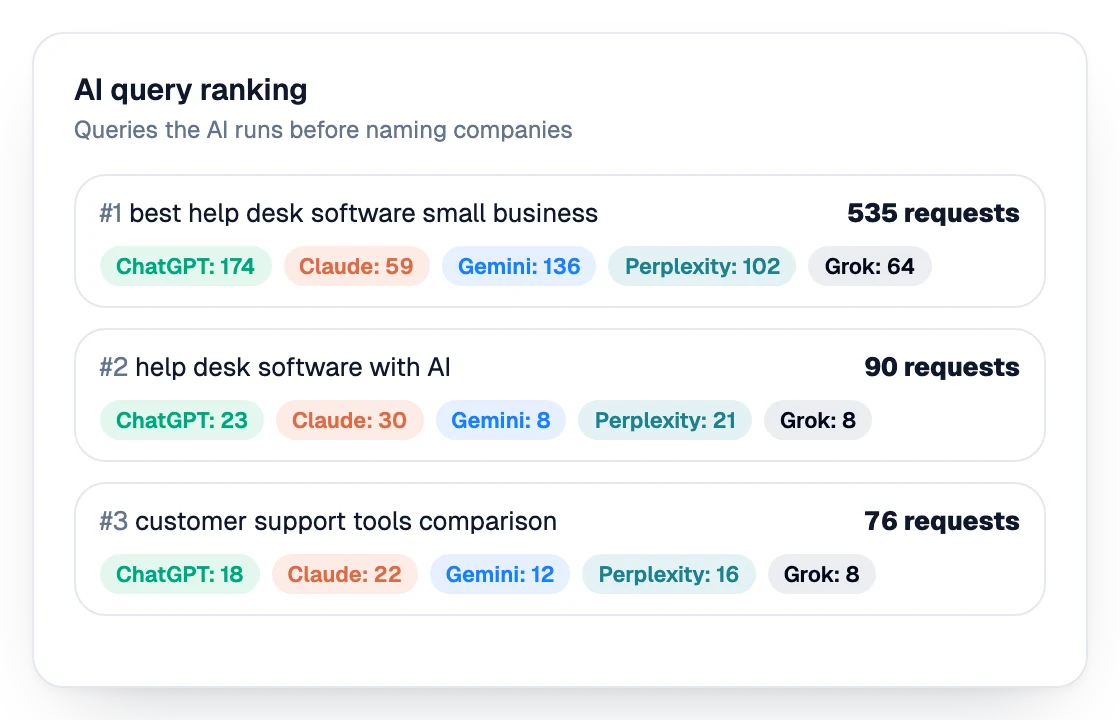
List 25 to 100 questions your buyers would type into an assistant: category questions ("best accounting software for freelancers"), comparison questions ("Brand A vs Brand B"), problem questions ("how to reduce churn in a SaaS") and brand questions ("is Brand A reliable?"). Ask them in ChatGPT, Gemini, Claude and Perplexity and note who is mentioned, in what order, and which pages are cited. This panel becomes your baseline.
Write one canonical description of your brand: what you are, for whom, your main use cases, price range, location and founding facts. Use it on your site, your social profiles, directories, marketplaces and partner pages. On your site, add Organization structured data with sameAs links to your official profiles, which Google documents as a way to understand your organization's details. Our guide to structured data for AI search explains which markup helps and which does not.
Models quote passages that answer a question in a few self-contained sentences. Put the answer first under each heading, define terms, add tables for comparisons and cite sources for figures. The research paper GEO: Generative Engine Optimization (KDD 2024) measured visibility gains of up to 40% in generative answers when content added citations, quotations and statistics. Prioritize the pages that match your question panel: comparison pages, "best X for Y" pages, pricing explanations and use-case guides.
Tip
Write an honest comparison page against your two main competitors. Assistants answer "A vs B" questions constantly, and a clear, sourced comparison table on your site is often one of the few pages that answers them directly.
This is the heart of LLM marketing, and the part most brands neglect. Look at the pages cited in your baseline answers: review platforms, industry media, "best of" lists, forums, Reddit threads, YouTube videos. Then work to appear there with digital PR, review requests to real customers, expert contributions and partnerships. Our guide to LLM seeding details how to place your brand on those sources without spamming them.
Original data travels further than opinions. A yearly survey, a benchmark built from your product data or a public index gives media a reason to cite you, and each citation adds your name next to your category in sources models trust. Keep the methodology on a dedicated page so it can be quoted with its context.
Re-run your question panel every week or month, on the same assistants, and track the trend. When a model describes you wrongly, find the source of the error (an old review, an outdated directory listing, a competitor's comparison) and correct it at the source. The next section details the metrics.
Measure on a fixed panel of questions, so that changes reflect your work and not a different sample. Five metrics cover most needs:
| Metric | What it shows | How to read it |
|---|---|---|
| Mention rate | Share of panel answers that name your brand | Your main trend line, per assistant |
| Citation rate | Share of answers that link to one of your pages | Shows which content models trust |
| Share of voice | Your mentions compared with competitors' on the same panel | Shows who wins the shortlist |
| Description accuracy | Whether price, features and positioning are stated correctly | Flags outdated or wrong sources to fix |
| AI referral traffic | Visits from chatgpt.com, perplexity.ai, gemini.google.com and similar | Links visibility to sessions and conversions |
A quick check on a single page is possible with our free LLM citation checker. For a recurring process, our guide on how to track brand mentions in AI explains how to build the panel and the reporting. Sorank's AI mention tracking runs this panel automatically: 25 to 150 questions depending on the plan, on ChatGPT, Claude and Gemini (plus Perplexity and Grok from the Pro plan), with the brands cited in your place.
Note
AI answers vary from one run to the next. Judge a single answer as anecdotal, and judge the trend over several weeks on the whole panel.
They reinforce each other. Assistants that search the web rely largely on pages that are indexed and rank well, so classic SEO remains the base. GEO adds the formatting and citation work that makes those pages quotable. LLM marketing adds the brand layer on top: consistent facts, third-party presence and measurement of what models say. In practice, one team can own all three with a shared question panel; see how marketing teams use Sorank to combine articles, backlinks and AI tracking in one place.
LLM marketing comes down to being described correctly and often, by your site and by others, on the questions your buyers ask. Start with a panel of 25 questions and one canonical brand description, then build mentions and measure every month. Sorank, an SEO and GEO software that runs on autopilot, writes the articles, obtains natural backlinks and tracks your AI mentions; you can start with a 3-day free trial.

They overlap but differ in scope. LLM SEO focuses on making pages crawlable, structured and quotable by AI assistants. LLM marketing includes that work and adds brand consistency, third-party mentions, PR and the measurement of how models describe and recommend the brand.
There is no paid placement inside the organic answers of ChatGPT, Gemini or Claude. Brands appear because the model learned about them or found relevant pages while searching the web. Advertising formats in AI assistants, where they exist, are labeled separately from the answer.
Assistants that search the web can cite a newly indexed page within days. Recommendations that rely on training data change more slowly, with new model versions, and depend on mentions accumulating on independent sites. Expect to judge the trend over at least three months on a fixed question panel.
We analyse your competitors, your website and your AI visibility to create a tailored content plan for free.
 AI Content Brief Generator
 FAQ Schema Generator
 AI Blog Post Ideas Generator
 Structured Data Validator (Schema Validator)
 Alt Text Checker
 Internal Link Analyzer
 Backlink Challenge
 AI Meta Description Generator
 AI Blog Title Generator
 Google Indexability Checker
 AI Blog Outline Generator
 UTM Link Builder
 Keyword Clustering Tool
 Canonical Tag Checker
 XML Sitemap Generator
 Broken Link Checker
 AI SEO Title Generator
 Headline Analyzer
 SERP Preview Tool
 Redirect Checker
 Hreflang Tag Generator
 Heading Structure Analyzer
 HTTP Headers Checker
 Favicon Extractor
 SERP CTR Calculator
 SEO vs Paid Search Savings Calculator
 SEO Share of Voice Calculator
 SEO ROI Calculator
 SEO Traffic and Revenue Forecast Calculator
 SEO Budget Calculator
 SEO Break-Even Calculator
 SaaS SEO ROI Calculator
 ROAS Calculator
 Reading Time Calculator
 Ranking Gain Simulator
 Organic Traffic Value Calculator
 Organic Traffic Estimator and Website Traffic Checker
 LTV to CAC Ratio Calculator
 Local SEO ROI Calculator
 Link Building Cost Calculator
 Keyword Value Calculator
 Keyword Opportunity Score Calculator
 Keyword Density Calculator
 GEO ROI Calculator
 GEO Content Investment Calculator
 Ecommerce SEO ROI Calculator
 Customer Lifetime Value Calculator
 Customer Acquisition Cost Calculator
 CTR Calculator
 Cost Per Article Calculator
 Conversion Rate Calculator
 Content Marketing ROI Calculator
 ChatGPT Referral Traffic Estimator
 Bounce Rate Calculator
 Backlink ROI Calculator
 AI Visibility Score Calculator
 AI Traffic Value Calculator
 AI Share of Voice Calculator
 Cost of AI Invisibility Calculator
 AI Citation Rate Calculator
 llms.txt Validator
 AI Overview Checker and AI Overviews Rank Checker
 Robots.txt Checker
 AI SEO Audit
 LLM Readability Checker
 SearchGPT Readiness Checker
 Structured Data LLM Audit
 Website Crawlability AI Audit
 Why ChatGPT Is Not Recommending My Website
 Gemini Ranking Tool
 Perplexity Ranking Checker
 LLM Citation Checker
 Answer Engine Optimization Audit
 GEO Audit
 AI Search Visibility Test
 ChatGPT Visibility Checker
 llms.txt Generator
 URL Extractor
 Webpage to Markdown
 Sitemap Checker
 SERP Volatility Sensor
 Page Size Checker
 Word Counter
 Slug Generator
 Schema Generator
 Robots Generator
 OG Preview
 Meta Tags Generator
 Image Compressor
 Favicon Generator
 On-Page SEO Audit: SEO Checker and SEO Analyzer
 Backlink Analysis Tool
 Keyword Research Tool
 Domain Authority Checker
THEY TRIED SORANK BEFORE YOU
 “I tested Sorank on a real client site and it's insane. It does everything an agency would bill you $1500 a month for. It's going into production on that client now.”

 Guillaume Guersanguersanguillaume.com“We are an Ads agency and we wanted to get our SEO back on track once and for all. Sorank gave us a clear view of our site, helped us prioritize optimizations, and properly structure our content. The tool is easy to use, well designed for a team, and very practical for centralizing tracking without having to juggle multiple platforms. A very solid foundation to start fresh with our SEO.”
 Gaspard MadouiAds Agency
 “I just let the Sorank software do its thing, and now my DR is 25 and my page is ranking higher.”
 Lucas Flandrefoundertrace.fr“I specialized in GEO thanks to Sorank. The GEO Leaderboard allows me to show my clients their position vs competitors on ChatGPT. It’s a real commercial differentiator.”
 MélanieSEO Freelance“Great service, works well for our website and helps us understand how to improve it to rank better on Google and elsewhere. Congrats, keep going, I recommend it.”
 Hugo T.E-commerce merchant