Preferences
Privacy is important to us, so you have the option of disabling certain types of storage that may not be necessary for the basic functioning of the website. Blocking categories may impact your experience on the website. More information
Privacy is important to us, so you have the option of disabling certain types of storage that may not be necessary for the basic functioning of the website. Blocking categories may impact your experience on the website. More information

Learn how the GEO flywheel works: a weekly loop to measure, build, earn and refresh your brand's visibility in  ChatGPT,
 Claude,
 Gemini and
 Perplexity.

In short
A GEO flywheel is a weekly loop. You measure which AI answers name your brand, change the pages and outside sources that decide those answers, then measure again. Each turn gives you the data for the next one, so the work gets easier over time. AI answers keep shifting, which is why a one-off audit loses value and a loop keeps you current.
Want to go further? Ask
Quick quiz
How should you get mentioned by ChatGPT and other AI assistants?
Sorank matches your answers


Test it for 3 days on your own site and see where you stand on Google, ChatGPT and the other AIs.
Start 3-day free trial3 days free, then stop whenever you want. 90-day results guarantee, conditions apply.
Generative Engine Optimization (GEO) is the work of getting your brand named, cited or recommended in answers from ChatGPT, Claude, Gemini and Perplexity. A flywheel is a way to run that work so that each round makes the next round cheaper. The name comes from the heavy wheel in an old engine. It takes effort to start, then keeps turning with less push.
The metaphor can mislead. A flywheel does not mean "publish more and wait." It means four stages run in a fixed order, and the output of one stage is the input of the next. You measure where you appear. You change what decides the answer. You earn mentions on the sources the answers already use. You refresh what has gone stale, and your measurements tell you what to do next.
Most GEO advice still reads like a project: audit once, fix the list, write a report, move on. That works for a broken site. It does not fit AI answers, because the models update their sources and their wording all the time. The same question can name a different set of brands next month, even when you changed nothing on your side.
One-off project vs. flywheel
If you want the full setup for ChatGPT, Claude and Gemini, the GEO optimization page covers the tooling. This article is about the loop itself, the part that keeps the setup useful after the first month.
Start with Google, because its position is the simplest. In its Search Central documentation, Google says there are "no additional requirements" to appear in AI Overviews or AI Mode, and that you don't need "new machine readable files, AI text files, or markup" for those features (Google Search Central, AI features and your website). Your page must be indexed and eligible to show a snippet. Beyond that, the usual rules of good content apply.
ChatGPT, Claude and Perplexity publish less guidance than Google, so you learn how they behave by measuring. Their answers depend on what they retrieve, what they already know about your brand, and what other sites say about you. Three things make those answers decay:
The table below maps each cause to the symptom you will see first.
| Cause | Symptom you see first | First check |
|---|---|---|
| Model update | Visibility drops in one engine and stays steady in the others | Run the same prompts again in the other engines, then wait one review cycle |
| Competitor publishes | A rival appears in answers where you used to be named | Open the page the answer cites and note what it says that yours does not |
| Your page goes stale | The answer repeats an old price, feature or date | Check the last-updated date and each number on the page |
| A source changes | A review site or forum thread no longer appears in the answers | Compare the sources cited this week with the sources cited last month |
A loop answers this problem. Each cycle catches decay early, and each cycle leaves a record of what changed. A one-off audit gives you a snapshot. A loop gives you a trend, and a trend is what you can act on.

The loop has four stages: Measure, Build, Earn and Refresh. The names are plain on purpose. You should be able to say in one line what you are doing this week.
The GEO flywheel in four stages
Each stage has a cost and a payoff. Measure costs time and gives you a baseline. Build costs writing time and changes what models can quote. Earn costs outreach and changes which sources mention you. Refresh costs review time and keeps the other three honest. Skip a stage and the loop still turns, but it turns blind, or it stops improving.
The sections below go through each stage in order, with the exact steps and the mistakes that show up most often.
A prompt panel is a fixed list of questions, asked the same way in each engine, every week. Fixed means the same wording. If you change the question, you cannot tell whether an answer moved because of the engine or because of your typing.
Write prompts the way a buyer types them, not the way a marketer names a category. "Best accounting software for a five-person agency" tells you more than "accounting software." Mix three kinds of prompt:
Get the wording from sales calls, support tickets, and the long questions in your analytics. Customers also ask a question after they buy: "is it worth it," "what does it replace." Those prompts often name a competitor the buyer already looked at. For a structured way to build the list, see the AI prompt research feature and the guide on AI prompts.
A yes or no hides most of the signal. For every prompt and every engine, write down the fields in the table. Keep the sheet in the same order each week, so you can compare rows across time.
| Field | What to write down | Why it matters |
|---|---|---|
| Prompt | The exact wording you used | The same wording each week keeps results comparable |
| Engine | ChatGPT, Claude, Gemini or Perplexity | Each engine cites different sources |
| Named | Yes or no | This is your headline number |
| Position | First, second, later, or not listed | A late mention counts for less than a first one |
| Sentence | The line that names you, copied word for word | It shows how the model describes you, which can be wrong |
| Sources | The URLs the answer cites | They tell you where to earn mentions |
| Competitors | The brands named in your place | They show your real competitive set |
Score the panel as a share. If you are named in 9 of 25 answers, your share is 36%. Keep the share per engine too, because the four engines cite different sources and often disagree.
Engines answer the same question differently from one run to the next. One answer per prompt is a sample of one. Run each prompt at least twice per engine and average the result. Small panels are sensitive: with 25 prompts, one answer is 4 percentage points of share. Judge the trend over four weeks, not the change of a single week.
A tool can run this for you. The AI mention tracking feature is built around the same idea: it follows each prompt and shows when an AI cites you.
Models quote the parts of a page that stand on their own. Your job in this stage is to make each section easy to lift out, without turning the page into a list of keywords. Start with the pages that won the most prompts in your baseline, and leave the rest for later.
Lead each section with the answer, then give the evidence. The reason is position. In "Lost in the Middle: How Language Models Use Long Contexts," Liu and colleagues (2023, arXiv 2307.03172) tested how language models use long inputs. They found that performance is often highest when relevant information sits at the beginning or end of the input, and that it falls when the key content is buried in the middle. A web page is not a prompt, and a retrieval system is not the same as their test setup. The lesson still holds for writing: the first lines of a section carry the most weight.
Compare two versions of the same claim:
The strong version gives a model a sentence it can quote whole, with its scope, its number and its method. The weak version forces the model to guess what you mean, and a model that guesses usually leaves you out.
The GEO paper is the closest thing the field has to a controlled test. Aggarwal and colleagues (KDD 2024, arXiv 2311.09735) built a benchmark of generative engine answers and tested text changes: citing sources, adding quotations and adding statistics. They measured how much of each generated answer drew on the source text. The paper states that GEO "can boost visibility by up to 40%" in its benchmark.
The figures in the block below come from the paper's own tables. The GEO-bench setup used a Google-sourced configuration with a GPT-3.5 generative engine. The Perplexity.ai results come from a separate test. In both cases the gains are relative to the baseline text in that setup, not to absolute traffic.
Best methods against the baseline, in the GEO paper
Source: Aggarwal et al., "GEO: Generative Engine Optimization", KDD 2024, Tables 1 and 7 (arXiv 2311.09735)
Read the numbers as a direction, not a forecast. The paper chose its own queries and its own engines, and your category may behave differently. What the numbers do support is a practical habit. Where you can, cite the primary source for each figure, add the exact number with its date, and attribute a claim to the person or document behind it. A line with a dated number and a named source is harder to skip than "widely recognized."
Structured data tells crawlers what a page is: its headline, its author and its dates. It does not make a model cite you. It does remove doubt about who wrote the page and when it was last checked. The block below is a minimal Article description. Add it through your CMS or template, then test it with the structured data validator.
{
  "@context": "https://schema.org",
  "@type": "Article",
  "headline": "GEO Flywheel: A Weekly Loop That Builds Your AI Visibility",
  "author": {"@type": "Person", "name": "Thibault Besson-Magdelain"},
  "datePublished": "2026-11-19",
  "dateModified": "2026-11-19"
}
Warning
You may read advice to add an llms.txt file as a first step toward AI citation. Google says its AI features need no such file. Add one if you like, but treat it as a small task outside the loop. It will not replace claims that are clear, sourced and current.
Models rarely form a view of your brand from your site alone. They read other pages too. A claim that appears in one place is easy to ignore, while the same claim on several independent sites is easier to repeat. That is the reason for the Earn stage: you widen the set of sources that say the right thing about you.
Your panel already tells you where to go. Open the sources cited in each answer and list the URLs. Group them by type: review sites, comparison articles, industry media, community threads, directories. Then read each page and ask three questions:
A page that names your competitors and not you is the most valuable target. A page with an outdated figure comes second. Send the editor the correct figure with its source, in two or three lines. A correction with a source is easier to say yes to than a general pitch, because it helps the page without asking for anything in return.
Keep paid placements out of this stage. A sponsored line that promises a mention in AI answers can run into Google's rules on links, and it leaves no record you can defend later. The risks and the safer options are covered in Should You Buy Backlinks? Risks, Google's Rules and Safer Alternatives.
Your own site is the first place a model and a crawler look for depth. Internal links tell crawlers which pages matter, and they tell readers where to go next. Google's Search Central documentation covers the basics. It says that "every page you care about should have a link from at least one other page on your site," and that Google "can only crawl your link if it's an <a> HTML element" (Google Search Central, Link best practices for Google Search).
The anchor text matters as much as the link. Google's guidance is that "good anchor text is descriptive, reasonably concise, and relevant to the page that it's on." Here is a link written the way the guidance asks:
<a href="/blog-geo-seo/ai-visibility-optimization">how to get named by ChatGPT, Gemini and Perplexity</a>Avoid "read more" and "click here." The anchor is the only part of the link that tells a reader and a crawler what the target is about. The same guidance says there is no magical ideal number of links for a page, but that "if you think it's too much, then it probably is." Use the links that help the reader, and stop there.
Build hubs, not piles. A hub page covers a topic broadly and links to supporting pages that go deeper. That structure is a topic cluster, defined in the topic cluster entry, and it works best when each supporting page links back to the hub. For the planning side, read content pillars. The topical cluster generator feature plans the structure for you, with no overlapping pages.
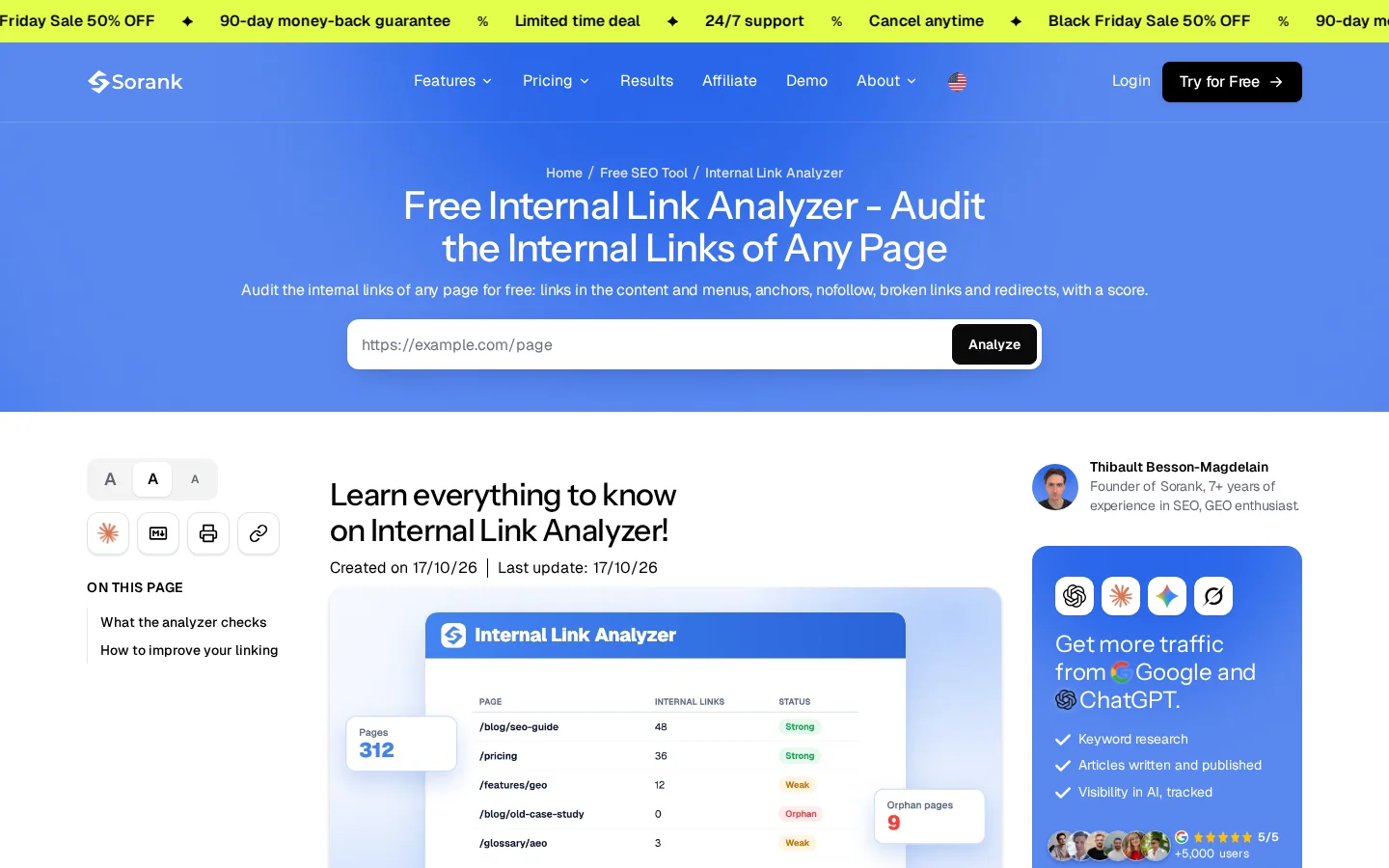
To audit the links you already have, the internal link analyzer checks the internal links of any page.
Tip
Run the analyzer on your hub page first. If it links to fewer supporting pages than you expect, fix that before you write anything new. The internal linking strategy guide gives the order of work.
Refresh means updating a page or a source when the data says so, not on a calendar. A page you update every month without a reason tells you nothing, and it can drift away from the facts you verified. The rule is simple: every change has a reason in the log, and every reason comes from a measurement or a dated fact.
Use the same list every week, so the review takes the same shape and you can compare one week with the next.
Weekly review
Keep the review short. Read the changes, pick one or two actions, and stop. The loop depends on the rhythm more than on the size of each round. Weekly is enough for most sites. Daily results mostly carry noise, and a monthly review lets too much decay pile up between checks.
A drop has a cause, and the cause decides the action. Use this table before you touch a page.
| Symptom | Likely cause | Action |
|---|---|---|
| Drop in all four engines at once | Your site changed, or crawlers can no longer reach a key page | Check indexing and your robots rules (see robots.txt for AI crawlers), then review your last edit |
| Drop in one engine only | That engine changed its model or its sources | Wait one review cycle, then compare with the other three before you edit |
| A competitor appears in new answers | They published or earned a new source | Read the page the answer cites and plan a better answer to the same question |
| Negative wording in an answer | An old review, a forum thread or a stale fact | Find the cited page, fix the fact at its source, or correct it with your own evidence |
The log is the part of the flywheel that most teams skip, and it is what makes the loop compound. For each change, record the date, the page or source, what changed, and which prompts it should affect. After four to six weeks you have a record that shows which kinds of change moved your share. That record decides the next round's work.
When answers shift for reasons you cannot explain, the AI search volatility guide shows how to separate noise from a real change before you rewrite anything.
Tip
Before you change a page, run the free GEO audit on it. The result is your baseline for that page, so the change can be measured against it later.
There is more than one way to run the four stages. Each has a different cost in time and a different risk. Pick the one that matches the size of your panel and the size of your team, and move up only when the one you have stops keeping up.
In this version, a person asks each prompt by hand, records the answer in a sheet, and makes the changes. The principle is that a human reads every answer. It fits up to about 10 prompts, one or two engines and a team of one. Its advantage is that it costs nothing beyond time, and it gives you a real feel for how each engine writes about your category. Its limits are time and drift: manual runs slip, the wording creeps, and the sheet gets harder to read after a few months.
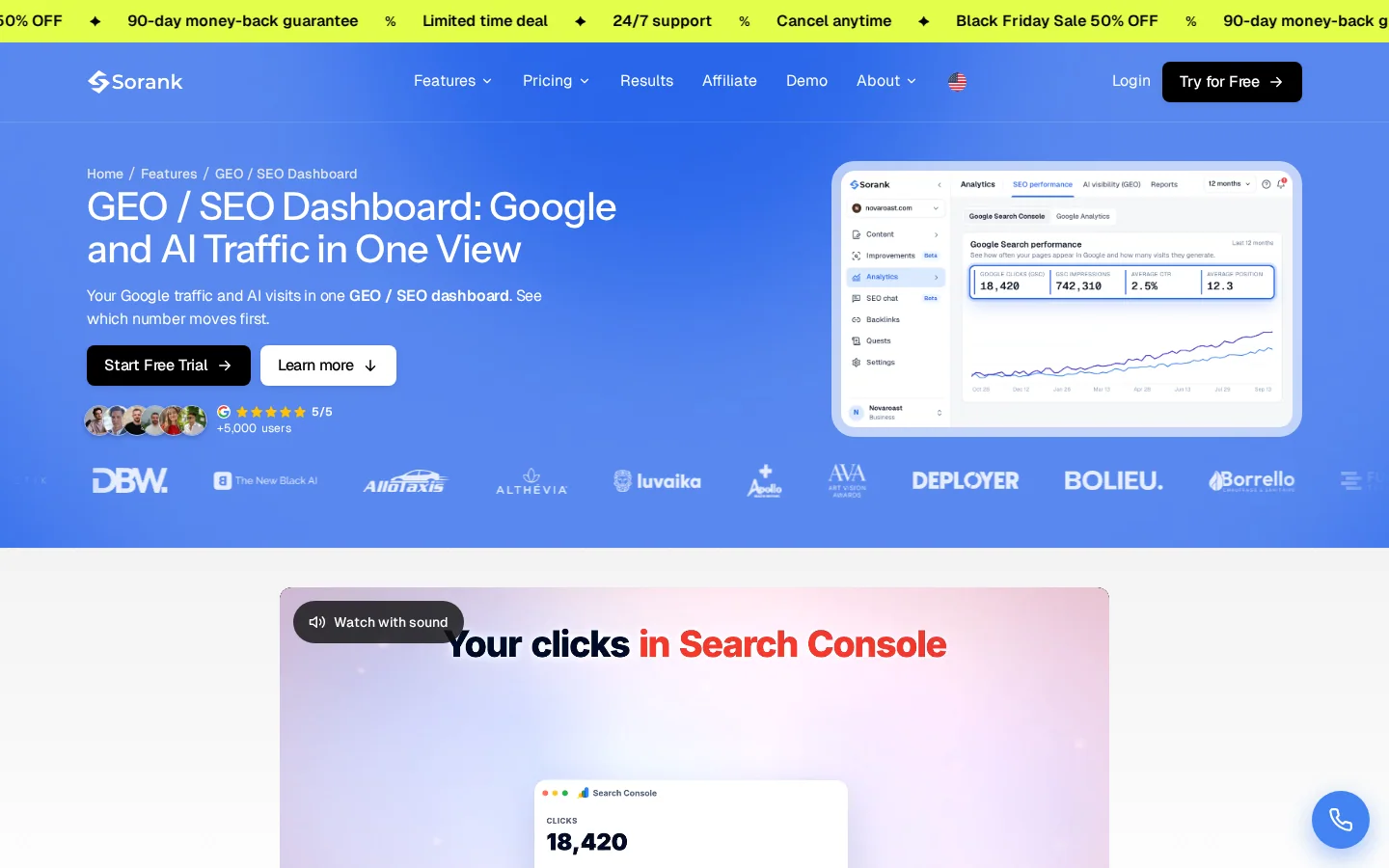
Here a tracking tool runs the panel and keeps the history, and a person does the actions. It fits 20 to 50 prompts, several engines and a team that writes content. The advantage is consistent sampling and a clear trend line. The limit is that a dashboard shows the change but not the fix. You still need an editor to decide what to rewrite. The GEO and SEO dashboard puts Google and AI traffic in one view, which gives the weekly review its input.
In this version, software runs the measurement, drafts or updates pages, and proposes links, while a person approves each change. It fits a large number of pages and a small team that needs steady output. The advantage is that the loop turns every week without someone chasing it. The limit is that a bad rule repeats at scale. You need a review of each change and a log of what the system did, or you will not know which change moved your share.
Sorank is built for the third version: it tracks AI mentions, writes and updates articles, and gets links, all on autopilot. Whichever version you choose, keep the weekly review. Even an autopilot needs someone to check what changed and why.
| Version | Fits | Main risk | Who does the work |
|---|---|---|---|
| Spreadsheet loop | Up to about 10 prompts, one or two engines | Missed runs and drifting wording | One person, by hand |
| Dashboard loop | 20 to 50 prompts, several engines | A clear trend with no fix attached | A team that writes and edits |
| Autopilot loop | Many pages, a small team, steady output | A bad rule repeats at scale | Software, with a person approving each change |
Each mistake below has three parts: what it looks like, how to spot it in your own data, and how to fix it. Start with the ones you recognize, and check the rest during your first review.
What it looks like. A single run of the panel, usually in one engine, saved as the starting point for the whole year.
How to spot it. Your sheet has one date in the header and no second column for the same prompt. Every change you make looks like a success or a failure, with no noise to compare against.
How to fix it. Run each prompt twice per engine for the baseline, average the two runs, and keep the raw answers so you can recheck a disputed row. Only then count a change as a result.
What it looks like. The whole panel runs in ChatGPT, because it is the best known engine, and the team assumes the result holds everywhere.
How to spot it. Your sources column lists the same few domains in every row. The other engines name you in a different way, or not at all, and nobody has looked.
How to fix it. Add all four engines to the panel. Each one cites different sources, so the fix for one may not touch the others. Report the share per engine next to the overall share.
What it looks like. The team spends two weeks on a machine-readable file and no time on the pages the panel says are losing mentions.
How to spot it. The loop's Build stage has no changed paragraphs in the log, only file edits. The weekly review shows no page changes at all.
How to fix it. Google's documentation says its AI features need no new machine-readable files, AI text files or markup. Put the time into the claims at the top of each section, the dated sources and the internal links, which are the parts the Build stage actually changes.
What it looks like. A big rewrite of the site after a bad baseline, with every page changed at once.
How to spot it. Next week's share moves, and nobody can say which change caused it. The log has one entry for ten pages.
How to fix it. Change one cluster per round, log each page separately, and wait a full review cycle before the next change. A slower loop that you can read beats a fast loop you cannot explain.
What it looks like. A "partner article" with your link and a mention in an AI answer, with no disclosure and no real editorial review.
How to spot it. The page is paid, the link is not marked as sponsored, and the mention exists only in that one place. Such a mention rarely appears in answers across engines for long.
How to fix it. Stop the placement, and replace it with a correction or a data point sent to the editor of a page that already exists. The rules and the safer options are in Should You Buy Backlinks?
What it looks like. Every internal link says "read more," so the link tells a reader and a crawler nothing about the target page.
How to spot it. Sort your anchors in a crawl report or in the link analyzer. If the most common anchors are generic, the problem is systematic.
How to fix it. Rewrite each anchor so it names what the target page answers. The change takes minutes per link and gives crawlers a clearer map.
One internal link, two ways
Use this plan if you are starting from zero. Each week has one main job, so the loop starts before you are ready to run it at scale.
Your first 30 days
Plan for at least two or three rounds before you judge it. The first round gives you a baseline and one set of changes. AI answers vary from run to run, so a single week proves little. A trend over four weeks is the first thing worth reading.
No, not for Google's AI features. Google says they need no new machine-readable files, AI text files or markup. Other engines publish less guidance, so judge any file by your own results. It is cheap to add, but it is not a stage of the loop.
Yes, with a spreadsheet and 20 prompts. The limit is time, because manual runs are slow and the wording drifts. Start by hand, learn which prompts matter, then move to a tracker when the panel outgrows the sheet.
Start this week with the panel. Write 20 prompts, ask them in four engines, and record the first number. That number is your baseline, and every later round is measured against it.
Plan for at least two or three rounds before you judge it. The first round gives you a baseline and one set of changes. AI answers vary from run to run, so a single week proves little, and a trend over four weeks is the first thing worth reading.
Not for Google's AI features, which Google says need no new machine-readable files, AI text files or markup. Other engines publish less guidance, so judge any file by your own results. It is cheap to add, but it is not a stage of the loop.
Yes, with a spreadsheet and 20 prompts. The limit is time, because manual runs are slow and the wording drifts. Start by hand, learn which prompts matter, then move to a tracker when the panel outgrows the sheet.
We analyse your competitors, your website and your AI visibility to create a tailored content plan for free.
 AI Content Brief Generator
 FAQ Schema Generator
 AI Blog Post Ideas Generator
 Structured Data Validator (Schema Validator)
 Alt Text Checker
 Internal Link Analyzer
 Backlink Challenge
 AI Meta Description Generator
 AI Blog Title Generator
 Google Indexability Checker
 AI Blog Outline Generator
 UTM Link Builder
 Keyword Clustering Tool
 Canonical Tag Checker
 XML Sitemap Generator
 Broken Link Checker
 AI SEO Title Generator
 Headline Analyzer
 SERP Preview Tool
 Redirect Checker
 Hreflang Tag Generator
 Heading Structure Analyzer
 HTTP Headers Checker
 Favicon Extractor
 SERP CTR Calculator
 SEO vs Paid Search Savings Calculator
 SEO Share of Voice Calculator
 SEO ROI Calculator
 SEO Traffic and Revenue Forecast Calculator
 SEO Budget Calculator
 SEO Break-Even Calculator
 SaaS SEO ROI Calculator
 ROAS Calculator
 Reading Time Calculator
 Ranking Gain Simulator
 Organic Traffic Value Calculator
 Organic Traffic Estimator and Website Traffic Checker
 LTV to CAC Ratio Calculator
 Local SEO ROI Calculator
 Link Building Cost Calculator
 Keyword Value Calculator
 Keyword Opportunity Score Calculator
 Keyword Density Calculator
 GEO ROI Calculator
 GEO Content Investment Calculator
 Ecommerce SEO ROI Calculator
 Customer Lifetime Value Calculator
 Customer Acquisition Cost Calculator
 CTR Calculator
 Cost Per Article Calculator
 Conversion Rate Calculator
 Content Marketing ROI Calculator
 ChatGPT Referral Traffic Estimator
 Bounce Rate Calculator
 Backlink ROI Calculator
 AI Visibility Score Calculator
 AI Traffic Value Calculator
 AI Share of Voice Calculator
 Cost of AI Invisibility Calculator
 AI Citation Rate Calculator
 llms.txt Validator
 AI Overview Checker and AI Overviews Rank Checker
 Robots.txt Checker
 AI SEO Audit
 LLM Readability Checker
 SearchGPT Readiness Checker
 Structured Data LLM Audit
 Website Crawlability AI Audit
 Why ChatGPT Is Not Recommending My Website
 Gemini Ranking Tool
 Perplexity Ranking Checker
 LLM Citation Checker
 Answer Engine Optimization Audit
 GEO Audit
 AI Search Visibility Test
 ChatGPT Visibility Checker
 llms.txt Generator
 URL Extractor
 Webpage to Markdown
 Sitemap Checker
 SERP Volatility Sensor
 Page Size Checker
 Word Counter
 Slug Generator
 Schema Generator
 Robots Generator
 OG Preview
 Meta Tags Generator
 Image Compressor
 Favicon Generator
 On-Page SEO Audit: SEO Checker and SEO Analyzer
 Backlink Analysis Tool
 Keyword Research Tool
 Domain Authority Checker
 “I tested Sorank on a real client site and it's insane. It does everything an agency would bill you $1500 a month for. It's going into production on that client now.”

 Guillaume Guersanguersanguillaume.com“We are an Ads agency and we wanted to get our SEO back on track once and for all. Sorank gave us a clear view of our site, helped us prioritize optimizations, and properly structure our content. The tool is easy to use, well designed for a team, and very practical for centralizing tracking without having to juggle multiple platforms. A very solid foundation to start fresh with our SEO.”
 Gaspard MadouiAds Agency
 “I just let the Sorank software do its thing, and now my DR is 25 and my page is ranking higher.”
 Lucas Flandrefoundertrace.fr“I specialized in GEO thanks to Sorank. The GEO Leaderboard allows me to show my clients their position vs competitors on ChatGPT. It’s a real commercial differentiator.”
 MélanieSEO Freelance“Great service, works well for our website and helps us understand how to improve it to rank better on Google and elsewhere. Congrats, keep going, I recommend it.”
 Hugo T.E-commerce merchant