Preferences
Privacy is important to us, so you have the option of disabling certain types of storage that may not be necessary for the basic functioning of the website. Blocking categories may impact your experience on the website. More information
Privacy is important to us, so you have the option of disabling certain types of storage that may not be necessary for the basic functioning of the website. Blocking categories may impact your experience on the website. More information

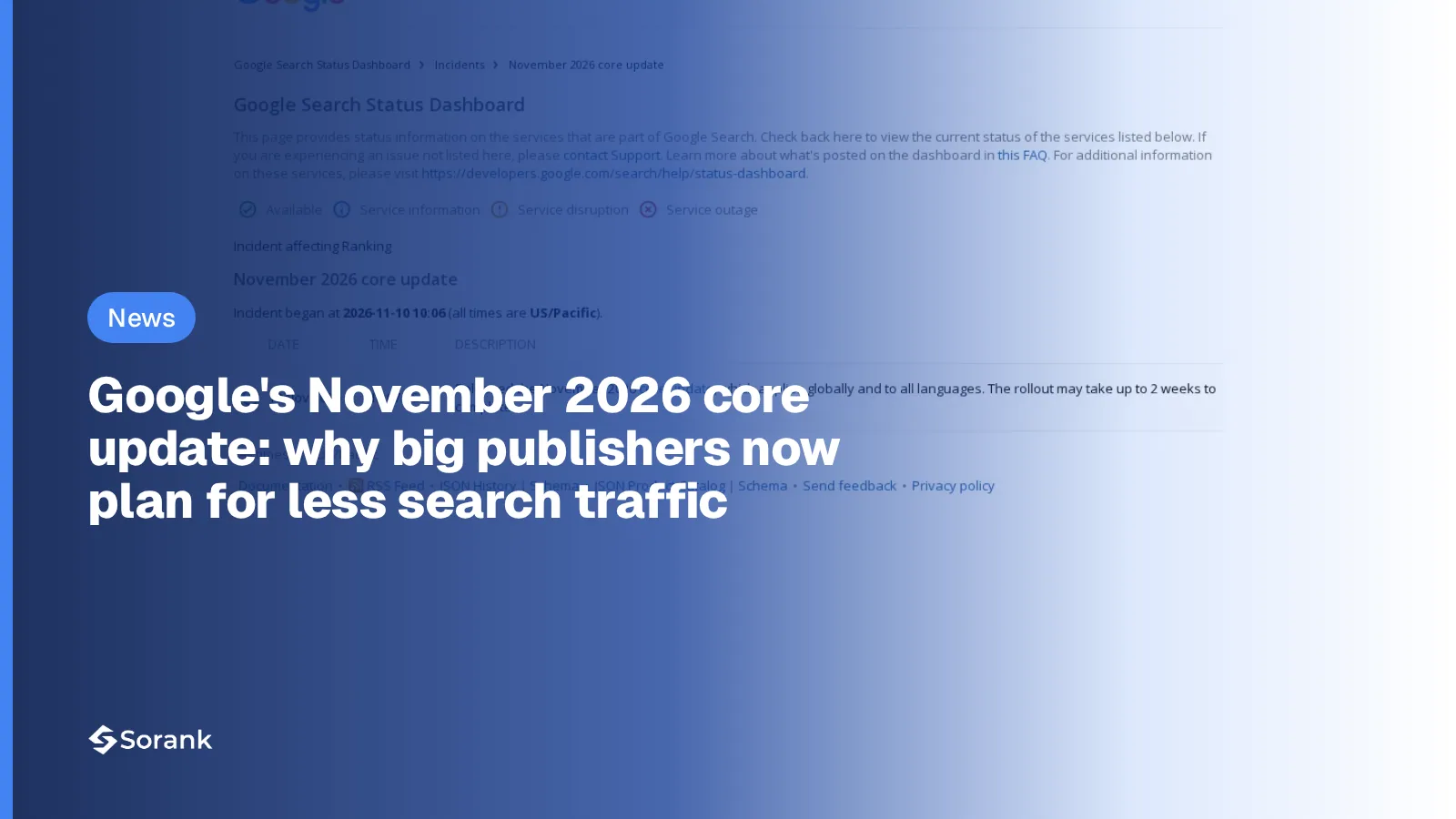
Google's November 2026 core update is still rolling out as Ziff Davis and Tripadvisor plan for less search traffic. What it means for your site and what to do.

Tools

In short
Google's November 2026 core update has been rolling out since November 10, 2026, and as of November 15, 2026 Google has not announced its end. In the same week, two large web businesses, Ziff Davis and Tripadvisor, told investors they no longer plan for search traffic to come back. For a site owner, the lesson is simple: read the core update carefully, but build a plan that does not depend on a recovery.
Want to go further? Ask
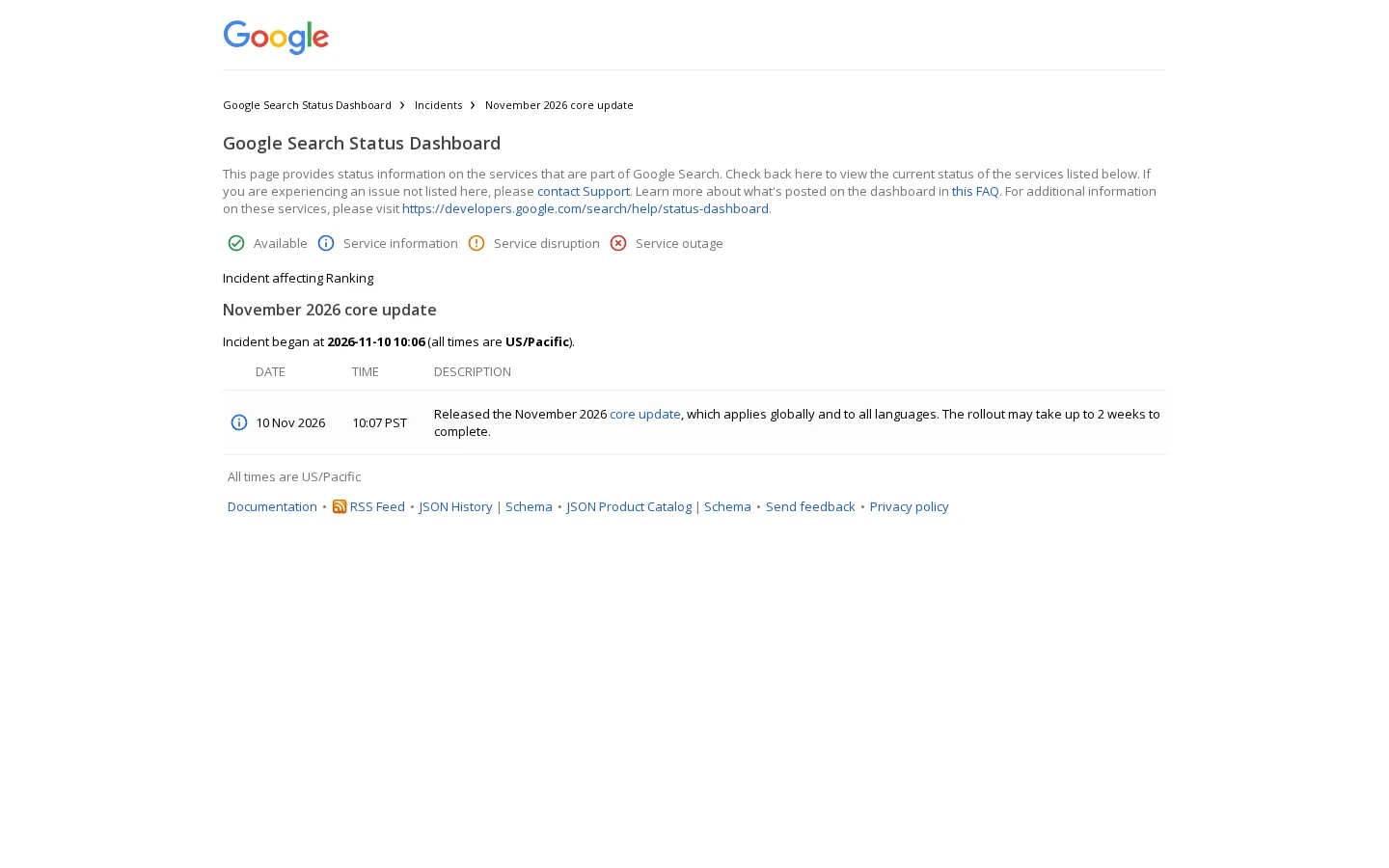
On November 10, 2026 at 10:07 a.m. Pacific time, Google posted on its Search Status Dashboard: "Released the November 2026 core update, which applies globally and to all languages." Google added that the rollout "may take up to 2 weeks to complete." It is the third core update of 2026.
When we checked the dashboard on November 15, 2026, there was still no completion notice. If the rollout uses its full two weeks, it ends around November 24, 2026. Google has not named the systems that changed, and it has not targeted any type of site or technique.
We already covered the start of the update and how to read your data. If you missed them, read how to read your traffic before you act and how to separate the update from the November 8 swings and a Search Console bug. This article looks at what changed around the update in the same week.
One week, five changes in search
On its third quarter call on November 6, 2026, Ziff Davis CEO Vivek Shah said organic Google referrals to the group's sites fell about 37% year over year. The year before, the drop was about 23%, so the two-year loss is over 50%. As reported by PPC Land, the company now assumes referrals will keep falling instead of planning for a rebound. Shah also cited about 2.7 billion appearances in AI Overviews and AI Mode, nearly 10 times the clicks those sites got from Google Search. Be careful with that ratio: it compares AI impressions to all Search clicks, not to clicks from AI features.
A day earlier, on November 5, 2026, Tripadvisor published its third quarter results. The company recorded a non-cash goodwill impairment of $369.5 million on its Hotels and Other segment, "largely due to the multi-period acceleration of traffic headwinds resulting from changes in the search landscape." Its marketing spend reached 48.8% of revenue, against 43.3% a year earlier.
What two large web businesses told investors
Sources: Ziff Davis Q3 2026 call (via PPC Land), Tripadvisor Q3 2026 earnings release
A core update moves rankings. The publishers' numbers show something else: even when rankings hold, fewer people click. Two changes in the same week push in that direction.
First, on November 12, 2026, Google made Gemini 4 Hydrogen the default model in AI Mode. We explained what it changes in our article on Gemini 4 Hydrogen in AI Mode. More answers inside Google means fewer visits for the same position.
Second, on November 10, 2026, OpenAI opened business profiles in ChatGPT, with counts of mentions and website clicks over 28 days. For the first time, many businesses can see how often ChatGPT sends them visitors. Our guide to claiming your business in ChatGPT covers the setup.
So when you look at your traffic after this core update, you will see three effects mixed together: ranking moves from the update, fewer clicks per position because of AI answers, and visits that now come from AI assistants instead of Google.
| Effect | What you see | Where to check |
|---|---|---|
| Core update | Positions go up or down | Search Console, average position by page |
| AI answers in Google | Same position, fewer clicks | Search Console, clicks and CTR per query |
| AI assistants | New visits from ChatGPT and others | Analytics referrals, ChatGPT business profile |
How to read a traffic change in November 2026
The core update applies to every site that gets traffic from Google Search, in every country and language. The traffic trend described by Ziff Davis and Tripadvisor hits hardest the sites that live on informational queries: guides, reviews, comparisons, travel and advice. Local businesses and service pages with a clear buying intent are usually less exposed to AI answers, but they still depend on Google for most of their visits.
If you run an online shop, timing matters: the rollout may end around November 24, 2026, three days before Black Friday on November 27, 2026.
Google's core updates documentation gives the base rule: wait "at least a full week after a core update completes," then compare that week with the week before the update began. Avoid quick fixes. On top of that, plan for a world with fewer clicks.
Your plan for the next four weeks
For step 4, our guides to the content audit and to Google's ranking systems and core updates give the full method. To watch Google and AI traffic side by side while the update settles, Sorank's GEO / SEO dashboard shows both channels in one view, so you can tell a ranking loss from a click loss.
Google has not said when the rollout will end. "Up to 2 weeks" is a maximum, not a date. Google has not said which signals changed either. The documentation also warns that recovery "could take several months" when a site improves its content.
We also do not know how much of the publishers' traffic loss comes from AI answers and how much from earlier core updates. Ziff Davis and Tripadvisor did not split those effects, and Google does not publish click data for AI features alone. We will update our coverage when Google confirms the end of the rollout.
Source of the weekly roundup: Search Engine Journal, SEO Pulse, November 14, 2026.
Not as of November 15, 2026. Google started the rollout on November 10, 2026 and said it may take up to two weeks, so it could end around November 24, 2026. Check the Google Search Status Dashboard for the completion notice.
They show a trend beyond rankings. Ziff Davis reported organic Google referrals down about 37% year over year and no longer plans on a search recovery. Tripadvisor tied a $369.5 million impairment to changes in the search landscape. Fewer clicks per position can hit any site that lives on informational queries.
Avoid big changes and fix only technical faults. Wait at least a full week after the rollout ends, then compare that week with the week before November 10. Read positions and clicks separately, track AI referrals as their own channel, and audit only the pages that really lost positions.
We analyse your competitors, your website and your AI visibility to create a tailored content plan for free.
 AI Content Brief Generator
 FAQ Schema Generator
 AI Blog Post Ideas Generator
 Structured Data Validator (Schema Validator)
 Alt Text Checker
 Internal Link Analyzer
 Backlink Challenge
 AI Meta Description Generator
 AI Blog Title Generator
 Google Indexability Checker
 AI Blog Outline Generator
 UTM Link Builder
 Keyword Clustering Tool
 Canonical Tag Checker
 XML Sitemap Generator
 Broken Link Checker
 AI SEO Title Generator
 Headline Analyzer
 SERP Preview Tool
 Redirect Checker
 Hreflang Tag Generator
 Heading Structure Analyzer
 HTTP Headers Checker
 Favicon Extractor
 SERP CTR Calculator
 SEO vs Paid Search Savings Calculator
 SEO Share of Voice Calculator
 SEO ROI Calculator
 SEO Traffic and Revenue Forecast Calculator
 SEO Budget Calculator
 SEO Break-Even Calculator
 SaaS SEO ROI Calculator
 ROAS Calculator
 Reading Time Calculator
 Ranking Gain Simulator
 Organic Traffic Value Calculator
 Organic Traffic Estimator and Website Traffic Checker
 LTV to CAC Ratio Calculator
 Local SEO ROI Calculator
 Link Building Cost Calculator
 Keyword Value Calculator
 Keyword Opportunity Score Calculator
 Keyword Density Calculator
 GEO ROI Calculator
 GEO Content Investment Calculator
 Ecommerce SEO ROI Calculator
 Customer Lifetime Value Calculator
 Customer Acquisition Cost Calculator
 CTR Calculator
 Cost Per Article Calculator
 Conversion Rate Calculator
 Content Marketing ROI Calculator
 ChatGPT Referral Traffic Estimator
 Bounce Rate Calculator
 Backlink ROI Calculator
 AI Visibility Score Calculator
 AI Traffic Value Calculator
 AI Share of Voice Calculator
 Cost of AI Invisibility Calculator
 AI Citation Rate Calculator
 llms.txt Validator
 AI Overview Checker and AI Overviews Rank Checker
 Robots.txt Checker
 AI SEO Audit
 LLM Readability Checker
 SearchGPT Readiness Checker
 Structured Data LLM Audit
 Website Crawlability AI Audit
 Why ChatGPT Is Not Recommending My Website
 Gemini Ranking Tool
 Perplexity Ranking Checker
 LLM Citation Checker
 Answer Engine Optimization Audit
 GEO Audit
 AI Search Visibility Test
 ChatGPT Visibility Checker
 llms.txt Generator
 URL Extractor
 Webpage to Markdown
 Sitemap Checker
 SERP Volatility Sensor
 Page Size Checker
 Word Counter
 Slug Generator
 Schema Generator
 Robots Generator
 OG Preview
 Meta Tags Generator
 Image Compressor
 Favicon Generator
 On-Page SEO Audit: SEO Checker and SEO Analyzer
 Backlink Analysis Tool
 Keyword Research Tool
 Domain Authority Checker
5/5 from 5 reviews
 “I tested Sorank on a real client site and it's insane. It does everything an agency would bill you $1500 a month for. It's going into production on that client now.”

 Guillaume Guersanguersanguillaume.com“We are an Ads agency and we wanted to get our SEO back on track once and for all. Sorank gave us a clear view of our site, helped us prioritize optimizations, and properly structure our content. The tool is easy to use, well designed for a team, and very practical for centralizing tracking without having to juggle multiple platforms. A very solid foundation to start fresh with our SEO.”
 Gaspard MadouiAds Agency
 “I just let the Sorank software do its thing, and now my DR is 25 and my page is ranking higher.”
 Lucas Flandrefoundertrace.fr“I specialized in GEO thanks to Sorank. The GEO Leaderboard allows me to show my clients their position vs competitors on ChatGPT. It’s a real commercial differentiator.”
 MélanieSEO Freelance“Great service, works well for our website and helps us understand how to improve it to rank better on Google and elsewhere. Congrats, keep going, I recommend it.”
 Hugo T.E-commerce merchant