Preferences
Privacy is important to us, so you have the option of disabling certain types of storage that may not be necessary for the basic functioning of the website. Blocking categories may impact your experience on the website. More information
Privacy is important to us, so you have the option of disabling certain types of storage that may not be necessary for the basic functioning of the website. Blocking categories may impact your experience on the website. More information

Google released its November 2026 core update on 10 November at 10:07 a.m. Pacific. Here is how to read your traffic without reacting too early.

Tools

In short
Google released the November 2026 core update on 10 November 2026, at 10:07 a.m. Pacific time. Google says it applies globally and to all languages, and that the rollout may take up to two weeks. For a site owner, the main risk is not the update itself. It is reacting to the first curve in your analytics before that curve can be read.
Want to go further? Ask
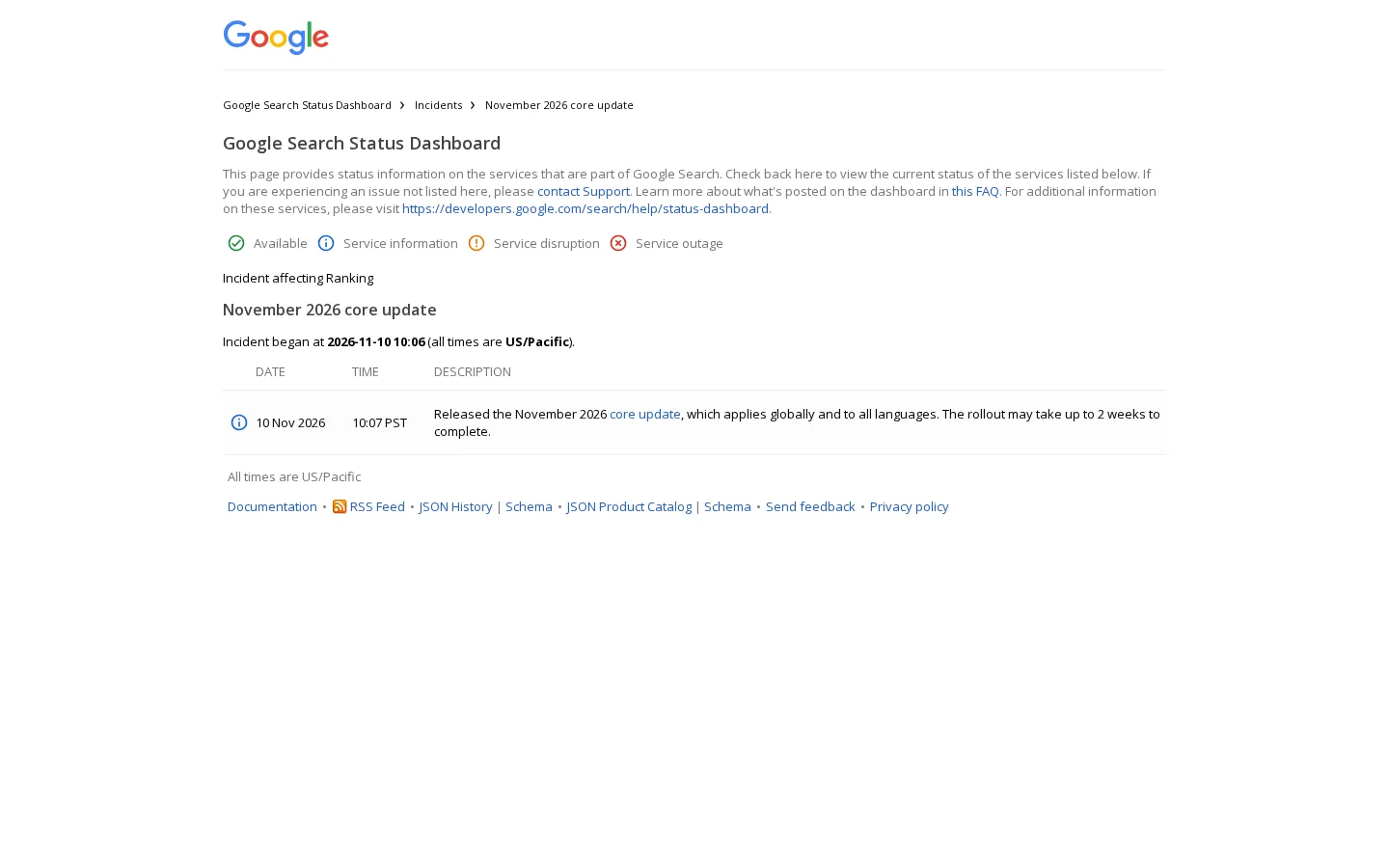
Google logged the update on its Search Status Dashboard under the title "Incident affecting Ranking", with the subtitle "November 2026 core update". The entry reads: "Released the November 2026 core update, which applies globally and to all languages." It adds: "The rollout may take up to 2 weeks to complete."
Two things are missing from that entry. It gives no end time, and it does not say which ranking systems were changed. When we checked on 12 November 2026, we found no completion notice from Google. Treat the rollout as still running until Google says otherwise.
| Point | What the sources give |
|---|---|
| Release | 10 November 2026, 10:07 a.m. Pacific time (Google Search Status Dashboard) |
| Scope | Applies globally and to all languages |
| Maximum rollout time | Up to 2 weeks |
| End of rollout | Not published by Google. If it uses its full two weeks, 24 November 2026 (our calculation) |
| Earliest clean reading | Week of 1 to 7 December 2026, compared with 3 to 9 November 2026 |
Two numbers to keep in mind
Sources: Google Search Status Dashboard; Google Search Central documentation
The French site Abondance reported the release on 11 November 2026 and describes it as the third core update of 2026, after the March and May updates. We take the date from Google's own log. Abondance is useful for the context, not for the timing.
Google's documentation on core updates says that "several times a year, Google makes significant, broad changes to our search algorithms and systems." It adds that these changes "don't target specific sites or individual web pages."
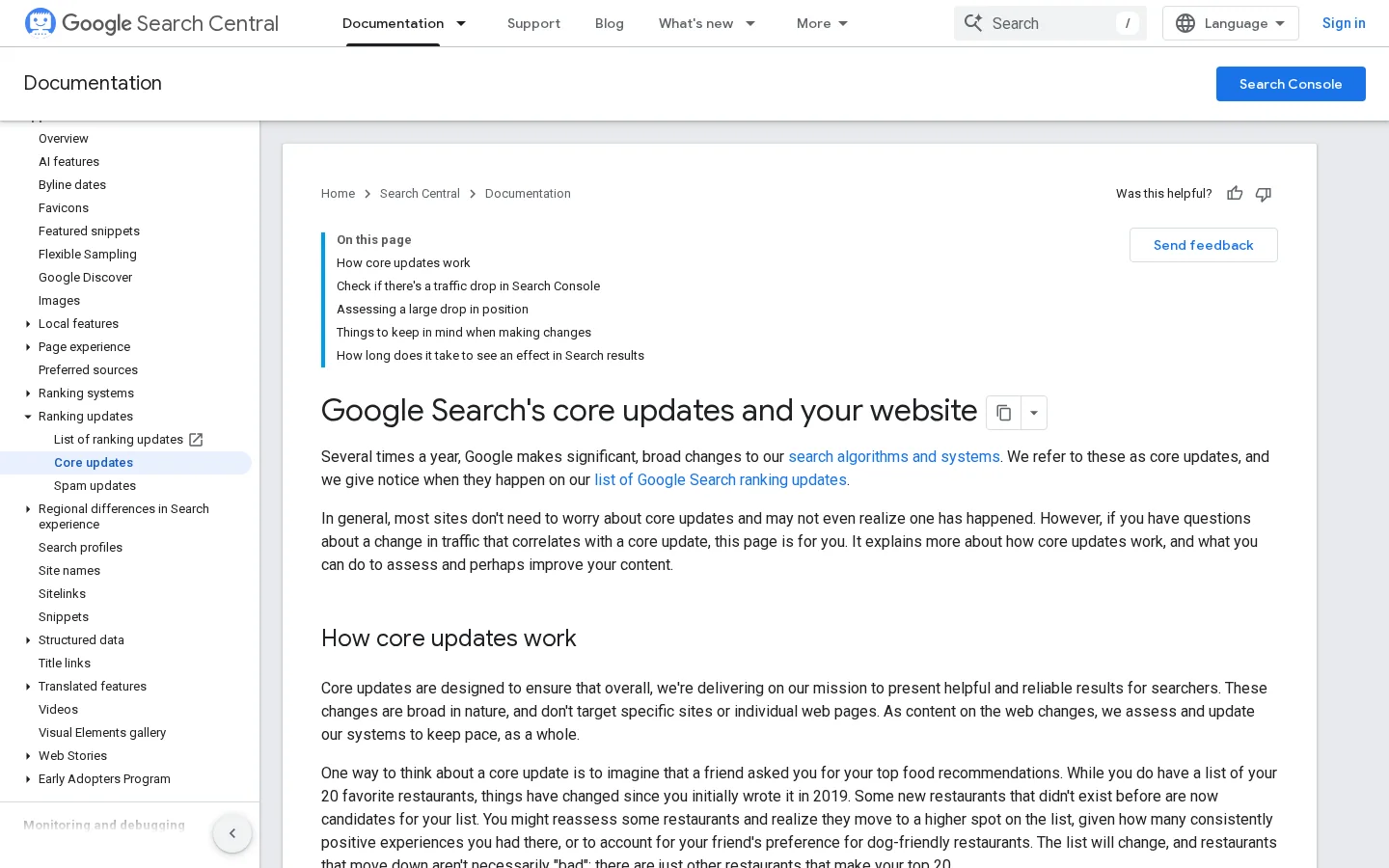
That gives you three practical consequences. First, a drop after a core update is not a penalty, so there is no manual action to look for and no reconsideration request to send. Second, the update is broad, so a drop is not a verdict on one page. Third, the announcement does not explain the changes. You will only see the effect in your own data, and you have to read it carefully.
Google's guidance for small drops is also clear: there is "no need to take drastic action". That line matters most for teams under pressure to show a result in the same week.
Google says the update applies to all languages and territories, and that it is meant for all types of sites. No market, language or site size is exempt. A small blog and a large store can both move. What decides how much you feel it is the mix of your traffic: how much comes from informational pages, how much from product or service pages, and how much from people who already search for your brand. Check that split before you read the total, because a total can hide the part that moved.
The calendar makes the reading harder. The rollout overlaps Thanksgiving in the United States on 26 November 2026, and Black Friday on 27 November. If you sell online, demand will move for seasonal reasons in the same weeks. Compare with the same days last year, not only with the week before. Our Black Friday marketing plan covers the same week for your other channels.
Google's dashboard gives a maximum: up to two weeks. Counting from 10 November 2026, the last day of the rollout would be 24 November 2026 if it uses the full length. That date is our calculation, not a date Google has published.
Google's documentation then sets the reading rule. Wait "at least a full week after a core update completes" before you analyse your site in Search Console, and compare that week with a week before the rollout started. On that basis, the earliest clean reading is the full week of 1 to 7 December 2026, compared with 3 to 9 November 2026.
When the update can be read
Sources: Google Search Status Dashboard; Google Search Central. Dates after 10 November are calculated.
Reading before that point mostly captures noise. Google says some changes can take effect in a few days, but that "it could take several months for our systems to learn and confirm" the improvements. A movement in the first days is a signal to watch, not a verdict.
This is the order we suggest. It is our advice, built on Google's guidance, not a Google checklist.
Three things remain open. The first is the end date: the dashboard gives only a maximum. The second is which signals changed. The announcement does not name them, so any explanation of a specific drop is a hypothesis until your own data confirms it. The third is how long the effect lasts. Google says that if a few months pass without any effect, the answer may be to wait for the next core update.
Our earlier news piece, Google's November 2026 core update has started: what to do now, covers the first actions. This article is about reading the numbers, which is the part that takes longest. For the history of earlier updates, see our Google March core update guide, and for the general definition, the core update glossary entry.
Google released it on 10 November 2026 at 10:07 a.m. Pacific time. Google says the rollout may take up to two weeks.
Not straight away. Check for technical faults first, then wait at least a full week after the rollout ends before you compare Search Console data.
Compare full weeks: the period after the rollout against the week before 10 November 2026. Then look at which pages and queries moved, not only the total.
We analyse your competitors, your website and your AI visibility to create a tailored content plan for free.
 AI Content Brief Generator
 FAQ Schema Generator
 AI Blog Post Ideas Generator
 Structured Data Validator (Schema Validator)
 Alt Text Checker
 Internal Link Analyzer
 Backlink Challenge
 AI Meta Description Generator
 AI Blog Title Generator
 Google Indexability Checker
 AI Blog Outline Generator
 UTM Link Builder
 Keyword Clustering Tool
 Canonical Tag Checker
 XML Sitemap Generator
 Broken Link Checker
 AI SEO Title Generator
 Headline Analyzer
 SERP Preview Tool
 Redirect Checker
 Hreflang Tag Generator
 Heading Structure Analyzer
 HTTP Headers Checker
 Favicon Extractor
 SERP CTR Calculator
 SEO vs Paid Search Savings Calculator
 SEO Share of Voice Calculator
 SEO ROI Calculator
 SEO Traffic and Revenue Forecast Calculator
 SEO Budget Calculator
 SEO Break-Even Calculator
 SaaS SEO ROI Calculator
 ROAS Calculator
 Reading Time Calculator
 Ranking Gain Simulator
 Organic Traffic Value Calculator
 Organic Traffic Estimator and Website Traffic Checker
 LTV to CAC Ratio Calculator
 Local SEO ROI Calculator
 Link Building Cost Calculator
 Keyword Value Calculator
 Keyword Opportunity Score Calculator
 Keyword Density Calculator
 GEO ROI Calculator
 GEO Content Investment Calculator
 Ecommerce SEO ROI Calculator
 Customer Lifetime Value Calculator
 Customer Acquisition Cost Calculator
 CTR Calculator
 Cost Per Article Calculator
 Conversion Rate Calculator
 Content Marketing ROI Calculator
 ChatGPT Referral Traffic Estimator
 Bounce Rate Calculator
 Backlink ROI Calculator
 AI Visibility Score Calculator
 AI Traffic Value Calculator
 AI Share of Voice Calculator
 Cost of AI Invisibility Calculator
 AI Citation Rate Calculator
 llms.txt Validator
 AI Overview Checker and AI Overviews Rank Checker
 Robots.txt Checker
 AI SEO Audit
 LLM Readability Checker
 SearchGPT Readiness Checker
 Structured Data LLM Audit
 Website Crawlability AI Audit
 Why ChatGPT Is Not Recommending My Website
 Gemini Ranking Tool
 Perplexity Ranking Checker
 LLM Citation Checker
 Answer Engine Optimization Audit
 GEO Audit
 AI Search Visibility Test
 ChatGPT Visibility Checker
 llms.txt Generator
 URL Extractor
 Webpage to Markdown
 Sitemap Checker
 SERP Volatility Sensor
 Page Size Checker
 Word Counter
 Slug Generator
 Schema Generator
 Robots Generator
 OG Preview
 Meta Tags Generator
 Image Compressor
 Favicon Generator
 On-Page SEO Audit: SEO Checker and SEO Analyzer
 Backlink Analysis Tool
 Keyword Research Tool
 Domain Authority Checker
5/5 from 5 reviews
 “I tested Sorank on a real client site and it's insane. It does everything an agency would bill you $1500 a month for. It's going into production on that client now.”

 Guillaume Guersanguersanguillaume.com“We are an Ads agency and we wanted to get our SEO back on track once and for all. Sorank gave us a clear view of our site, helped us prioritize optimizations, and properly structure our content. The tool is easy to use, well designed for a team, and very practical for centralizing tracking without having to juggle multiple platforms. A very solid foundation to start fresh with our SEO.”
 Gaspard MadouiAds Agency
 “I just let the Sorank software do its thing, and now my DR is 25 and my page is ranking higher.”
 Lucas Flandrefoundertrace.fr“I specialized in GEO thanks to Sorank. The GEO Leaderboard allows me to show my clients their position vs competitors on ChatGPT. It’s a real commercial differentiator.”
 MélanieSEO Freelance“Great service, works well for our website and helps us understand how to improve it to rank better on Google and elsewhere. Congrats, keep going, I recommend it.”
 Hugo T.E-commerce merchant