Preferences
Privacy is important to us, so you have the option of disabling certain types of storage that may not be necessary for the basic functioning of the website. Blocking categories may impact your experience on the website. More information

Privacy is important to us, so you have the option of disabling certain types of storage that may not be necessary for the basic functioning of the website. Blocking categories may impact your experience on the website. More information

Magento vs Shopify in 2026: verified prices, SEO settings point by point, speed data, migration risks and a clear verdict for each type of store.
Tools

In short
Shopify is the better choice for most stores: it is hosted, fast out of the box, priced from 29 dollars a month and covers the SEO essentials without a developer. Magento (Magento Open Source, free, or Adobe Commerce, paid and quote-based) is the better choice for large catalogs, complex B2B rules and teams with developers who need full control over URLs, templates and infrastructure. For SEO, Magento gives more control, Shopify gives fewer ways to make mistakes.
Want to go further? Ask
Quick quiz
Where should your online shop find its next customers?
Sorank matches your answers


Test it for 3 days on your own site and see where you stand on Google, ChatGPT and the other AIs.
Start 3-day free trial3 days free, then stop whenever you want. 90-day results-or-refund guarantee.
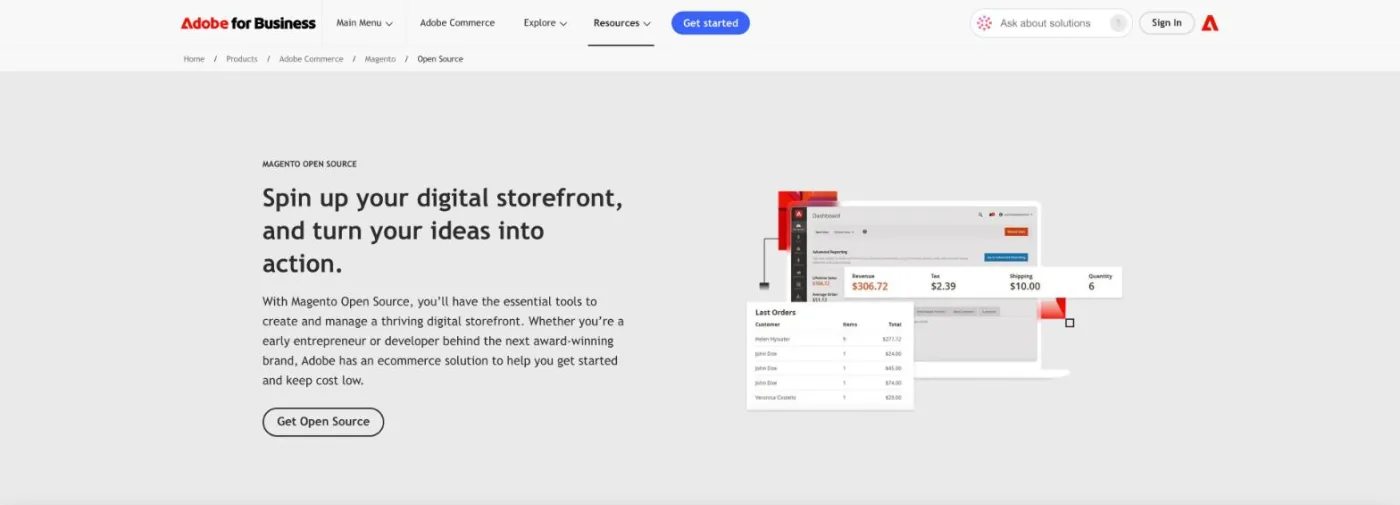
The Magento vs Shopify question opposes two models. Magento is open-source software you install and host yourself, now owned by Adobe, which describes Magento Open Source as a free platform with “thousands of third-party extensions and templates” on its marketplace. Shopify is a subscription service: hosting, security, updates and checkout are included. This guide compares what changes your organic traffic and your visibility in ChatGPT, Gemini and Perplexity: real costs, URL control, technical SEO settings, speed, scaling, migration and AI citations. For the wider market, see our ranking of the best ecommerce platforms for SEO.
Magento is a self-hosted, open-source ecommerce platform written in PHP. You download it, install it on a server, and your team (or an agency) handles hosting, security patches, upgrades and extensions. It exists in two editions: Magento Open Source, free, and Adobe Commerce, the paid edition with B2B features, cloud hosting options and Adobe support. Adobe bought Magento in 2018, and the original Magento 1 reached end of support in June 2020, so every live store today runs on the Magento 2 line.
Shopify is a hosted ecommerce platform (software as a service). You pay a monthly plan, and Shopify runs the servers, the content delivery network, the checkout and the updates. You customize the store with themes and apps from the Shopify App Store, and the code you can touch is limited to the theme layer (Liquid templates) and app extensions.
| Criterion | Magento (Open Source / Adobe Commerce) | Shopify |
|---|---|---|
| Model | Self-hosted software (Adobe Commerce also offered as a cloud service) | Hosted subscription |
| Software price | Open Source free; Adobe Commerce on quote | From 29 dollars per month (Basic, billed yearly) |
| Hosting and security | Your responsibility (except Adobe cloud offers) | Included |
| Code access | Full source code | Theme and app layer only |
| URL structure | Fully configurable | Fixed /products/ and /collections/ folders |
| Built-in blog | No (extension or separate CMS) | Yes |
| Multi-store and multi-language | Native websites, stores and store views | Shopify Markets (subfolders or domains) |
| B2B | Native in Adobe Commerce | Included in Shopify Plus |
| Team needed | Developers or a specialist agency | Merchant alone, developer optional |
The market share gap is wide. According to W3Techs (October 2026), Shopify runs 5.3% of all websites, while Adobe Commerce (Magento) runs 0.3%. More stores means more apps, themes, tutorials and freelancers on the Shopify side, and a smaller, more specialized talent pool on the Magento side.
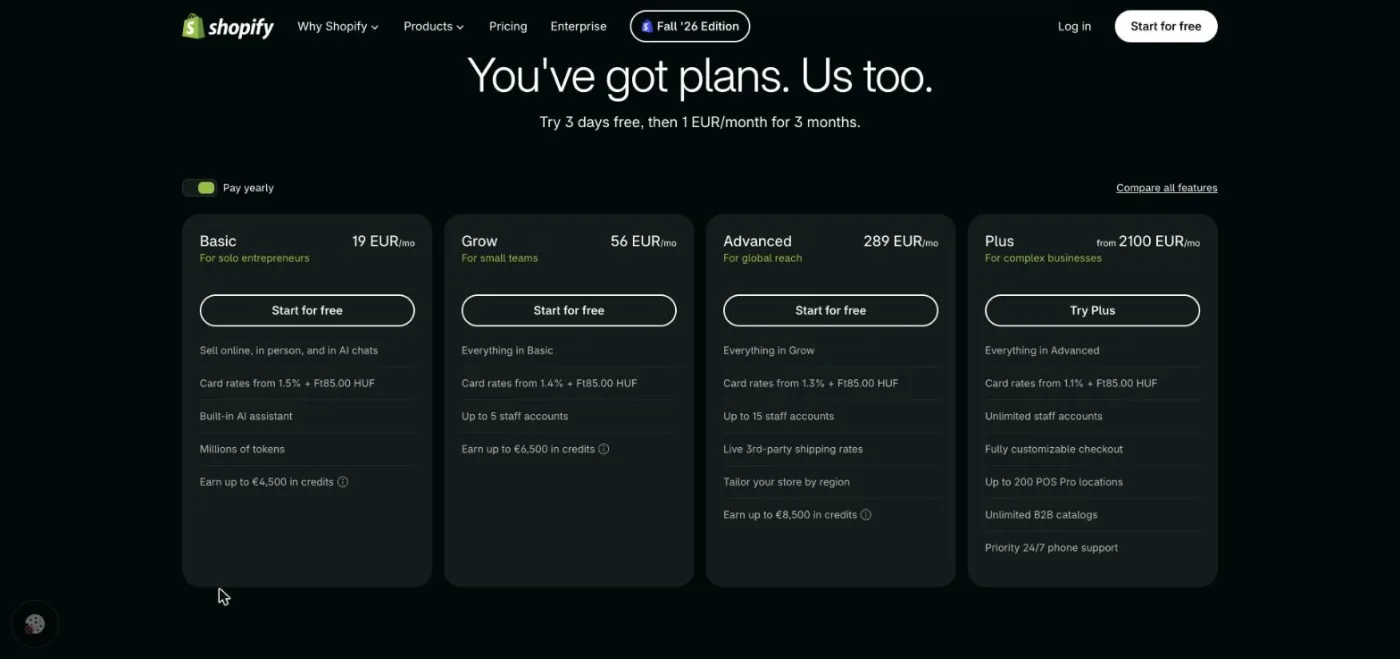
Shopify has a public price list; Magento does not. Magento Open Source costs nothing to download, but every store pays for hosting, a developer or agency, extensions and upgrades. Adobe Commerce has no public list price: Adobe sells it on quote, and the licence is generally tied to the store's sales volume. Shopify's subscription is predictable, with apps and payment fees on top.
| Plan | Price per month (billed yearly) | Price per month (billed monthly) | Extra fee with a third-party payment provider |
|---|---|---|---|
| Shopify Basic | 29 dollars | 39 dollars | 2% |
| Shopify Grow | 89 dollars | 105 dollars | 1% |
| Shopify Advanced | 359 dollars | 399 dollars | 0.6% |
| Shopify Plus | From 2,300 dollars (1 or 3 year term) | 0.2% | |
| Magento Open Source | 0 dollars for the software; hosting, development and extensions extra | Depends on the payment provider | |
| Adobe Commerce | On quote, no public price | Depends on the payment provider | |
Prices from the official Shopify pricing page (United States, checked October 2026) and Adobe's Magento pages. With Shopify Payments, online card rates start at 2.9% + 30 cents in the United States, with no extra transaction fee.
The real cost of a Magento store sits outside the licence. A serious Open Source store needs a server sized for PHP, a database, a search engine (OpenSearch), a cache (Redis, Varnish), monitoring and regular security patches. The build itself is a development project, measured in weeks or months of agency time, and each major upgrade is another project. On Shopify, the cost grows with the apps you install and with the plan you need, but the platform team handles hosting and upgrades.
Watch out
Compare total cost of ownership over three years, not the licence. A free Magento Open Source store with a developer retainer and managed hosting often costs more than a Shopify Advanced plan with a few paid apps.
Magento gives more SEO control; Shopify gives a cleaner default setup. Magento lets you choose the URL structure, the URL suffix, the canonical rules, the sitemap and the robots.txt from the admin, and a developer can change any template. Shopify generates canonical tags, a sitemap and clean HTML automatically, but imposes its URL folders and limits server-level access. Both can rank: the quality of product and category pages matters more than the platform.
| SEO setting | Magento | Shopify |
|---|---|---|
| URLs | Editable URL key, optional category path, configurable suffix (.html by default) | Editable handle; fixed /products/, /collections/, /pages/, /blogs/ folders |
| Title and meta description | Per product, category and page; default templates by store view | Per product, collection, page and article |
| 301 redirects | URL rewrites in the admin; automatic permanent redirect when a URL key changes (setting) | URL redirects in the admin; automatic redirect when a handle changes |
| XML sitemap | Built in, configured by store view, with frequency and priority | Automatic sitemap.xml, not editable |
| robots.txt | Editable in the admin, per website | Editable through the robots.txt.liquid template |
| Structured data | Depends on the theme; often added with an extension or custom code | Product markup in most themes; extendable with apps or Liquid |
| Canonical | Canonical tags for products and categories, switched on in the configuration | Automatic on every page |
| Speed | Depends on hosting, cache and theme | Managed hosting and global content delivery network |
| Multilingual | Store views per language; hreflang needs an extension or custom code | Shopify Markets with subfolders and automatic hreflang |
| Blog | No native blog; extension or separate CMS | Native blog, basic but indexable |
On Magento, the main SEO risks are duplicate URLs (layered navigation filters, sort parameters, products reachable under several categories) and settings left at their defaults. Switching on canonical tags for products and categories, controlling filter parameters and generating a clean XML sitemap per store view are the first tasks after launch. Filtered category pages deserve a specific plan, described in our guide to ecommerce category page SEO.
On Shopify, the constraints are known and stable. The /products/ and /collections/ folders cannot be removed, products also appear under collection paths (Shopify handles this with canonical tags), and the native blog is simple. The admin redirect tool covers most needs; our guide to SEO redirects explains which type to use when.
Tip
On Magento, set “Use Categories Path for Product URLs” to No and switch on the canonical link meta tags before you launch. Changing the URL structure later creates thousands of redirects.
Shopify is faster by default; Magento is as fast as its hosting and its developers make it. Speed feeds the Core Web Vitals, a ranking signal and a conversion factor on mobile. Shopify serves every store from its own infrastructure and content delivery network, so a merchant cannot misconfigure the server. A Magento store needs full-page caching, a tuned server and a light theme to reach good scores.
Field data confirms the gap. The HTTP Archive Web Almanac 2024 reports that only 49% of Magento sites pass the Interaction to Next Paint threshold on mobile, and that Shopify has “consistently had good LCP pass rates since 2022”. The same report notes that Magento is “struggling more than others” on layout stability.
Adobe's answer is a new storefront architecture for Adobe Commerce, served from an edge network, which Adobe says reaches Lighthouse scores of 90 or above. This storefront is part of the paid Adobe offers; on Magento Open Source, speed remains a hosting and theme project.
Shopify is easier to run without technical staff. Products, collections, discounts, orders and content are managed from one admin, and updates arrive without any action from the merchant. Security, PCI compliance for payments and server capacity during traffic peaks are handled by Shopify. A small team can run a store of several thousand products alone, and call a developer only for theme work or a custom app.
Magento's admin is more powerful and more complex. Attribute sets, configurable products, store view scopes and indexers give precise control, but they take training, and many tasks (installing an extension, applying a security patch, upgrading to a new release) require a developer and a test environment. Each extension adds code that must stay compatible with the next upgrade. Merchants who underestimate this maintenance end up with an outdated store, which is the most common reason Magento projects lose speed, security and rankings over time.
Magento and Adobe Commerce handle the most complex catalogs: hundreds of thousands of products, several websites and brands on one installation, customer-specific prices, quotes, company accounts and deep ERP integrations. A single Magento installation can run several websites, each with several stores and store views (languages), sharing one catalog. This is why Magento remains common among manufacturers, distributors and multi-brand groups.
Shopify scales by plan rather than by code. Shopify Plus adds B2B features (company profiles, price lists, payment terms), expansion stores, checkout customization and higher API limits. For most brands selling to consumers, Shopify Plus covers the needs at a lower running cost. For catalogs with complex product configurations, heavy custom logic or on-premises requirements, Magento keeps the advantage. Large catalogs also bring SEO work at scale (crawl budget, internal linking, templates), covered in our guide to enterprise SEO.
Adobe Commerce is the paid, supported edition of Magento. It adds native B2B tools, customer segmentation, content staging, advanced search and recommendations, and Adobe support, and it can be deployed on your own servers, on Adobe's cloud infrastructure, or since June 2025 as Adobe Commerce as a Cloud Service, a version managed and updated by Adobe. Magento Open Source keeps the core catalog, checkout and admin, without these additions.
For existing merchants, Adobe has stated that the current editions remain supported:
“Existing Adobe Commerce customers using Adobe Commerce on Cloud or On Premises products will continue to receive the same level of support as before, including access to new features, with no end date.”
Surya Lamech, product marketing manager for Adobe Commerce at Adobe, Adobe blog
In practice, the choice between Open Source and Adobe Commerce depends on budget and needs. A store without B2B rules or a large merchandising team can run on Open Source; a group that needs B2B, staging and vendor support pays for Adobe Commerce.
Migrating from Magento to Shopify changes almost every URL, so the success of the move depends on the redirect map. Magento product URLs such as /blue-shirt.html become /products/blue-shirt on Shopify, and category URLs move to /collections/. Without a 301 redirect for each old URL, the store loses the rankings and backlinks built over years.
Keep the Magento store online until the redirects are tested on a sample of real URLs, and keep the old URL export: it is the only record of what Google had indexed. Backlinks pointing to old category pages should land on the closest collection, never on the home page, which Google may treat as a soft 404.
The reverse move (Shopify to Magento) follows the same logic. Our SEO migration checklist details each step, and an ecommerce SEO audit before and after the switch shows what changed.
Note
Shopify cannot reproduce Magento's .html suffix or category paths. Plan the redirects before the launch date, never after.
AI assistants cite pages they can read and trust. On both platforms, three things matter: clean, crawlable HTML (no product content hidden behind scripts), complete product data (prices, availability, reviews, specifications) and editorial content that answers buyers' questions. Shopify's native blog and product markup give a head start; Magento stores often need a blog extension and custom structured data to reach the same level.
Shopify is also building direct sales channels inside AI assistants (its pricing page now lists an agentic plan for selling in AI channels), and Adobe promotes AI product discovery and support for agentic commerce protocols in Adobe Commerce. Our Shopify AI citation study shows which pages the AIs cite most for Shopify stores.
Content is where most stores fall short on both platforms. Sorank, our product, analyzes the store, finds the keywords and writes optimized articles with its article generator, publishes them directly on Shopify (see the Shopify integration) or through a webhook on Magento (see the Magento integration), and tracks whether ChatGPT, Gemini and Claude mention the brand.
Choose Shopify unless your catalog, B2B rules or integrations require Magento's control. The verdict by profile:
For most stores, Shopify is the safer and cheaper choice; Magento wins when control and complexity justify a development team. Whichever platform you pick, rankings and AI citations come from useful product pages and regular content, and this content work can run on autopilot: see the plans and the 3-day free trial.

Magento offers more SEO control: configurable URL structure and suffix, editable robots.txt, built-in sitemap settings and full template access. Shopify covers the essentials automatically (canonical tags, sitemap, clean HTML) and is faster by default, with fixed /products/ and /collections/ folders. For most stores, content and product page quality matter more than the platform.
Magento Open Source is still free to download and use. You pay for hosting, development, extensions and maintenance. Adobe Commerce, the paid edition with B2B features and Adobe support, is sold on quote with no public list price.
The main reasons are cost and maintenance: Magento needs hosting, security patches, upgrades and developers, while Shopify includes hosting and updates in a monthly plan. Faster launches and a large app ecosystem also play a role. The move requires a complete 301 redirect plan because almost every URL changes.
We analyse your competitors, your website and your AI visibility to create a tailored content plan for free.
 AI Content Brief Generator
 FAQ Schema Generator
 AI Blog Post Ideas Generator
 Structured Data Validator (Schema Validator)
 Alt Text Checker
 Internal Link Analyzer
 Backlink Challenge
 AI Meta Description Generator
 AI Blog Title Generator
 Google Indexability Checker
 AI Blog Outline Generator
 UTM Link Builder
 Keyword Clustering Tool
 Canonical Tag Checker
 XML Sitemap Generator
 Broken Link Checker
 AI SEO Title Generator
 Headline Analyzer
 SERP Preview Tool
 Redirect Checker
 Hreflang Tag Generator
 Heading Structure Analyzer
 HTTP Headers Checker
 Favicon Extractor
 SERP CTR Calculator
 SEO vs Paid Search Savings Calculator
 SEO Share of Voice Calculator
 SEO ROI Calculator
 SEO Traffic and Revenue Forecast Calculator
 SEO Budget Calculator
 SEO Break-Even Calculator
 SaaS SEO ROI Calculator
 ROAS Calculator
 Reading Time Calculator
 Ranking Gain Simulator
 Organic Traffic Value Calculator
 Organic Traffic Estimator and Website Traffic Checker
 LTV to CAC Ratio Calculator
 Local SEO ROI Calculator
 Link Building Cost Calculator
 Keyword Value Calculator
 Keyword Opportunity Score Calculator
 Keyword Density Calculator
 GEO ROI Calculator
 GEO Content Investment Calculator
 Ecommerce SEO ROI Calculator
 Customer Lifetime Value Calculator
 Customer Acquisition Cost Calculator
 CTR Calculator
 Cost Per Article Calculator
 Conversion Rate Calculator
 Content Marketing ROI Calculator
 ChatGPT Referral Traffic Estimator
 Bounce Rate Calculator
 Backlink ROI Calculator
 AI Visibility Score Calculator
 AI Traffic Value Calculator
 AI Share of Voice Calculator
 Cost of AI Invisibility Calculator
 AI Citation Rate Calculator
 llms.txt Validator
 AI Overview Checker and AI Overviews Rank Checker
 Robots.txt Checker
 AI SEO Audit
 LLM Readability Checker
 SearchGPT Readiness Checker
 Structured Data LLM Audit
 Website Crawlability AI Audit
 Why ChatGPT Is Not Recommending My Website
 Gemini Ranking Tool
 Perplexity Ranking Checker
 LLM Citation Checker
 Answer Engine Optimization Audit
 GEO Audit
 AI Search Visibility Test
 ChatGPT Visibility Checker
 llms.txt Generator
 URL Extractor
 Webpage to Markdown
 Sitemap Checker
 SERP Volatility Sensor
 Page Size Checker
 Word Counter
 Slug Generator
 Schema Generator
 Robots Generator
 OG Preview
 Meta Tags Generator
 Image Compressor
 Favicon Generator
 On-Page SEO Audit: SEO Checker and SEO Analyzer
 Backlink Analysis Tool
 Keyword Research Tool
 Domain Authority Checker
THEY TRIED SORANK BEFORE YOU
 “I tested Sorank on a real client site and it's insane. It does everything an agency would bill you $1500 a month for. It's going into production on that client now.”

 Guillaume Guersanguersanguillaume.com“We are an Ads agency and we wanted to get our SEO back on track once and for all. Sorank gave us a clear view of our site, helped us prioritize optimizations, and properly structure our content. The tool is easy to use, well designed for a team, and very practical for centralizing tracking without having to juggle multiple platforms. A very solid foundation to start fresh with our SEO.”
 Gaspard MadouiAds Agency
 “I just let the Sorank software do its thing, and now my DR is 25 and my page is ranking higher.”
 Lucas Flandrefoundertrace.fr“I specialized in GEO thanks to Sorank. The GEO Leaderboard allows me to show my clients their position vs competitors on ChatGPT. It’s a real commercial differentiator.”
 MélanieSEO Freelance“Great service, works well for our website and helps us understand how to improve it to rank better on Google and elsewhere. Congrats, keep going, I recommend it.”
 Hugo T.E-commerce merchant