Preferences
Privacy is important to us, so you have the option of disabling certain types of storage that may not be necessary for the basic functioning of the website. Blocking categories may impact your experience on the website. More information
Privacy is important to us, so you have the option of disabling certain types of storage that may not be necessary for the basic functioning of the website. Blocking categories may impact your experience on the website. More information

The Yandex leak lists 1922 ranking factors, but only 417 are active. Here is what it shows, which factors still matter and what applies to Google.

In short
The Yandex leak is a January 2023 release of source code from Yandex. Its main file lists 1922 ranking factors, and Sistrix counts only 417 as active. Most of the list is deprecated or unused. It shows how a search engine can score pages, but it does not prove how Google ranks them.
Want to go further? Ask
Quick quiz
How should you follow your positions on Google?
Sorank matches your answers


Test it for 3 days on your own site and see where you stand on Google, ChatGPT and the other AIs.
Start 3-day free trial3 days free, then stop whenever you want. 90-day results guarantee, conditions apply.
The Yandex leak was a January 2023 release of source code from Yandex, the Russian search engine and tech company. According to TechRadar, published 31 January 2023, a former Yandex employee allegedly leaked git sources totalling 44.7GB of files.
SEO people read these files for one reason. Inside them are the names of the signals a search engine uses to rank pages. Those names are clues about how a large engine organises its thinking. They are not a rulebook for Google, and you should read them as clues.
Yandex and Google are not strangers. TechRadar reports that Yandex uses Google open source technologies such as TensorFlow and BERT, and that references to Google data appear in the leaked codebase. Some experts think the two companies may share a lineage. That is a reason to read the leak closely, and also a reason to be careful about what you conclude from it.
The timeline below shows how quickly the first counts appeared. Two analyses were published within two days of each other, and both counted the factors in the leaked files.
The leak in three dates
If you want to compare how Yandex sits next to Google and the other engines in the wider market, our guide on search engine market share covers that. This article stays on the ranking factors themselves.
The main leaked file contains 1922 ranking factors. Wider estimates are much higher, at roughly 17800 to 17854, because the rest of the leaked material holds many more. The two numbers measure different things, so quote the one that fits your claim.
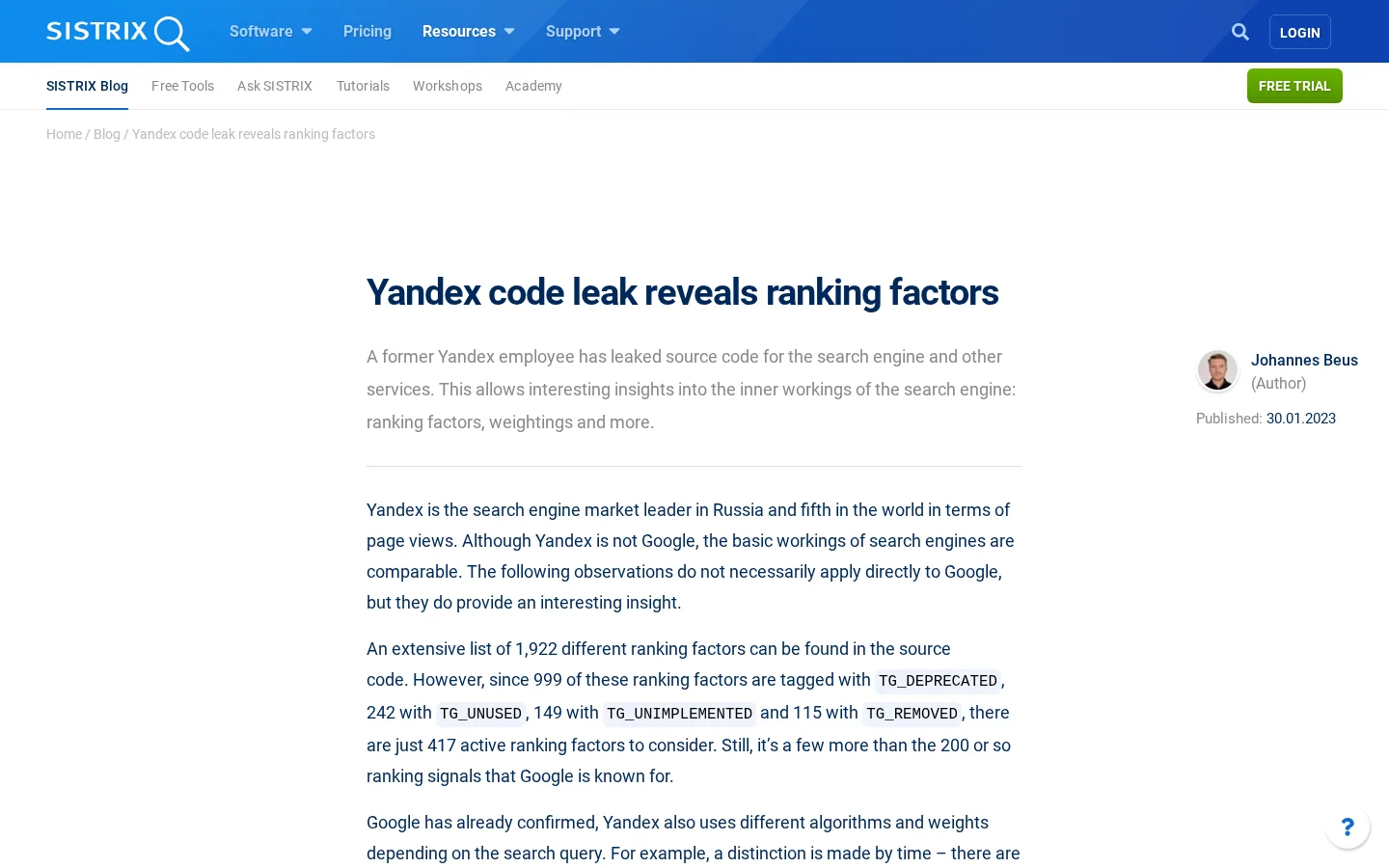
Sistrix published its count on 30 January 2023. Its author, Johannes Beus, writes that an extensive list of 1922 different ranking factors can be found in the source code, and that just 417 of them are active. The analysis is the most precise count we found, because it gives the status of each factor, not only a total.
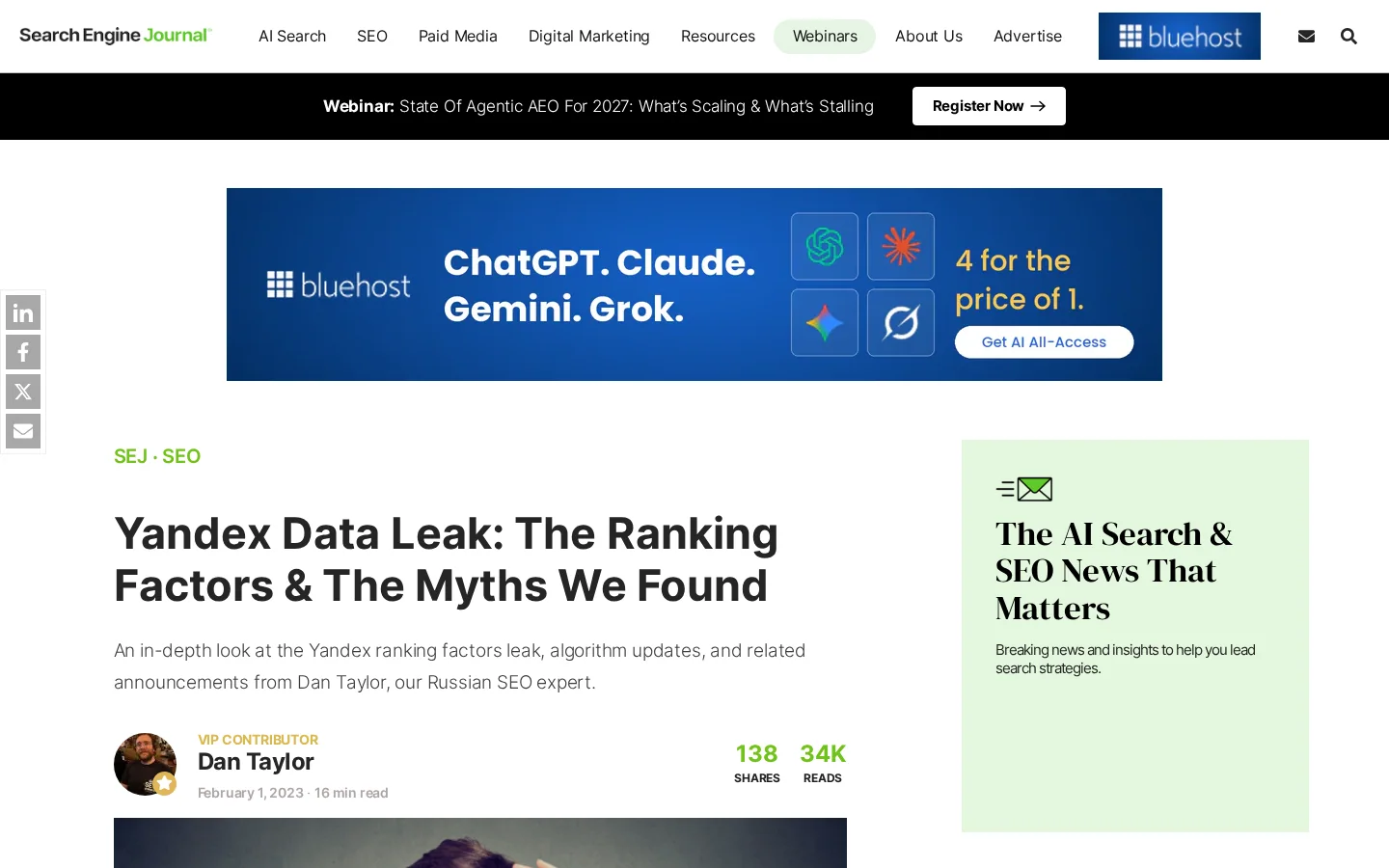
Search Engine Journal took a wider view. In an article by Dan Taylor, published 1 February 2023, the author estimates roughly 17800 factors across the wider code. That figure is an estimate, not a count of every file, so treat it as a rough size of the whole leak.
The gap between the two numbers is the first thing to get right when you quote the leak. Write the scope every time. Say "1922 factors in the main file" or "about 17800 across the wider code", and never let one number stand in for the other.
The share of active factors is a simple calculation. The formula below uses the Sistrix counts.
Active factors: 417
Total factors in the main file: 1922
Share active: 417 / 1922 = 21.7%
So roughly one factor in five is active in the list Sistrix checked. That is the number to keep in mind before you read any factor name as a live signal.
The Yandex leak in numbers
Sources: Sistrix, 30 January 2023; TechRadar, 31 January 2023
Most of the leaked factors are obsolete. Sistrix tags 999 as deprecated, 242 as unused, 149 as unimplemented and 115 as removed. Together that is 1505 of the 1922 factors, or 78.3 percent. Only 417 carry none of these tags.
In plain terms, the tags mean different things. Deprecated means Yandex has stopped using the factor. Unused means the code exists but nothing calls it. Unimplemented means the factor is named but never built. Removed means it was taken out. Each tag tells you the factor is not part of the live ranking, and that is the point to take from them.
The split depends on which tags you count. Deprecated and unused alone make 1241 factors, or 64.6 percent of the list. That matches the "over 64 percent" figure in the Search Engine Journal article. Add unimplemented and removed, and the share rises to 78.3 percent. Both numbers are correct, and both come from the same list.
An obsolete factor tells you something about Yandex, and nothing about Google. If Yandex has stopped using a signal, that is a fact about Yandex's code. It does not show whether Google ever used the same signal, or whether it uses it today.
The practical rule is simple. Before you spend an hour on a factor, check its status. If it is deprecated or unused, drop it. If it is active, you have a question worth testing, but you still do not have an answer for Google.
The sources we read do not name the 417 active factors one by one, so no source can give you a complete list of live signals. The reports name a few families of factors, and those are the ones worth testing first. Each family needs a test on your own site before you act on it.
The table below lists what the reports name, and what that means for Google. The last column is the honest one. Only one row has a clear link to a known Google concept, and even that row does not give Google's weights.
| Factor family named in reports | What the leak shows | Does it carry over to Google? |
|---|---|---|
| PageRank | Named in the Yandex code | Google has used links to rank pages for a long time, but this leak gives no weights for Google |
| Link age and link relevance | Named in the Yandex code | Not confirmed by the leak. Test it on your own links |
| Preference for authoritative sites | Named in the Yandex code | Not confirmed by the leak. Test it on your own pages |
| References to Google data | Google data appears in the codebase | No. It shows Yandex refers to Google data, not that Google uses Yandex factors |
Links appear in more than one row, and that is the main reason to start there. A backlink is a link from another site to yours, and the leak names link age and link relevance as factors. That does not prove Google weights them the same way. It is a reason to check your own link profile before you change anything.
The sources we read name few content or user-behaviour factors. Do not build a plan on them alone. Check what your own Search Console data shows, and test one change at a time.
Very little of the leak applies to Google as a fact. Yandex and Google are different search engines, and the sources we read do not show that Google uses any specific Yandex factor. The leak is a good hint, not a confirmation. We found no public statement from Google about the Yandex leak in the sources we checked.
Sistrix is direct on this point. Its author writes that the observations "do not necessarily apply directly to Google, but they do provide an interesting insight". The same analysis adds that the Yandex findings are "not a confirmation that Google uses them, but a good indication."
Search Engine Journal reaches the same conclusion from another angle. Its article notes that Yandex and Google are "disparate search engines, with a number of differences". It also compares one Yandex system, MatrixNet, with Google's RankBrain, and calls them "two very different systems". The engineers at both companies may have built things in a similar way, but the article says that is not the same as direct copying.
Two ways to read a leaked factor
The right reading is the second one. A leaked factor is useful when it gives you a question. It is not useful when it gives you a rule. For the list of signals Google has confirmed, and the ones that are still speculation, read our Google ranking factors guide. That page is the better source for Google, because it separates what Google has said from what SEO people believe.
Use the leak as a list of questions. Start from the active factors, match them to a problem you can see on your site, test one factor at a time, and keep the result only if your data shows a change. Anything else is guessing with extra steps.
There are three common ways teams use a leak like this. They differ in cost, speed and risk. The table below compares them, so you can choose on purpose.
| Approach | Principle | Use it when | Limit |
|---|---|---|---|
| Ignore it | Keep your current plan | You have no time to test anything | You may miss a signal you could have measured |
| Copy the list | Apply factors as rules | Never | Most of the list is obsolete, and the rest is not confirmed for Google |
| Test it as a question | Turn one active factor into one measured change | You have enough traffic to see a change in your data | Slow, and it needs a clean baseline before you start |
The third approach is the only one that teaches you something. Here is how to run it, in order.
Testing one leaked factor
Each step is simple, but most teams skip the baseline and the comparison group. Without them, a rise in rankings after a change proves very little. It may come from seasonality, from a competitor's drop, or from a change you forgot about.
Tip
Before you change a page, run the free On-Page SEO Audit Tool on it and save the result. That gives you the baseline you need for the comparison in step five.
The most common mistake is to treat the full leaked list as a checklist for Google. Three other mistakes follow from it: chasing obsolete factors, quoting one number without its scope, and changing many things at once. Each one wastes time, and each one is easy to spot once you know what to look for.
The same plan, before and after the leak
What it is: You try to cover the whole list. Your work spreads across factors that are deprecated or unused, and nothing gets measured properly.
How to spot it: Your task list has items that nobody on the team can measure in a quarter, or items you cannot explain in one sentence.
How to fix it: Cut the list to the 417 active factors. Then cut it again to the three you can measure this quarter. Put the rest in a notes file, and leave them there.
What it is: You spend time on a signal that Yandex has tagged as deprecated. The engine no longer uses it, so the work cannot show a result in Yandex, and it says nothing reliable about Google.
How to spot it: The factor is one of the 999 deprecated tags in the Sistrix breakdown, or you cannot tell which tag it has. If you cannot tell, you have not checked it yet.
How to fix it: Drop the factor unless another source shows it is live. Write down why you dropped it, so the same idea does not come back in a month.
What it is: You write 1922 in one paragraph and 17854 in another. Readers think the numbers conflict, and in fact they measure different things.
How to spot it: Your text gives a count of factors without saying which file, which tags or which scope it covers.
How to fix it: Name the scope every time. Say "1922 in the main file", "about 17800 across the wider code" or "417 active", and link the source in the same sentence.
What it is: You rewrite titles, add links and change the content in the same week. If rankings move, you cannot tell which change did it, and the next plan rests on a guess.
How to spot it: Your change log shows more than one change per page group in the same test window.
How to fix it: Change one thing on one page group. Compare it with a group you did not touch, and wait for the data before the next change. The backlink audit guide shows how to keep link changes separate from content changes.
Warning
Treat every leaked factor as a question until your own data answers it. A factor that Yandex uses is not a rule for your site, and a factor that the leak does not mention is not proof that Google ignores it.
This week, read the Sistrix analysis, pick one factor family and run one test on one page group. Do not change the whole site. A narrow test that you measure properly teaches you more than a broad change that you cannot explain.
The checklist below is the minimum. Each item takes less than an hour. Together they give you a test you can read in a month, with a baseline you trust.
This week's checklist
If the factor you picked is links, start with a step-by-step link review before you change anything. Know which links you already have, and which ones were lost, before you add new ones. That baseline is what makes the test readable.
Sorank works on the Google and AI side of SEO on autopilot. Its features cover keyword research, articles, backlinks and tracking in ChatGPT, Gemini and Claude. The Yandex leak does not change that work. It does give a reason to test links and content signals one at a time, instead of guessing from a list.
If you want to see how the platform handles the research and the content side, the automated keyword research page explains the workflow. For the link side, the natural backlink acquisition page covers contextual links from your niche. Check both pages for the current details, since the product changes over time.
The rings below show two shares from the same Sistrix count. They are a reminder that most of the list is not live, and that the active part is small. Use them to keep your plan narrow.
Two shares of the leaked list
Source: Sistrix, Johannes Beus, 30 January 2023
The main leaked file contains 1922 ranking factors. Sistrix counts 417 of them as active. TechRadar reports roughly 17854 across the wider leaked material. Always name which of these three numbers you mean.
No. Sistrix says the observations do not necessarily apply directly to Google, and that they are a good indication rather than a confirmation that Google uses them. The leak gives you questions to test on your own site, not answers about Google.
Sistrix tags 999 factors as deprecated, 242 as unused, 149 as unimplemented and 115 as removed. Together that is 1505 of the 1922 factors. The sources we read do not list each obsolete factor by name, so check the status of any factor you want to use.
The main leaked file lists 1922 ranking factors. Sistrix counts 417 of them as active, and TechRadar reports roughly 17854 across the wider leaked material.
No. Sistrix says the findings do not necessarily apply directly to Google. They are a good indication, not a confirmation that Google uses them.
Sistrix tags 999 factors as deprecated, 242 as unused, 149 as unimplemented and 115 as removed, which is 1505 of the 1922. A tagged factor is not part of Yandex's live ranking.
We analyse your competitors, your website and your AI visibility to create a tailored content plan for free.
 AI Content Brief Generator
 FAQ Schema Generator
 AI Blog Post Ideas Generator
 Structured Data Validator (Schema Validator)
 Alt Text Checker
 Internal Link Analyzer
 Backlink Challenge
 AI Meta Description Generator
 AI Blog Title Generator
 Google Indexability Checker
 AI Blog Outline Generator
 UTM Link Builder
 Keyword Clustering Tool
 Canonical Tag Checker
 XML Sitemap Generator
 Broken Link Checker
 AI SEO Title Generator
 Headline Analyzer
 SERP Preview Tool
 Redirect Checker
 Hreflang Tag Generator
 Heading Structure Analyzer
 HTTP Headers Checker
 Favicon Extractor
 SERP CTR Calculator
 SEO vs Paid Search Savings Calculator
 SEO Share of Voice Calculator
 SEO ROI Calculator
 SEO Traffic and Revenue Forecast Calculator
 SEO Budget Calculator
 SEO Break-Even Calculator
 SaaS SEO ROI Calculator
 ROAS Calculator
 Reading Time Calculator
 Ranking Gain Simulator
 Organic Traffic Value Calculator
 Organic Traffic Estimator and Website Traffic Checker
 LTV to CAC Ratio Calculator
 Local SEO ROI Calculator
 Link Building Cost Calculator
 Keyword Value Calculator
 Keyword Opportunity Score Calculator
 Keyword Density Calculator
 GEO ROI Calculator
 GEO Content Investment Calculator
 Ecommerce SEO ROI Calculator
 Customer Lifetime Value Calculator
 Customer Acquisition Cost Calculator
 CTR Calculator
 Cost Per Article Calculator
 Conversion Rate Calculator
 Content Marketing ROI Calculator
 ChatGPT Referral Traffic Estimator
 Bounce Rate Calculator
 Backlink ROI Calculator
 AI Visibility Score Calculator
 AI Traffic Value Calculator
 AI Share of Voice Calculator
 Cost of AI Invisibility Calculator
 AI Citation Rate Calculator
 llms.txt Validator
 AI Overview Checker and AI Overviews Rank Checker
 Robots.txt Checker
 AI SEO Audit
 LLM Readability Checker
 SearchGPT Readiness Checker
 Structured Data LLM Audit
 Website Crawlability AI Audit
 Why ChatGPT Is Not Recommending My Website
 Gemini Ranking Tool
 Perplexity Ranking Checker
 LLM Citation Checker
 Answer Engine Optimization Audit
 GEO Audit
 AI Search Visibility Test
 ChatGPT Visibility Checker
 llms.txt Generator
 URL Extractor
 Webpage to Markdown
 Sitemap Checker
 SERP Volatility Sensor
 Page Size Checker
 Word Counter
 Slug Generator
 Schema Generator
 Robots Generator
 OG Preview
 Meta Tags Generator
 Image Compressor
 Favicon Generator
 On-Page SEO Audit: SEO Checker and SEO Analyzer
 Backlink Analysis Tool
 Keyword Research Tool
 Domain Authority Checker
 “I tested Sorank on a real client site and it's insane. It does everything an agency would bill you $1500 a month for. It's going into production on that client now.”

 Guillaume Guersanguersanguillaume.com“We are an Ads agency and we wanted to get our SEO back on track once and for all. Sorank gave us a clear view of our site, helped us prioritize optimizations, and properly structure our content. The tool is easy to use, well designed for a team, and very practical for centralizing tracking without having to juggle multiple platforms. A very solid foundation to start fresh with our SEO.”
 Gaspard MadouiAds Agency
 “I just let the Sorank software do its thing, and now my DR is 25 and my page is ranking higher.”
 Lucas Flandrefoundertrace.fr“I specialized in GEO thanks to Sorank. The GEO Leaderboard allows me to show my clients their position vs competitors on ChatGPT. It’s a real commercial differentiator.”
 MélanieSEO Freelance“Great service, works well for our website and helps us understand how to improve it to rank better on Google and elsewhere. Congrats, keep going, I recommend it.”
 Hugo T.E-commerce merchant