Preferences
Privacy is important to us, so you have the option of disabling certain types of storage that may not be necessary for the basic functioning of the website. Blocking categories may impact your experience on the website. More information
Privacy is important to us, so you have the option of disabling certain types of storage that may not be necessary for the basic functioning of the website. Blocking categories may impact your experience on the website. More information

Learn listicle outreach step by step: find the best-of lists that matter, pitch editors with a real reason, and stay clear of paid link schemes.

Tools

In short
Listicle outreach means asking the people who write "best of" pages to add your brand, move it higher, or fix an outdated entry. These pages are often what AI assistants read when they compare products, so a place on the right list can affect both your rankings and your visibility in AI answers. Pitch only lists that show a clear method, and give each editor one specific reason to change the page.
Want to go further? Ask
Quick quiz
Which way of finding customers online fits you best?
Sorank matches your answers


Test it for 3 days on your own site and see where you stand on Google, ChatGPT and the other AIs.
Start 3-day free trial3 days free, then stop whenever you want. 90-day results guarantee, conditions apply.
A listicle is a ranked or curated list: "the 10 best invoicing tools", "top SEO agencies in Lyon", "X alternatives". Listicle outreach is the work of contacting the editor or writer of such a page and asking for one of three things: a new listing, a better position, or an update to an entry that is wrong or out of date. The format is old. What is new is who reads these pages. When someone asks an AI assistant for the best tool in a category, the answer often draws on pages that already compare the options, so a listing there can reach buyers who never search on Google.
There is data behind this, although the field is young. In a study published on December 4, 2025, Ahrefs looked at 750 top-of-funnel prompts covering software, product and agency recommendations. It found that "best X" blog lists made up 43.8% of the page types ChatGPT cited, and that 35% of the cited best lists sat on low-authority domains. The authors also write that they are "still studying this", so read the figures as a strong signal, not a law.
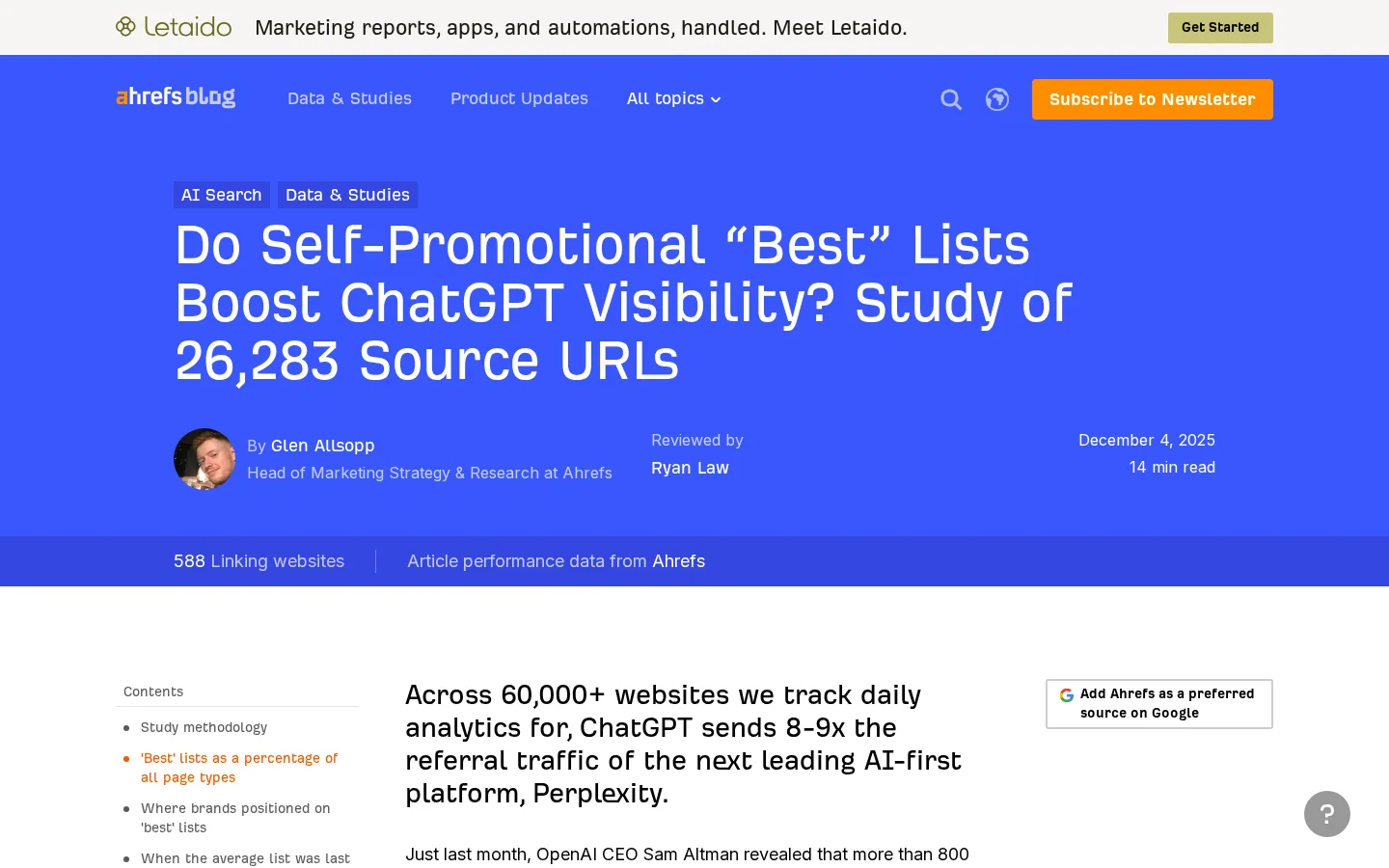
What ChatGPT cited in best-of answers
Source: Ahrefs, "Do Self-Promotional 'Best' Lists Boost ChatGPT Visibility?", December 4, 2025
The second piece of evidence is a campaign. In its Hunter.io case study, Ahrefs describes a listicle outreach campaign run by one person in under three months. The results were not a promise, and one company is a single benchmark, but they show the kind of return that steady, targeted work can produce.
One person, under three months
Source: Ahrefs, listicle outreach case study on the Hunter.io campaign
The third piece comes from Peec AI, a company that tracks brand mentions in AI answers. Its analysis covered nearly 200000 AI responses collected between September 2025 and March 2026, across eight engines and three markets. For B2B SaaS, a first-place rank in a listicle that AI cited raised the chance of a brand mention by 16.5 percentage points. Peec calls these observational associations, not proof of cause, and that is the right way to read them.
The logic is simple. Listicles are where comparisons happen. If your brand is absent from the lists that get cited, an AI model has fewer reasons to name you. The rest of this guide covers how to get into the right lists without breaking the rules Google sets for links.
Most outreach fails before the first email, at the selection step. You pitch a page nobody reads, or a sales page with a ranking attached, and no email can fix that. The goal of this section is a shortlist of lists you can defend in one sentence each.
Write 10 to 20 seed terms that describe what you sell, in the words customers use and not in your internal jargon. For an invoicing app, the seeds might be "invoicing software", "invoice generator", "invoicing tools for freelancers" and "recurring billing". Then search each seed with the modifiers that listicles tend to use: best, top, alternatives, tools, review and list. Run the queries in a private window and in the country you sell to, because results change with location.
"invoicing software" best
"invoicing software" top 10
"invoicing software" alternatives
"invoicing tools" "for freelancers"
"recurring billing" review list
Export the results of each query, merge the files and remove duplicate URLs. Keep four columns for every row: the domain, the URL, the seed term that found it, and the date you checked it. You will need the seed term later, because it tells you which buyer question the list is answering.
Once you have a long list, cut it hard. One practical rule from the Ahrefs case study is to drop every site with a Domain Rating of 30 or lower. Use that as a starting filter, not a law. Domain Rating is a third-party score, and Ahrefs itself says it is not a perfect indicator of site quality. Two other checks matter more than the score.
First, read the method. Does the page explain how it chose the products, or does it show a ranking with affiliate links next to every item and no criteria? Ask whether a reader could repeat the ranking. If the answer is no, the list is a weak target, and an editor who wrote it may be unable to justify a change. Second, check the date and the links. A list last updated years ago, with dead links and products that no longer exist, is a poor place to be listed, and it is also an opening for an update pitch (section 3).
Next, check which domains already link to the competitors you know. A list that links to two or three of your rivals has already accepted that kind of product, so it is a better first target than a list with no sign of your category. You can check any domain with our free backlink checker.
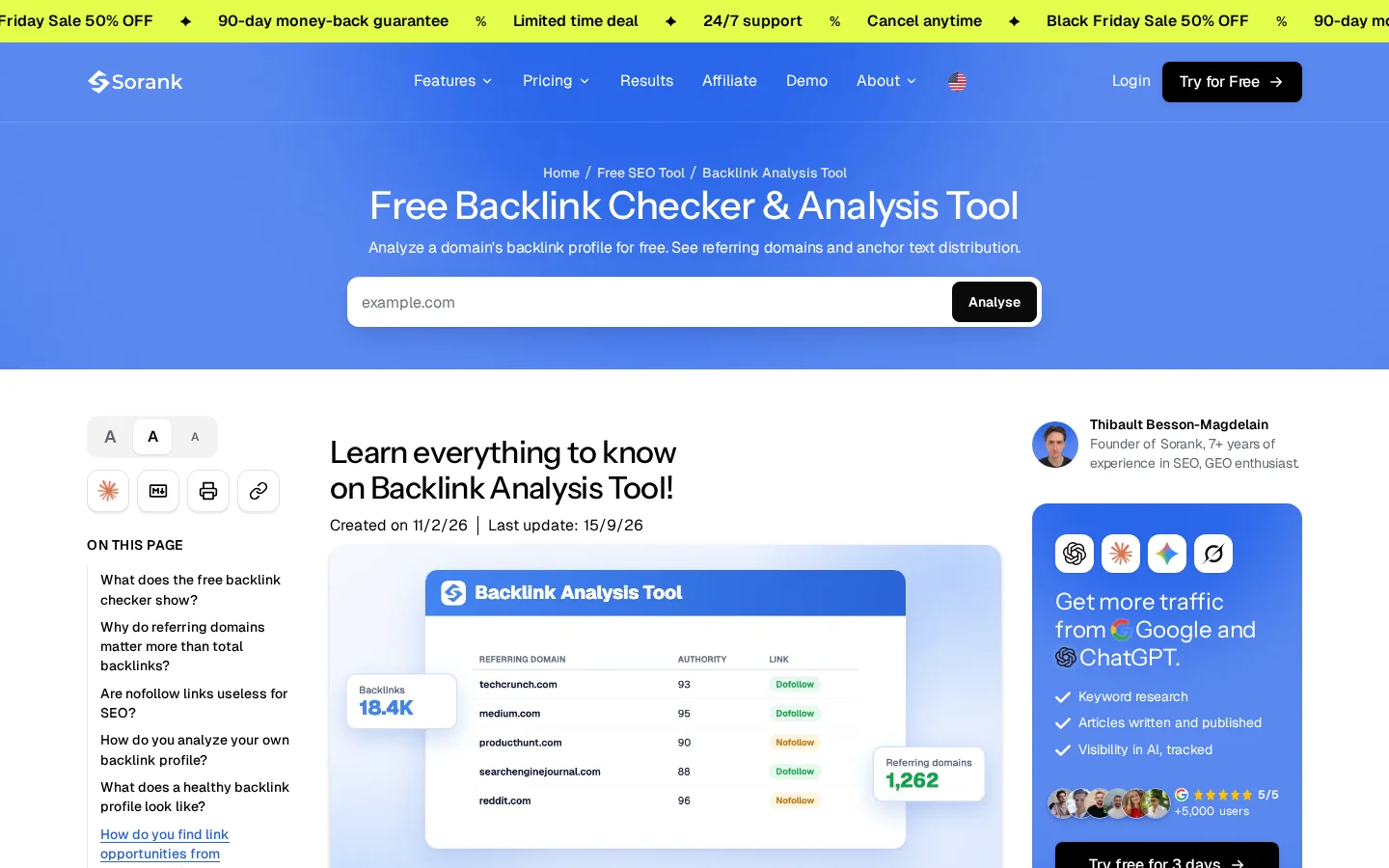
The test you use for any link is the same test described in our guide to quality backlinks. It applies here without change.
If you sell in several countries, run the seed terms in each language. A best-of list in German can reach buyers that an English list never will. Local lists are often run by a small team, so the editor is easier to reach, but the audience is also smaller. Check the page traffic and the audience before you decide how much effort a list deserves.
Every list falls into one of a few situations, and each situation needs a different ask. Sorting them first stops you from pitching the wrong thing to the wrong page.
| Segment | What it means | What to ask for |
|---|---|---|
| Not mentioned | Your brand is absent from the list | A new entry, with one concrete reason |
| Mentioned without a link | Your brand is named in the text but not linked | A link to the most relevant page on your site |
| Mentioned below rivals | You are listed, but after competitors | A better position, backed by a use case the list misses |
| Already first | You lead the list | Nothing, unless a fact in the list is now wrong |

There is more than one way to get a listing, and each carries a different amount of effort and risk. Some editors will accept one kind of ask and ignore another. The four methods below are the ones we would use, and the ratings in the table at the end are our own judgment, not measured results.
This is close to, but not the same as, resource page link building. There, you ask a curator to add your page to a list of resources. Here, you pitch the writer of a comparison, so your reason has to be about the comparison itself.
Principle: You show the editor a gap. The list covers a category, and your brand fits a need the list does not address.
When to use it: The list sits in the "not mentioned" segment, the page is maintained, and you can name the gap in one sentence.
Advantages: It is the most direct route to a new mention, and the ask is easy to understand.
Limits: Some editors only add products they have tested or that buy sponsored space, and the page may not say so. Look for a submission or contribution process before you write, and stop if the only route is payment.
Example: In the Ahrefs case study, the author offered three things: enrollment in an affiliate program with recurring revenue, a pack of free requests, and help updating the listicle. Each benefit was real and tied to the page.
Principle: You are already on the list, but low down. You ask for a higher rank by pointing to a use case the list ignores.
When to use it: Your segment is "mentioned below rivals", and the products above you have a weakness you can describe, such as a missing feature or a customer type they do not serve.
Advantages: You already have the mention, so the editor only needs to change an order, which is a smaller ask than a new entry.
Limits: Do not claim the top place without evidence. An editor who feels pushed will not move you, and may remove you.
Example: A sample pitch might read: "Your guide lists us fourth. Your section on freelancers asks for multi-currency support, which is the one case the top three do not describe. Would that justify a higher place?" The reason is specific, and the editor can check it in a minute.
Principle: The list has stopped serving its readers. You help fix it, and you earn a place in the fix.
When to use it: The page shows old dates, dead links or products that no longer exist, and you can help without writing the whole piece for the editor.
Advantages: It saves the editor work, which is the value they care about. It is also the method that looks least like advertising.
Limits: Only pitch an update you can verify. An editor who checks the page and finds nothing outdated will stop trusting your emails.
Example: In the Ahrefs case study, the author offered to help update an outdated guide that had lost organic traffic, and supported the offer with a screenshot of the drop. Showing the problem is what made the offer credible.
Principle: You pay for the placement, and the page labels it as sponsored.
When to use it: Only when the publisher sells sponsored placements openly, with a clear label, and when the link carries the rel="sponsored" attribute described in section 8.
Advantages: It is predictable. You know the price, the date and the placement, and you can budget it like any other channel.
Limits: A bought mention is not an editorial endorsement. An unlabelled paid link breaks Google's link spam rules. For most teams, this is the method to skip.
Example: A page that says "sponsored" at the top, shows a price and uses a rel="sponsored" link is a placement you can defend. A page that ranks you first after a private payment, with no label, is a violation waiting to be reported.
| Method | Effort | Risk | Best for | Main limit |
|---|---|---|---|---|
| 1. Pitch a missing listing | Medium | Low | Lists with no mention of you | Needs a clear, real gap |
| 2. Ask for a better position | Low | Low | Lists where you already appear | Needs a use case, not a claim |
| 3. Offer an update | Medium | Low | Outdated lists with lost traffic | Must be verifiable |
| 4. Paid or sponsored placement | Low | High | Publishers that sell sponsored spots | Must be labelled and marked rel="sponsored" |
Methods 1 to 3 are earned, because the editor chooses to change the page. Method 4 is bought. Other tactics such as digital PR and linkable assets can earn mentions without an ask at all, and they make a good complement to a pitch campaign.
This is the method we would run for one category. It takes a few hours to set up. After that, the pace depends on how much research each pitch needs, so plan for fewer, better emails rather than a bulk send. The seven steps below are the spine of the process, and the sections that follow explain the steps that need care.
The seven steps
The search work is in section 2. Here, the output matters. Keep a single sheet with one row per list, and columns for the domain, the URL, the seed term, the segment, the date you last checked it and a short note on the method. A shortlist of 30 lists sorted into four segments is a plan. A folder of 300 links is not.
Sort fast and sort honestly. If you put a list in "already first" because it looks good, check whether the top spot is yours or whether you are reading it as a bias. Then move on. Time spent on lists you will never pitch is time you do not have for the ones that matter.
Start with the page itself. Many lists show a byline, an author box or an "updated by" line. Open the author's name, look for a professional profile, and check the site for a contact form. Ahrefs reports that blog editors and content managers, often the writer of the specific list, gave the best response rates. So aim for the person who decides, not the generic contact address.
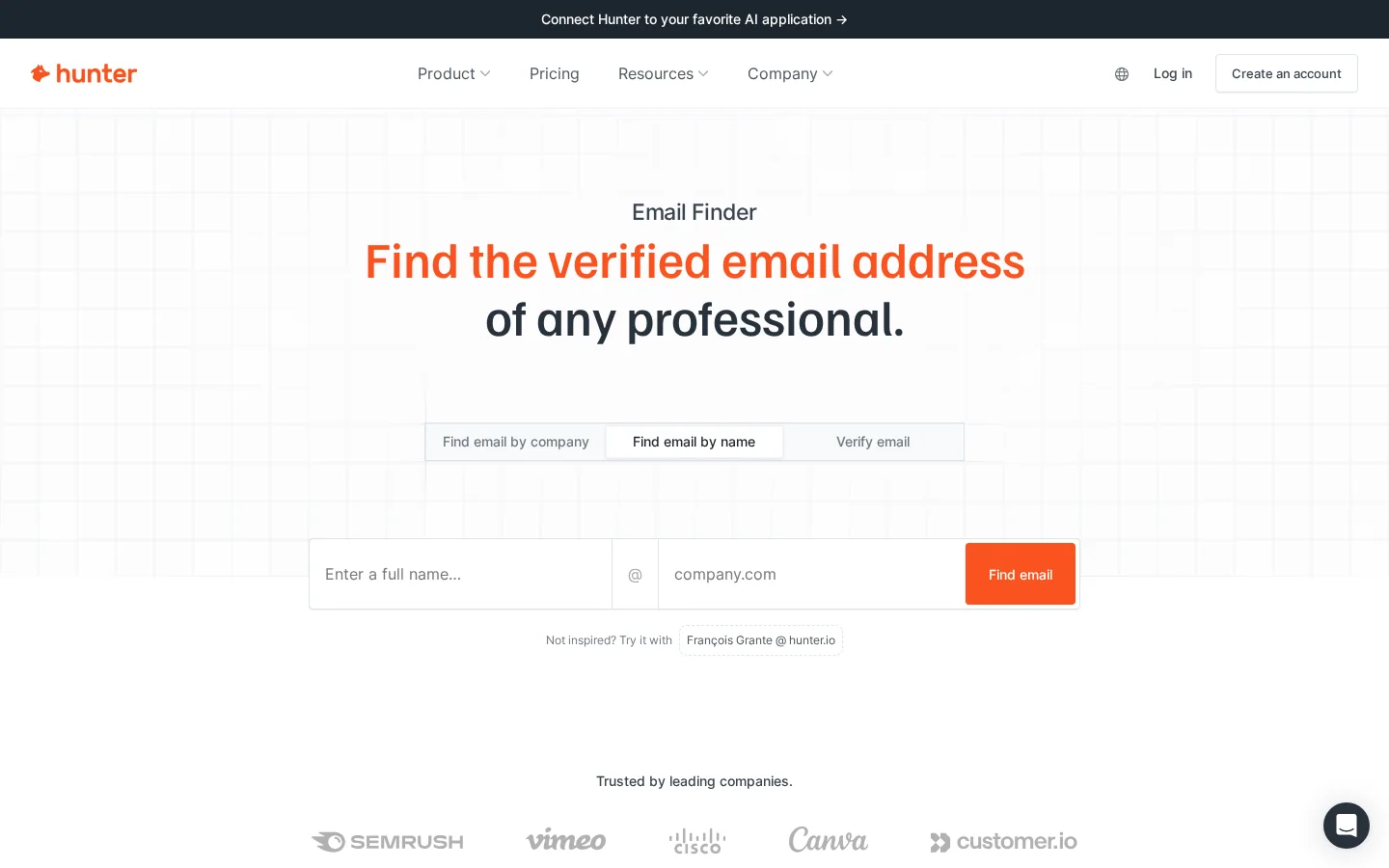
When you have a name and the publisher's domain, a finder can return a verified address. Hunter's Email Finder, for example, takes a full name and a company domain, then returns the address with a verification status and a confidence score. Verify the address before you send anything, and skip the ones that fail. Guessing a pattern such as firstname.lastname at the domain is how bounces pile up, and bounces damage the sender reputation you need for every later campaign.
Write each pitch by hand, then read it out loud. Section 5 covers what goes in it, and our guide to email outreach covers the mechanics of sending. Save the draft in your mail tool, review it, then send. Log every send with its date, its segment and the day you will follow up. Logging is the step most people skip, and it is the one that makes the work repeatable.
If you want to automate the search for niche-matched placements, Sorank's natural backlink acquisition feature handles that part. The pitch to a human editor still needs a reason you can defend, so use automation to narrow the list, not to write the emails for you.
Editors receive many requests, and most of them are form letters that could be sent to any list. Yours should read as if it was written for this page, because it was. The Ahrefs author put the rule in four words: "No value = no pitch."
1. Name the list and the section. Use the exact title and, if you can, the heading where your brand fits. This shows the editor you read the page.
2. Give one concrete reason. A missing category, a use case the list does not cover, a fact that has changed, or a dataset you can share. One reason works better than three, because three read like a sales sheet.
3. Link one relevant page. Send the editor to the page that answers the gap, not to your homepage. The editor should be able to check your claim in one click.
4. Make one short ask. Ask for an entry, a position or an update. Do not ask for three things at once.
The difference is easiest to see side by side.
A generic pitch versus a specific one
Example
Hi Maria,
Your guide to invoicing tools for freelancers covers the basics well, but it does not mention invoices in several currencies, which is the setup many freelancers with EU clients need. We built [feature name] for that case, and [page link] explains how it works. Would it fit as one line in your section on international clients? Happy to answer questions.
Best,
[Your name]
Personal emails take time. The Ahrefs author reports that manual, personalised emails sometimes took up to 30 minutes each, and that the response rate on them was "incredibly high (more than 50%)". That is one person's experience, not a controlled test. It still shows the trade-off: fewer emails, each written for one editor, are worth more than a long list of templates.
When you can, offer something of value. The Ahrefs examples include an affiliate program, free access and help updating the page. Keep the offer real and modest. A reward that is tied to the placement itself turns the mention into a paid one, and that puts you back in the territory covered in section 8.
Some editors reply with a price for the mention. Treat that as a sponsored offer. Decide whether a labelled sponsored placement fits your budget, which is a marketing decision, or whether to decline. Do not pay for a ranking and call it an editorial mention, because your readers and Google will see the difference.
Many replies come after a follow-up, not after the first email. The rule for follow-ups is simple, and it protects both the editor and your reputation.
Send no more than two follow-ups to one prospect. That limit comes from the Ahrefs case study, which says: "Don't send more than two follow-ups to one prospect." Space the messages a few days apart, and make each one add something: a new fact, a second use case or a short offer. "Just checking in" adds nothing, and an editor who receives three of those will mark you as spam.
Reply fast when an editor answers. The same case study lists being flexible, replying quickly and doing something in return among its negotiation tips. An editor who asks for a changed sentence or a shorter description should get it the same day.
Track what the campaign produces, not how many emails you sent. A week with a few sends and one accepted entry can beat a week with many sends and no reply, depending on the quality of the lists.
| Metric | What it tells you | How to check it |
|---|---|---|
| Replies | Whether the name and the reason landed | Count replies by segment and by pitch version |
| Accepted changes | Entries added or positions moved | Recheck each list at one week and at four weeks |
| Live links | Whether the link is indexed and points to the right page | Use a backlink monitor, see backlink monitoring |
| AI mentions | Whether the list now feeds AI answers about your category | Run your buyer prompts in several AI tools and note the brand mentions |
AI answers change between runs, so test each prompt several times before you draw a conclusion. Our guide to an AI visibility audit explains a method for doing this consistently.
Lists change. An editor may drop an entry, or the page may be rebuilt. Recheck the list after each update. If you lose a placement, ask politely why. The answer is useful feedback for your next pitch, and it often shows you a gap in your own page that is worth fixing.
Most failed campaigns fail in the same few ways. The table gives you a quick check, and the sections below explain each mistake.
| Mistake | How to spot it | How to fix it |
|---|---|---|
| One template for every list | Replies never mention the list's content | Write one specific line per list: a section, a gap or a date |
| Pitching lists with no method | No criteria, and the owner ranks first on every list | Skip them, or pitch only when the method is visible |
| Asking for first place with no reason | The pitch says "put us first" | Ask for the position that a concrete use case supports |
| Too many follow-ups | Three or four messages to one editor | Stop after two, then log the outcome |
| Paying without a label | A fee is involved and the placement is not labelled as sponsored | Label it and use rel="sponsored", or do not buy it |
What it is: The same email goes to every list writer, with only the name and the URL changed. It is the most common mistake, and it is easy to make when the list is long.
How to spot it: Replies never mention the list's content, and your open rate looks fine while your reply rate is weak. That gap is the signal.
How to fix it: Write one specific line per list. Name a section, a gap, an outdated fact or a new product category. If you cannot write that line, the list is not ready for a pitch, so move it to a later batch.
What it is: You pitch a ranking that has no criteria, where the publisher or a single brand sits first on every list it appears in. The page looks like a sales funnel with a list attached.
How to spot it: Look for the method, the testing notes or the date of the last review. If none exist, and the same brand sits at the top of many pages, the list is a weak target.
How to fix it: Skip the list, or pitch it only after you have read enough of it to see whether the editor cares about accuracy. Ahrefs notes that self-promotional best lists can work for some companies, but that is a choice a company makes about its own pages, not a reason to pitch someone else's sales page.
What it is: The pitch asks the editor to put your brand first, and gives no reason why the order should change.
How to spot it: The email contains the word "first" or "top", and nothing about the readers' needs.
How to fix it: Ask for the position that a concrete use case supports. A move from fourth to second, backed by a feature the top two lack for a specific buyer, is easier to accept than a jump to first with no reason.
What it is: You send a sequence of messages to the same editor, each one shorter than the last, until the editor stops answering.
How to spot it: Three or four messages in the log for one person, and no reply after the second.
How to fix it: Stop after two follow-ups, as the Ahrefs case study advises. Log the outcome as "no reply", and come back to that list only when the page changes.
What it is: You pay for a listing, or offer a fee to the writer, and the placement is not labelled as sponsored or marked with the right link attribute.
How to spot it: The payment is in a message thread, not on the page, and the link carries no sponsored label.
How to fix it: If you want a paid placement, ask for a labelled one and use rel="sponsored" on the link. If the publisher will not label it, do not buy it. Section 8 explains the rule.
Listicle outreach sits close to a line that Google draws clearly. The line is not "asking for a link". It is buying or trading links to manipulate rankings. Google's spam policies define link spam as "creating links to or from a site primarily for the purpose of manipulating search rankings". Three parts of that policy matter for listicles.
The first is paid links. Google's examples include "Exchanging money for links, or posts that contain links". The second is link exchanges. Google names "Excessive link exchanges ('Link to me and I'll link to you')" as spam. The third is sponsored content, and here Google is precise: "It's not a violation of our policies to have such links as long as they are qualified with a rel="nofollow" or rel="sponsored" attribute value to the <a> tag."
Earned mention versus bought placement
Source: Google Search Central, spam policies
If a sponsored placement is the right call, the markup matters. Here is the form Google expects on the link:
<a href="https://example.com/" rel="sponsored">Invoicing for freelancers</a>Warning
A placement with a fee and no label is not a grey area. If a publisher offers to guarantee a top spot for money, decline. Your readers can see the difference, and so can the search engine.
The boundary is covered in more depth in our guides to whether to buy backlinks and backlink exchange. Read them before you agree to any swap, however small.
Start small. A focused list of lists in one category beats a broad campaign across ten categories, because you can learn from each reply.
This week
Tip
Before you build the shortlist, run two or three competitor domains through our free backlink checker. The listicles that link to them are your first candidates.
Listicle outreach is slow, specific work, and it pays off when the list is one that readers and AI systems already trust. Pick lists with a visible method, give the editor one good reason, and stop after two follow-ups. Then check, a few weeks later, whether the page changed and whether the brand now shows up in the answers your buyers read.
Listicle outreach means contacting the editors or writers of best-of and comparison pages to get your brand added, moved up or updated. It works because these pages are often read by buyers and by AI assistants. It only works when you give the editor one specific, verifiable reason to change the page.
Start with 10 to 20 seed terms that describe what you sell, then search each one with modifiers such as best, top, alternatives and tools. Merge the results, remove duplicates and low-authority domains, and keep only the lists that show a visible method.
It is not when you ask an editor for an editorial mention with a real reason. Buying placements or trading links to manipulate rankings is link spam under Google's policies, unless the link is qualified with a rel attribute set to sponsored or nofollow.
We analyse your competitors, your website and your AI visibility to create a tailored content plan for free.
 AI Content Brief Generator
 FAQ Schema Generator
 AI Blog Post Ideas Generator
 Structured Data Validator (Schema Validator)
 Alt Text Checker
 Internal Link Analyzer
 Backlink Challenge
 AI Meta Description Generator
 AI Blog Title Generator
 Google Indexability Checker
 AI Blog Outline Generator
 UTM Link Builder
 Keyword Clustering Tool
 Canonical Tag Checker
 XML Sitemap Generator
 Broken Link Checker
 AI SEO Title Generator
 Headline Analyzer
 SERP Preview Tool
 Redirect Checker
 Hreflang Tag Generator
 Heading Structure Analyzer
 HTTP Headers Checker
 Favicon Extractor
 SERP CTR Calculator
 SEO vs Paid Search Savings Calculator
 SEO Share of Voice Calculator
 SEO ROI Calculator
 SEO Traffic and Revenue Forecast Calculator
 SEO Budget Calculator
 SEO Break-Even Calculator
 SaaS SEO ROI Calculator
 ROAS Calculator
 Reading Time Calculator
 Ranking Gain Simulator
 Organic Traffic Value Calculator
 Organic Traffic Estimator and Website Traffic Checker
 LTV to CAC Ratio Calculator
 Local SEO ROI Calculator
 Link Building Cost Calculator
 Keyword Value Calculator
 Keyword Opportunity Score Calculator
 Keyword Density Calculator
 GEO ROI Calculator
 GEO Content Investment Calculator
 Ecommerce SEO ROI Calculator
 Customer Lifetime Value Calculator
 Customer Acquisition Cost Calculator
 CTR Calculator
 Cost Per Article Calculator
 Conversion Rate Calculator
 Content Marketing ROI Calculator
 ChatGPT Referral Traffic Estimator
 Bounce Rate Calculator
 Backlink ROI Calculator
 AI Visibility Score Calculator
 AI Traffic Value Calculator
 AI Share of Voice Calculator
 Cost of AI Invisibility Calculator
 AI Citation Rate Calculator
 llms.txt Validator
 AI Overview Checker and AI Overviews Rank Checker
 Robots.txt Checker
 AI SEO Audit
 LLM Readability Checker
 SearchGPT Readiness Checker
 Structured Data LLM Audit
 Website Crawlability AI Audit
 Why ChatGPT Is Not Recommending My Website
 Gemini Ranking Tool
 Perplexity Ranking Checker
 LLM Citation Checker
 Answer Engine Optimization Audit
 GEO Audit
 AI Search Visibility Test
 ChatGPT Visibility Checker
 llms.txt Generator
 URL Extractor
 Webpage to Markdown
 Sitemap Checker
 SERP Volatility Sensor
 Page Size Checker
 Word Counter
 Slug Generator
 Schema Generator
 Robots Generator
 OG Preview
 Meta Tags Generator
 Image Compressor
 Favicon Generator
 On-Page SEO Audit: SEO Checker and SEO Analyzer
 Backlink Analysis Tool
 Keyword Research Tool
 Domain Authority Checker
 “I tested Sorank on a real client site and it's insane. It does everything an agency would bill you $1500 a month for. It's going into production on that client now.”

 Guillaume Guersanguersanguillaume.com“We are an Ads agency and we wanted to get our SEO back on track once and for all. Sorank gave us a clear view of our site, helped us prioritize optimizations, and properly structure our content. The tool is easy to use, well designed for a team, and very practical for centralizing tracking without having to juggle multiple platforms. A very solid foundation to start fresh with our SEO.”
 Gaspard MadouiAds Agency
 “I just let the Sorank software do its thing, and now my DR is 25 and my page is ranking higher.”
 Lucas Flandrefoundertrace.fr“I specialized in GEO thanks to Sorank. The GEO Leaderboard allows me to show my clients their position vs competitors on ChatGPT. It’s a real commercial differentiator.”
 MélanieSEO Freelance“Great service, works well for our website and helps us understand how to improve it to rank better on Google and elsewhere. Congrats, keep going, I recommend it.”
 Hugo T.E-commerce merchant