Preferences
Privacy is important to us, so you have the option of disabling certain types of storage that may not be necessary for the basic functioning of the website. Blocking categories may impact your experience on the website. More information

Privacy is important to us, so you have the option of disabling certain types of storage that may not be necessary for the basic functioning of the website. Blocking categories may impact your experience on the website. More information

BigCommerce vs Shopify compared for SEO and GEO: URL control, robots.txt, speed, verified prices, sales limits, AI visibility and the right pick for each store.

Tools

In short
Shopify is the better choice for most stores: it is easier to run, has the largest app ecosystem, no sales caps and new tools to sell inside AI assistants. BigCommerce is the better choice for a large or B2B catalog that needs native flexibility: customizable URL structure, many features built in without apps and no extra transaction fee with its embedded payment providers, but each plan has a yearly sales limit. For SEO, both cover the essentials, and the difference is smaller than most comparisons claim.
Want to go further? Ask
Quick quiz
Where should your online shop find its next customers?
Sorank matches your answers


Test it for 3 days on your own site and see where you stand on Google, ChatGPT and the other AIs.
Start 3-day free trial3 days free, then stop whenever you want. 90-day results-or-refund guarantee.
The BigCommerce vs Shopify choice is a choice between a giant and a specialist. According to W3Techs (October 2026), Shopify runs 5.3% of all websites, against 0.1% for BigCommerce. That gap shapes everything else: number of apps, themes, agencies and tutorials. This comparison looks at what moves your organic traffic and your visibility in ChatGPT, Gemini and Perplexity: URL control, robots.txt, duplicate content, structured data, speed, multilingual setup, blogging, real costs and migration. For a wider view, see our ranking of the best ecommerce platforms for SEO.
Both are hosted ecommerce platforms (software as a service): you pay a monthly subscription, the platform handles hosting, security, updates and checkout, and you manage products from a web admin. The difference lies in philosophy. Shopify keeps the core simple and relies on apps for advanced needs. BigCommerce puts more features in the core (product options, B2B tools, faceted search, multi-storefront) and targets mid-sized brands with complex catalogs.
| Criterion | BigCommerce | Shopify |
|---|---|---|
| Best for | Large catalogs, B2B, mid-market brands | Beginners to enterprise, direct-to-consumer brands |
| Entry price (US, billed yearly) | 29 dollars per month (Core) | 29 dollars per month (Basic) |
| Yearly sales limit | Yes, on every plan | No |
| Extra transaction fee | None with embedded payment providers | None with Shopify Payments, 0.2% to 2% with third-party providers |
| Product and category URLs | Customizable pattern | Fixed /products/ and /collections/ folders |
| App ecosystem | Smaller, more native features | Largest in ecommerce |
| Ease of use | Steeper learning curve | Easiest admin in the category |
| Selling in AI assistants | Through product feeds (Feedonomics, same group) | Agentic plan and catalog syndication to AI channels |
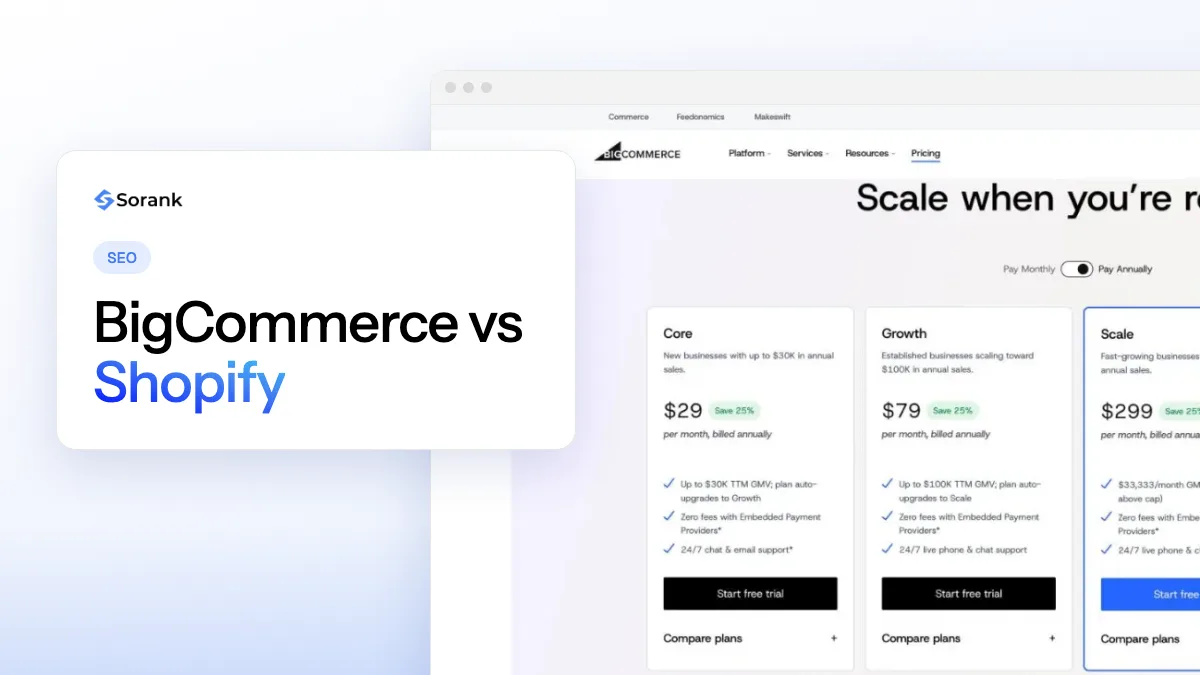
In the US, the two price grids start at the same level, then Shopify becomes more expensive from the second tier. The table below lists the official prices per month (checked October 2026 on the BigCommerce pricing page and the Shopify pricing page).
| Level | BigCommerce (billed yearly / monthly) | Shopify (billed yearly / monthly) |
|---|---|---|
| Entry | Core: 29 / 39 dollars | Basic: 29 / 39 dollars |
| Growth | Growth: 79 / 105 dollars | Grow: 89 / 105 dollars |
| Advanced | Scale: 299 / 399 dollars | Advanced: 359 / 399 dollars |
| Enterprise | Performance: from 1,499 dollars, billed yearly | Plus: from 2,300 dollars |
| Yearly sales limit | 30,000 dollars (Core), 100,000 dollars (Growth), about 400,000 dollars (Scale) | None |
| Fee with an outside payment provider | 2% (Core), 1% (Growth), 0.6% (Scale) | 2% (Basic), 1% (Grow), 0.6% (Advanced), 0.2% (Plus) |
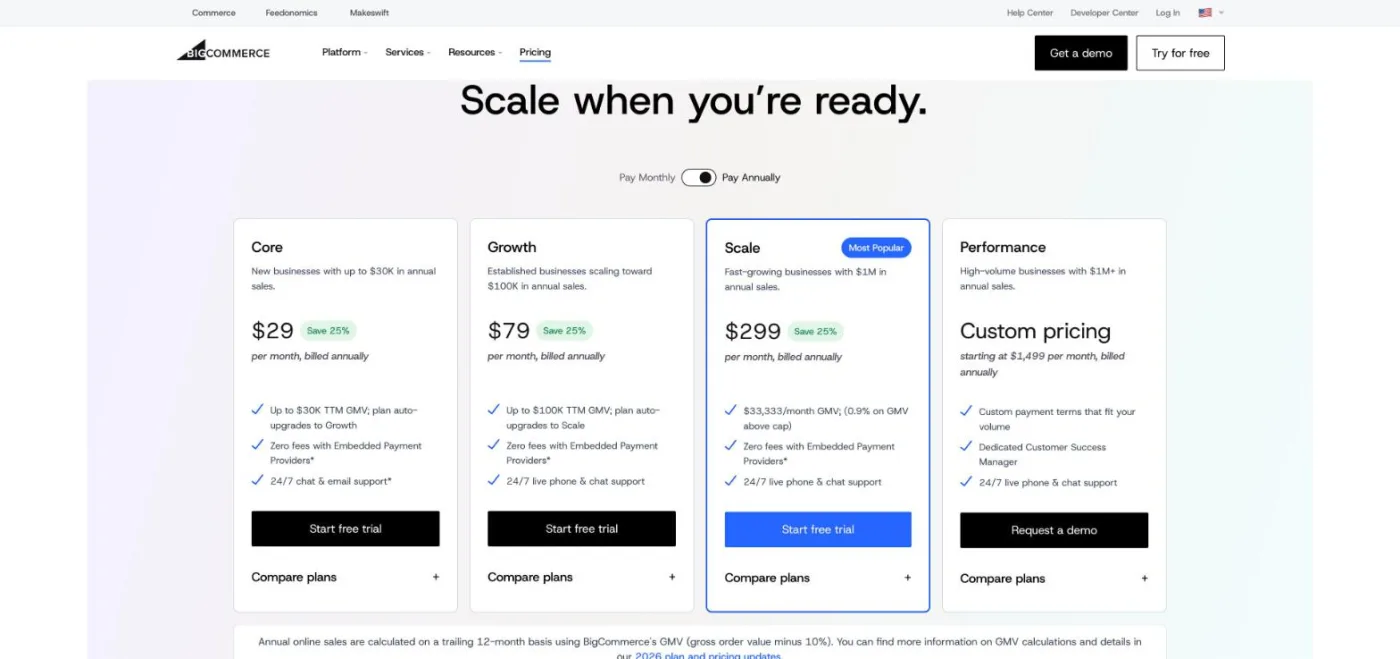
The real gap is elsewhere. BigCommerce measures your sales over the trailing twelve months and, once you pass the limit of your plan, moves you to the next one. Its pricing page states that an account reaching 2 million dollars in yearly sales is automatically upgraded to Performance. Shopify has no sales cap: a store doing 500,000 dollars a year can stay on Basic if it wants. In return, Shopify adds a transaction fee when you use a payment provider other than Shopify Payments, while BigCommerce charges nothing extra with its embedded payment providers.
Watch out
On BigCommerce, a successful season can change your plan. A store selling 110,000 dollars a year is above the Growth limit and moves to Scale, from 79 to 299 dollars per month billed yearly. Check your trailing twelve-month sales before choosing a plan.
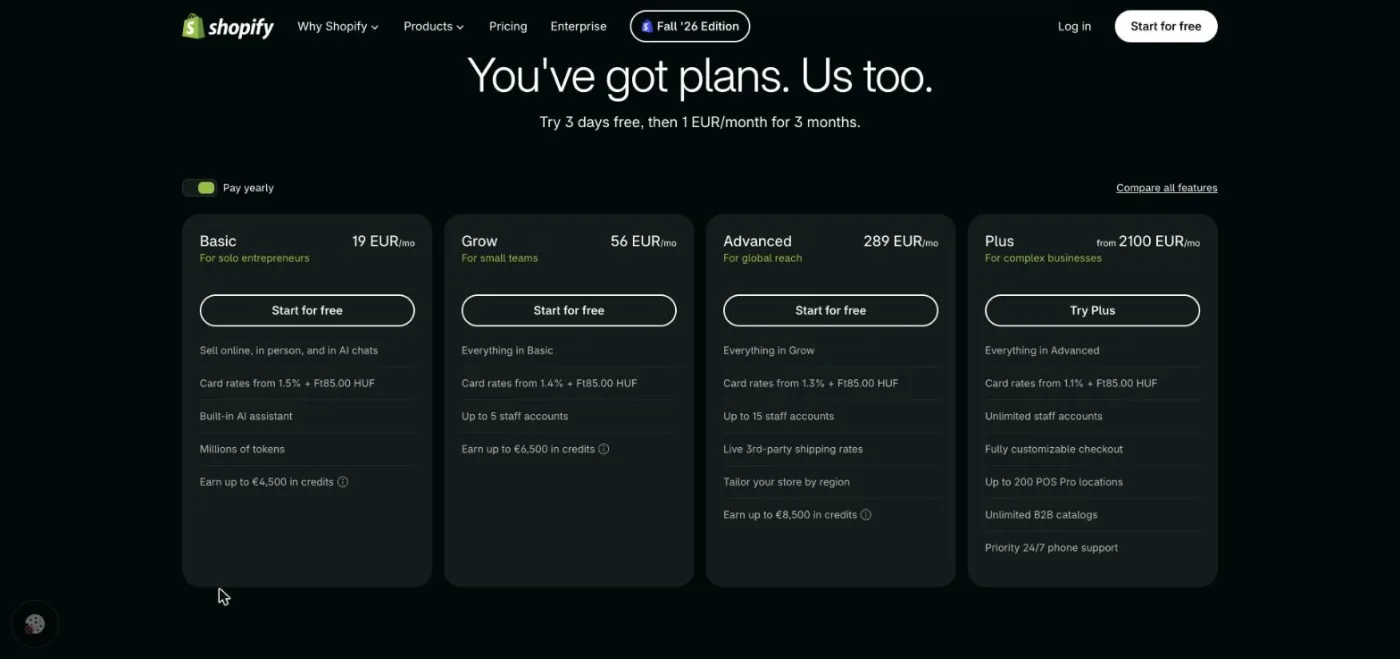
Shopify's grid shows the same structure from Europe, in euros: Basic at 19 euros, Grow at 56 euros and Advanced at 289 euros per month billed yearly, and Plus from 2,100 euros. The page also lists a free Agentic plan, built to sell products in AI channels.
Add the hidden costs to the comparison: paid themes (roughly 100 to 500 dollars one time on both platforms), apps billed monthly (more common on Shopify, where features such as advanced filters or bundles often require one) and card processing fees, which depend on the country and the plan.
BigCommerce has a small edge in native control, Shopify a large edge in ecosystem. Both platforms generate clean HTML, an automatic XML sitemap, canonical tags and editable titles, meta descriptions and alt text. The table compares every setting that matters for organic traffic.
| SEO setting | BigCommerce | Shopify |
|---|---|---|
| URL structure | Pattern editable for products, categories, brands and pages (short, long or custom) | Fixed folders: /products/, /collections/, /pages/, /blogs/; only the slug changes |
| Title and meta description | Editable on every product, category, brand and page | Editable on every product, collection, page and article |
| 301 redirects | Automatic when a URL changes, manual manager and CSV import | Automatic option when a URL changes, URL redirects manager and CSV import |
| XML sitemap | Generated automatically | Generated automatically at /sitemap.xml |
| robots.txt | Editable in the admin settings | Editable through the robots.txt.liquid theme template |
| Structured data | Product microdata built into themes | Product data built into most themes, apps for richer markup |
| Canonical tags | Automatic, one URL per page | Automatic, collection product links point to /products/ |
| Speed | Global CDN, depends on the theme and scripts | Global CDN, fast reference themes, apps add weight |
| Multilingual | Multi-storefront, translations often through apps or a headless front end | Shopify Markets with subfolders or domains and automatic hreflang |
| Blog | Built in, basic | Built in, basic, fixed /blogs/ folder |
| SEO apps | Fewer | Hundreds |
This is the clearest difference. BigCommerce lets you choose the URL pattern of products and categories, so a product can live at /blue-linen-shirt/ or under its category path. Shopify forces /products/blue-linen-shirt and /collections/shirts: you control the URL slug, never the folder. Google ranks pages with fixed folders without difficulty, so this rarely costs rankings, but it complicates migrations from platforms with different paths and limits keyword-rich hierarchies.
Many comparisons still say that Shopify does not let you edit robots.txt. That has been outdated since 2021: Shopify themes accept a robots.txt.liquid template that adds or removes rules. BigCommerce offers a simpler editor directly in the settings. On both platforms, check that GPTBot, ClaudeBot and PerplexityBot are not blocked if you want your products to appear in AI answers.
Shopify creates several paths to the same product (/products/x and /collections/shirts/products/x) and solves it with a canonical tag pointing to /products/x. Tag filters on collections also produce extra URLs that are worth keeping out of the index. BigCommerce states that every unique page has a single URL, and its faceted search generates parameters you should exclude from crawling. On either platform, a quick audit of duplicate content after launch avoids diluted signals.
Both platforms output product data (name, price, availability, reviews when an app provides them) that Google reads for rich results and that AI assistants use to describe products. Complete markup matters more than ever: our guide to structured data for AI search lists what helps. Speed depends mostly on the theme and the number of scripts. Shopify's reference themes are fast, but each app can add JavaScript; on Shopify, choose a few well-built SEO apps rather than ten overlapping ones.
Note
The platform rarely decides your rankings. On both, the stores that rank have unique product descriptions, useful category texts, a clean internal linking structure and a few quality backlinks. Copying manufacturer descriptions loses on any platform.
Shopify is simpler for selling in several languages. With Shopify Markets, you add languages and countries from the admin, publish each one in a subfolder (/fr/, /de/) or on its own domain, and Shopify adds hreflang tags and localized sitemaps automatically. Translations come from the free Translate and Adapt app or from third-party apps.
BigCommerce handles multiple countries through Multi-Storefront: several storefronts, each with its own domain, currency and catalog, managed from one admin. It is powerful for brands that sell different ranges in different markets, but multilingual content on a single domain often requires a translation app or a headless front end, and the hreflang setup needs more care. Whatever the platform, the rules of international SEO stay the same: one URL per language, reciprocal hreflang, translated metadata.
Neither platform is a great blogging tool. Both include a basic blog with titles, metas, featured images and authors. Shopify places articles under /blogs/blog-name/ and organizes them with tags; BigCommerce has a simple blog with fewer layout options. Neither offers the depth of WordPress (categories, revisions, advanced editors), which is why some brands run a headless WordPress blog alongside their store.
For a store, the blog serves three purposes: capture informational searches (guides, comparisons, size charts), feed internal links to category and product pages, and give AI assistants sourced content to cite. The bottleneck is regular publishing, not the platform. An article generator that publishes directly to your store keeps a steady pace when the team has no time to write.
Shopify has moved faster. Its pricing page now lists an Agentic plan dedicated to selling in AI channels, and Shopify syndicates merchant catalogs to AI shopping experiences. The scale explains this priority: according to Shopify's 2025 annual report filed with the SEC, the platform processed 378.4 billion dollars of gross merchandise volume in 2025, up 29% in a year. BigCommerce relies on Feedonomics, a product feed service owned by the same group, to send clean product data to marketplaces, Google Shopping and AI channels.
For organic visibility in AI answers, the platform matters less than the content. ChatGPT, Gemini and Perplexity cite stores whose pages answer real questions, with precise specifications, prices, reviews and comparisons. Our study of how AI assistants cite Shopify stores shows which pages they pick. To know whether your brand comes up when a buyer asks for a product recommendation, track your brand mentions in AI answers on a set of buyer prompts.
Moving in either direction is common and well equipped: migration apps transfer products, variants, customers, orders and blog posts. The SEO risk lies in the URLs. Going from BigCommerce to Shopify, almost every product and category URL changes, because Shopify adds its fixed folders. Going from Shopify to BigCommerce, you can recreate URLs close to the old ones thanks to the custom pattern, which reduces the redirect list.
Tip
Before switching the domain, export every indexed URL (sitemap plus Search Console), map each one to its new address and import the file into the redirect manager. One 301 redirect per old URL, in a single hop, preserves most of the authority.
Then follow a complete SEO migration checklist (metadata, images, internal links, structured data, sitemap submission) and run an ecommerce SEO audit a few weeks after launch to catch broken links and lost pages.
Shopify's admin is the easiest to learn in the category, and its theme store and editor let a beginner launch a clean store in a few days. BigCommerce's admin is denser because it exposes more options by default. It suits teams that manage thousands of products with many variants and custom fields.
The Shopify App Store is the largest in ecommerce, which covers almost any need but adds monthly subscriptions. BigCommerce includes more natively: product options, customer groups, price lists, faceted search and, on higher plans, B2B features. For a complex catalog, that means fewer apps to pay and maintain.
Both platforms can run headless, with a separate front end connected to the store through an API. Shopify offers Hydrogen, its React framework, with free hosting on Oxygen. BigCommerce offers Catalyst, a storefront built on Next.js, and has a long history of headless setups with WordPress or other content systems. Headless gives full control over URLs, HTTP headers and page speed, but it moves SEO responsibility to your developers: server rendering, canonical tags, sitemaps and redirects must be rebuilt and tested. For most stores under a few million dollars in sales, a well-configured theme is the safer SEO choice.
Shopify limits staff accounts by plan (5 on Grow, 15 on Advanced, unlimited on Plus), while BigCommerce lists staff accounts on every plan without a stated limit. Shopify's point of sale is the stronger choice for brands with shops, with POS Pro as a paid add-on per location. BigCommerce connects to third-party point-of-sale systems instead.
The right choice depends on catalog size, sales volume, team and markets. BigCommerce's management says openly that it does not target everyone:
“We’re not trying to win by being everything to everyone. We’re solving for the companies in the messy middle.”
Travis Hess, CEO of Commerce (parent company of BigCommerce), BigSummit 2025 keynote recap
| Profile | Best choice | Why |
|---|---|---|
| Store starting out | Shopify | Easiest admin, no sales cap, huge choice of themes and tutorials |
| Fast-growing direct-to-consumer brand | Shopify | No plan change forced by sales, apps for every channel, AI selling tools |
| Large catalog with many variants | BigCommerce | Native product options, faceted search, custom URL structure |
| B2B or wholesale seller | BigCommerce | Customer groups, price lists and B2B features without extra apps |
| Several countries and languages | Shopify (one brand), BigCommerce (different catalogs per market) | Markets handles languages and hreflang; Multi-Storefront handles separate stores |
| Shop with physical stores | Shopify | Integrated point of sale and unified stock |
| Agency managing many client stores | Shopify | Larger talent pool, partner program and app ecosystem |
Whichever you choose, the platform only sets the foundations. Traffic comes from the content and the links you add over time. Sorank connects to Shopify in a few minutes and to BigCommerce through a webhook to find keywords, publish optimized articles and track your visibility in AI assistants: see the Shopify integration and the BigCommerce integration.
Choose Shopify for simplicity, ecosystem and growth without sales caps; choose BigCommerce for a complex or B2B catalog that needs native flexibility and full URL control. Both can rank on Google and be cited by AI assistants when the product pages are complete and the content is regular.

BigCommerce has slightly more native SEO control: you can change the URL pattern of products and categories and edit robots.txt from the admin. Shopify covers the same essentials (titles, metas, sitemap, redirects, canonical tags, editable robots.txt) but imposes fixed URL folders. In practice, rankings depend far more on product content, category pages and links than on the platform.
The entry prices are the same in the US: 29 dollars per month billed yearly for BigCommerce Core and Shopify Basic. BigCommerce charges no extra transaction fee with its embedded payment providers but caps the yearly sales of each plan, while Shopify has no sales cap and adds a fee only if you use a third-party payment provider. Apps and themes usually make the real difference in the bill.
Yes, if the migration is planned. Export products, customers and orders with a migration app, map every old URL to its new Shopify address and import the list into Shopify's URL redirects before switching the domain. Most rankings stabilize within a few weeks when every old URL returns a single 301 redirect to the right page.
We analyse your competitors, your website and your AI visibility to create a tailored content plan for free.
 AI Content Brief Generator
 FAQ Schema Generator
 AI Blog Post Ideas Generator
 Structured Data Validator (Schema Validator)
 Alt Text Checker
 Internal Link Analyzer
 Backlink Challenge
 AI Meta Description Generator
 AI Blog Title Generator
 Google Indexability Checker
 AI Blog Outline Generator
 UTM Link Builder
 Keyword Clustering Tool
 Canonical Tag Checker
 XML Sitemap Generator
 Broken Link Checker
 AI SEO Title Generator
 Headline Analyzer
 SERP Preview Tool
 Redirect Checker
 Hreflang Tag Generator
 Heading Structure Analyzer
 HTTP Headers Checker
 Favicon Extractor
 SERP CTR Calculator
 SEO vs Paid Search Savings Calculator
 SEO Share of Voice Calculator
 SEO ROI Calculator
 SEO Traffic and Revenue Forecast Calculator
 SEO Budget Calculator
 SEO Break-Even Calculator
 SaaS SEO ROI Calculator
 ROAS Calculator
 Reading Time Calculator
 Ranking Gain Simulator
 Organic Traffic Value Calculator
 Organic Traffic Estimator and Website Traffic Checker
 LTV to CAC Ratio Calculator
 Local SEO ROI Calculator
 Link Building Cost Calculator
 Keyword Value Calculator
 Keyword Opportunity Score Calculator
 Keyword Density Calculator
 GEO ROI Calculator
 GEO Content Investment Calculator
 Ecommerce SEO ROI Calculator
 Customer Lifetime Value Calculator
 Customer Acquisition Cost Calculator
 CTR Calculator
 Cost Per Article Calculator
 Conversion Rate Calculator
 Content Marketing ROI Calculator
 ChatGPT Referral Traffic Estimator
 Bounce Rate Calculator
 Backlink ROI Calculator
 AI Visibility Score Calculator
 AI Traffic Value Calculator
 AI Share of Voice Calculator
 Cost of AI Invisibility Calculator
 AI Citation Rate Calculator
 llms.txt Validator
 AI Overview Checker and AI Overviews Rank Checker
 Robots.txt Checker
 AI SEO Audit
 LLM Readability Checker
 SearchGPT Readiness Checker
 Structured Data LLM Audit
 Website Crawlability AI Audit
 Why ChatGPT Is Not Recommending My Website
 Gemini Ranking Tool
 Perplexity Ranking Checker
 LLM Citation Checker
 Answer Engine Optimization Audit
 GEO Audit
 AI Search Visibility Test
 ChatGPT Visibility Checker
 llms.txt Generator
 URL Extractor
 Webpage to Markdown
 Sitemap Checker
 SERP Volatility Sensor
 Page Size Checker
 Word Counter
 Slug Generator
 Schema Generator
 Robots Generator
 OG Preview
 Meta Tags Generator
 Image Compressor
 Favicon Generator
 On-Page SEO Audit: SEO Checker and SEO Analyzer
 Backlink Analysis Tool
 Keyword Research Tool
 Domain Authority Checker
THEY TRIED SORANK BEFORE YOU
 “I tested Sorank on a real client site and it's insane. It does everything an agency would bill you $1500 a month for. It's going into production on that client now.”

 Guillaume Guersanguersanguillaume.com“We are an Ads agency and we wanted to get our SEO back on track once and for all. Sorank gave us a clear view of our site, helped us prioritize optimizations, and properly structure our content. The tool is easy to use, well designed for a team, and very practical for centralizing tracking without having to juggle multiple platforms. A very solid foundation to start fresh with our SEO.”
 Gaspard MadouiAds Agency
 “I just let the Sorank software do its thing, and now my DR is 25 and my page is ranking higher.”
 Lucas Flandrefoundertrace.fr“I specialized in GEO thanks to Sorank. The GEO Leaderboard allows me to show my clients their position vs competitors on ChatGPT. It’s a real commercial differentiator.”
 MélanieSEO Freelance“Great service, works well for our website and helps us understand how to improve it to rank better on Google and elsewhere. Congrats, keep going, I recommend it.”
 Hugo T.E-commerce merchant