Preferences
Privacy is important to us, so you have the option of disabling certain types of storage that may not be necessary for the basic functioning of the website. Blocking categories may impact your experience on the website. More information
Privacy is important to us, so you have the option of disabling certain types of storage that may not be necessary for the basic functioning of the website. Blocking categories may impact your experience on the website. More information

Scholarship link building: launch a real scholarship, find colleges that list outside awards, write outreach that gets replies and avoid Google's spam rules.

In short
Scholarship link building is earning links from university financial aid pages by running a real scholarship and asking schools to list it. It can earn .edu links, but fewer than most people expect, and it becomes link spam when the award exists only to buy a link. Run it only if the scholarship would be worth funding without the link.
Want to go further? Ask
Quick quiz
How should you get links from other websites?
Sorank matches your answers


Test it for 3 days on your own site and see where you stand on Google, ChatGPT and the other AIs.
Start 3-day free trial3 days free, then stop whenever you want. 90-day results guarantee, conditions apply.
Scholarship link building is a link acquisition method. You fund or sponsor a scholarship, publish the rules on a page on your own domain, and ask universities to add the scholarship to their financial aid or student resources pages. Those pages often list outside awards with a short description and a link. If your scholarship is listed, you get a link from a university domain, usually one ending in .edu in the United States.
The method sits next to other ways to earn links from schools. The wider picture, with eight methods and the traps in each, is in our guide to edu backlinks in 2026. This article goes deeper on one method, the scholarship, because it is the one most often copied and the one most often misused.
If the basic idea of a link is new to you, the link building entry explains the vocabulary. Here we assume you know what a link is and want to know whether a scholarship can earn one, how much it earns, and where it stops being safe.
A financial aid office has one job: help students find money. It does not care about your SEO. It lists an outside scholarship when the award is real, the eligibility is clear, the deadline is in the future, and the page leads to a working application. Most rejections come from the same three problems: the scholarship is vague, the page reads like an advertisement, or the deadline has already passed. Write for the student first, and the link becomes a side effect of a useful page.
Schools also have a practical limit. A financial aid office can only list a handful of outside awards per term, and it prefers awards that match its students' fields. A scholarship for students in one specific field of study, with a clear rubric, has a better chance than a general "any student can apply" award with no detail.
The link is worth the trust of the page that gives it and the relevance of that page to your topic. A link from a financial aid page about student money tells search engines little about your software, your store, or your services. That is the main limit of the method. Roger Montti made the same point in Search Engine Journal on November 22, 2019: scholarship links can help rank scholarship-related terms, but they do little for the core topic of the business that runs the scholarship.
The .edu ending is not a bonus in itself. The same article argues that .edu links carry no extra link power on their own, because Google weighs the context of a link more than the ending of the domain. Treat the .edu domain as a sign of a trusted institution, not as a ranking shortcut. A link from a page that is relevant to your topic, on a school that does not link to spam, is worth more than a link from an irrelevant page on a prestigious domain.
| Link source | Effort | Typical risk | Notes |
|---|---|---|---|
| Scholarship listed on a university aid page | High, because you run a real program | Medium, if the award looks fake or the link is a condition | Repeats each year if the program continues |
| Guest article on an industry blog | Medium to high | High if the link is paid | Editorial, depends on the writing |
| Listing on a useful resource page | Medium | Low | Hard to get without a page worth linking to |
| Directory submission | Low | High, low value | Rarely worth the time |
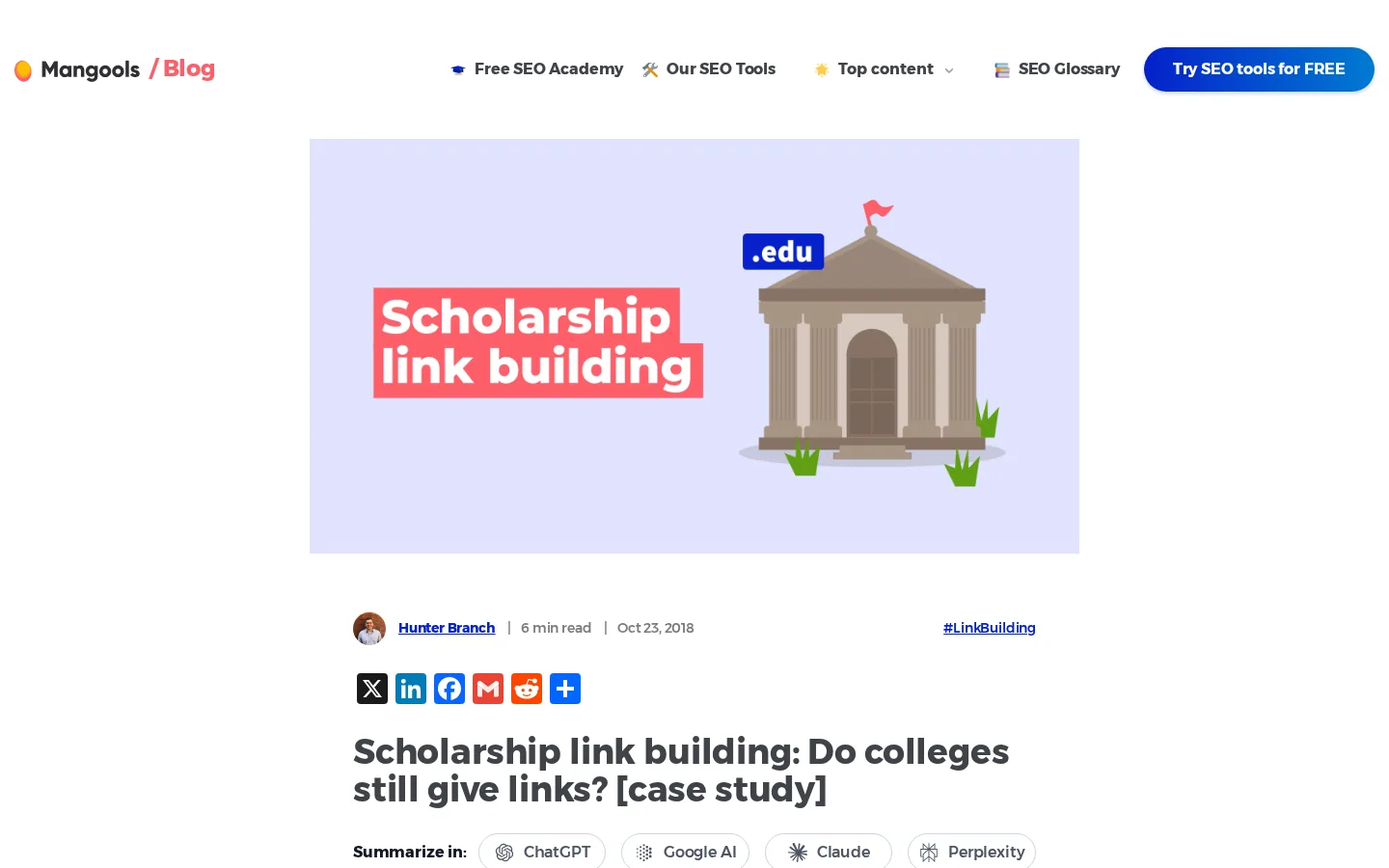
Scholarship outreach can earn links, but the response rate is low. The most detailed public test is a 60-day experiment written by Hunter Branch and published on the Mangools blog on October 23, 2018. The author sent 200 emails to US colleges and earned 12 links, a 6% conversion rate. The author had predicted 1% or less before running the test, so the result was better than expected, and still small in absolute numbers.
The test in three numbers
Source: Hunter Branch, Mangools blog, October 23, 2018
Three details matter more than the rate itself. First, 95% of the emails went to general scholarship or financial aid addresses, not to a named person. Second, the open rate was 97%, which suggests the subject line and the sender name were not the problem. Third, the links came only from schools that already had a page for outside scholarships. A school with no such page could not link to you, however good the email was. This is why the prospecting step matters more than the wording of the email.
Note
This is one test, by one author, in one year, on US colleges only. Use it to set expectations, not as a forecast. At the 2018 rate, you should plan for about 17 emails for each link, and for links that may take months to appear.

Google does not have a rule against scholarships. It has rules against link schemes, and scholarship links can fall into them. Google's spam policies page defines link spam as "creating links to or from a site primarily for the purpose of manipulating search rankings." Several of its examples match the scholarship trap closely. Among them are "Exchanging money for links, or posts that contain links", "Exchanging goods or services for links", and "Requiring a link as part of a Terms of Service, contract, or similar arrangement".
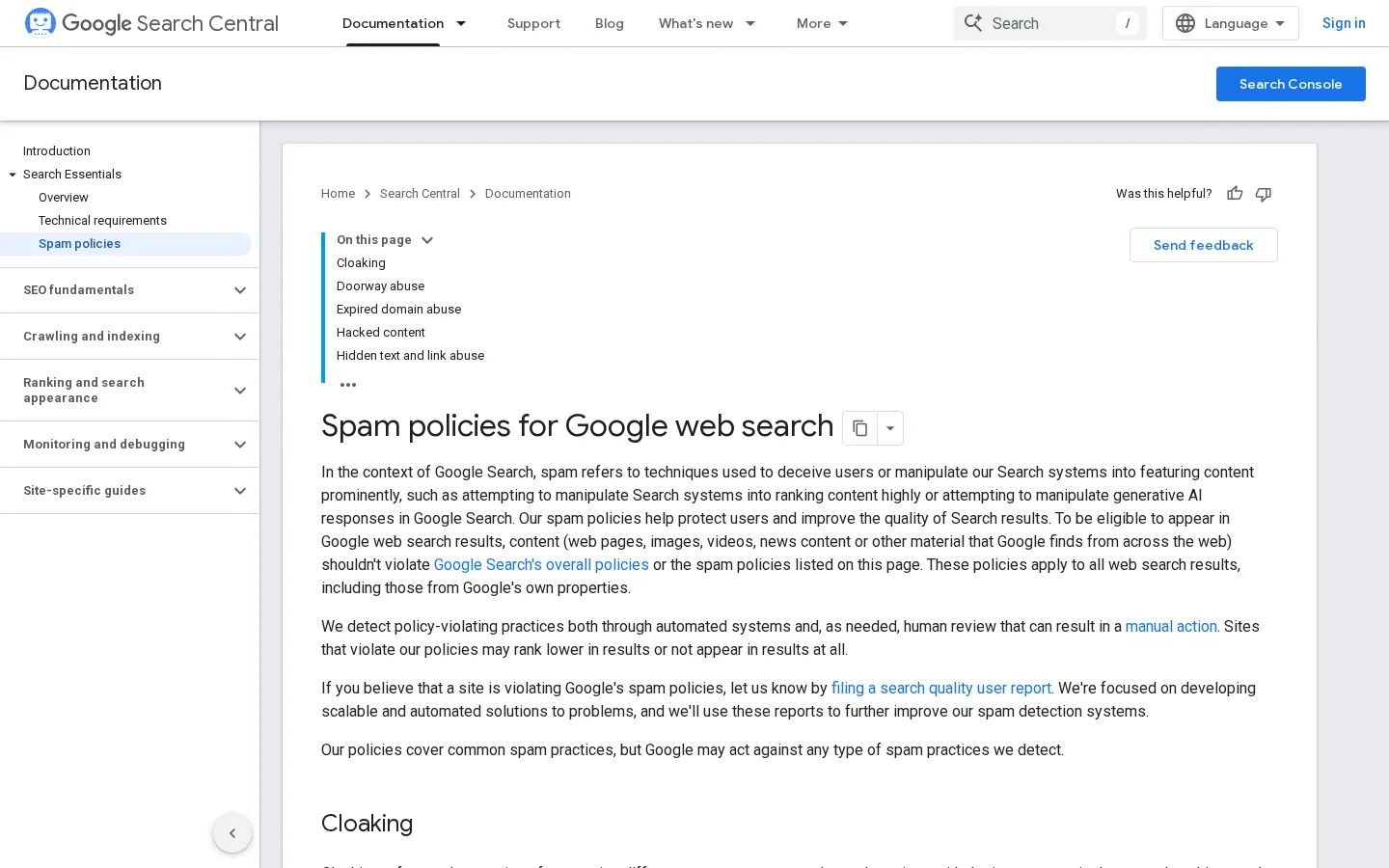
A scholarship you fund to help students is a legitimate program. It becomes a link scheme when the award is a cover for the link. Typical signs are a tiny award compared with the effort, no real winner, applicants who must link to you, or a page that exists only to be linked. The test is simple: would you run this scholarship if no college ever linked to it? If the honest answer is no, the program is a link purchase, and the rules above apply to it.
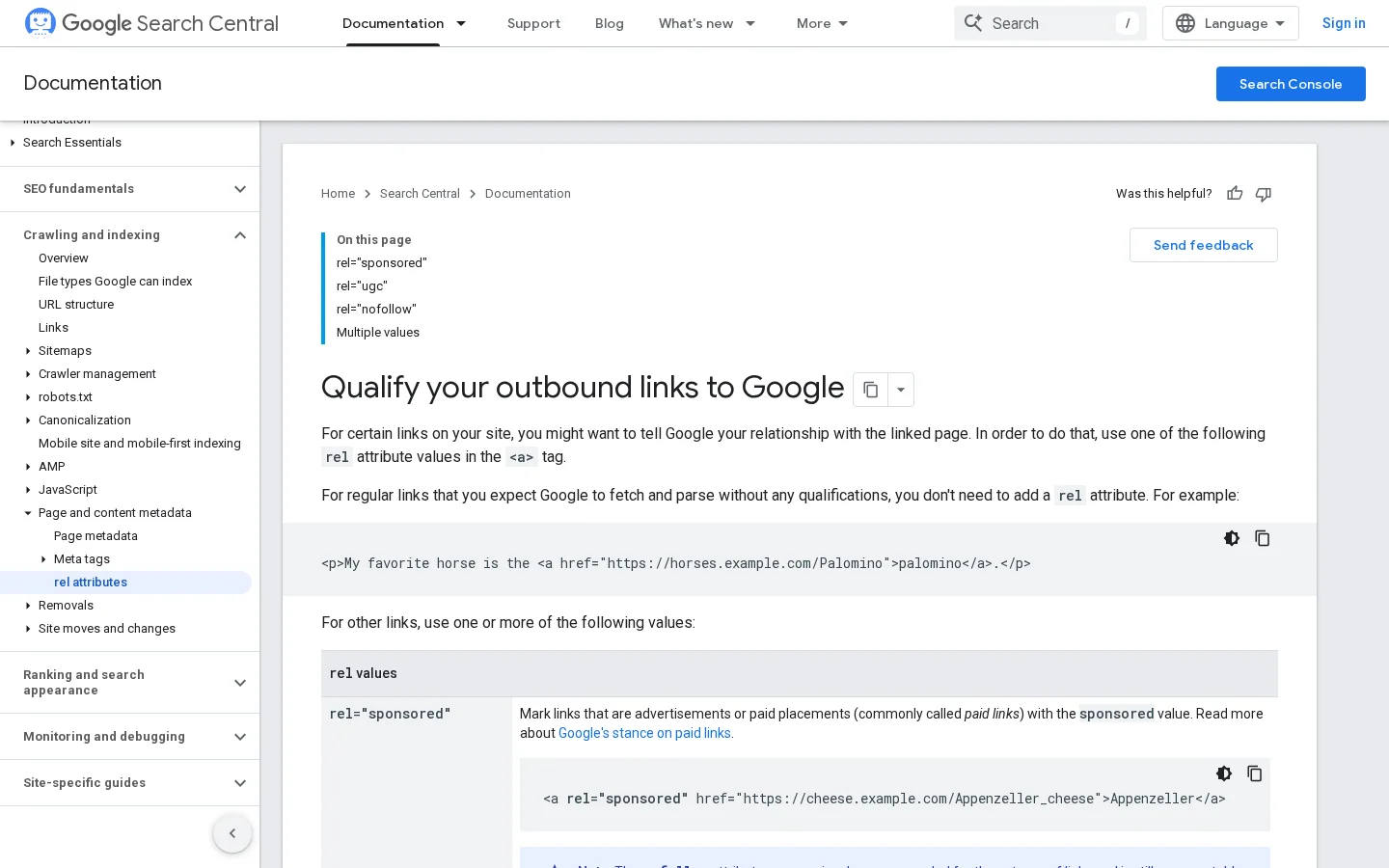
Google's guide to qualifying outbound links asks you to mark links that are "advertisements or paid placements" with rel="sponsored", and to use rel="nofollow" when no other value fits. The nofollow attribute is explained in our glossary. These values control the links you place on other sites or on your own pages. They do not control the links that schools place on their pages, which is why the rules of the scholarship itself matter more than the attributes.
In the same Search Engine Journal analysis from November 22, 2019, Roger Montti wrote that doing this "excessively and with highly optimized anchor text could in my opinion cause a site to receive a manual penalty." Read that as a reason to keep anchor text plain, not as permission to build links at scale. For the anchor side of the question, see our anchor text optimization guide.
Warning
Never make the award conditional on a link, a post, or a mention of your company. Both cases fall under the examples Google lists: requiring a link in an agreement, and exchanging goods or services for links. If a school or a partner asks for a link in return for a listing, stop and read the backlink exchange rules before you answer.
The practical job is to make the scholarship easy to list and easy to trust. Work through the six steps below in order. Each step has a test you can run before you move on, and skipping the test is the most common reason a page gets removed a year later.
The six-step setup
Pick an amount you can fund for several cycles. A page that works for one year and then vanishes loses its links and its credibility at the same time. Write the rules in plain language: who can apply, for example students enrolled in a degree program or students in a given field, the amount, how many awards there are, the deadline, and the date winners are announced. A rule a student can check in two minutes is worth more than a long essay about your mission.
Be specific about the field. "Students studying data analysis in Canada" is easier for a financial aid office to list than "any student who loves our brand". Specific rules also protect you. They make it obvious that the award is open to people who are a good fit, not to anyone who will write about you.
Use a simple page on your own domain. It does not need a designer. The Mangools case study used a plain page covering the purpose of the scholarship, an overview, and application instructions, and that was enough to be listed. Include the purpose, the eligibility, the amount and number of awards, the deadline, how to apply, how winners are selected, and a contact name and email address. Put the most important rule near the top, so a reader sees the deadline without scrolling.
If the page links to a sponsor or partner who pays for that placement, mark the link as sponsored. The format is the same as any link, with the attribute added:
<a href="https://example.com/partner" rel="sponsored">Partner name</a>Keep the rule simple: the attribute describes the link, not the award. An honest sponsor line is fine when it is marked correctly. A sponsor line that hides the payment is the problem.
A scholarship that never names a winner looks like a link page, and the people who read it know that. Name a selection process: a short essay, a review panel, or a draw among eligible applicants. Publish the winner's name and the award date on the same page after the deadline, with the winner's agreement. That update is what makes the page look like a real program when a school checks it a year later, and it is the first thing a careful reviewer looks for.
Prospecting decides most of your results. The Mangools method starts with search operators to find pages that already list outside awards, then logs each page in a spreadsheet. Run queries like these in Google and save the results. Use the same structure for each query so you can compare which phrasing gives you more usable pages:
"outside scholarships" site:.edu
"external scholarships" site:.edu
"scholarships" "financial aid" site:.edu
Open each result and check it before you add it to your list. The page should belong to a university, not to a student forum or an aggregator. It should list outside scholarships with a description, not only the school's own awards. The page should be current, because an old page may link to scholarships that no longer exist.
Before you add a page to your list
In the 2018 test, most emails went to general financial aid addresses, and that worked. Do not spend hours hunting for a named person when the page gives you a general contact. Look at the sidebar or the contact box of the financial aid page first. A personal name is better when you can find one, but a general address that reaches the right office is enough.
Use a spreadsheet with one row per page: school, URL, contact, date checked, status, and the date you emailed. Mark each page as listed, declined or silent. After a few weeks, the list tells you which search phrases produce usable pages, so you can drop the phrases that do not. Keep the list honest: if a page moves, update the row, do not email the old address again.
Your email has one job: help a financial aid staff member add a useful scholarship in less than a minute. The 2018 template had three parts, a short introduction of your company, the scholarship offer, and a summary of the deadline and how to apply. Only the name, the school, and the page link changed from one email to the next. That is the right model: personal, short, and factual.
Blast email or targeted email
Open with who you are in one sentence and the school's name. Then state the scholarship in one line: name, amount, number of awards, and deadline. End with the page link and one sentence on how to apply. Do not ask for a link. The page does the work. Asking for a link in the email is the quickest way to make the request look like a link trade, and it is the wording Google's examples describe.
If there is no reply, send one follow-up after three business days. The 2018 test used that rhythm, and it is enough for most offices. Send the follow-up to the same address, not to a new one, and link to the same page. In my view, a second follow-up adds little, and it makes the sender look like a bulk mailer.
For more on sending rules, subject lines and templates in other niches, see our email outreach method. The same principles apply here: one clear request, one link to the evidence, one follow-up.
Scholarship links come from three different setups. They differ in cost, in control over the award, and in the risk of looking like a link scheme. Each option below has a principle, a case where it fits, its advantages and limits, and an example. The table at the end compares them side by side.
Principle: you run the award on your own domain, and schools list it because it helps their students. When to use it: you have a budget you can keep for several years and a real reason to help students in your field. Advantages: the listing is the school's editorial choice, and the page keeps working as a long-term asset. Limits: it is slow, the response rate is low, and each school gives you one link at most. Example: a software company offers a yearly award for students who write a case study on a process in its field, with a published rubric and a named review panel.
Principle: you fund an award that a department or foundation already runs, and the school links to the sponsor. When to use it: you have a budget but no time to run a program, and the school already runs awards in your field. Advantages: the school handles selection, which makes the program look credible from the start. Limits: you need a relationship with the school, and the school decides whether to name you. Example: a business school scholarship with a sponsor line on its page. If you pay for that line, mark the link as sponsored and check the school's own rules on sponsor placements.
Principle: you publish an accurate list of outside scholarships, grants and aid in your niche, and schools link to useful resources. When to use it: you have no budget for an award but enough time to research and maintain a list. Advantages: no funding is needed, and the page helps students even if no school links to it. Limits: schools rarely link to a list that mentions competitors, and a list with dead links becomes a trap of its own. Example: a page listing verified awards for students in web design, with the deadline and the last check date for each one.
| Option | Cost | Control over the award | Link scheme risk | Time to first link |
|---|---|---|---|---|
| Your own scholarship | High, every year | High | Low if the award is real | Slow |
| Sponsor a school's scholarship | High, but no admin | Low | Low if paid links are marked as sponsored | Medium |
| Resource page for students | Low, mostly time | Medium | Low if the list is accurate | Slow to build, cheap to run |
Most failures come from six mistakes. For each one you get what it is, how to spot it, and how to fix it. The before and after below shows the three most common changes in one view.
Three changes that fix most failures
What it is: applicants must link to you, share a post, or mention your company to be eligible. How to spot it: read your rules and your application form. Any step that asks for a link, a post, or a mention is a problem, even if it is optional in practice. How to fix it: remove the step. The scholarship must be open to every eligible applicant, whatever they publish afterwards.
What it is: the link text is a commercial keyword, such as "best SEO software", instead of your name or the scholarship name. How to spot it: export your backlinks and count the anchor texts. If one money phrase makes up most of them, you have a pattern that looks engineered. How to fix it: use the scholarship name or your brand name as anchor text, and let some links use plain words such as "this scholarship". The anchor text optimization guide shows how to audit the mix.
What it is: sending the same email to hundreds of schools without checking that they list outside scholarships. How to spot it: your list contains pages that never mention outside awards, or pages from schools with no relation to your field. How to fix it: remove them. A shorter list of checked pages gets better replies, and it avoids sending mail to offices that have no reason to answer.
What it is: vague eligibility, no named winner, a deadline that keeps moving, or a page that disappears after the deadline. How to spot it: ask someone outside the company to read the page for one minute, then say what they would apply for and how winners are chosen. If they cannot answer, neither can a reviewer. How to fix it: name the selection process, publish the winner, and keep the page live.
What it is: the school removes the listing after a year, or the page moves and the link breaks. How to spot it: you only notice when someone asks about the award. How to fix it: set a quarterly reminder, re-check each listing, and ask for the link again when a page moves to a new URL. The steps are in our backlink audit guide.
What it is: paying an agency or a broker to place your scholarship on schools' pages, usually billed per link. How to spot it: the invoice says "placement", "per link" or "guaranteed links". How to fix it: stop. Google's list names "Exchanging money for links" as link spam, and a broker who promises a number of links is selling exactly that. If the scholarship is worth running, run it yourself and let the schools decide.
Measure links, not only emails. Track four things: the number of links earned, the domain of each linking page, the referral visits from those pages, and whether the scholarship received real applications. A link that brings no visitors and no applicants is still a link, but it tells you the page is not useful to people, and that is the signal to act on.
Set your expectations by topic. Montti's 2019 analysis argued that scholarship links are more likely to help queries about the scholarship than the main keywords of your business. Measure the scholarship page against its own queries, such as the name of the award and the phrases students type when they look for it. Use the free backlink checker to see which links point to the page and to your home page, and compare the two lists after each quarter.
Tip
Check the scholarship page each month with the backlink lookup tool. A listing that disappears is easy to miss in a spreadsheet and easy to see in a tool.
A quarterly link review
If you want the keyword side automated, Sorank's automated keyword research can find the search terms a scholarship page should target. The decision of which schools to contact and which award to fund still belongs to you.
It is worth it when the scholarship would be a good program on its own. It is not worth it when the scholarship is a link purchase in disguise. The method earns few links per email, the links carry limited relevance to your core topic, and the rules are clear enough that a careful team can stay inside them. If you decide to go ahead, start small: one real scholarship, one simple page, and a list of about 20 checked schools. Measure the results before you scale anything.
Worth it or not
They can, but usually less than people expect. A 2019 Search Engine Journal analysis argued that the .edu ending carries no special weight on its own. The relevance of the page and the context of the link matter more.
Not by itself. A scholarship you fund to help students is a legitimate program. It breaks Google's rules when the award exists to buy a link, when applicants must link to you, or when links are paid for.
There is no guarantee. In a 2018 test of 200 emails to US colleges, the author earned 12 links, about one link for every 17 emails. Plan for a low response rate and build a checked list before you send anything.
We analyse your competitors, your website and your AI visibility to create a tailored content plan for free.
 AI Content Brief Generator
 FAQ Schema Generator
 AI Blog Post Ideas Generator
 Structured Data Validator (Schema Validator)
 Alt Text Checker
 Internal Link Analyzer
 Backlink Challenge
 AI Meta Description Generator
 AI Blog Title Generator
 Google Indexability Checker
 AI Blog Outline Generator
 UTM Link Builder
 Keyword Clustering Tool
 Canonical Tag Checker
 XML Sitemap Generator
 Broken Link Checker
 AI SEO Title Generator
 Headline Analyzer
 SERP Preview Tool
 Redirect Checker
 Hreflang Tag Generator
 Heading Structure Analyzer
 HTTP Headers Checker
 Favicon Extractor
 SERP CTR Calculator
 SEO vs Paid Search Savings Calculator
 SEO Share of Voice Calculator
 SEO ROI Calculator
 SEO Traffic and Revenue Forecast Calculator
 SEO Budget Calculator
 SEO Break-Even Calculator
 SaaS SEO ROI Calculator
 ROAS Calculator
 Reading Time Calculator
 Ranking Gain Simulator
 Organic Traffic Value Calculator
 Organic Traffic Estimator and Website Traffic Checker
 LTV to CAC Ratio Calculator
 Local SEO ROI Calculator
 Link Building Cost Calculator
 Keyword Value Calculator
 Keyword Opportunity Score Calculator
 Keyword Density Calculator
 GEO ROI Calculator
 GEO Content Investment Calculator
 Ecommerce SEO ROI Calculator
 Customer Lifetime Value Calculator
 Customer Acquisition Cost Calculator
 CTR Calculator
 Cost Per Article Calculator
 Conversion Rate Calculator
 Content Marketing ROI Calculator
 ChatGPT Referral Traffic Estimator
 Bounce Rate Calculator
 Backlink ROI Calculator
 AI Visibility Score Calculator
 AI Traffic Value Calculator
 AI Share of Voice Calculator
 Cost of AI Invisibility Calculator
 AI Citation Rate Calculator
 llms.txt Validator
 AI Overview Checker and AI Overviews Rank Checker
 Robots.txt Checker
 AI SEO Audit
 LLM Readability Checker
 SearchGPT Readiness Checker
 Structured Data LLM Audit
 Website Crawlability AI Audit
 Why ChatGPT Is Not Recommending My Website
 Gemini Ranking Tool
 Perplexity Ranking Checker
 LLM Citation Checker
 Answer Engine Optimization Audit
 GEO Audit
 AI Search Visibility Test
 ChatGPT Visibility Checker
 llms.txt Generator
 URL Extractor
 Webpage to Markdown
 Sitemap Checker
 SERP Volatility Sensor
 Page Size Checker
 Word Counter
 Slug Generator
 Schema Generator
 Robots Generator
 OG Preview
 Meta Tags Generator
 Image Compressor
 Favicon Generator
 On-Page SEO Audit: SEO Checker and SEO Analyzer
 Backlink Analysis Tool
 Keyword Research Tool
 Domain Authority Checker
 “I tested Sorank on a real client site and it's insane. It does everything an agency would bill you $1500 a month for. It's going into production on that client now.”

 Guillaume Guersanguersanguillaume.com“We are an Ads agency and we wanted to get our SEO back on track once and for all. Sorank gave us a clear view of our site, helped us prioritize optimizations, and properly structure our content. The tool is easy to use, well designed for a team, and very practical for centralizing tracking without having to juggle multiple platforms. A very solid foundation to start fresh with our SEO.”
 Gaspard MadouiAds Agency
 “I just let the Sorank software do its thing, and now my DR is 25 and my page is ranking higher.”
 Lucas Flandrefoundertrace.fr“I specialized in GEO thanks to Sorank. The GEO Leaderboard allows me to show my clients their position vs competitors on ChatGPT. It’s a real commercial differentiator.”
 MélanieSEO Freelance“Great service, works well for our website and helps us understand how to improve it to rank better on Google and elsewhere. Congrats, keep going, I recommend it.”
 Hugo T.E-commerce merchant