Preferences
Privacy is important to us, so you have the option of disabling certain types of storage that may not be necessary for the basic functioning of the website. Blocking categories may impact your experience on the website. More information

Privacy is important to us, so you have the option of disabling certain types of storage that may not be necessary for the basic functioning of the website. Blocking categories may impact your experience on the website. More information

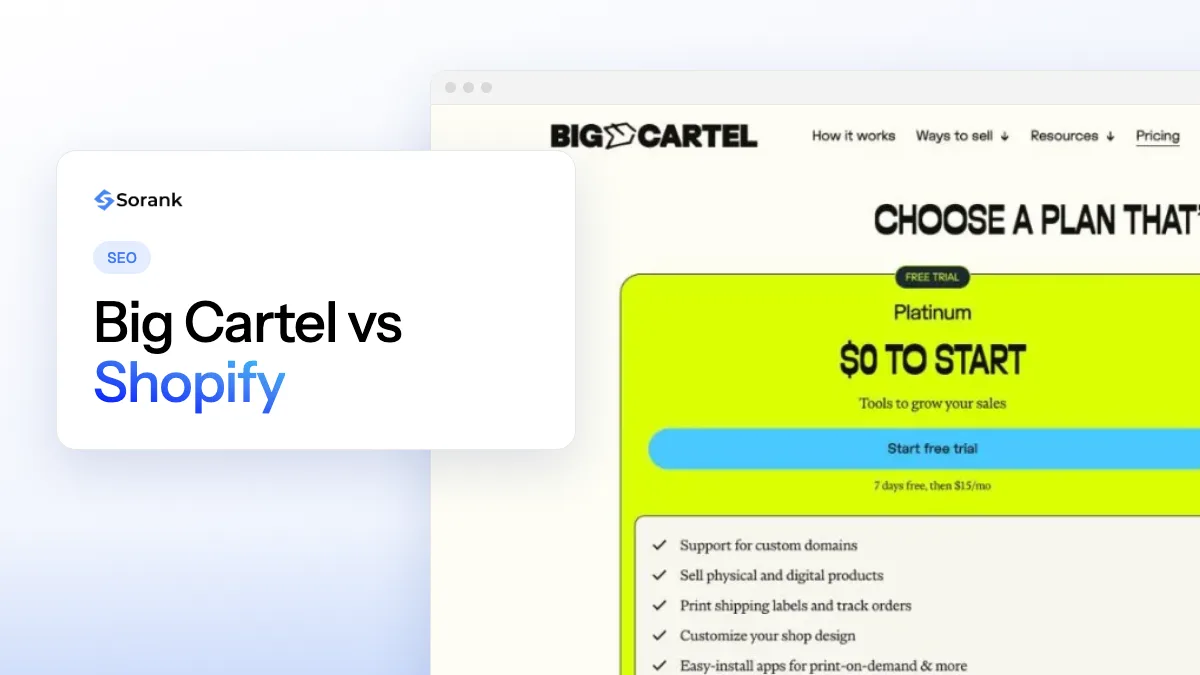
Big Cartel vs Shopify in 2026: verified prices, real cost per sale, SEO settings point by point, AI visibility and the right pick for each type of creator.

Tools

In short
Big Cartel is the better choice for an artist, band or maker with a small catalog who wants a clean shop for $0 to $30 a month and no fee on top of card processing. Shopify is the better choice once you sell more than a few dozen products, ship internationally, want a blog, translations and full control over SEO and redirects, or plan to grow into a real brand: it starts at $29 a month billed yearly. On cost per sale the two are almost identical, because card fees dominate; the real differences are the product limits, the SEO controls and how far each platform lets you grow.
Want to go further? Ask
Quick quiz
Where should your online shop find its next customers?
Sorank matches your answers


Test it for 3 days on your own site and see where you stand on Google, ChatGPT and the other AIs.
Start 3-day free trial3 days free, then stop whenever you want. 90-day results-or-refund guarantee.
The Big Cartel vs Shopify question comes up as soon as an illustrator, a printmaker or a band outgrows a link in bio. Both are hosted store builders, but they were built for very different sellers. Big Cartel was started by musicians to sell band merch and still targets independent creators: according to Big Cartel's own figures, it counts more than 4 million shops worldwide and over $5 billion in global sales (checked October 2026). Shopify is a full commerce platform used by stores of every size. This guide compares them on what decides your income over the next few years: verified prices, the real cost of each order, product limits, SEO settings point by point, visibility in ChatGPT, Gemini and Perplexity, migration, and a verdict for each type of creator.
Big Cartel is a deliberately simple shop builder for artists and makers: a storefront, a limited number of products, a handful of templates and the essentials for payments, shipping labels and discounts. Shopify is a complete ecommerce platform: unlimited products, a large theme and app store, international selling, a built-in blog, point of sale and selling channels that now include AI chats.
The difference shows in the philosophy. Big Cartel caps what you can do so that the shop stays easy to run alone. Shopify removes the caps and lets you add what you need, at the price of more settings, more apps and more monthly costs. Big Cartel's co-founder explained the original idea in an early interview:
"The e-commerce systems at that point were too expensive and too complicated to mess with. We knew we could do better."
Matt Wigham, co-founder of Big Cartel, Entrepreneur
That positioning still holds. The table below sums up the main differences before the detail.
| Criterion | Big Cartel | Shopify |
|---|---|---|
| Built for | Artists, bands, makers, small catalogs | Any store, from first sale to large brands |
| Entry price (US, checked October 2026) | Gold free, Platinum $15/month after a 7-day trial | Basic $29/month billed yearly, $39 monthly |
| Platform fee per sale | None, only the payment processor's fee | None with Shopify Payments, 2% on Basic with a third-party provider |
| Product limit | 5 on Gold, capped on paid plans | Unlimited on every plan |
| Blog | No, an external blog can be linked | Yes, built in |
| 301 redirects | No redirect manager for product URLs | Built-in URL redirect tool |
| Multilingual | No native translation | Yes, with Shopify Markets and a free translation app |
| Apps | A short list of apps, 7,000+ via Zapier on Diamond | Thousands in the Shopify App Store |
| Best for | Selling a small collection simply | Growing a brand and a long-term channel |
Big Cartel is cheaper at every level: $0, $15 or $30 a month, against $29 to $359 a month billed yearly for Shopify's standard plans. The prices below were checked on each platform's official pricing page in October 2026 (US prices; Shopify displays local currencies elsewhere).
| Plan | Monthly price | What it includes |
|---|---|---|
| Big Cartel Gold | $0 | 5 products, 1 template, card and PayPal payments, sales tax handled automatically |
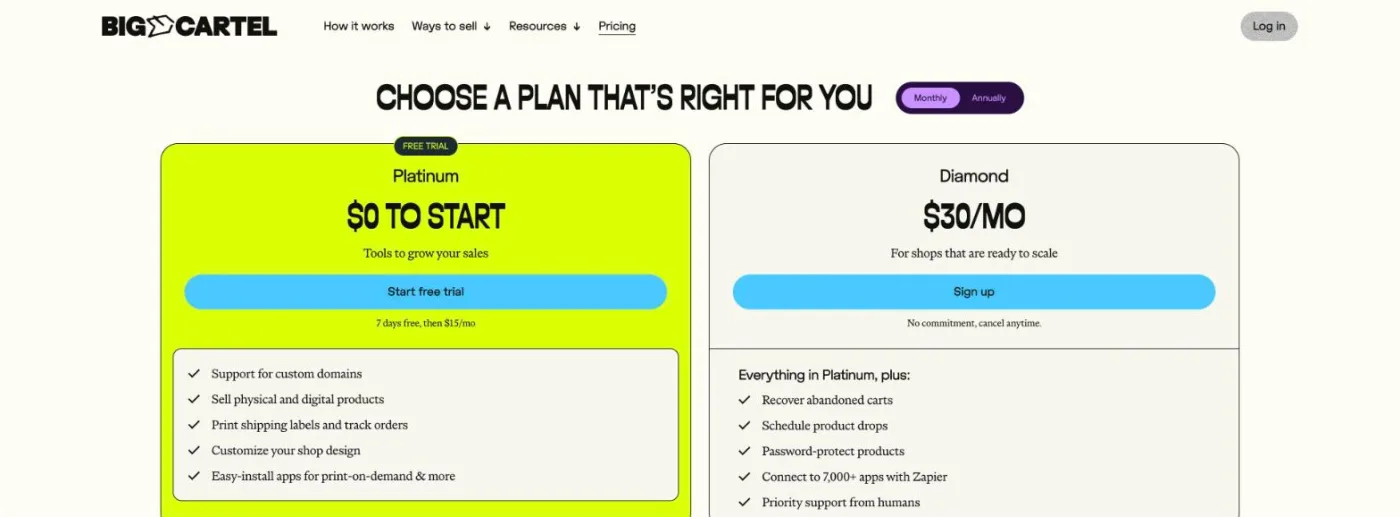
| Big Cartel Platinum | $15 after 7 days free | Custom domain, physical and digital products, shipping labels, theme customization, apps for print on demand |
| Big Cartel Diamond | $30 | Everything in Platinum plus abandoned cart recovery, scheduled product drops, password-protected products, Zapier, priority support |
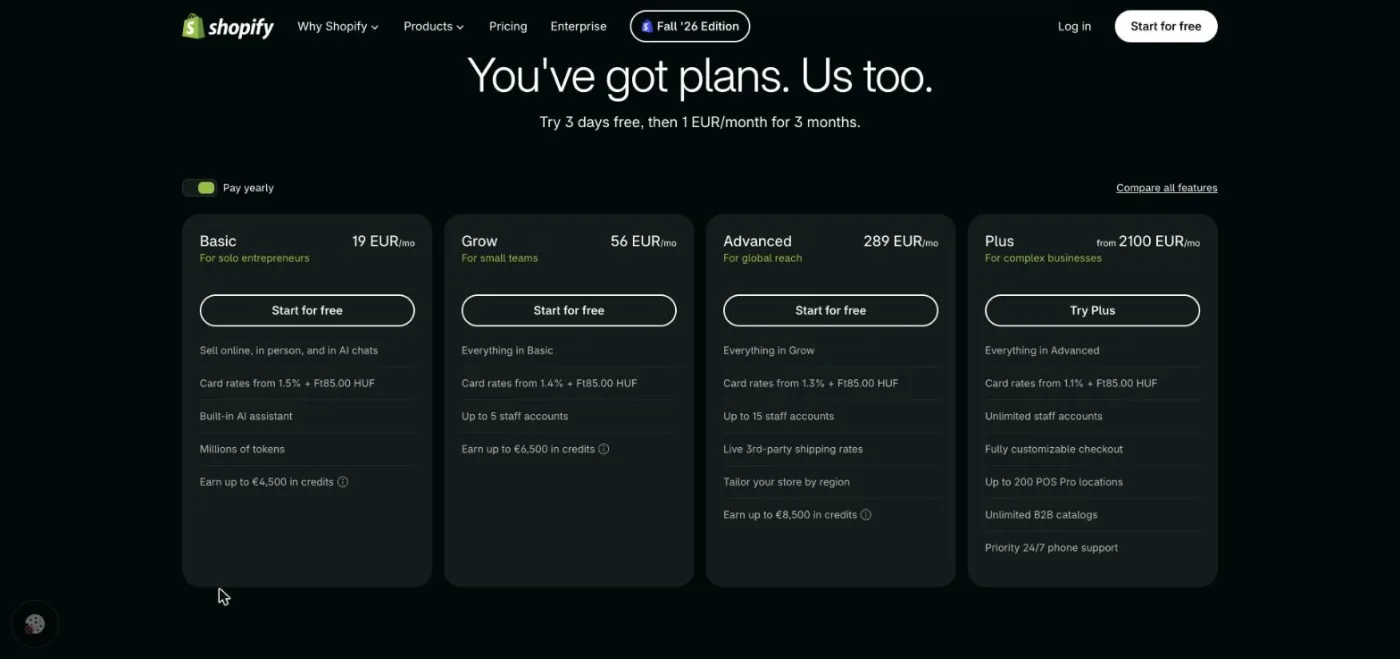
| Shopify Basic | $29 billed yearly, $39 monthly | Unlimited products, blog, 2% fee with a third-party payment provider |
| Shopify Grow | $89 billed yearly, $105 monthly | More staff accounts, lower card rates, 1% third-party fee |
| Shopify Advanced | $359 billed yearly, $399 monthly | Advanced reports, lowest standard rates, 0.6% third-party fee |
| Shopify Plus | From $2,300 | Large brands, 0.2% third-party fee |
Big Cartel's pricing page lists Platinum as "$0 to start", with 7 days free and then $15 a month, and Diamond at $30 a month, with no commitment. The free Gold plan still exists for up to 5 products. Big Cartel no longer prints the product caps of its paid plans on the pricing page; independent reviews published in 2026 report 50 products on Platinum and 500 on Diamond, so check the limit in your admin before importing a large catalog.
On Shopify's pricing page, paying yearly saves up to 25%, and new stores get a 3-day free trial followed by a low introductory price for the first months. With Shopify Payments, the US online card rate on Basic is 2.9% + 30¢; if you use another payment provider, Shopify adds its own fee of 2% on Basic, 1% on Grow, 0.6% on Advanced and 0.2% on Plus.
Big Cartel takes no commission of its own on sales: you pay the subscription and the payment processor. With Stripe, Big Cartel's help center lists US card fees starting at 2.9% + 30¢ per charge, which is the same rate as Shopify Payments on Basic. The gap between the two platforms is therefore mostly the monthly subscription, plus any paid Shopify apps.
Example
An illustrator sells 20 prints a month at $35. Card fees are about $1.32 per order on both platforms, so $26.30 a month. Total on Big Cartel Platinum: about $41 a month. Total on Shopify Basic billed yearly: about $55 a month, or $65 on monthly billing. At 100 orders a month, the card fees reach about $131 and the subscription becomes a detail: the gap stays at $14 a month, under 10% of the total.
Two costs are easy to forget. On Shopify, many useful features (reviews, advanced product options, some email tools) come from paid apps billed monthly. On Big Cartel, outgrowing the product cap forces an upgrade or a move: on the free plan, the help center states that a shop over the limit goes into maintenance mode until the extra products are removed.
Big Cartel is easier to learn and faster to launch: four steps (template, products, payments and shipping, launch) and very few settings to understand. Shopify takes longer to set up because it does more, but its admin is well organized and its documentation is the most complete in the market.
On Big Cartel, design means picking one of a small set of templates and adjusting colors, fonts and layout; paid plans let you edit the theme code (HTML, CSS and Big Cartel's template tags) if you want something unique. Products can be imported from Shopify, Etsy or Squarespace, which makes it easy to test the platform with an existing catalog. A mobile app for iOS and Android lets you manage orders and sell in person.
On Shopify, the theme store offers free and paid themes with a visual editor, and almost every behavior of the shop can be changed with settings, apps or Liquid code. That flexibility helps when you need product bundles, pre-orders, wholesale prices or complex shipping rules, and it is also the main source of extra time and cost.
Tip
Write every product page as if it had to stand alone in Google: what the piece is, the material, the size, who made it and how it ships. Our guide to the elements of a product page that ranks and converts applies to both platforms.
Both platforms handle physical products, digital downloads and print on demand. The difference is volume and complexity.
For a band selling ten shirts and a vinyl, or a ceramicist with a seasonal drop of thirty pieces, Big Cartel's limits never get in the way. For a print shop with hundreds of designs in several sizes, Shopify is the safer base from day one. If you are still comparing more platforms, our guide to the best ecommerce software covers the wider market.
Shopify is better for SEO as soon as search traffic matters to you: it offers a blog, a redirect manager, editable titles and meta descriptions on every page type, editable robots.txt and translated URLs. Big Cartel covers the basics (clean URLs, automatic sitemap, per-product search title and description, alt text, HTTPS) but has no blog, no redirect manager for product URLs and no native translations.
Big Cartel's SEO help article explains that each theme generates metadata automatically from the store description and product text, that the sitemap is at /sitemap.xml, and that connecting Google Search Console requires a premium plan. Its product editor adds a search engine optimization section where you can set the title and description shown in search results.
| SEO setting | Big Cartel | Shopify |
|---|---|---|
| URLs | Readable, generated from the product name (/product/name) | Editable handle, fixed folders (/products/, /collections/, /blogs/) |
| Title and meta description | Per product in the SEO section; home and pages built from the store description | Editable on products, collections, pages, blog posts and home |
| 301 redirects | No redirect manager for product URLs; navigation links can point elsewhere | URL redirect tool, automatic redirect when a handle changes, CSV import |
| Sitemap | Automatic at /sitemap.xml | Automatic at /sitemap.xml |
| robots.txt | Generated by the platform, no documented editor | Generated, editable with the robots.txt.liquid template |
| Structured data | Depends on the theme; JSON-LD can be added by editing theme code on paid plans | Product data in most themes, extendable with apps or code |
| Canonical tag | Set by the theme | Automatic on products and collections |
| Speed | Light templates, few scripts | Fast hosting; speed depends on the theme and the number of apps |
| Multilingual | No native translation, one language per shop | Shopify Markets plus a free translation app, translated URLs |
| Blog | None built in; link an external blog in the navigation | Built in, with tags, authors and comments |
Watch out
On Big Cartel, renaming a product changes its address and the old URL is not redirected. Pick the final product name before sharing the link, and avoid renaming pages that already receive visits or backlinks.
The missing blog is the biggest SEO gap for creators. Most searches that bring new buyers are informational ("how to frame a risograph print", "handmade ceramic mug care"), and only a blog answers them. On Big Cartel, the workaround is a blog on a subdomain or another platform, linked from the shop navigation. Big Cartel shops still gain a lot from marketplace-style care of titles and descriptions; the same principles as in our Etsy SEO guide apply, and well-named, compressed photos with alt text matter just as much (see our image SEO guide).
AI assistants cite pages they can read and trust: clear product facts, consistent brand information, structured data and content that answers real questions. Shopify gives more tools to build that, mainly because of the blog, the structured data in its themes and its growing integration with AI shopping. Big Cartel can work well too, because its pages are light and simple, but you have to add structured data yourself and publish your content elsewhere.
Scale matters here. Shopify merchants sold $378.44 billion in gross merchandise volume in fiscal year 2025, up about 29.5% on 2024, as reported by Digital Commerce 360 in February 2026. That weight explains why Shopify invests in selling inside AI chats and why AI assistants often meet Shopify stores when they look for products; our study of Shopify citations in AI answers measures how often they appear.
Whatever the platform, four actions make a shop easier to cite:
Big Cartel covers the marketing basics for a small shop: discount codes and promotions, scheduled product drops, password-protected products for exclusive releases, abandoned cart recovery on Diamond, Google Shopping and social selling connections, and over 7,000 apps through Zapier on Diamond. That is enough for a creator who sells to an existing audience on Instagram or at shows.
Shopify covers growth at any scale: native email marketing, customer segments, abandoned checkout emails on every plan, gift cards, advanced discounts, detailed reports and thousands of apps for reviews, loyalty, upsells and subscriptions. Shopify also connects to marketplaces and social channels from a single catalog. If you sell music merch, our page for music artists and labels details how organic visibility supports releases and tours.
Shopify offers support around the clock, while Big Cartel relies on a small team that promises "real humans, not chatbots" and reserves priority support for Diamond. Big Cartel sellers often praise that personal tone, and the help center covers every feature in plain language.
Shopify's advantage is depth: a large help center, community forums, thousands of tutorials and a network of freelancers and developers who know the platform. When something breaks on a busy launch day, that ecosystem matters. On Big Cartel, fewer moving parts means fewer things break in the first place, which is the trade-off many solo creators prefer.
Moving from Big Cartel to Shopify is straightforward for products and risky for URLs: product data can be exported and imported, but every address changes because Shopify uses its own folders.
Customer accounts and order history do not always follow cleanly, so keep an export of past orders. If you also sell on Etsy, our Etsy vs Shopify comparison explains how a marketplace and your own store can work together.
The right answer depends on your catalog size, your growth plans and how much traffic you expect from search. This verdict by profile sums it up.
| Your profile | Best choice | Why |
|---|---|---|
| Artist testing a first collection (up to 5 pieces) | Big Cartel Gold | Free, simple, no platform fee on sales |
| Band or musician selling merch | Big Cartel Platinum | Built for merch, custom domain, quick to run alone |
| Illustrator or printmaker with a few dozen designs | Big Cartel Diamond or Shopify Basic | Diamond if search traffic is secondary, Shopify if you want a blog |
| Maker planning hundreds of products or wholesale | Shopify | Unlimited products, B2B and apps |
| Creator selling abroad in several languages | Shopify | Shopify Markets, currencies and translated URLs |
| Brand counting on Google and AI visibility | Shopify | Blog, redirects, full SEO control, structured data |
Note
Starting on Big Cartel and moving to Shopify later is a common path. The move is easier if you keep stable product names from the start and save your list of URLs.
Whatever you choose, organic traffic needs regular content. Sorank, our software, finds the keywords your buyers type, writes and publishes optimized articles and tracks your mentions in AI answers; it connects to Shopify directly and to Big Cartel through a managed blog linked from your shop (see our pages for Shopify and Big Cartel, and the blog article generator). More resources for online sellers are on our ecommerce page.
Choose Big Cartel to sell a small collection simply and cheaply, and choose Shopify when you want to grow a brand that people and AI assistants can find on their own.

No, the two platforms do not connect to each other as a single store. Big Cartel can import products from Shopify, Etsy or Squarespace, which helps if you move to Big Cartel, and Shopify can import a CSV export of your Big Cartel products if you move the other way. Most sellers pick one platform for their own store and use marketplaces or social channels alongside it.
Yes. Big Cartel reports more than 4 million shops worldwide and over $5 billion in global sales on its website (checked October 2026). It remains popular with bands, illustrators, printmakers, jewelry makers and other independent creators who want a simple shop with low fixed costs.
Moving the products is easy with a CSV export or a migration app, but every URL changes because Shopify uses folders such as /products/ and /collections/. Build a list of 301 redirects from the old Big Cartel addresses to the new Shopify pages and import it before pointing your domain to Shopify, so you keep your Google rankings and your backlinks.
We analyse your competitors, your website and your AI visibility to create a tailored content plan for free.
 AI Content Brief Generator
 FAQ Schema Generator
 AI Blog Post Ideas Generator
 Structured Data Validator (Schema Validator)
 Alt Text Checker
 Internal Link Analyzer
 Backlink Challenge
 AI Meta Description Generator
 AI Blog Title Generator
 Google Indexability Checker
 AI Blog Outline Generator
 UTM Link Builder
 Keyword Clustering Tool
 Canonical Tag Checker
 XML Sitemap Generator
 Broken Link Checker
 AI SEO Title Generator
 Headline Analyzer
 SERP Preview Tool
 Redirect Checker
 Hreflang Tag Generator
 Heading Structure Analyzer
 HTTP Headers Checker
 Favicon Extractor
 SERP CTR Calculator
 SEO vs Paid Search Savings Calculator
 SEO Share of Voice Calculator
 SEO ROI Calculator
 SEO Traffic and Revenue Forecast Calculator
 SEO Budget Calculator
 SEO Break-Even Calculator
 SaaS SEO ROI Calculator
 ROAS Calculator
 Reading Time Calculator
 Ranking Gain Simulator
 Organic Traffic Value Calculator
 Organic Traffic Estimator and Website Traffic Checker
 LTV to CAC Ratio Calculator
 Local SEO ROI Calculator
 Link Building Cost Calculator
 Keyword Value Calculator
 Keyword Opportunity Score Calculator
 Keyword Density Calculator
 GEO ROI Calculator
 GEO Content Investment Calculator
 Ecommerce SEO ROI Calculator
 Customer Lifetime Value Calculator
 Customer Acquisition Cost Calculator
 CTR Calculator
 Cost Per Article Calculator
 Conversion Rate Calculator
 Content Marketing ROI Calculator
 ChatGPT Referral Traffic Estimator
 Bounce Rate Calculator
 Backlink ROI Calculator
 AI Visibility Score Calculator
 AI Traffic Value Calculator
 AI Share of Voice Calculator
 Cost of AI Invisibility Calculator
 AI Citation Rate Calculator
 llms.txt Validator
 AI Overview Checker and AI Overviews Rank Checker
 Robots.txt Checker
 AI SEO Audit
 LLM Readability Checker
 SearchGPT Readiness Checker
 Structured Data LLM Audit
 Website Crawlability AI Audit
 Why ChatGPT Is Not Recommending My Website
 Gemini Ranking Tool
 Perplexity Ranking Checker
 LLM Citation Checker
 Answer Engine Optimization Audit
 GEO Audit
 AI Search Visibility Test
 ChatGPT Visibility Checker
 llms.txt Generator
 URL Extractor
 Webpage to Markdown
 Sitemap Checker
 SERP Volatility Sensor
 Page Size Checker
 Word Counter
 Slug Generator
 Schema Generator
 Robots Generator
 OG Preview
 Meta Tags Generator
 Image Compressor
 Favicon Generator
 On-Page SEO Audit: SEO Checker and SEO Analyzer
 Backlink Analysis Tool
 Keyword Research Tool
 Domain Authority Checker
THEY TRIED SORANK BEFORE YOU
 “I tested Sorank on a real client site and it's insane. It does everything an agency would bill you $1500 a month for. It's going into production on that client now.”

 Guillaume Guersanguersanguillaume.com“We are an Ads agency and we wanted to get our SEO back on track once and for all. Sorank gave us a clear view of our site, helped us prioritize optimizations, and properly structure our content. The tool is easy to use, well designed for a team, and very practical for centralizing tracking without having to juggle multiple platforms. A very solid foundation to start fresh with our SEO.”
 Gaspard MadouiAds Agency
 “I just let the Sorank software do its thing, and now my DR is 25 and my page is ranking higher.”
 Lucas Flandrefoundertrace.fr“I specialized in GEO thanks to Sorank. The GEO Leaderboard allows me to show my clients their position vs competitors on ChatGPT. It’s a real commercial differentiator.”
 MélanieSEO Freelance“Great service, works well for our website and helps us understand how to improve it to rank better on Google and elsewhere. Congrats, keep going, I recommend it.”
 Hugo T.E-commerce merchant