Preferences
Privacy is important to us, so you have the option of disabling certain types of storage that may not be necessary for the basic functioning of the website. Blocking categories may impact your experience on the website. More information

Privacy is important to us, so you have the option of disabling certain types of storage that may not be necessary for the basic functioning of the website. Blocking categories may impact your experience on the website. More information

What a backlink indexer does, why Google ignores some linking pages, the risks of indexing services and the clean ways to get your backlinks crawled.

Tools

In short
A backlink indexer is a paid service that tries to make Google crawl the pages linking to your site, so the links get counted. It cannot force indexing: Google only offers indexing requests to the owner of a site, and its Indexing API is reserved for job postings and livestreams. When a linking page stays unindexed, the usual cause is that Google judges it low value. The durable fix is to earn links on pages that are already crawled and indexed, and to help discovery with clean methods.
Want to go further? Ask
Quick quiz
How should you get links from other websites?
Sorank matches your answers


Test it for 3 days on your own site and see where you stand on Google, ChatGPT and the other AIs.
Start 3-day free trial3 days free, then stop whenever you want. 90-day results-or-refund guarantee.
Anyone who has bought or built links has seen it: the link is live, but weeks later the page that carries it is still missing from Google, and backlink tools do not show it either. A backlink indexer promises to fix that by "pushing" the URL to Google. Before paying for one, it helps to understand how Google finds and keeps pages, and what its own documentation says about requesting a crawl. Google's guide on asking Google to recrawl your URLs is short and explains most of what follows.
A backlink indexer is a tool or service that takes a list of URLs, usually pages on other sites that link to you, and tries to get search engines to crawl and index them. The idea rests on a real mechanism: Google discovers a backlink by crawling the page that contains it. If Googlebot never fetches that page, the link has no effect on rankings.
Indexers are sold per URL or by monthly plan, and most publish an "indexing rate" and refund URLs that do not get indexed. Those rates come from the vendors themselves and cannot be checked independently, because the outcome depends on the quality of each page submitted.
Indexing happens in two steps: Google crawls a URL, then decides whether to keep it in its index. A linking page can fail at either step.
The third case is by far the most common for paid and mass-produced links. No tool changes Google's judgment of a page. Our guide to how Google indexing works details each stage, and you can run any URL through the indexability checker to rule out technical blocks first.
Note
A page that is crawled but left out of the index can still be read by Google. What matters for a link is that Google crawls the page and considers it trustworthy, and a page Google chose not to index is a weak signal on both counts.
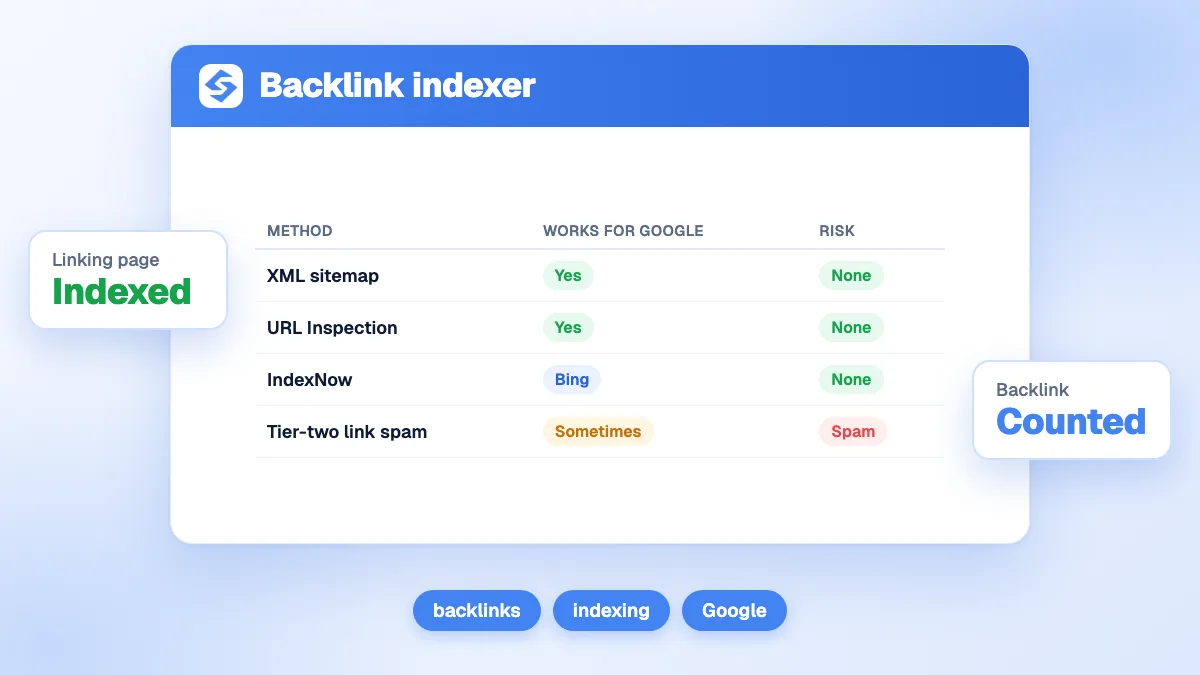
Indexing services rarely explain their method in detail. The techniques generally described in this market are:
The first two methods are cheap and mostly useless. The last two are clean when the site owner uses them for their own pages and questionable when a third party uses them for someone else's.
The risk depends on the method, and the buyer rarely knows which one is used. Google's spam policies list as link spam "using automated programs or services to create links to your site" and low-quality directory or bookmark links. An indexer that builds automatic tier-two links to your backlinks falls close to that description.
| Method | Who can use it | Works for Google? | Risk |
|---|---|---|---|
| URL Inspection, request indexing | Verified owner of the site | Yes, for a few URLs, with a quota | None |
| XML sitemap | Owner of the site | Yes, for discovery at scale | None |
| IndexNow | Owner of the site (key file) | No, Bing and other participating engines | None |
| Internal and external links to the linking page | Anyone | Yes, if the linking pages are crawled | None if the links are editorial |
| Pings and RSS submissions | Anyone | Little visible effect | Low, mostly wasted money |
| Auto-generated tier-two links | Anyone | Sometimes speeds up crawling | Link spam under Google's policies |
| Indexing API on ordinary pages | API account holders | Outside the permitted use | Access revoked, spam detection |
The financial risk is the other side. Paying to index a link that Google judged worthless rarely changes the outcome: either the page stays out, or it gets in briefly and drops. A link that needs an indexer to be seen is usually a link worth little.
Watch out
If a link seller offers "guaranteed indexing" as part of the package, treat it as a warning sign about the quality of the sites in the offer. Our list of toxic backlinks shows the patterns to avoid.
Search Google for the exact URL, or a distinctive sentence from the page in quotes. If the page appears, the link is visible to Google, even if your backlink tool has not found it yet. Third-party tools crawl on their own schedule, so a missing link in a report does not mean Google ignores it. A backlink analysis helps you list the referring pages to check.
The site owner has the tools you lack: they can add the page to their sitemap, link it from a category or a recent article, and request indexing in their own Search Console. A polite request after publication is often enough, and it is the only way to use Google's official tools for a page you do not own.
Mention the article from your own site (a press page, a resources page, a related article), share it on your social accounts and in your newsletter. These are editorial links and real visits, which also tell Google the page has an audience. Strong internal linking on your side makes sure these mentions are themselves crawled quickly.
For the pages you control, IndexNow notifies Bing, Yandex, Naver, Seznam.cz and the other participants as soon as a URL is published or updated. The IndexNow FAQ confirms that a submission to one engine is shared with all participating engines and that it does not guarantee indexing. Google is not among the participants listed (checked October 2026). Bing's IndexNow getting started guide shows the three steps: generate a key, host the key file on your domain, then submit URLs one by one or in bulk. Setup and checks are covered in our guide to Bing Webmaster Tools.
Google says crawling can take from a few days to a few weeks, and that requesting the same URL several times does not speed it up. If a linking page is still absent after two or three months despite these steps, consider it a link Google does not value and invest elsewhere.
Tip
Before accepting a link opportunity, check that the site's existing articles are indexed. Three or four quick searches tell you more about the future of your link than any indexing service.
Links that never need an indexer share a profile: they sit on sites Google crawls often, inside articles linked from the site's own navigation, on topics close to yours. Those are also the links that move rankings. Our guide to quality backlinks lists the criteria, and counting referring domains rather than raw links gives a truer picture of your progress.
The same profile matters for AI assistants. ChatGPT, Perplexity and Gemini build answers from pages their search systems can retrieve, which in practice means pages indexed by the underlying search engines. A mention on an indexed, trusted page can be quoted; a link on a page nobody indexes cannot. Our study of the platforms AI assistants cite shows how concentrated those sources are.
Indexing is only the first check. Links disappear when pages are edited, moved or deleted, and a lost link costs as much as an unindexed one. Set up backlink monitoring to catch losses early, and follow the trend of your authority over months rather than days with the domain authority tracker.
If the real problem is getting good links at all, Sorank's backlinks acquisition obtains natural backlinks automatically from the sites of its 5,000+ users: links placed in articles on real, active sites, the kind Google crawls without outside help.
A backlink indexer treats a symptom. When Google does not index a linking page, it is usually telling you something about that page. Earn links on pages Google already crawls and keeps, help discovery through the site owner and your own links, and use IndexNow and Search Console only for pages you own. That approach costs nothing extra and carries no risk.

It depends on how often Google crawls the linking site. On an active, well-linked site a new article can be crawled within days; on a small or rarely updated site it can take several weeks. Google states that crawling can take from a few days to a few weeks.
No. Requesting indexing in the URL Inspection tool requires owner or full user rights on the Search Console property, so only the site that publishes the page can do it. You can ask the publisher to request indexing or to add the page to their sitemap.
Google has to crawl a page to see the links on it, and a page it chose to leave out of its index is a weak signal of trust. In practice, links from pages that stay unindexed for months bring little or no ranking value. Focus on links from pages that are already in Google.
We analyse your competitors, your website and your AI visibility to create a tailored content plan for free.
 AI Content Brief Generator
 FAQ Schema Generator
 AI Blog Post Ideas Generator
 Structured Data Validator (Schema Validator)
 Alt Text Checker
 Internal Link Analyzer
 Backlink Challenge
 AI Meta Description Generator
 AI Blog Title Generator
 Google Indexability Checker
 AI Blog Outline Generator
 UTM Link Builder
 Keyword Clustering Tool
 Canonical Tag Checker
 XML Sitemap Generator
 Broken Link Checker
 AI SEO Title Generator
 Headline Analyzer
 SERP Preview Tool
 Redirect Checker
 Hreflang Tag Generator
 Heading Structure Analyzer
 HTTP Headers Checker
 Favicon Extractor
 SERP CTR Calculator
 SEO vs Paid Search Savings Calculator
 SEO Share of Voice Calculator
 SEO ROI Calculator
 SEO Traffic and Revenue Forecast Calculator
 SEO Budget Calculator
 SEO Break-Even Calculator
 SaaS SEO ROI Calculator
 ROAS Calculator
 Reading Time Calculator
 Ranking Gain Simulator
 Organic Traffic Value Calculator
 Organic Traffic Estimator and Website Traffic Checker
 LTV to CAC Ratio Calculator
 Local SEO ROI Calculator
 Link Building Cost Calculator
 Keyword Value Calculator
 Keyword Opportunity Score Calculator
 Keyword Density Calculator
 GEO ROI Calculator
 GEO Content Investment Calculator
 Ecommerce SEO ROI Calculator
 Customer Lifetime Value Calculator
 Customer Acquisition Cost Calculator
 CTR Calculator
 Cost Per Article Calculator
 Conversion Rate Calculator
 Content Marketing ROI Calculator
 ChatGPT Referral Traffic Estimator
 Bounce Rate Calculator
 Backlink ROI Calculator
 AI Visibility Score Calculator
 AI Traffic Value Calculator
 AI Share of Voice Calculator
 Cost of AI Invisibility Calculator
 AI Citation Rate Calculator
 llms.txt Validator
 AI Overview Checker and AI Overviews Rank Checker
 Robots.txt Checker
 AI SEO Audit
 LLM Readability Checker
 SearchGPT Readiness Checker
 Structured Data LLM Audit
 Website Crawlability AI Audit
 Why ChatGPT Is Not Recommending My Website
 Gemini Ranking Tool
 Perplexity Ranking Checker
 LLM Citation Checker
 Answer Engine Optimization Audit
 GEO Audit
 AI Search Visibility Test
 ChatGPT Visibility Checker
 llms.txt Generator
 URL Extractor
 Webpage to Markdown
 Sitemap Checker
 SERP Volatility Sensor
 Page Size Checker
 Word Counter
 Slug Generator
 Schema Generator
 Robots Generator
 OG Preview
 Meta Tags Generator
 Image Compressor
 Favicon Generator
 On-Page SEO Audit: SEO Checker and SEO Analyzer
 Backlink Analysis Tool
 Keyword Research Tool
 Domain Authority Checker
THEY TRIED SORANK BEFORE YOU
 “I tested Sorank on a real client site and it's insane. It does everything an agency would bill you $1500 a month for. It's going into production on that client now.”

 Guillaume Guersanguersanguillaume.com“We are an Ads agency and we wanted to get our SEO back on track once and for all. Sorank gave us a clear view of our site, helped us prioritize optimizations, and properly structure our content. The tool is easy to use, well designed for a team, and very practical for centralizing tracking without having to juggle multiple platforms. A very solid foundation to start fresh with our SEO.”
 Gaspard MadouiAds Agency
 “I just let the Sorank software do its thing, and now my DR is 25 and my page is ranking higher.”
 Lucas Flandrefoundertrace.fr“I specialized in GEO thanks to Sorank. The GEO Leaderboard allows me to show my clients their position vs competitors on ChatGPT. It’s a real commercial differentiator.”
 MélanieSEO Freelance“Great service, works well for our website and helps us understand how to improve it to rank better on Google and elsewhere. Congrats, keep going, I recommend it.”
 Hugo T.E-commerce merchant