Preferences
Privacy is important to us, so you have the option of disabling certain types of storage that may not be necessary for the basic functioning of the website. Blocking categories may impact your experience on the website. More information

Privacy is important to us, so you have the option of disabling certain types of storage that may not be necessary for the basic functioning of the website. Blocking categories may impact your experience on the website. More information

App store optimization in 2026: metadata limits, keywords, ratings and A/B tests on the App Store and Google Play, plus how web SEO feeds ASO.

Tools

In short
App store optimization (ASO) is the work of making a mobile app easier to find and more convincing to install inside the Apple App Store and Google Play. It has two halves: visibility (keywords placed in the title, subtitle, keyword field or description, plus ratings and downloads) and conversion (icon, screenshots, video, reviews). The two stores index text differently, so each needs its own plan. Your website, your reviews and what AI assistants say about your app now weigh on installs as much as the store page itself.
Want to go further? Ask
Quick quiz
Is SEO right for you, and how should you start?
Sorank matches your answers


Test it for 3 days on your own site and see where you stand on Google, ChatGPT and the other AIs.
Start 3-day free trial3 days free, then stop whenever you want. 90-day results-or-refund guarantee.
App store optimization is to an app what SEO is to a website: a set of on-page and off-page levers that decide where a listing appears and whether people tap "Get" or "Install". The rules are public. Apple documents them in its guide to creating your product page, and Google in the Play Console help. This guide covers both stores field by field, then the part most ASO guides skip: how the app's website, its search presence and its visibility in ChatGPT or Gemini bring installs the stores never see coming.
Each store runs its own search engine. When someone types "budget tracker" in the App Store, the algorithm matches the query against the text fields of every listing, then orders the matches using signals such as downloads, ratings, engagement and relevance. Apple says it plainly on its developer pages: keywords "help determine where your app displays in search results", and ratings and reviews "influence how your app ranks in search".
ASO therefore works on two funnels at once:
The same logic as keyword optimization on the web applies: match the words people use, place them where the algorithm reads them, and never stuff them.
The biggest difference is where the store reads keywords. Apple gives you a hidden keyword field and ignores the long description for search. Google Play has no keyword field and reads the full description instead. The table sums up the official limits (checked October 2026).
| Field | Apple App Store | Google Play |
|---|---|---|
| App name / title | 30 characters, indexed | 30 characters, indexed |
| Second line | Subtitle, 30 characters, indexed | Short description, 80 characters, indexed |
| Keyword field | 100 characters, commas, no spaces, hidden | None |
| Long description | Not used for search ranking | 4,000 characters, indexed |
| Promotional text | 170 characters, no effect on ranking | None |
| Screenshots and video | Up to 10 screenshots, up to 3 previews of 30 seconds | Screenshots, feature graphic, optional video |
| Native A/B testing | Product page optimization (icons, screenshots, previews) | Store listing experiments (graphics and text) |
| Alternative listings | Up to 70 custom product pages, keyword assignment possible | Custom store listings by country or audience |
Sources: Apple's product page and custom product pages documentation, and the Play Console store listing help.
ASO keyword research starts from the same question as web research: what do people type when they need what your app does? Three sources give the raw list:
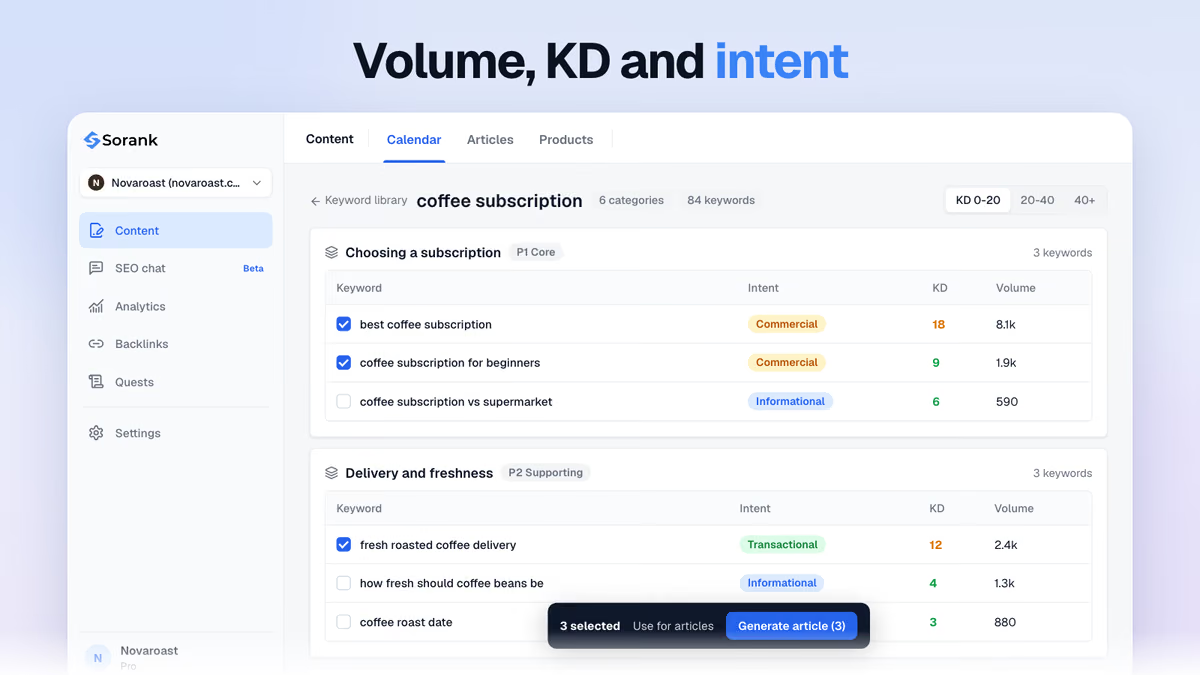
Then sort the list by relevance, volume and competition. A new app rarely ranks for a head term such as "fitness"; a long-tail keyword such as "home workout no equipment" is reachable and converts better because the intent is precise. Automated keyword research does this sorting for websites (intent, difficulty, volume), and the website side of ASO starts from the same list.
The name carries the most weight in both stores. Put the brand first, then the main keyword if space allows ("Calmly: Sleep & Meditation"). Apple's App Review Guideline 2.3.7 limits names to 30 characters and forbids packing metadata with "trademarked terms, popular app names, pricing information, or other irrelevant phrases".
The Apple subtitle (30 characters) and the Google Play short description (80 characters) are the second indexed line and the first sentence users read in results. Use them for a benefit plus a secondary keyword, never a repeat of the title.
Apple's rules for the 100-character field are precise: separate terms with commas and no spaces, skip plurals of words already present, skip the word "app" and category names, and never repeat a word already in the name or subtitle. Apple combines words across fields, so "budget" in the title and "planner" in the keyword field can rank for "budget planner".
Tip
Do not waste Apple's promotional text on keywords: Apple states it does not affect search ranking. Use those 170 characters for news, offers or seasonal messages you can change without submitting a new version.
On Google Play, the 4,000-character description is indexed, so write it like a good web page: the main keyword in the first lines, secondary terms spread naturally, short paragraphs and lists. Google warns that repetitive or irrelevant keyword use in the title or descriptions can lead to suspension, and its metadata policy bans emojis, ALL CAPS (unless part of the brand) and ranking claims such as "#1" or "App of the year" in the title, icon and developer name.
Most visitors decide from the search result itself, without opening the full page. On the App Store, the first one to three screenshots appear in results when there is no preview video, so they work as an ad. Good practice from both stores' guidance:
Then test. Apple's product page optimization runs up to three treatments against the original for up to 90 days, on icons, screenshots and previews. Google Play's store listing experiments also cover text. Run one change at a time and wait for a clear result, the same discipline used to increase the conversion rate of a website.
Example
A meditation app with an audience of both students and shift workers can build two Apple custom product pages, one per audience, each with its own screenshots, and assign "study focus" keywords to the first and "sleep after night shift" keywords to the second. Each search then lands on the page that speaks to it.
Ratings act on both funnels: they are a ranking signal, and the star average is visible in every search result. Apple's guideline 5.6.1 requires the official API to ask for a review and disallows custom review prompts, so timing is the only lever: ask after a success (a task completed, a goal reached), never at first launch or after an error.
Reply to reviews, especially negative ones that describe a bug, and mention the fix in the next release notes. Users who see a team that answers are more likely to install, the same mechanism that makes more Google reviews lift a local business. Regular updates also help: they keep the app compatible, give you a reason to refresh screenshots, and let you test new keywords on Apple, where the keyword field only changes with a new version.
Watch out
Incentivized reviews (a reward in exchange for stars) and review gating (sending only happy users to the store) break both stores' rules and can get the app removed. Ask everyone, at the right moment.
Yes, as soon as you target more than one language. Both stores let you write a separate name, subtitle or short description, keywords and screenshots per locale. Localization is more than translation: a Spanish user may search a different word than the literal translation of your English keyword, so run the research again in each market, as you would for SEO localization of a website.
Many installs start outside the stores. People search Google for "best app to split bills", read a comparison, ask ChatGPT, then open the store already decided. A website optimized for search captures that demand before the store does:
A strong site also helps the store indirectly: more branded searches and more direct installs raise the download velocity that both algorithms reward. For the bigger picture, product marketing ties ASO, positioning and launch together.
Questions like "what is the best habit tracker for iPhone" now go to ChatGPT, Gemini or Perplexity as often as to a store. These assistants answer from web pages they can retrieve: review sites, comparison articles, Reddit threads and the app's own website. An app with no web presence outside its store page has little chance of being named.
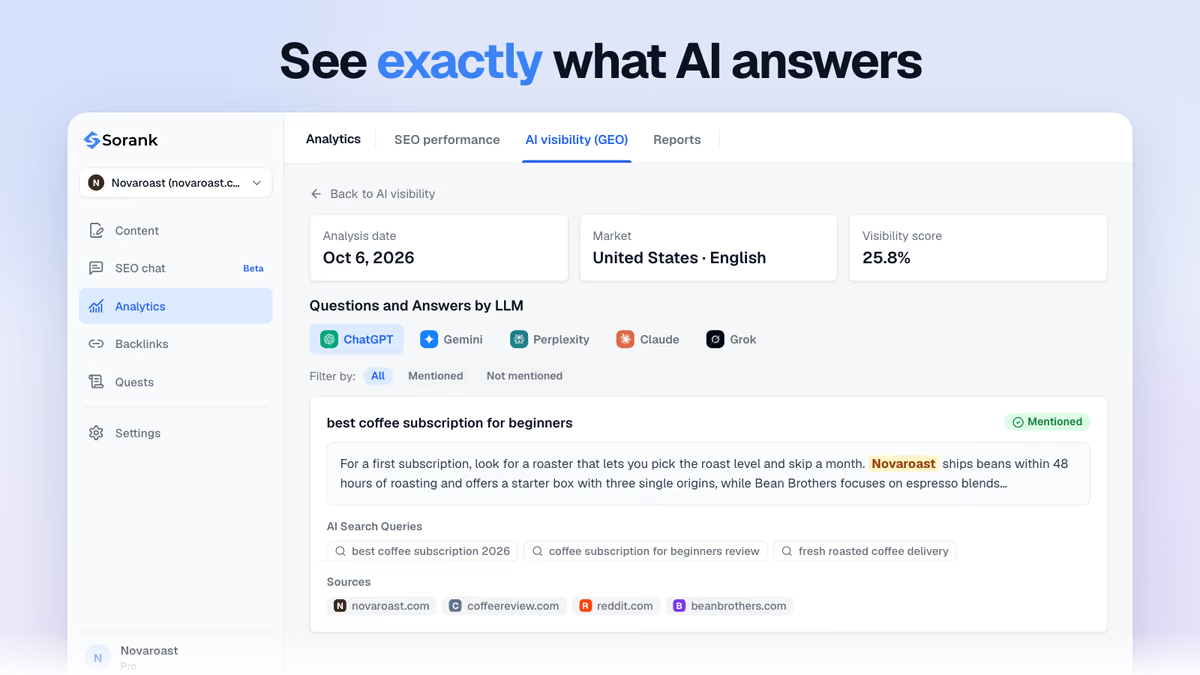
The levers are those of generative search optimization: clear pages that answer one question each, reviews on third-party sites, comparisons where your app appears with honest strengths and limits. To know where you stand, track your brand in AI answers: Sorank follows the prompts you choose on ChatGPT, Claude and Gemini (plus Grok on Pro) and shows which apps are cited instead of yours.
Both consoles provide the essentials for free: App Store Connect (App Analytics) and the Google Play Console. Watch these numbers by week and by country:
On the web side, Google Search Console and visits from AI assistants complete the picture. A GEO and SEO dashboard puts both in one place for the app's website.
ASO wins installs inside the stores; the website and AI visibility win the decision before users get there. Work both, and if you want the website side handled without adding hours to the week, look at Sorank's plans, with a 3-day free trial.

Text changes such as a new title or keyword field are usually indexed within a few days of the update going live, and ranking movements show within one to four weeks. Conversion gains from new screenshots can be measured as soon as a test reaches enough traffic. ASO is ongoing work: competitors and search habits change, so most teams review keywords and visuals with every release.
ASO and SEO share the same principles (keywords, relevance, authority, conversion) but apply to different search engines. ASO targets the internal search of the App Store and Google Play, with fixed metadata fields and character limits. SEO targets Google and other web search, where the website, its content and its backlinks drive rankings. An app grows fastest when both work together.
Yes. App Store Connect and the Google Play Console include free analytics, A/B testing and localization, and store autocomplete is a free source of keyword ideas. Paid ASO tools mainly add estimated search volumes and keyword rankings across many countries. The budget usually goes into design for icons and screenshots rather than tools.
We analyse your competitors, your website and your AI visibility to create a tailored content plan for free.
 AI Content Brief Generator
 FAQ Schema Generator
 AI Blog Post Ideas Generator
 Structured Data Validator (Schema Validator)
 Alt Text Checker
 Internal Link Analyzer
 Backlink Challenge
 AI Meta Description Generator
 AI Blog Title Generator
 Google Indexability Checker
 AI Blog Outline Generator
 UTM Link Builder
 Keyword Clustering Tool
 Canonical Tag Checker
 XML Sitemap Generator
 Broken Link Checker
 AI SEO Title Generator
 Headline Analyzer
 SERP Preview Tool
 Redirect Checker
 Hreflang Tag Generator
 Heading Structure Analyzer
 HTTP Headers Checker
 Favicon Extractor
 SERP CTR Calculator
 SEO vs Paid Search Savings Calculator
 SEO Share of Voice Calculator
 SEO ROI Calculator
 SEO Traffic and Revenue Forecast Calculator
 SEO Budget Calculator
 SEO Break-Even Calculator
 SaaS SEO ROI Calculator
 ROAS Calculator
 Reading Time Calculator
 Ranking Gain Simulator
 Organic Traffic Value Calculator
 Organic Traffic Estimator and Website Traffic Checker
 LTV to CAC Ratio Calculator
 Local SEO ROI Calculator
 Link Building Cost Calculator
 Keyword Value Calculator
 Keyword Opportunity Score Calculator
 Keyword Density Calculator
 GEO ROI Calculator
 GEO Content Investment Calculator
 Ecommerce SEO ROI Calculator
 Customer Lifetime Value Calculator
 Customer Acquisition Cost Calculator
 CTR Calculator
 Cost Per Article Calculator
 Conversion Rate Calculator
 Content Marketing ROI Calculator
 ChatGPT Referral Traffic Estimator
 Bounce Rate Calculator
 Backlink ROI Calculator
 AI Visibility Score Calculator
 AI Traffic Value Calculator
 AI Share of Voice Calculator
 Cost of AI Invisibility Calculator
 AI Citation Rate Calculator
 llms.txt Validator
 AI Overview Checker and AI Overviews Rank Checker
 Robots.txt Checker
 AI SEO Audit
 LLM Readability Checker
 SearchGPT Readiness Checker
 Structured Data LLM Audit
 Website Crawlability AI Audit
 Why ChatGPT Is Not Recommending My Website
 Gemini Ranking Tool
 Perplexity Ranking Checker
 LLM Citation Checker
 Answer Engine Optimization Audit
 GEO Audit
 AI Search Visibility Test
 ChatGPT Visibility Checker
 llms.txt Generator
 URL Extractor
 Webpage to Markdown
 Sitemap Checker
 SERP Volatility Sensor
 Page Size Checker
 Word Counter
 Slug Generator
 Schema Generator
 Robots Generator
 OG Preview
 Meta Tags Generator
 Image Compressor
 Favicon Generator
 On-Page SEO Audit: SEO Checker and SEO Analyzer
 Backlink Analysis Tool
 Keyword Research Tool
 Domain Authority Checker
THEY TRIED SORANK BEFORE YOU
 “I tested Sorank on a real client site and it's insane. It does everything an agency would bill you $1500 a month for. It's going into production on that client now.”

 Guillaume Guersanguersanguillaume.com“We are an Ads agency and we wanted to get our SEO back on track once and for all. Sorank gave us a clear view of our site, helped us prioritize optimizations, and properly structure our content. The tool is easy to use, well designed for a team, and very practical for centralizing tracking without having to juggle multiple platforms. A very solid foundation to start fresh with our SEO.”
 Gaspard MadouiAds Agency
 “I just let the Sorank software do its thing, and now my DR is 25 and my page is ranking higher.”
 Lucas Flandrefoundertrace.fr“I specialized in GEO thanks to Sorank. The GEO Leaderboard allows me to show my clients their position vs competitors on ChatGPT. It’s a real commercial differentiator.”
 MélanieSEO Freelance“Great service, works well for our website and helps us understand how to improve it to rank better on Google and elsewhere. Congrats, keep going, I recommend it.”
 Hugo T.E-commerce merchant