
Preferences
Privacy is important to us, so you have the option of disabling certain types of storage that may not be necessary for the basic functioning of the website. Blocking categories may impact your experience on the website. More information
Privacy is important to us, so you have the option of disabling certain types of storage that may not be necessary for the basic functioning of the website. Blocking categories may impact your experience on the website. More information

Generative search optimization (GSO) makes content the AIs understand, trust, and cite. Learn how it works, how it differs from SEO, and the tactics.








Founder Sorank, 7+ years in SEO.
Summary
Generative search optimization (GSO) is the practice of optimizing your content and online presence so AI-driven search engines can understand, trust, and cite it in the answers they generate.
Want to go further? Ask
Generative search optimization, or GSO, is the process of making your brand's content and digital presence easy for AI-powered assistants to comprehend, trust, and cite. Instead of asking how to rank a page, GSO asks how to become the source that an engine like ChatGPT, Gemini, Perplexity, or Google's AI Overviews picks to explain a topic. The unit of success shifts from a ranking position to inclusion as a cited source inside a generated answer.
This reframing matters because the AIs now mediate huge volumes of search. By various estimates ChatGPT serves hundreds of millions of users daily, Google AI Overviews appear on a quarter to a third of searches, and a large majority of those AI answers end without a click. Being the source the answer draws from is therefore a primary visibility channel, and the core of AI citation optimization.
Generative search optimization is the discipline of structuring and distributing content so that generative systems treat it as citation-ready material. Because an AI answer may synthesize information from many sources, the aim is to be one of the trusted sources it includes, repeatedly, across the questions in your category. It targets understanding and trust by machines, not just relevance to a keyword.
GSO is closely tied to AI search and to the rise of generative answers. It assumes a world where the user sees a composed response rather than a list, so your content has to be clear, factual, and easy to reuse. That makes it a natural partner to answer engine optimization, which focuses on the citation moment itself.
The terminology in this space is still settling. Functionally, generative search optimization and generative engine optimization describe the same challenge; the difference is emphasis, with GSO aligning to search naming and GEO emphasizing the answer engines. Some treat GEO as the tactical implementation inside GSO's broader strategy, but the two are largely interchangeable.
Against traditional SEO, the contrast is sharper. SEO targets ranked link lists, keywords, and clicks for a single page, while GSO targets a single synthesized answer, prioritizes entities and trust, and seeks web-wide presence across owned media, Wikipedia, forums, and news. Crucially, GSO is an add-on, not a replacement: strong fundamentals from AI search optimization feed it, since the AIs often source top-ranking pages.
Generative engine optimization (GEO) is the name researchers gave to this practice. The paper "GEO: Generative Engine Optimization" by Pranjal Aggarwal and co-authors, first published in November 2023 and accepted at the KDD 2024 conference, reports that GEO methods can boost visibility by up to 40% in generative engine responses (paper on arXiv). GSO and GEO name the same work; our GEO guide gives the full definition.
| Method tested in the study | Score (position-adjusted word count, baseline 19.5) |
|---|---|
| Quotation addition | 27.8, the best result |
| Statistics addition | 25.9 |
| Citing sources | 24.9 |
| Keyword stuffing | 17.8, below the baseline |
The content that generative engines reuse is the content that brings verifiable material: quotations, figures and named sources. Keyword stuffing, still common as an SEO habit, did worse than changing nothing. Our guide on how to optimize content for AI search turns these findings into a page-by-page method.
Note
The study measured visibility with its own metric on a benchmark of test queries: read the percentages as a direction to follow, not as a forecast for your site.
To see whether these changes work for you, track your brand on the questions that matter with AI mention tracking, and compare with our study of the sources each AI platform cites.
A useful way to picture the process is in three steps: get, understand, and generate. The engine first fetches relevant pages, much like classic retrieval. It then understands them using entities and the relationships between them, building a model of what each page actually says. Finally it generates an answer and may display citation cards pointing to the sources it used.
This means clarity and structure directly affect whether you are chosen. The understanding step rewards content that states facts plainly and identifies entities cleanly, while the generation step favors passages that are easy to lift. Mechanically the whole flow rests on retrieval augmented generation, so being retrievable and parseable is foundational.
Start with answer-first structure: lead each page or section with a direct answer of roughly 40 to 70 words under a question-based heading, then support it with clear sub-sections, bullet points, and tables. Add schema markup such as Article, FAQPage, Organization, and Person so machines can parse your content, and keep facts accurate and neutral so they read as reliable answer material.
Then strengthen entities and authority. Establish strong home pages for your key entities with consistent naming everywhere, and demonstrate real expertise through author profiles, case studies, and citations to credible sources. This is the practical side of entity SEO and the trust signals captured by E-A-T.
Because generative answers synthesize across many sources, presence on your own site is not enough. Publishing and being referenced on Wikipedia, industry wikis, reputable Q&A forums, and credible publications helps engines encounter consistent information about you from independent places. That repetition builds the trust that makes a model comfortable citing you.
This distributed footprint is what separates GSO from a purely on-page approach. The more consistently your brand is described across the web, the more likely it is to surface, which is why cultivating AI brand mentions across channels is a central GSO activity rather than an afterthought.
The payoff is visibility where attention is moving. AI-referred visitors have been reported to convert at roughly twice the rate of traditional organic traffic, and well optimized content has been reported to achieve meaningfully higher visibility in AI responses. As zero-click answers grow, being inside the answer is increasingly the only way to be seen.
Adoption is accelerating but uneven, which is the opportunity. Surveys suggest a majority of marketers plan to implement GSO within months, while many have not started, so acting early compounds your AI search visibility before competitors catch up. The market itself is growing quickly, signaling that this is a durable shift rather than a fad.
Track presence in AI panels and answers: how often engines cite you, your share of voice against competitors, and which pages get referenced for which questions. Because answers vary between runs and across engines, sample repeatedly and across platforms rather than checking once. Monitor what AI systems say about your brand and correct inaccuracies you find.
This monitoring is the work of AI search analytics. Treat it as a loop tied to your AI content strategy: find the questions where you are absent, improve or restructure the pages and authority behind them, then re-measure. Disciplined keyword research and content planning keeps you aimed at the questions that matter.
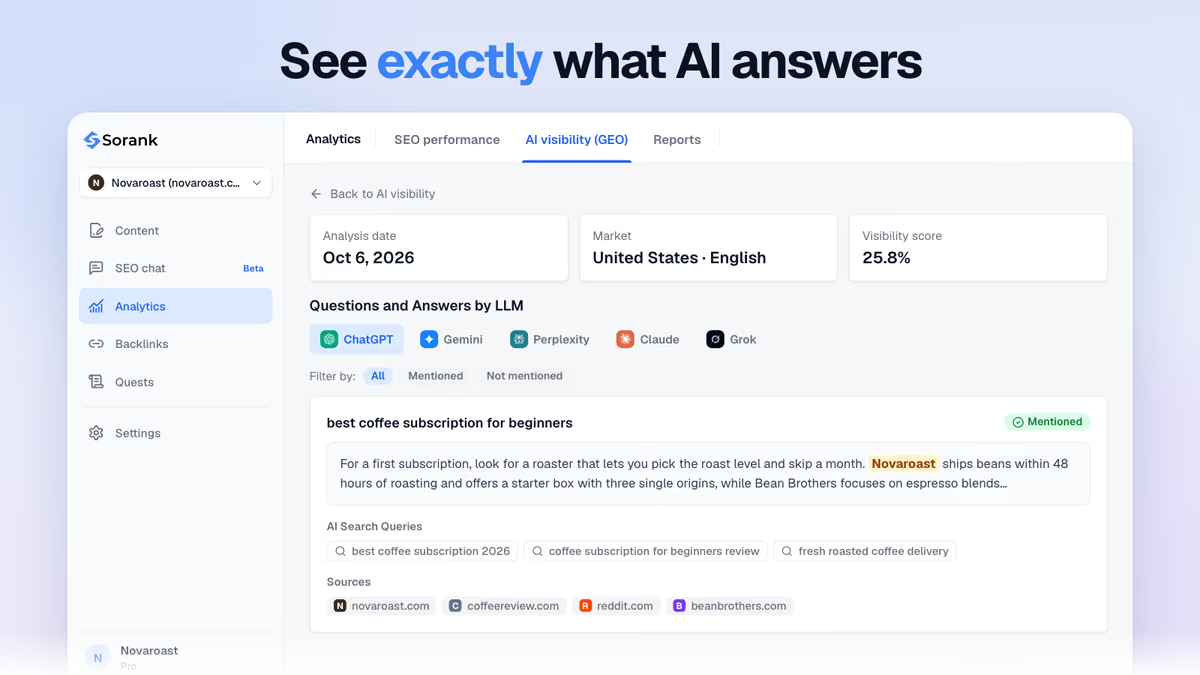
Generative search optimization is about becoming the trusted source AI search understands, trusts, and cites, rather than ranking a single page. It is functionally the same as generative engine optimization, builds on rather than replaces SEO, and works by making content clear and citation-ready while establishing web-wide authority around your entities. As AI answers absorb more search, GSO is how brands stay visible.
To go further, connect this with answer engine optimization and entity SEO, and use Sorank's research and content planning tools to target the questions the AIs answer. Reference sources: Superlines, Shakir Azim, and Hookflash.
Sources
Functionally, yes. GSO and GEO describe the same challenge: optimizing so AI-driven search understands, trusts, and cites your content. The names differ in emphasis, GSO aligns with the SEO naming around search experiences, while GEO emphasizes the answer engines themselves. Some practitioners treat GEO as the tactical layer inside GSO's broader strategy, but in practice the terms are used interchangeably.
No, it builds on it. The AIs often fetch and trust top-ranking pages, so strong technical SEO, on-page work, and links remain the foundation. GSO adds a layer: presenting information so generative systems can reuse it, and building authority across the wider web. The common formula is SEO plus GSO for full visibility, not one instead of the other.
Often you do not need new content. Restructuring your best existing pages helps: add answer-first sections, clear question-based headings, FAQ blocks, and schema, then strengthen internal linking within topic clusters. Reinforce your key entities with consistent naming across the web, and monitor which pages the AIs cite. These low-effort changes can start earning AI citations quickly.
 “I tested Sorank on a real client site and it's insane. It does everything an agency would bill you $1500 a month for. It's going into production on that client now.”

 Guillaume Guersanguersanguillaume.com“We are an Ads agency and we wanted to get our SEO back on track once and for all. Sorank gave us a clear view of our site, helped us prioritize optimizations, and properly structure our content. The tool is easy to use, well designed for a team, and very practical for centralizing tracking without having to juggle multiple platforms. A very solid foundation to start fresh with our SEO.”
 Gaspard MadouiAds Agency
 “I just let the Sorank software do its thing, and now my DR is 25 and my page is ranking higher.”
 Lucas Flandrefoundertrace.fr“I specialized in GEO thanks to Sorank. The GEO Leaderboard allows me to show my clients their position vs competitors on ChatGPT. It’s a real commercial differentiator.”
 MélanieSEO Freelance“Great service, works well for our website and helps us understand how to improve it to rank better on Google and elsewhere. Congrats, keep going, I recommend it.”
 Hugo T.E-commerce merchant



















