Preferences
Privacy is important to us, so you have the option of disabling certain types of storage that may not be necessary for the basic functioning of the website. Blocking categories may impact your experience on the website. More information

Privacy is important to us, so you have the option of disabling certain types of storage that may not be necessary for the basic functioning of the website. Blocking categories may impact your experience on the website. More information

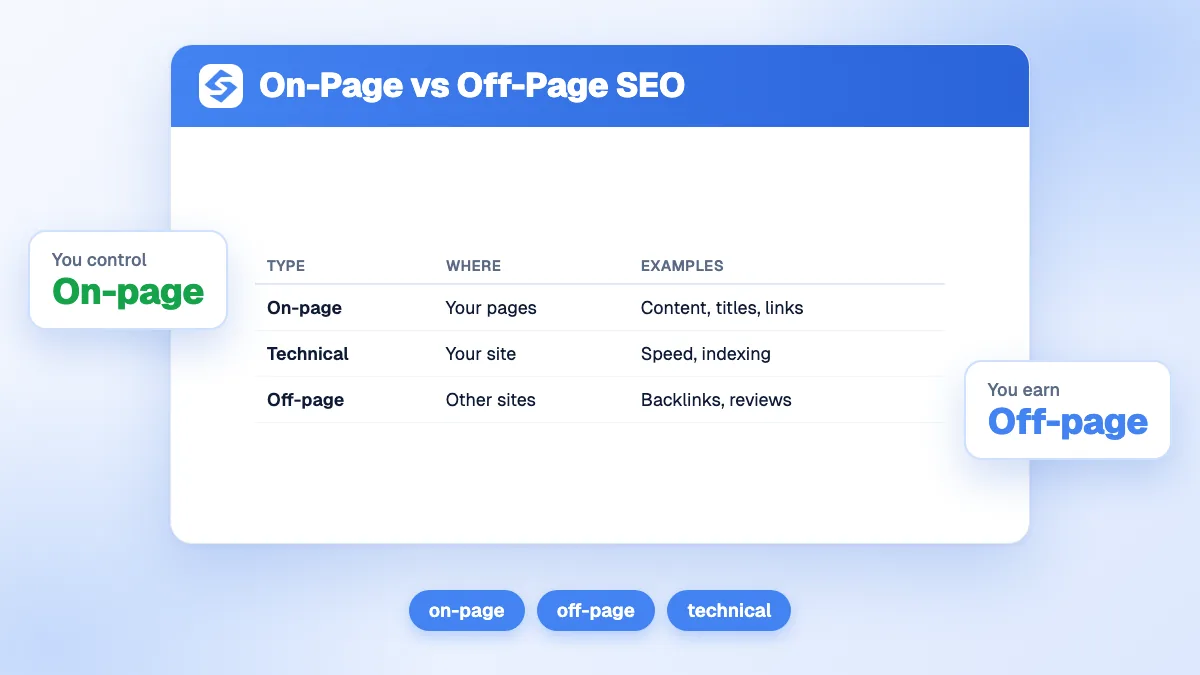
On-page vs off-page SEO: on-page is what you optimize on your pages, off-page is what other sites say about you. Factors of each, technical SEO and priorities.

Tools

In short
on-page SEO covers everything you optimize on your own pages: content, title, headings, internal links, images, structured data. Off-page SEO covers the signals that come from outside your site: backlinks, brand mentions, reviews, social and press presence. Technical SEO, often counted as a third pillar, makes sure pages can be crawled, indexed and loaded fast. Start with technical basics and on-page work, which you control fully, then build off-page authority, which you earn over time.
Want to go further? Ask
Quick quiz
Is SEO right for you, and how should you start?
Sorank matches your answers


Test it for 3 days on your own site and see where you stand on Google, ChatGPT and the other AIs.
Start 3-day free trial3 days free, then stop whenever you want. 90-day results-or-refund guarantee.
The distinction between on-page vs off-page SEO is useful because it separates what you can change today from what you must earn. Both matter: a great page with no links struggles in competitive markets, and strong links cannot save a page that does not answer the query. This guide lists the factors of each, adds technical SEO, and gives an order of priority. Definitions: on-page SEO, off-page SEO and technical SEO.
| Criterion | On-page SEO | Off-page SEO | Technical SEO |
|---|---|---|---|
| Where | On each page | On other websites and platforms | Across the site and server |
| Control | Full | Indirect (earned) | Full, sometimes needs a developer |
| Main elements | Content, title, headings, internal links, images, schema | Backlinks, mentions, reviews, PR, social signals | Crawling, indexing, speed, mobile, HTTPS, sitemaps |
| Speed of effect | Weeks after reindexing | Months, cumulative | Fast once fixed |
| Main question answered | Is this the best answer? | Is this source trusted? | Can Google access it? |
Google's SEO Starter Guide covers most of these. The free on-page audit checks a page in seconds.
Watch out
Off-page work has rules: Google's spam policies treat bought links that pass ranking credit, excessive reciprocal linking and automated link creation as link spam.
It depends on competition. In a niche with few strong competitors, excellent on-page content often ranks with modest links. In competitive markets, pages of similar quality are separated by authority, and off-page work makes the difference. In every case, on-page comes first: links pointing to a weak page are wasted.
Example
A new site writes the most complete guide on "how to clean a cast iron pan". It reaches page two, behind food media with thousands of links. Improving the guide further changes little; earning a few mentions from cooking blogs and a local newspaper moves it to page one.
Tip
Use internal links as an on-page lever for authority: link from your most-linked pages (often the home page and popular guides) to the pages you want to rank. It spreads off-page value you already have.
AI assistants use both sides: on-page clarity decides whether a passage can be quoted, and off-page reputation decides whether a brand is trusted enough to recommend. See GEO vs SEO and brand authority.
On-page SEO makes your pages the best answer; off-page SEO makes your site a trusted source; technical SEO lets Google see both. Sorank, SEO and GEO software that runs on autopilot, covers on-page content with its article generator and off-page authority by obtaining natural backlinks automatically; see the Sorank plans, with a 3-day free trial.

Sometimes it is grouped with on-page SEO because it happens on your own site, but most practitioners treat it as a separate pillar: it concerns crawling, indexing, speed and site structure rather than the content of individual pages.
Social shares are not a direct Google ranking factor, but social visibility brings readers, mentions and sometimes links, and AI assistants read some social and community platforms. They support off-page SEO indirectly.
Yes for low-competition queries and long-tail topics, where the best answer often wins without many links. For competitive queries, you will usually need off-page authority as well.
We analyse your competitors, your website and your AI visibility to create a tailored content plan for free.
 AI Content Brief Generator
 FAQ Schema Generator
 AI Blog Post Ideas Generator
 Structured Data Validator (Schema Validator)
 Alt Text Checker
 Internal Link Analyzer
 Backlink Challenge
 AI Meta Description Generator
 AI Blog Title Generator
 Google Indexability Checker
 AI Blog Outline Generator
 UTM Link Builder
 Keyword Clustering Tool
 Canonical Tag Checker
 XML Sitemap Generator
 Broken Link Checker
 AI SEO Title Generator
 Headline Analyzer
 SERP Preview Tool
 Redirect Checker
 Hreflang Tag Generator
 Heading Structure Analyzer
 HTTP Headers Checker
 Favicon Extractor
 SERP CTR Calculator
 SEO vs Paid Search Savings Calculator
 SEO Share of Voice Calculator
 SEO ROI Calculator
 SEO Traffic and Revenue Forecast Calculator
 SEO Budget Calculator
 SEO Break-Even Calculator
 SaaS SEO ROI Calculator
 ROAS Calculator
 Reading Time Calculator
 Ranking Gain Simulator
 Organic Traffic Value Calculator
 Organic Traffic Estimator and Website Traffic Checker
 LTV to CAC Ratio Calculator
 Local SEO ROI Calculator
 Link Building Cost Calculator
 Keyword Value Calculator
 Keyword Opportunity Score Calculator
 Keyword Density Calculator
 GEO ROI Calculator
 GEO Content Investment Calculator
 Ecommerce SEO ROI Calculator
 Customer Lifetime Value Calculator
 Customer Acquisition Cost Calculator
 CTR Calculator
 Cost Per Article Calculator
 Conversion Rate Calculator
 Content Marketing ROI Calculator
 ChatGPT Referral Traffic Estimator
 Bounce Rate Calculator
 Backlink ROI Calculator
 AI Visibility Score Calculator
 AI Traffic Value Calculator
 AI Share of Voice Calculator
 Cost of AI Invisibility Calculator
 AI Citation Rate Calculator
 llms.txt Validator
 AI Overview Checker and AI Overviews Rank Checker
 Robots.txt Checker
 AI SEO Audit
 LLM Readability Checker
 SearchGPT Readiness Checker
 Structured Data LLM Audit
 Website Crawlability AI Audit
 Why ChatGPT Is Not Recommending My Website
 Gemini Ranking Tool
 Perplexity Ranking Checker
 LLM Citation Checker
 Answer Engine Optimization Audit
 GEO Audit
 AI Search Visibility Test
 ChatGPT Visibility Checker
 llms.txt Generator
 URL Extractor
 Webpage to Markdown
 Sitemap Checker
 SERP Volatility Sensor
 Page Size Checker
 Word Counter
 Slug Generator
 Schema Generator
 Robots Generator
 OG Preview
 Meta Tags Generator
 Image Compressor
 Favicon Generator
 On-Page SEO Audit: SEO Checker and SEO Analyzer
 Backlink Analysis Tool
 Keyword Research Tool
 Domain Authority Checker
THEY TRIED SORANK BEFORE YOU
 “I tested Sorank on a real client site and it's insane. It does everything an agency would bill you $1500 a month for. It's going into production on that client now.”

 Guillaume Guersanguersanguillaume.com“We are an Ads agency and we wanted to get our SEO back on track once and for all. Sorank gave us a clear view of our site, helped us prioritize optimizations, and properly structure our content. The tool is easy to use, well designed for a team, and very practical for centralizing tracking without having to juggle multiple platforms. A very solid foundation to start fresh with our SEO.”
 Gaspard MadouiAds Agency
 “I just let the Sorank software do its thing, and now my DR is 25 and my page is ranking higher.”
 Lucas Flandrefoundertrace.fr“I specialized in GEO thanks to Sorank. The GEO Leaderboard allows me to show my clients their position vs competitors on ChatGPT. It’s a real commercial differentiator.”
 MélanieSEO Freelance“Great service, works well for our website and helps us understand how to improve it to rank better on Google and elsewhere. Congrats, keep going, I recommend it.”
 Hugo T.E-commerce merchant