Preferences
Privacy is important to us, so you have the option of disabling certain types of storage that may not be necessary for the basic functioning of the website. Blocking categories may impact your experience on the website. More information

Privacy is important to us, so you have the option of disabling certain types of storage that may not be necessary for the basic functioning of the website. Blocking categories may impact your experience on the website. More information

Link insertion (niche edits) explained: how it works, what Google says about paid links and rel=sponsored, how to evaluate a host page, and the real risks.

Tools

In short
link insertion, also called a niche edit, means adding a link to your site inside an article that already exists on another website, instead of publishing a new guest post. Google treats links bought or exchanged for ranking purposes as link spam unless they carry rel="sponsored" or rel="nofollow". A link insertion is safe when it is editorial (the site owner adds it because it improves the page, without payment) or when a paid placement is labeled as sponsored.
Want to go further? Ask
Quick quiz
How should you get links from other websites?
Sorank matches your answers


Test it for 3 days on your own site and see where you stand on Google, ChatGPT and the other AIs.
Start 3-day free trial3 days free, then stop whenever you want. 90-day results-or-refund guarantee.
Link insertion is popular because the host page is already indexed, often already ranking, and already has its own backlinks. It is also one of the link building tactics most exposed to Google's rules. Google's spam policies define link spam as "creating links to or from a site primarily for the purpose of manipulating search rankings". This guide explains how niche edits work, where the line is, how to evaluate a host page and what to do instead when the risk is too high. It contains no links to link vendors.
A link insertion is a link added after publication to an existing page on a third-party site. The editor, or someone with access to the site, edits an article and turns a phrase into a link, or adds a sentence that contains one. The term "niche edit" comes from the fact that the target pages are chosen within the same niche as the linked site.
| Type of link | Where the link lives | Who writes the content | Typical compliance |
|---|---|---|---|
| Link insertion (niche edit) | An existing, often aged article | The host site; one sentence may be added | Fine if editorial; link spam if paid and unlabeled |
| Guest post | A new article on the host site | You, as a guest author | Fine if editorial; link spam if paid for ranking |
| Editorial link | Any page, chosen by the author | The author, without your input | The model Google rewards |
| Sponsored content | A paid article, disclosed | Advertiser or host | Compliant when links use rel="sponsored" |
The technique itself is neutral. What matters for Google is why the link exists: because it helps readers, or because someone paid for ranking credit.
Google's spam policies list "buying or selling links for ranking purposes" as link spam, including "exchanging money for links, or posts that contain links", "exchanging goods or services for links" and sending someone a product in exchange for a link. A paid niche edit without qualification falls squarely in that list. Our guide to buying backlinks details these rules.
Paid placements are allowed as advertising. The same policy states that such links are not a violation "as long as they are qualified" with rel="nofollow" or rel="sponsored". Google's page on qualifying outbound links recommends rel="sponsored" for "advertisements or paid placements", rel="ugc" for user-generated content and rel="nofollow" when the other values do not apply. Since September 2019, Google has said in its "Evolving nofollow" announcement that these attributes "are treated as hints". Our glossary entry on nofollow explains the difference between the values.
Enforcement is mostly automatic. In its December 2022 link spam update, Google explained that SpamBrain, its AI-based spam-prevention system, "can now detect both sites buying links, and sites used for the purpose of passing outgoing links", with the aim of neutralizing the impact of unnatural links. When automated systems are not enough, a manual action can follow.
Watch out
A paid niche edit that passes ranking credit is the exact case Google targets. The most likely outcome is a link that Google ignores, so the money is lost; the worst case is a manual action for unnatural links to your site.
Many link insertions are perfectly normal editorial work. A site owner updates an article and adds a better source, a fresh statistic or a tool that did not exist when the page was written. These situations do not involve payment:
The test is simple: would the editor add this link if no money or favor changed hands, and does the page become more useful with it?
Whether you pursue an editorial insertion or a disclosed sponsorship, judge the page, not only the domain. A strong domain with an irrelevant or abandoned page brings little.
| Criterion | Good sign | Red flag |
|---|---|---|
| Topical relevance | The article covers your subject and its readers are your buyers | Unrelated topic, link forced into a generic sentence |
| Organic visibility of the page | The page appears in Google for its main query | Indexed but invisible, or not indexed at all |
| Outbound links | A few cited sources, chosen for readers | Dozens of commercial links on unrelated topics |
| Site signals | Real authors, editorial policy, regular updates | "Write for us" or price lists for links, every article with a sponsored placement |
| Placement and anchor | Inside the body, natural wording | Footer, sidebar or exact-match commercial anchor text |
| Link attributes | Editorial follow link, or rel="sponsored" when paid | Paid link presented as editorial |
Tip
Before contacting a site, run its domain through a backlink analysis and look at its outgoing links too. A site that links to casinos, loans and supplements from articles about gardening is a link seller, whatever its authority score.
If you have bought links in the past, a backlink audit helps you list them and decide what to clean, and our article on toxic backlinks explains when a disavow is worth it.
The reply rate is lower than with paid placements, but every link obtained this way is one Google wants to count.
The durable alternatives are slower but compound: publish content that deserves citations (original data, tools, clear guides), run digital PR around that content, convert unlinked mentions, and offer real updates to pages that cite outdated sources. Our overview of link building lists the methods that fit Google's rules.
The same work also feeds AI visibility. Assistants such as ChatGPT, Gemini and Perplexity build answers from pages they consider reliable and often cite brands that appear in relevant articles, with or without a link. A mention in a well-read, on-topic article is worth more for GEO than a link hidden in an off-topic page.
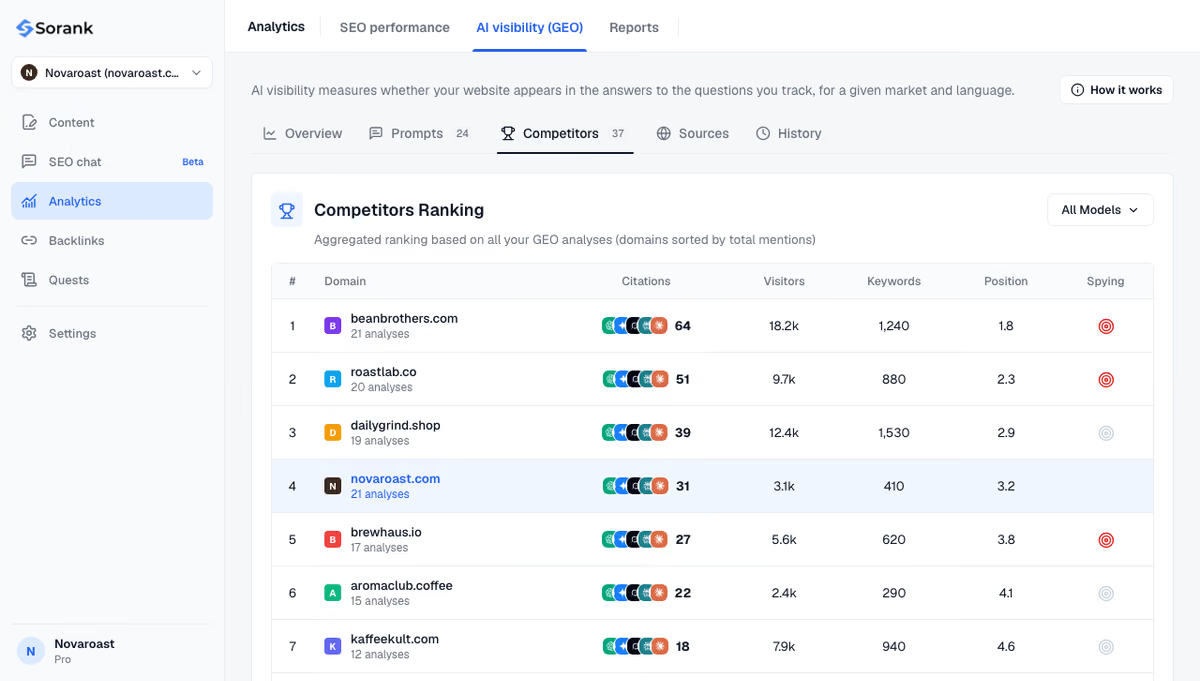
Sorank, our product, is an autopilot SEO and GEO software. It publishes optimized articles on your site and obtains natural backlinks automatically from the sites of its 5,000+ users, as described on the backlinks acquisition page. Its competitor tracking shows which sites AI assistants cite in your market, which tells you where an editorial mention would matter most.
The short version: a link insertion is safe when it improves the host page and no one paid for ranking credit; a paid placement must carry rel="sponsored". Judge every host page on relevance, visibility and outbound links before you ask. To grow links and citations without buying them, see Sorank's plans, from $49 per month with a 3-day free trial.

Yes. Both terms describe adding a link to an article that already exists on another website, rather than publishing a new article. "Niche edit" stresses that the host page is in the same niche as the linked site; "link insertion" describes the action. Google's rules apply the same way to both.
They carry a high risk of not working. Google's spam policies classify paid links for ranking as link spam, and its SpamBrain system is designed to detect sites that buy or sell links and neutralize those links. A paid placement is compliant only when the link carries rel="sponsored" or rel="nofollow", which means it is not meant to pass ranking credit.
Editorial link insertions earned through outreach cost time, not money: finding pages, writing a useful pitch and following up. Paid insertions are sold at widely varying prices, but paying for a followed link breaks Google's link spam policy, so the relevant budget question is whether the placement is worth it as labeled advertising for its audience.
We analyse your competitors, your website and your AI visibility to create a tailored content plan for free.
 AI Content Brief Generator
 FAQ Schema Generator
 AI Blog Post Ideas Generator
 Structured Data Validator (Schema Validator)
 Alt Text Checker
 Internal Link Analyzer
 Backlink Challenge
 AI Meta Description Generator
 AI Blog Title Generator
 Google Indexability Checker
 AI Blog Outline Generator
 UTM Link Builder
 Keyword Clustering Tool
 Canonical Tag Checker
 XML Sitemap Generator
 Broken Link Checker
 AI SEO Title Generator
 Headline Analyzer
 SERP Preview Tool
 Redirect Checker
 Hreflang Tag Generator
 Heading Structure Analyzer
 HTTP Headers Checker
 Favicon Extractor
 SERP CTR Calculator
 SEO vs Paid Search Savings Calculator
 SEO Share of Voice Calculator
 SEO ROI Calculator
 SEO Traffic and Revenue Forecast Calculator
 SEO Budget Calculator
 SEO Break-Even Calculator
 SaaS SEO ROI Calculator
 ROAS Calculator
 Reading Time Calculator
 Ranking Gain Simulator
 Organic Traffic Value Calculator
 Organic Traffic Estimator and Website Traffic Checker
 LTV to CAC Ratio Calculator
 Local SEO ROI Calculator
 Link Building Cost Calculator
 Keyword Value Calculator
 Keyword Opportunity Score Calculator
 Keyword Density Calculator
 GEO ROI Calculator
 GEO Content Investment Calculator
 Ecommerce SEO ROI Calculator
 Customer Lifetime Value Calculator
 Customer Acquisition Cost Calculator
 CTR Calculator
 Cost Per Article Calculator
 Conversion Rate Calculator
 Content Marketing ROI Calculator
 ChatGPT Referral Traffic Estimator
 Bounce Rate Calculator
 Backlink ROI Calculator
 AI Visibility Score Calculator
 AI Traffic Value Calculator
 AI Share of Voice Calculator
 Cost of AI Invisibility Calculator
 AI Citation Rate Calculator
 llms.txt Validator
 AI Overview Checker and AI Overviews Rank Checker
 Robots.txt Checker
 AI SEO Audit
 LLM Readability Checker
 SearchGPT Readiness Checker
 Structured Data LLM Audit
 Website Crawlability AI Audit
 Why ChatGPT Is Not Recommending My Website
 Gemini Ranking Tool
 Perplexity Ranking Checker
 LLM Citation Checker
 Answer Engine Optimization Audit
 GEO Audit
 AI Search Visibility Test
 ChatGPT Visibility Checker
 llms.txt Generator
 URL Extractor
 Webpage to Markdown
 Sitemap Checker
 SERP Volatility Sensor
 Page Size Checker
 Word Counter
 Slug Generator
 Schema Generator
 Robots Generator
 OG Preview
 Meta Tags Generator
 Image Compressor
 Favicon Generator
 On-Page SEO Audit: SEO Checker and SEO Analyzer
 Backlink Analysis Tool
 Keyword Research Tool
 Domain Authority Checker
THEY TRIED SORANK BEFORE YOU
 “I tested Sorank on a real client site and it's insane. It does everything an agency would bill you $1500 a month for. It's going into production on that client now.”

 Guillaume Guersanguersanguillaume.com“We are an Ads agency and we wanted to get our SEO back on track once and for all. Sorank gave us a clear view of our site, helped us prioritize optimizations, and properly structure our content. The tool is easy to use, well designed for a team, and very practical for centralizing tracking without having to juggle multiple platforms. A very solid foundation to start fresh with our SEO.”
 Gaspard MadouiAds Agency
 “I just let the Sorank software do its thing, and now my DR is 25 and my page is ranking higher.”
 Lucas Flandrefoundertrace.fr“I specialized in GEO thanks to Sorank. The GEO Leaderboard allows me to show my clients their position vs competitors on ChatGPT. It’s a real commercial differentiator.”
 MélanieSEO Freelance“Great service, works well for our website and helps us understand how to improve it to rank better on Google and elsewhere. Congrats, keep going, I recommend it.”
 Hugo T.E-commerce merchant