Preferences
Privacy is important to us, so you have the option of disabling certain types of storage that may not be necessary for the basic functioning of the website. Blocking categories may impact your experience on the website. More information

Privacy is important to us, so you have the option of disabling certain types of storage that may not be necessary for the basic functioning of the website. Blocking categories may impact your experience on the website. More information

The skyscraper technique explained step by step: why it fails in 2026, outreach reply rates and the information gain variant that still earns links.

Tools

In short
the skyscraper technique is a link building method in three steps: find a page that already has many backlinks, publish a clearly better version, then ask the sites linking to the original to link to yours. It still works when your page adds something the original lacks (fresh data, a tool, first-hand tests) and when outreach is personal and segmented. Making a longer copy and sending a template email no longer earns links.
Want to go further? Ask
Quick quiz
How should you get links from other websites?
Sorank matches your answers


Test it for 3 days on your own site and see where you stand on Google, ChatGPT and the other AIs.
Start 3-day free trial3 days free, then stop whenever you want. 90-day results-or-refund guarantee.
The skyscraper technique was named by Brian Dean, who described it on Backlinko: he improved a popular list, emailed 160 site owners and earned 17 links, an 11% success rate, while organic traffic to his site doubled in 14 days. The method became one of the most copied ideas in link building, and that popularity is now its main weakness. This guide covers the original method step by step, the reasons it fails today, the variant that still works, and how the same logic helps a page get cited by ChatGPT, Gemini and Perplexity.
The idea comes from architecture: the tallest building in a city gets the attention. In SEO, the "tallest" page on a topic is the one that sites cite as the reference, so the plan is to build a taller one and tell the people who cited the old one.
Brian Dean's original process has three steps:
The logic is sound: a site that linked to a resource once has shown it links to that kind of content, so it is a warm prospect, far better than a random list of blogs. What has changed is what "better" must mean and how many other people are sending the same email.
Here is the method as it should be run today, with two steps the original version skipped: understanding why the page was linked, and following up.
Pick a topic close to your offer, then list the pages that rank for it and the pages with the most backlinks. Ahrefs suggests treating pages with more than 50 referring domains as good targets. A free backlink analysis shows how many sites link to a URL and who they are. Look beyond the single best page: the backlinks of the top 5 to 10 results give you a much larger prospect list.
This is the step most campaigns skip. Read 20 to 30 of the linking pages and note the reason for the link: a statistic they quoted, a definition, a tool they recommend, a list they used as a source. Group prospects by reason. A blogger who quoted one number needs a fresher number; a resource page needs a better resource. The anchor text of each link is a fast clue to that reason.
Google's guidance on helpful content asks whether a page provides "original information, reporting, research, or analysis" and "substantial value when compared to other pages in search results". That is the bar. Length alone does not clear it; information gain does: new data, a calculator, real screenshots from tests, an updated figure where the original is outdated, a clearer table. A content brief generator helps list what the top pages cover, so you can see what is missing.
Write one short email per segment, built around the reason that site linked. Point to the exact sentence on their page, say what is outdated or missing, and give the one element of your page that fixes it. Our guide to email outreach covers finding the right contact and writing subject lines.
Example
"Hi Sarah, your guide on remote team tools cites a 2021 survey on meeting time. We just ran the same survey on 1,200 managers in 2026 and the figure has dropped by a third. The new chart is here, free to reuse with a link, if it helps keep your guide current."
Send one polite follow-up after five to seven days. Track for each segment: emails sent, replies, links earned and the quality of the linking site. If a segment gets replies but no links, the pitch is fine and the page is not convincing enough; if it gets no replies, the pitch or the targeting is wrong.
It works far less well in its original form. Ahrefs (February 2023) cites Aira's State of Link Building report: only 18% of SEOs still use it, which ranks it 20th among link building tactics. In a poll by Ahrefs of 1,242 people, 61% still said it works. Both figures say the same thing: it can work, but most practitioners have moved on.
Five reasons explain the drop:
The same study shows what still moves the numbers: one follow-up raised replies by 65.8%, a personalized email body by 32.7%, and contacting several people at the same organization by 93%.
Watch out
Never send a template word for word, and never offer money for a followed link. Recipients recognize the classic skyscraper email at first glance, and a paid link puts your whole profile at risk.
| Step | Original skyscraper | Version that works now |
|---|---|---|
| Target | One page with many links | Backlinks of the top 5 to 10 pages, grouped by reason |
| What "better" means | Longer, fresher, nicer design | New data, tool, tests or expert input the original lacks |
| Outreach | One template for everyone | One pitch per segment, pointing to the exact sentence to update |
| Follow-up | Rarely | One follow-up, several contacts per organization |
| Measure | Links earned | Reply rate and link rate per segment, quality of linking sites |
| Bonus | Google rankings | Google rankings and citations in AI answers |
The variant that works best is a data-led skyscraper: instead of rewriting the reference page, you produce the one fact everybody quotes, updated. Four forms are worth testing:
Combine the skyscraper with other methods rather than relying on it alone: digital PR for data stories, unlinked brand mentions for quick wins, and the full comparison in our guide to backlink strategies.
ChatGPT, Gemini and Perplexity build their answers from pages they can quote: a clear definition, a dated number, a comparison table. A skyscraper page built on information gain is exactly that kind of source. When a page holds the most recent figure on a topic, it can win both the backlinks and the citations in AI answers, which our study of AI citations by platform tracks across ChatGPT, Gemini, Perplexity and Claude.
The research step changes too. Besides the pages with the most backlinks, look at the pages AI assistants already cite in your niche: those are the references you need to beat. Sorank's competitor spy shows which competitors are cited by AI on your topics, and AI mention tracking follows whether your brand appears once your new page is live.
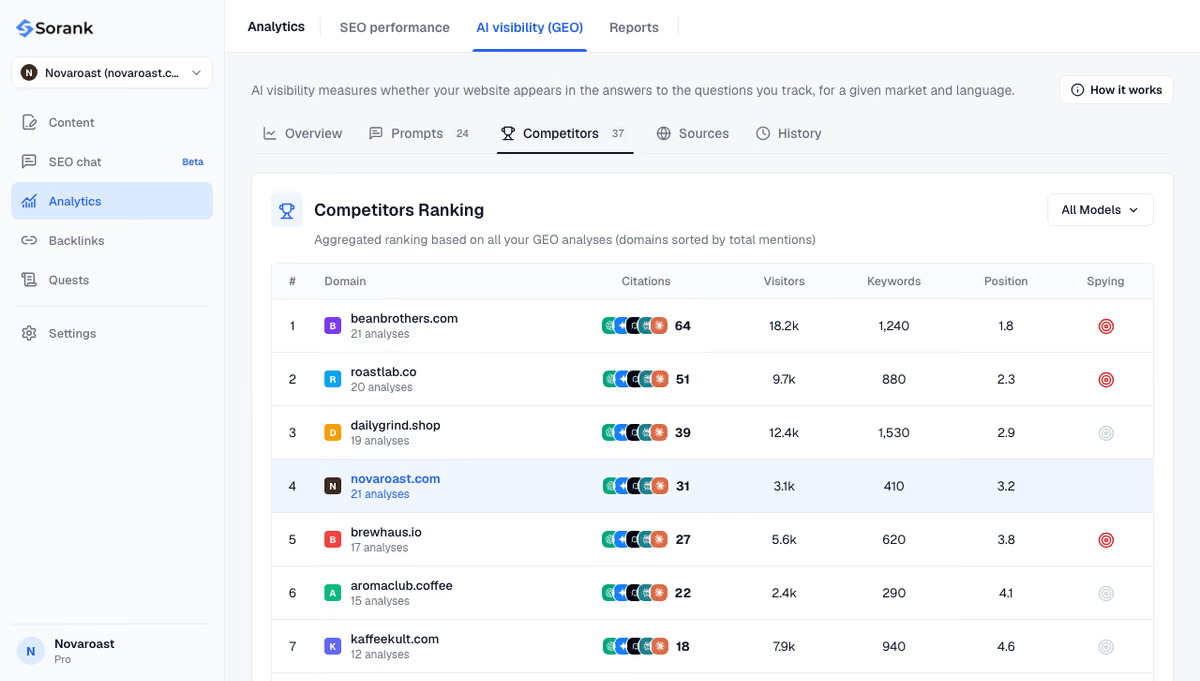
Sorank is our product: an SEO and GEO software in autopilot. Its article generator writes and publishes sourced articles for Google and AI every month, and backlink acquisition obtains natural backlinks automatically from the sites of its 5,000+ users, which covers the steady link base while you reserve skyscraper campaigns for your best assets.
Use it for one or two strong assets per quarter, not as your only link source. Pick a topic where the reference page is outdated, bring something it lacks, segment your prospects and write to each group about the exact sentence your page improves. Information gain earns the link; length does not. To keep a steady flow of optimized articles and links running in the background, see Sorank's plans, with a 3-day free trial.

Brian Dean, the founder of Backlinko, named and popularized the skyscraper technique. In his case study he improved a popular resource, emailed 160 site owners and earned 17 links, an 11% success rate. The name refers to building the tallest building in town so that it gets noticed.
Plan for several hundred prospects for one asset. A study of 12 million outreach emails by Backlinko and Pitchbox found an average reply rate of 8.5%, and only part of the replies turn into links. Segmenting prospects, personalizing the email and sending one follow-up raise the rate significantly.
The skyscraper technique asks sites to swap a working link to a competitor for a link to your better page. Broken link building targets links that point to dead pages, so the site owner has a clear reason to replace them. The two combine well: a dead or outdated reference page is the easiest skyscraper target.
We analyse your competitors, your website and your AI visibility to create a tailored content plan for free.
 AI Content Brief Generator
 FAQ Schema Generator
 AI Blog Post Ideas Generator
 Structured Data Validator (Schema Validator)
 Alt Text Checker
 Internal Link Analyzer
 Backlink Challenge
 AI Meta Description Generator
 AI Blog Title Generator
 Google Indexability Checker
 AI Blog Outline Generator
 UTM Link Builder
 Keyword Clustering Tool
 Canonical Tag Checker
 XML Sitemap Generator
 Broken Link Checker
 AI SEO Title Generator
 Headline Analyzer
 SERP Preview Tool
 Redirect Checker
 Hreflang Tag Generator
 Heading Structure Analyzer
 HTTP Headers Checker
 Favicon Extractor
 SERP CTR Calculator
 SEO vs Paid Search Savings Calculator
 SEO Share of Voice Calculator
 SEO ROI Calculator
 SEO Traffic and Revenue Forecast Calculator
 SEO Budget Calculator
 SEO Break-Even Calculator
 SaaS SEO ROI Calculator
 ROAS Calculator
 Reading Time Calculator
 Ranking Gain Simulator
 Organic Traffic Value Calculator
 Organic Traffic Estimator and Website Traffic Checker
 LTV to CAC Ratio Calculator
 Local SEO ROI Calculator
 Link Building Cost Calculator
 Keyword Value Calculator
 Keyword Opportunity Score Calculator
 Keyword Density Calculator
 GEO ROI Calculator
 GEO Content Investment Calculator
 Ecommerce SEO ROI Calculator
 Customer Lifetime Value Calculator
 Customer Acquisition Cost Calculator
 CTR Calculator
 Cost Per Article Calculator
 Conversion Rate Calculator
 Content Marketing ROI Calculator
 ChatGPT Referral Traffic Estimator
 Bounce Rate Calculator
 Backlink ROI Calculator
 AI Visibility Score Calculator
 AI Traffic Value Calculator
 AI Share of Voice Calculator
 Cost of AI Invisibility Calculator
 AI Citation Rate Calculator
 llms.txt Validator
 AI Overview Checker and AI Overviews Rank Checker
 Robots.txt Checker
 AI SEO Audit
 LLM Readability Checker
 SearchGPT Readiness Checker
 Structured Data LLM Audit
 Website Crawlability AI Audit
 Why ChatGPT Is Not Recommending My Website
 Gemini Ranking Tool
 Perplexity Ranking Checker
 LLM Citation Checker
 Answer Engine Optimization Audit
 GEO Audit
 AI Search Visibility Test
 ChatGPT Visibility Checker
 llms.txt Generator
 URL Extractor
 Webpage to Markdown
 Sitemap Checker
 SERP Volatility Sensor
 Page Size Checker
 Word Counter
 Slug Generator
 Schema Generator
 Robots Generator
 OG Preview
 Meta Tags Generator
 Image Compressor
 Favicon Generator
 On-Page SEO Audit: SEO Checker and SEO Analyzer
 Backlink Analysis Tool
 Keyword Research Tool
 Domain Authority Checker
THEY TRIED SORANK BEFORE YOU
 “I tested Sorank on a real client site and it's insane. It does everything an agency would bill you $1500 a month for. It's going into production on that client now.”

 Guillaume Guersanguersanguillaume.com“We are an Ads agency and we wanted to get our SEO back on track once and for all. Sorank gave us a clear view of our site, helped us prioritize optimizations, and properly structure our content. The tool is easy to use, well designed for a team, and very practical for centralizing tracking without having to juggle multiple platforms. A very solid foundation to start fresh with our SEO.”
 Gaspard MadouiAds Agency
 “I just let the Sorank software do its thing, and now my DR is 25 and my page is ranking higher.”
 Lucas Flandrefoundertrace.fr“I specialized in GEO thanks to Sorank. The GEO Leaderboard allows me to show my clients their position vs competitors on ChatGPT. It’s a real commercial differentiator.”
 MélanieSEO Freelance“Great service, works well for our website and helps us understand how to improve it to rank better on Google and elsewhere. Congrats, keep going, I recommend it.”
 Hugo T.E-commerce merchant