Preferences
Privacy is important to us, so you have the option of disabling certain types of storage that may not be necessary for the basic functioning of the website. Blocking categories may impact your experience on the website. More information

Privacy is important to us, so you have the option of disabling certain types of storage that may not be necessary for the basic functioning of the website. Blocking categories may impact your experience on the website. More information

SEO for MSPs in 2026: the local and service keywords to target, how to build service and city pages, and the trust signals that win IT clients.

Tools

In short
SEO for MSPs means ranking for the searches a business owner types when they need outside IT help: a service plus a place ("managed IT services Denver"), a pain point ("server keeps crashing") or a compliance need ("HIPAA IT support"). It rests on four things: one page per service, a complete Google Business Profile with a defined service area, city pages with real local detail, and visible trust signals (certifications, vendor partnerships, case studies, reviews). The same pages, written as clear, factual answers, are the ones ChatGPT, Gemini and Google's AI Overviews quote when a buyer asks them to recommend an IT provider.
Want to go further? Ask
Quick quiz
Is SEO right for you, and how should you start?
Sorank matches your answers


Test it for 3 days on your own site and see where you stand on Google, ChatGPT and the other AIs.
Start 3-day free trial3 days free, then stop whenever you want. 90-day results-or-refund guarantee.
A managed service provider sells a recurring contract to a small group of local or regional companies, so SEO for MSPs is a game of a few hundred precise searches rather than millions of visits. The buyer is usually an office manager, a finance director or a founder who does not speak in acronyms, and who will compare three providers before booking a call. Google's own guidance on creating helpful, reliable content states that of all quality aspects, "trust is most important": for a company that will hold the keys to a client's network, that sentence sums up the whole strategy.
Three traits of the IT services market shape every decision below.
This is classic B2B SEO with a strong local layer, and the closest model is the playbook of a regional law or accounting firm rather than a software company.
Sort keywords by search intent and by the page that will answer them. Five families cover almost every MSP site.
| Keyword family | Examples | Intent | Page that answers it |
|---|---|---|---|
| Service + location | managed IT services Austin, IT support company Leeds, outsourced IT Lyon | Ready to buy | Service page or city page |
| Specific service | managed cybersecurity services, Microsoft 365 migration, backup and disaster recovery | Comparing providers | Dedicated service page |
| Industry + compliance | IT support for dental practices, HIPAA compliant IT, IT for law firms | Ready to buy, high value | Industry page |
| Pain point | slow office network, phishing email clicked what to do, server down | Problem aware | Blog article linking to a service |
| Cost and comparison | managed IT services pricing, MSP vs in-house IT, break-fix vs managed services | Evaluating | Pricing guide or comparison article |
Start with the first three families: they are short lists, they convert, and they are rarely contested well by local competitors. Generic terms such as "cybersecurity" or "cloud" are dominated by vendors and media, so leave them aside. A dedicated keyword research tool shows search volume and difficulty per term; then group the terms so that each page owns one topic and two pages never target the same query.
Tip
Read your support tickets and sales call notes before opening any keyword tool. The exact words clients used when they first contacted you ("our email keeps going to spam", "we need IT for a new office") are the long-tail queries your competitors never target.
The most common mistake on MSP sites is a single "Services" page listing ten offers in ten lines. Google cannot rank one page for ten different needs, and a buyer cannot judge an offer from one line. Give each core service its own page.
Industry pages follow the same pattern for verticals you serve: dental, legal, accounting, manufacturing. They match the "industry + compliance" searches and show that you know the software and regulations of that trade. If security is a core offer, our cybersecurity sector page shows how search visibility works in that market.
Local SEO is where most MSP contracts start. Google's support page on how local ranking works names three factors: relevance, distance and prominence, and prominence includes links to your business and the number of reviews you have.
Most MSPs visit clients or work remotely and do not receive walk-in customers. Google's Business Profile guidelines say service-area businesses should hide their address, and that the service area "shouldn't extend farther than about 2 hours of driving time" from where the business is based. Fill in the primary category ("Computer support and services" or "Computer consultant", depending on what fits), list each service, add real photos of the team and keep the business name exactly as it appears on your signage: adding "Best IT Support Austin" to the name breaks the rules. A complete Google Business Profile is the single biggest local lever.
Ask every client after a successful project or quarterly review, with a direct link. Reviews that mention a service and a town ("they moved our 40 users to Microsoft 365 in Plano over a weekend") help relevance more than five stars without text. Our guide on how to get more Google reviews has request templates you can adapt.
If you serve several towns, a page per town can capture "IT support + city" searches, on one condition: each page carries local substance (clients in that area, response time from your office, local regulations or industries). Pages that only swap the city name are thin content. Follow the structure in our guide to local landing pages and mark up the office with LocalBusiness schema, which Google's structured data documentation describes as the way to state hours and departments.
Watch out
Do not create a Business Profile for every town you serve or for a virtual office. Google allows one profile per real location with staff, and fake listings are a common reason for suspensions.
Handing over network access is a high-stakes decision, and your site has to answer the question "can I trust these people?" before the first call. Google groups these signals under E-E-A-T (experience, expertise, authoritativeness, trust) and notes that it is not a single ranking factor, but the same signals drive conversions.
A blog helps when each article answers a question a future client asks before buying, and links to the service that solves it. Useful formats for IT providers:
Two to four solid articles a month beat daily filler. If writing is the bottleneck, an article generator can draft and publish optimized posts from your keyword list, with internal links to your service pages, while your engineers review the technical details.
More buyers now ask an AI assistant "which MSP should I choose in Denver?" or "what should managed IT include?". Google states that there are no additional requirements to appear in AI Overviews or AI Mode: a page must be indexed and eligible to show with a snippet. Classic SEO is the entry ticket; what changes is the form of the content that gets quoted.
Our cybersecurity AI citation study (1710 AI answers measured between June and August 2026) found that the sector is the most documentation-driven of all those measured: vendor documentation is cited more than eight times its general rate, and Microsoft alone accounts for 8.36% of citations. For an MSP, the lesson is direct: precise, documentation-style pages (scope of a service, setup steps, response times, compliance coverage) are the format AI assistants pick up.
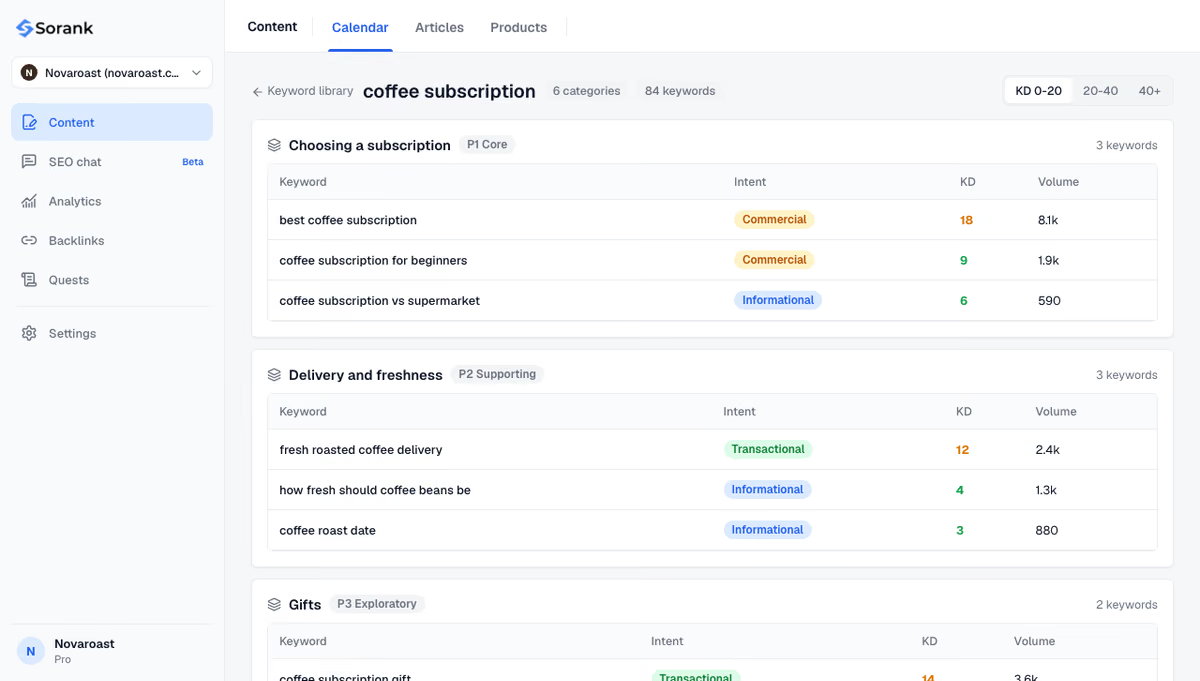
Sorank is our product: an SEO and GEO software that runs on autopilot. It finds the keywords of your market, writes and publishes optimized articles linked to your service pages, obtains natural backlinks automatically from the sites of its 5,000+ users, and tracks whether ChatGPT, Claude and Gemini cite your company. First effects on Google usually appear within 2 to 4 months.
Expect the Business Profile and reviews to move map pack visibility within weeks, and service and city pages to rank for low-competition local terms within a few months. Competitive regional terms take longer. Measure what pays the bills:
| Metric | Where to read it | Why it matters |
|---|---|---|
| Impressions and clicks on service + city queries | Google Search Console | Shows whether money pages are found |
| Calls, direction requests and website clicks | Business Profile performance | Local demand captured by the map pack |
| Assessment requests and calls from organic visits | Analytics goals, call tracking | Leads, not traffic |
| Signed contracts by first source | Your CRM | The real return on SEO |
| Mentions in AI answers | Prompt tracking | Visibility in the new buyer journey |
For a typical MSP, a dozen well-built service, industry and city pages plus a trusted Business Profile will bring more contracts than any volume of generic content. Build those first, then add articles that answer buyer questions. To run the keyword research, writing and AI tracking without hiring a team, see Sorank's plans, which start with a 3-day free trial and a 90-day money-back guarantee.

Budgets vary with the size of the service area and competition. A local MSP can start with a well-built site, a complete Business Profile and a few articles a month, using software or a freelancer; regional providers targeting competitive cities usually invest more in content and links. Judge the budget against the value of one signed contract, which renews every month.
Google's guidelines say service-area businesses that serve clients at their locations should hide their address and define a service area instead. You can still have a profile as long as staff work at that location. Keep the same name, phone and area everywhere online.
Paid search brings calls from the first day but stops when the budget stops, and IT keywords are expensive. SEO takes a few months and keeps working once pages rank. Many MSPs run ads on their most valuable service terms while building organic pages that will lower their cost per lead over time.
We analyse your competitors, your website and your AI visibility to create a tailored content plan for free.
 AI Content Brief Generator
 FAQ Schema Generator
 AI Blog Post Ideas Generator
 Structured Data Validator (Schema Validator)
 Alt Text Checker
 Internal Link Analyzer
 Backlink Challenge
 AI Meta Description Generator
 AI Blog Title Generator
 Google Indexability Checker
 AI Blog Outline Generator
 UTM Link Builder
 Keyword Clustering Tool
 Canonical Tag Checker
 XML Sitemap Generator
 Broken Link Checker
 AI SEO Title Generator
 Headline Analyzer
 SERP Preview Tool
 Redirect Checker
 Hreflang Tag Generator
 Heading Structure Analyzer
 HTTP Headers Checker
 Favicon Extractor
 SERP CTR Calculator
 SEO vs Paid Search Savings Calculator
 SEO Share of Voice Calculator
 SEO ROI Calculator
 SEO Traffic and Revenue Forecast Calculator
 SEO Budget Calculator
 SEO Break-Even Calculator
 SaaS SEO ROI Calculator
 ROAS Calculator
 Reading Time Calculator
 Ranking Gain Simulator
 Organic Traffic Value Calculator
 Organic Traffic Estimator and Website Traffic Checker
 LTV to CAC Ratio Calculator
 Local SEO ROI Calculator
 Link Building Cost Calculator
 Keyword Value Calculator
 Keyword Opportunity Score Calculator
 Keyword Density Calculator
 GEO ROI Calculator
 GEO Content Investment Calculator
 Ecommerce SEO ROI Calculator
 Customer Lifetime Value Calculator
 Customer Acquisition Cost Calculator
 CTR Calculator
 Cost Per Article Calculator
 Conversion Rate Calculator
 Content Marketing ROI Calculator
 ChatGPT Referral Traffic Estimator
 Bounce Rate Calculator
 Backlink ROI Calculator
 AI Visibility Score Calculator
 AI Traffic Value Calculator
 AI Share of Voice Calculator
 Cost of AI Invisibility Calculator
 AI Citation Rate Calculator
 llms.txt Validator
 AI Overview Checker and AI Overviews Rank Checker
 Robots.txt Checker
 AI SEO Audit
 LLM Readability Checker
 SearchGPT Readiness Checker
 Structured Data LLM Audit
 Website Crawlability AI Audit
 Why ChatGPT Is Not Recommending My Website
 Gemini Ranking Tool
 Perplexity Ranking Checker
 LLM Citation Checker
 Answer Engine Optimization Audit
 GEO Audit
 AI Search Visibility Test
 ChatGPT Visibility Checker
 llms.txt Generator
 URL Extractor
 Webpage to Markdown
 Sitemap Checker
 SERP Volatility Sensor
 Page Size Checker
 Word Counter
 Slug Generator
 Schema Generator
 Robots Generator
 OG Preview
 Meta Tags Generator
 Image Compressor
 Favicon Generator
 On-Page SEO Audit: SEO Checker and SEO Analyzer
 Backlink Analysis Tool
 Keyword Research Tool
 Domain Authority Checker
THEY TRIED SORANK BEFORE YOU
 “I tested Sorank on a real client site and it's insane. It does everything an agency would bill you $1500 a month for. It's going into production on that client now.”

 Guillaume Guersanguersanguillaume.com“We are an Ads agency and we wanted to get our SEO back on track once and for all. Sorank gave us a clear view of our site, helped us prioritize optimizations, and properly structure our content. The tool is easy to use, well designed for a team, and very practical for centralizing tracking without having to juggle multiple platforms. A very solid foundation to start fresh with our SEO.”
 Gaspard MadouiAds Agency
 “I just let the Sorank software do its thing, and now my DR is 25 and my page is ranking higher.”
 Lucas Flandrefoundertrace.fr“I specialized in GEO thanks to Sorank. The GEO Leaderboard allows me to show my clients their position vs competitors on ChatGPT. It’s a real commercial differentiator.”
 MélanieSEO Freelance“Great service, works well for our website and helps us understand how to improve it to rank better on Google and elsewhere. Congrats, keep going, I recommend it.”
 Hugo T.E-commerce merchant