Preferences
Privacy is important to us, so you have the option of disabling certain types of storage that may not be necessary for the basic functioning of the website. Blocking categories may impact your experience on the website. More information

Privacy is important to us, so you have the option of disabling certain types of storage that may not be necessary for the basic functioning of the website. Blocking categories may impact your experience on the website. More information

Barnacle SEO explained: which platforms to attach to (directories, YouTube, Reddit, Medium), how to do it step by step and why AI assistants cite them.

Tools

In short
Barnacle SEO means getting visibility on search results you cannot win with your own site by placing your brand on the large platforms that already rank for them: directories and review sites, marketplaces, YouTube, Reddit, Medium or industry publications. You build a complete, useful presence on those pages and let their authority carry you. The tactic matters even more with AI assistants, because ChatGPT, Gemini, Perplexity and Grok cite these same platforms in their answers. It complements the SEO of your own site and stays legitimate as long as you publish genuine content within each platform's rules.
Want to go further? Ask
Quick quiz
Is SEO right for you, and how should you start?
Sorank matches your answers


Test it for 3 days on your own site and see where you stand on Google, ChatGPT and the other AIs.
Start 3-day free trial3 days free, then stop whenever you want. 90-day results-or-refund guarantee.
On many queries, the first page of Google is locked: Yelp, Tripadvisor, Amazon, G2 or Wikipedia hold the top spots and a new site will not displace them for years. Barnacle SEO takes the opposite route. Will Scott of the agency Search Influence, generally credited with coining the term around 2008, described it as attaching oneself to a large fixed object and waiting for the customers to float by in the current. This guide explains which platforms to attach to in 2026, how to do it step by step, where the line with spam sits and how to measure the result on Google and in AI answers.
Barnacle SEO is an off-page tactic: instead of trying to rank your own URL for a competitive query, you secure a strong presence on the pages that already rank for it. A plumber who cannot get past the directories on "emergency plumber Lyon" completes and optimizes his listings on those directories. A software publisher who cannot beat the comparison sites gets reviewed on G2 and Capterra. A recipe brand that cannot rank against the big portals publishes videos on YouTube, which already shows in the results.
The idea came from local search, where directories and review sites dominated results long before the Google local pack took its current form. It now applies to every sector, and its two cousins are often confused with it. The table sets them apart.
| Approach | Where the content lives | Who controls it | Main risk |
|---|---|---|---|
| Classic SEO | Your own site | You, fully | Slow on competitive queries |
| Barnacle SEO | Your profile, video, post or listing on a large platform | The platform sets the rules, you supply the content | Dependence on a platform's rules and algorithm |
| Parasite SEO | Third-party content published on an authoritative host mainly to borrow its rankings | The host, often paid | Google penalty for site reputation abuse |
The difference with parasite SEO lies in intent and in the content itself. A barnacle adds something useful where users already look (a complete listing, a helpful answer, a real video). A parasite places content that does not belong on the host, only to exploit its ranking signals.
The large platforms you attach to are also the sources AI assistants cite most. In the Sorank AI citation study (301,025 AI answers collected between August 2025 and August 2026), Trustpilot is cited in 2.7% of answers, YouTube in 2.35%, Wikipedia in 1.62%, Reddit in 1.48% and Amazon in 1.12%. Directories weigh just as much: in the Sorank study of directories and marketplaces, a single sector directory, sortlist.fr, appears in 2.06% of answers, more than most social networks.
The mechanism is simple. To answer a question, Google explains that AI Overviews and AI Mode may run multiple related searches across subtopics and data sources, then pick supporting pages. Other assistants work in a similar way. If the pages that rank for "best accountant for freelancers" are a directory and a Reddit thread, the answer will draw on them. A brand that is present and well described on those pages has a chance of being named; a brand that is absent has none.
Note
Each model has its own citation habits. In the same Sorank data, YouTube is cited in 3.69% of Gemini answers and in none of Claude's, and Reddit reaches 4.11% on Grok against 0.33% on ChatGPT. Choose your platforms according to the assistants your customers use: the average across models hides these gaps.
Barnacle SEO also feeds entity consensus: when several independent sources describe your business in the same way (same name, same activity, same strengths), AI assistants are more confident about who you are and when to recommend you.
The right platform is the one that already ranks for your target queries and that your buyers trust. The table summarizes the main families.
| Platform type | Examples | What you publish | Best for |
|---|---|---|---|
| Local listings and directories | Google Business Profile, Yelp, Pages Jaunes, sector directories | Complete listing, photos, hours, categories, reviews | Local businesses, trades, clinics, restaurants |
| Review and comparison sites | Trustpilot, Tripadvisor, G2, Capterra | Verified profile, customer reviews, replies | Software, travel, ecommerce, services |
| Marketplaces | Amazon, Etsy, app stores | Product pages with full attributes and photos | Physical products, apps |
| Video | YouTube | Tutorials, comparisons, demonstrations | How-to queries, products that need showing |
| Forums and Q&A | Reddit, Quora | Expert answers, honest experience | Comparison and "best X" questions |
| Publishing platforms | Medium, LinkedIn articles | Opinion pieces, guides, case analyses | B2B, thought leadership |
| Industry publications | Trade media, top lists, roundups | Guest articles, expert quotes, inclusion in lists | Every sector |
This is the original barnacle and still the most profitable for local businesses. Start with your Google Business Profile, then the directories that rank for your trade and city. Our guide to business directories lists those that still matter. Use exactly the same name, address and phone number everywhere: Google's guidelines for representing your business require the name to match the real-world name, without added keywords or taglines, under penalty of suspension. Then work on reviews, which drive both the ranking of the listing and its citation by AI assistants (see how to get more Google reviews).
Google shows videos on many how-to and product queries, and Gemini and Perplexity cite YouTube frequently. A short tutorial with an explicit title, a description that answers the question in the first lines, chapters and a transcript can rank where your blog post never will. Our YouTube SEO and GEO guide details the settings that count.
Threads rank high on Google for "best", "vs" and "worth it" queries, and Grok and Gemini quote them. The rule is to answer as an expert, disclose your affiliation and add value before any mention of your brand: moderators and users remove anything that looks like advertising, and each subreddit has its own rules. Read our guide to Reddit for SEO and GEO before posting.
Medium and LinkedIn articles benefit from very strong domains and can rank on niche queries within days. Republish an adapted version of your best guides, with a link to the original. On Medium, join a publication in your field to gain readers. Trade media and "top 10" lists that already rank are the last lever: being included in a list on page one of Google is often worth more than a new article on your own site.
Tip
In step 2, look at the sources listed under the AI answer, not only at the text. A directory or a Reddit thread that appears in several answers is a better target than a platform with a higher domain authority that the assistants never cite.
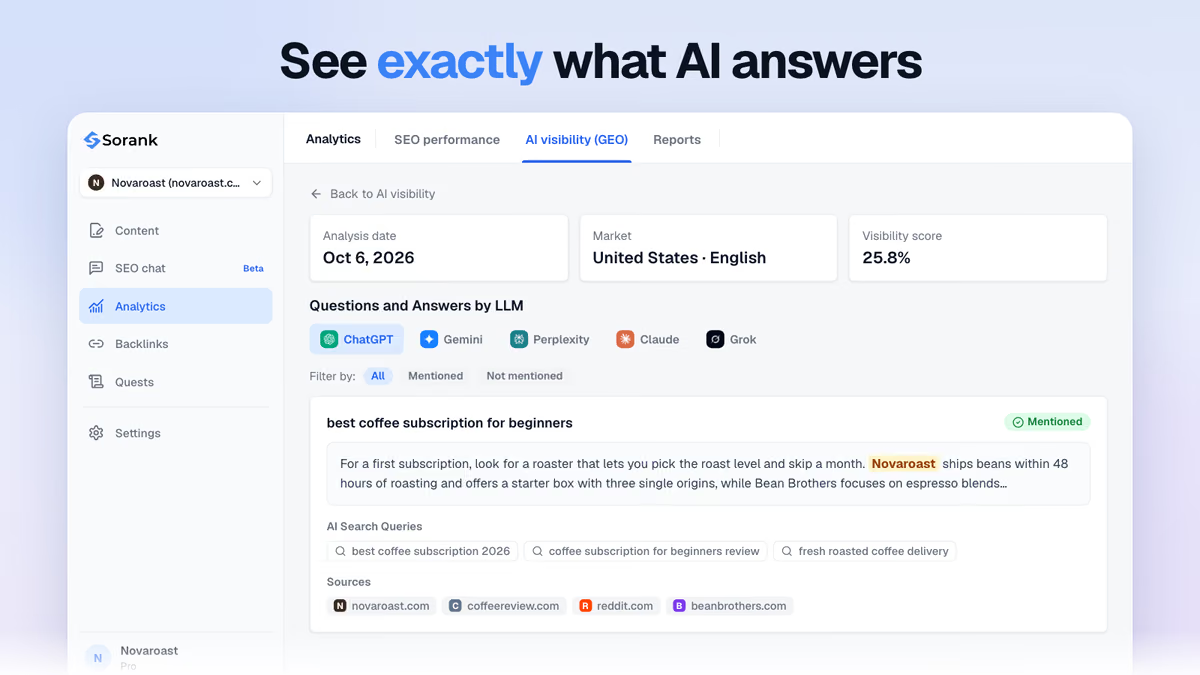
Tracking which sources the assistants cite by hand quickly becomes tedious. Sorank's AI mention tracking runs your questions on ChatGPT, Claude and Gemini (plus Grok from the Pro plan) and shows, for each answer, the brands mentioned and the sources cited, which gives you the list of platforms worth attaching to.
Google's spam policies define site reputation abuse as third-party content published on a host site mainly because of that host's ranking signals. The policy explicitly excludes sites designed for user-generated content, such as forums, as well as editorial content under real oversight by the host. A complete directory listing, a genuine Reddit answer or a guest article accepted by an editor are therefore normal barnacle SEO. Paying a news site to host a "best casinos" page unrelated to its subject is the abuse Google targets.
Watch out
The platforms have their own rules on top of Google's. Fake reviews, multiple accounts, keyword-stuffed business names or repeated links to your own site get profiles suspended and accounts banned, and you lose the visibility you had borrowed.
Two more limits. First, you do not own the page: a platform can change its layout, its rules or its ranking overnight. Second, most links from these platforms are nofollow and pass little authority to your site. Barnacle SEO brings visibility, clicks and AI mentions; it does not replace the backlinks your own domain needs.
Measure on both sides, Google and the AI assistants.
Give each placement two to three months before judging it, and drop those that bring neither clicks nor mentions.
No. Borrowed visibility works best when it leads somewhere: the platforms send visitors and citations, and your site must turn them into customers and build its own authority over time. Mentions on third-party sites can also become links later (see our guide to unlinked brand mentions). The most robust strategy combines the two: barnacle SEO on the queries held by platforms, and content on your own site for everything else.
For that second part, Sorank finds your keywords, writes and publishes optimized articles on your site in autopilot, and tracks whether ChatGPT, Gemini and the other assistants cite your brand.
Barnacle SEO lets a small brand appear on the pages Google and the AI assistants already trust: pick the platforms that rank and get cited for your queries, build a complete and genuine presence there, and link it back to a site that converts. Start by listing your five hardest queries and the platforms that hold them.

No. Barnacle SEO consists of building a genuine presence on platforms that already rank, such as directories, review sites, YouTube or forums, within their rules. It becomes spam when it relies on fake reviews, multiple accounts or third-party content placed on a host only to borrow its rankings, which Google treats as site reputation abuse.
The term is credited to Will Scott, founder of the agency Search Influence, who introduced it in local search around 2008. He compared the tactic to a barnacle that attaches to a large fixed object and waits for customers to float by in the current.
Rarely in a way that passes authority, because most links on directories, forums, Medium or YouTube descriptions are nofollow. The value comes from visibility, referral clicks, reviews, branded searches and citations by AI assistants. Backlinks for your own domain need a separate link building effort.
We analyse your competitors, your website and your AI visibility to create a tailored content plan for free.
 AI Content Brief Generator
 FAQ Schema Generator
 AI Blog Post Ideas Generator
 Structured Data Validator (Schema Validator)
 Alt Text Checker
 Internal Link Analyzer
 Backlink Challenge
 AI Meta Description Generator
 AI Blog Title Generator
 Google Indexability Checker
 AI Blog Outline Generator
 UTM Link Builder
 Keyword Clustering Tool
 Canonical Tag Checker
 XML Sitemap Generator
 Broken Link Checker
 AI SEO Title Generator
 Headline Analyzer
 SERP Preview Tool
 Redirect Checker
 Hreflang Tag Generator
 Heading Structure Analyzer
 HTTP Headers Checker
 Favicon Extractor
 SERP CTR Calculator
 SEO vs Paid Search Savings Calculator
 SEO Share of Voice Calculator
 SEO ROI Calculator
 SEO Traffic and Revenue Forecast Calculator
 SEO Budget Calculator
 SEO Break-Even Calculator
 SaaS SEO ROI Calculator
 ROAS Calculator
 Reading Time Calculator
 Ranking Gain Simulator
 Organic Traffic Value Calculator
 Organic Traffic Estimator and Website Traffic Checker
 LTV to CAC Ratio Calculator
 Local SEO ROI Calculator
 Link Building Cost Calculator
 Keyword Value Calculator
 Keyword Opportunity Score Calculator
 Keyword Density Calculator
 GEO ROI Calculator
 GEO Content Investment Calculator
 Ecommerce SEO ROI Calculator
 Customer Lifetime Value Calculator
 Customer Acquisition Cost Calculator
 CTR Calculator
 Cost Per Article Calculator
 Conversion Rate Calculator
 Content Marketing ROI Calculator
 ChatGPT Referral Traffic Estimator
 Bounce Rate Calculator
 Backlink ROI Calculator
 AI Visibility Score Calculator
 AI Traffic Value Calculator
 AI Share of Voice Calculator
 Cost of AI Invisibility Calculator
 AI Citation Rate Calculator
 llms.txt Validator
 AI Overview Checker and AI Overviews Rank Checker
 Robots.txt Checker
 AI SEO Audit
 LLM Readability Checker
 SearchGPT Readiness Checker
 Structured Data LLM Audit
 Website Crawlability AI Audit
 Why ChatGPT Is Not Recommending My Website
 Gemini Ranking Tool
 Perplexity Ranking Checker
 LLM Citation Checker
 Answer Engine Optimization Audit
 GEO Audit
 AI Search Visibility Test
 ChatGPT Visibility Checker
 llms.txt Generator
 URL Extractor
 Webpage to Markdown
 Sitemap Checker
 SERP Volatility Sensor
 Page Size Checker
 Word Counter
 Slug Generator
 Schema Generator
 Robots Generator
 OG Preview
 Meta Tags Generator
 Image Compressor
 Favicon Generator
 On-Page SEO Audit: SEO Checker and SEO Analyzer
 Backlink Analysis Tool
 Keyword Research Tool
 Domain Authority Checker
THEY TRIED SORANK BEFORE YOU
 “I tested Sorank on a real client site and it's insane. It does everything an agency would bill you $1500 a month for. It's going into production on that client now.”

 Guillaume Guersanguersanguillaume.com“We are an Ads agency and we wanted to get our SEO back on track once and for all. Sorank gave us a clear view of our site, helped us prioritize optimizations, and properly structure our content. The tool is easy to use, well designed for a team, and very practical for centralizing tracking without having to juggle multiple platforms. A very solid foundation to start fresh with our SEO.”
 Gaspard MadouiAds Agency
 “I just let the Sorank software do its thing, and now my DR is 25 and my page is ranking higher.”
 Lucas Flandrefoundertrace.fr“I specialized in GEO thanks to Sorank. The GEO Leaderboard allows me to show my clients their position vs competitors on ChatGPT. It’s a real commercial differentiator.”
 MélanieSEO Freelance“Great service, works well for our website and helps us understand how to improve it to rank better on Google and elsewhere. Congrats, keep going, I recommend it.”
 Hugo T.E-commerce merchant