Preferences
Privacy is important to us, so you have the option of disabling certain types of storage that may not be necessary for the basic functioning of the website. Blocking categories may impact your experience on the website. More information

Privacy is important to us, so you have the option of disabling certain types of storage that may not be necessary for the basic functioning of the website. Blocking categories may impact your experience on the website. More information

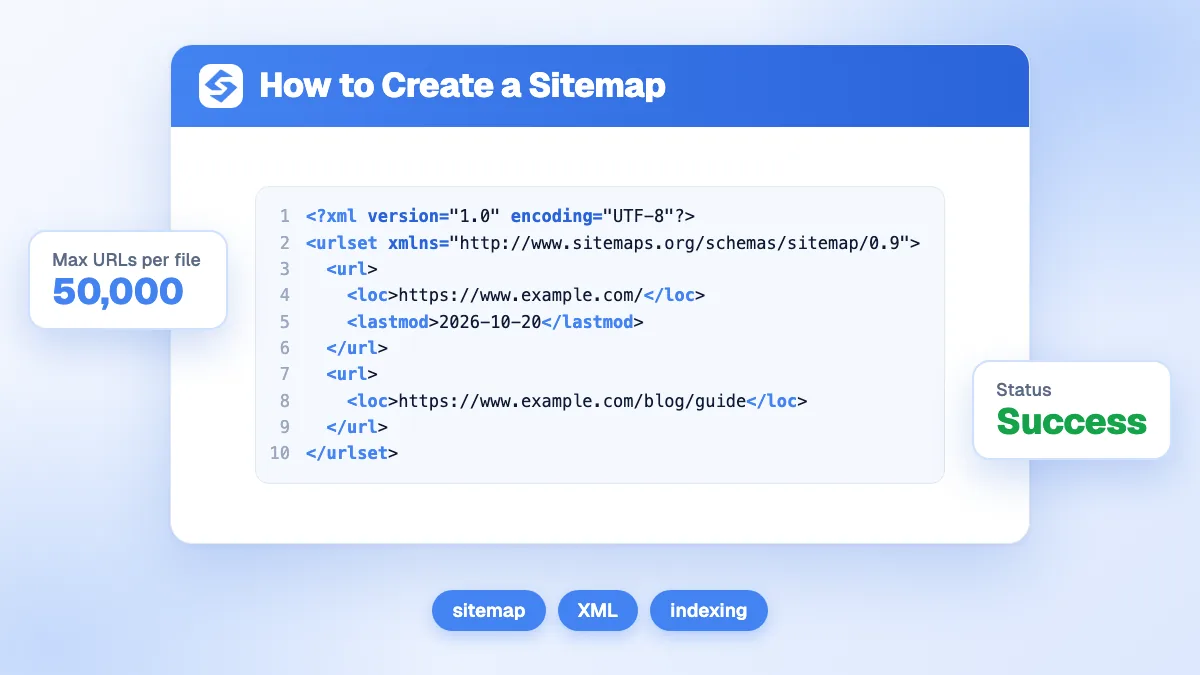
How to create a sitemap: what to include, how to generate an XML sitemap with your CMS or a free generator, Google's limits, and how to submit it in Search Console.

Tools

In short
a sitemap is a file that lists the URLs you want search engines to find, usually in XML. Most CMSs generate one automatically (WordPress, Shopify, Wix, Webflow); otherwise, use a generator or build it from your list of pages. Include only canonical, indexable pages that return 200, keep each file under 50,000 URLs or 50 MB, then submit it in Google Search Console and reference it in robots.txt. A sitemap helps discovery; it does not guarantee indexing.
Want to go further? Ask
Quick quiz
Who should fix the technical side of your site?
Our advice for you
Check whether your CMS already makes one is the right solution for you
Number 1 in this ranking, the best match for your answers.
Our advice for you
Otherwise, generate it is the right solution for you
Number 2 in this ranking, the best match for your answers.
Our advice for you
Include the right URLs is the right solution for you
Number 3 in this ranking, the best match for your answers.
Our advice for you
Respect the limits is the right solution for you
Number 4 in this ranking, the best match for your answers.
Knowing how to create a sitemap is basic SEO hygiene, especially for new sites, large sites and sites with pages that few internal links reach. This guide follows Google's documentation on building and submitting a sitemap: formats, limits, what to include, how to generate the file and how to check it. For the definition, see our glossary entry on the XML sitemap.
A sitemap tells search engines which pages exist on your site and, optionally, when they last changed. The XML format follows the open sitemaps.org protocol, supported by Google, Bing and others. Google also accepts RSS or Atom feeds and plain text files with one URL per line.
| Format | Best for | Notes |
|---|---|---|
| XML | Most sites | Supports lastmod, images, videos, news, hreflang |
| RSS / Atom | Blogs and frequently updated content | Often generated by the CMS already |
| Text (.txt) | Very simple sites | One URL per line, nothing else |
| Sitemap index | Large sites | Lists several sitemap files |
Google says sitemaps are most useful for large sites, new sites with few external links, sites with many pages not well linked internally, and sites with rich media or news. A small, well-linked site can be crawled without one, but a sitemap costs little and helps you monitor indexing in Search Console. Most SEOs create one for every site.
WordPress (core since version 5.5, or through SEO plugins), Shopify, Wix, Squarespace and Webflow generate sitemaps automatically, usually at /sitemap.xml. Open that address on your domain first.
Use a crawler or the free XML sitemap generator, or build the file from your database or framework. Static site generators and frameworks often have a sitemap plugin.
Each file can contain up to 50,000 URLs or 50 MB uncompressed, in UTF-8. Above that, split into several files and list them in a sitemap index.
Google uses lastmod only when it is consistently accurate, and ignores priority and changefreq. Update lastmod for significant content changes, not for a new copyright year.
Tip
Split large sites into one sitemap per section (products, categories, articles). In Search Console, you then see indexing coverage section by section and spot where pages are left out.
Sitemap: https://www.example.com/sitemap.xml to your robots.txt so all engines find it (the robots.txt generator can add it).Watch out
A sitemap full of URLs that redirect, return errors or carry noindex sends mixed signals and makes the Search Console reports useless. Regenerate it after redesigns and migrations, and validate it with the free sitemap checker.
| Error in Search Console | Usual cause | Fix |
|---|---|---|
| Couldn't fetch | Wrong URL, blocked by robots.txt, server error | Open the URL in a browser, check robots.txt and server |
| Invalid format or XML errors | Unescaped characters, wrong namespace | Validate the XML, escape & as & |
| URLs not indexed | Low-value, duplicate or noindex pages | Clean the list, improve the pages |
| Too many URLs | Over 50,000 entries | Split and use a sitemap index |
AI crawlers such as GPTBot and ClaudeBot also read robots.txt, where your sitemap line helps them discover pages. Decide which bots you allow (see robots.txt and AI crawlers); the free llms.txt generator covers the optional file some AI tools read.
Create a sitemap with only your indexable, canonical pages, keep it under Google's limits, submit it and watch the reports. It is a small step that makes indexing problems visible. Sorank, SEO and GEO software that runs on autopilot, publishes articles that your CMS adds to its sitemap automatically, with internal links that help discovery; see the Sorank plans, with a 3-day free trial. For indexing in general, read Google indexing.

Most CMSs publish it at /sitemap.xml or /sitemap_index.xml on your domain. You can also find it in your robots.txt (a line starting with Sitemap:) or in the Sitemaps report of Google Search Console if someone already submitted it.
No. A sitemap helps Google discover URLs, but Google decides what to crawl and index based on quality, duplication and technical access. Use the Page indexing report to see which listed pages are excluded and why.
It should update automatically whenever you publish, change or delete pages; most CMSs do this. If you generate it manually, regenerate it after each batch of changes and keep lastmod accurate.
We analyse your competitors, your website and your AI visibility to create a tailored content plan for free.
 AI Content Brief Generator
 FAQ Schema Generator
 AI Blog Post Ideas Generator
 Structured Data Validator (Schema Validator)
 Alt Text Checker
 Internal Link Analyzer
 Backlink Challenge
 AI Meta Description Generator
 AI Blog Title Generator
 Google Indexability Checker
 AI Blog Outline Generator
 UTM Link Builder
 Keyword Clustering Tool
 Canonical Tag Checker
 XML Sitemap Generator
 Broken Link Checker
 AI SEO Title Generator
 Headline Analyzer
 SERP Preview Tool
 Redirect Checker
 Hreflang Tag Generator
 Heading Structure Analyzer
 HTTP Headers Checker
 Favicon Extractor
 SERP CTR Calculator
 SEO vs Paid Search Savings Calculator
 SEO Share of Voice Calculator
 SEO ROI Calculator
 SEO Traffic and Revenue Forecast Calculator
 SEO Budget Calculator
 SEO Break-Even Calculator
 SaaS SEO ROI Calculator
 ROAS Calculator
 Reading Time Calculator
 Ranking Gain Simulator
 Organic Traffic Value Calculator
 Organic Traffic Estimator and Website Traffic Checker
 LTV to CAC Ratio Calculator
 Local SEO ROI Calculator
 Link Building Cost Calculator
 Keyword Value Calculator
 Keyword Opportunity Score Calculator
 Keyword Density Calculator
 GEO ROI Calculator
 GEO Content Investment Calculator
 Ecommerce SEO ROI Calculator
 Customer Lifetime Value Calculator
 Customer Acquisition Cost Calculator
 CTR Calculator
 Cost Per Article Calculator
 Conversion Rate Calculator
 Content Marketing ROI Calculator
 ChatGPT Referral Traffic Estimator
 Bounce Rate Calculator
 Backlink ROI Calculator
 AI Visibility Score Calculator
 AI Traffic Value Calculator
 AI Share of Voice Calculator
 Cost of AI Invisibility Calculator
 AI Citation Rate Calculator
 llms.txt Validator
 AI Overview Checker and AI Overviews Rank Checker
 Robots.txt Checker
 AI SEO Audit
 LLM Readability Checker
 SearchGPT Readiness Checker
 Structured Data LLM Audit
 Website Crawlability AI Audit
 Why ChatGPT Is Not Recommending My Website
 Gemini Ranking Tool
 Perplexity Ranking Checker
 LLM Citation Checker
 Answer Engine Optimization Audit
 GEO Audit
 AI Search Visibility Test
 ChatGPT Visibility Checker
 llms.txt Generator
 URL Extractor
 Webpage to Markdown
 Sitemap Checker
 SERP Volatility Sensor
 Page Size Checker
 Word Counter
 Slug Generator
 Schema Generator
 Robots Generator
 OG Preview
 Meta Tags Generator
 Image Compressor
 Favicon Generator
 On-Page SEO Audit: SEO Checker and SEO Analyzer
 Backlink Analysis Tool
 Keyword Research Tool
 Domain Authority Checker
THEY TRIED SORANK BEFORE YOU
 “I tested Sorank on a real client site and it's insane. It does everything an agency would bill you $1500 a month for. It's going into production on that client now.”

 Guillaume Guersanguersanguillaume.com“We are an Ads agency and we wanted to get our SEO back on track once and for all. Sorank gave us a clear view of our site, helped us prioritize optimizations, and properly structure our content. The tool is easy to use, well designed for a team, and very practical for centralizing tracking without having to juggle multiple platforms. A very solid foundation to start fresh with our SEO.”
 Gaspard MadouiAds Agency
 “I just let the Sorank software do its thing, and now my DR is 25 and my page is ranking higher.”
 Lucas Flandrefoundertrace.fr“I specialized in GEO thanks to Sorank. The GEO Leaderboard allows me to show my clients their position vs competitors on ChatGPT. It’s a real commercial differentiator.”
 MélanieSEO Freelance“Great service, works well for our website and helps us understand how to improve it to rank better on Google and elsewhere. Congrats, keep going, I recommend it.”
 Hugo T.E-commerce merchant