Preferences
Privacy is important to us, so you have the option of disabling certain types of storage that may not be necessary for the basic functioning of the website. Blocking categories may impact your experience on the website. More information

Privacy is important to us, so you have the option of disabling certain types of storage that may not be necessary for the basic functioning of the website. Blocking categories may impact your experience on the website. More information

How often should you blog? Realistic cadences by goal and site size, what Google says about frequency, and when updating old posts beats writing new ones.

Tools

In short
Most business blogs do well with one to two quality posts per week; a new site chasing search traffic benefits from two to three per week for its first months, while a blog built on expert opinion can publish twice a month. Google states that publishing at any specific frequency does not help rankings: what moves results is the number of useful pages that answer real searches, published at a pace you can keep for at least a year, plus regular updates of the posts that already rank.
Want to go further? Ask
Quick quiz
How should you run your blog?
Sorank matches your answers


Test it for 3 days on your own site and see where you stand on Google, ChatGPT and the other AIs.
Start 3-day free trial3 days free, then stop whenever you want. 90-day results-or-refund guarantee.
Ask ten marketers how often you should blog and you get ten numbers, from daily to monthly. The disagreement is real because the right cadence depends on three variables: what the blog is for, how established the site is and how many good posts the team can produce. The data also shows that the effort per post keeps rising: Orbit Media's 2026 blogger survey (1,042 content marketers) puts the average post at 1,312 words and 3 hours 20 minutes of writing time. This guide turns those variables into a cadence you can defend, explains what Google says about frequency, and shows where updates and AI answers fit in.
Not directly. Asked whether daily posting helps, Google answered during an SEO office-hours session in 2022: "Posting daily or at any specific frequency for that matter doesn't help with ranking better in Google search results" (reported by Search Engine Journal, September 2022). Frequency is a means, never a signal.
Frequency still matters indirectly, for three reasons:
The limit is quality. Google's guide to creating helpful content lists as a warning sign: "Are you producing lots of content on many different topics in hopes that some of it might perform well in search results?" Volume without a keyword plan and without real expertise drags a site down.
Start from the goal, then check what your resources allow. The ranges below combine common practice with HubSpot's frequency recommendations (updated May 2025), which suggest 6 to 8 posts per month for a blog less than a year old and 2 to 4 per month in complex niches.
| Goal | Suggested cadence | What to publish |
|---|---|---|
| Organic traffic (new site) | 8 to 12 posts per month for 3 to 6 months, then 4 to 8 | A full cluster of long-tail questions around your core topic |
| Organic traffic (established site) | 4 to 8 posts per month plus monthly updates | New keywords from the gap with competitors, refreshes of declining posts |
| Leads and sales | 2 to 4 posts per month | Comparisons, pricing, use cases, problem-solution posts close to purchase |
| Brand and expertise | 2 posts per month or fewer | Original data, strong opinions, in-depth guides that earn links |
| Local business | 2 to 4 posts per month | Local questions, service guides, seasonal topics, customer cases |
| E-commerce | 4 to 8 posts per month | Buying guides, how-to articles that link to category pages |
Competition shifts these numbers. If the sites ranking on your keywords publish 20 articles per month and have hundreds of indexed guides, two posts a month will not close the gap. Look at their blogs before settling on a cadence.
Tip
Count your keywords before you pick a frequency. A list of 120 worthwhile topics published at 4 posts a month takes 2.5 years to cover; at 10 a month it takes one year. The size of the list tells you how fast you need to go.
A young site has no history and few links, so its first goal is to show Google and readers that it covers a topic thoroughly. That argues for a higher pace at the start: two to three posts per week for the first three to six months, organized into clusters built with keyword clustering, then a steadier one to two per week. Our guide to SEO for new websites details the full first 90 days.
Two caveats keep this from turning into a race. First, results lag: a new post typically needs several months to reach its stable position, as explained in how long SEO takes, so judge a cadence after six months, not six weeks. Second, low-competition long-tail questions come first. A new blog that publishes 40 posts on broad, contested topics gets fewer visits than one that publishes 20 precise answers its competitors overlooked.
Consistency, as long as the pace is high enough for your goal. A blog that publishes eight posts in January and nothing until June loses reader habit, newsletter momentum and internal links to fresh content. A steady rhythm also makes the work plannable: briefs, writing, review and publication slot into a weekly routine instead of a scramble.
Orbit Media's long-running survey shows how hard sustaining a high pace is: the share of marketers publishing 2 to 6 times per week fell from 28% in 2014 to 12% in 2022, while the share publishing monthly doubled. In the 2026 edition, only 13.9% of marketers report strong results from their blog. More time per post and fewer posts is the dominant pattern; the sites that keep both quality and volume stand out.
Three habits help keep a rhythm:
Length is a separate decision. A post should be as long as the question requires, which our guide on how long an article should be covers; never cut depth to hit a weekly count.
Once a blog passes 50 to 100 posts, updates often bring more traffic per hour than new articles. Posts lose positions over time as competitors publish better pages and facts age, a process called content decay. A practical rhythm:
| Blog size | New posts vs updates | Review rhythm |
|---|---|---|
| Under 50 posts | Almost all new posts | Check figures and links twice a year |
| 50 to 200 posts | About 70% new, 30% updates | Quarterly review of posts losing clicks |
| Over 200 posts | About 50% new, 50% updates | Monthly review, merge or delete weak posts |
Priority goes to posts ranking in positions 5 to 20 and to posts whose clicks dropped over the last six months in Google Search Console. The method is in our guide to content refresh.
Watch out
Changing the date without changing the content does not count as an update. Google's helpful content guide explicitly flags "changing the date of pages to make them seem fresh when the content has not substantially changed".
Freshness weighs a little more in AI answers than in classic search. An Ahrefs study of about 17 million citations (July 2025) found that pages cited by ChatGPT, Perplexity, Gemini and Copilot were 25.7% fresher than pages ranking in organic Google results, measured by publication date. Google AI Overviews were the exception, citing pages of roughly the same age as the organic results.
Google also runs dedicated freshness systems that show fresher content "for queries where it would be expected", such as news, new products or yearly topics. For these subjects, a regular publishing and updating rhythm is a direct requirement. Our study of the sources ChatGPT cites shows which page types it favors. For AI answers, the practical rule is the same as for Google: cover each question clearly, keep figures dated and current, and revisit the posts that matter at least once a year.
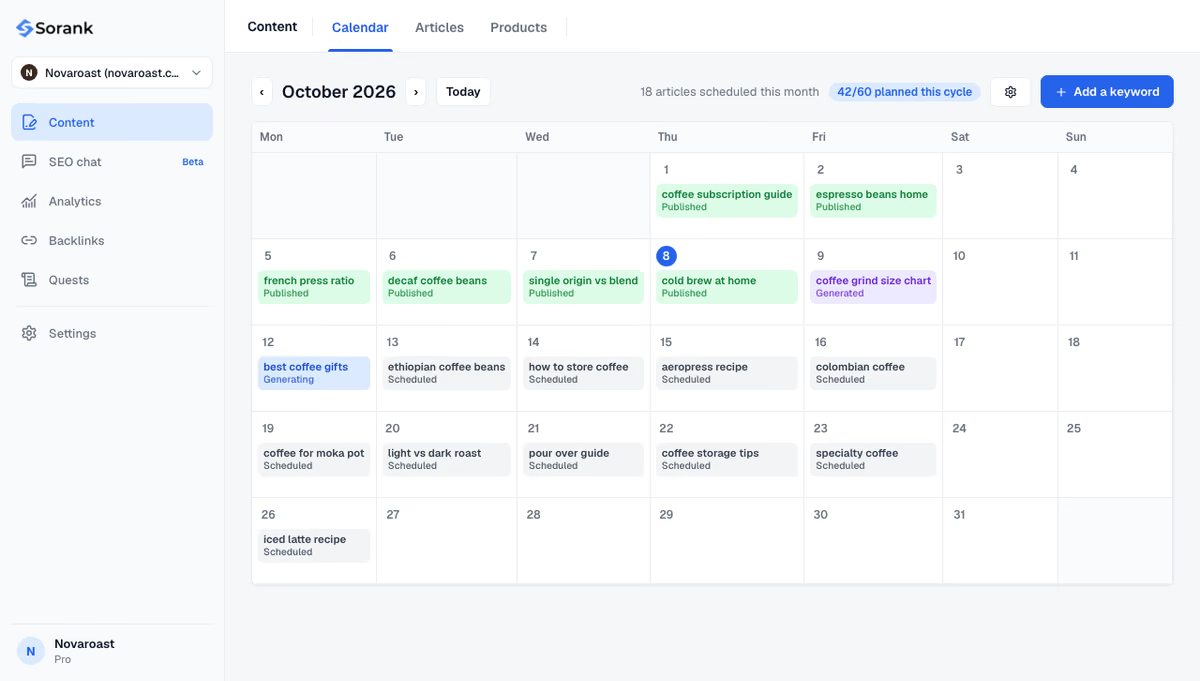
If capacity is the bottleneck, automation can carry part of the load. Sorank's blog planner builds the monthly calendar from your keywords, and its article generator writes and publishes 20, 60 or 120 sourced articles per month depending on the plan, with internal links and images, published automatically or saved as drafts for review (see pricing).
Whatever the tool, the blog's results come from the same place: posts that answer real searches, as described in our guide to blogging for SEO, and the benchmarks in our blogging statistics help you compare your pace with the market.
Publish as often as you can keep producing posts that deserve to rank, then spend a growing share of your time updating them. For most businesses that means one to two posts per week, more in the first months of a new site, fewer for an expert blog built on original insight. Set the floor, plan it in a calendar and review the numbers every quarter.

Once a week is enough for many small and medium businesses, provided each post targets a real search query and is better than what already ranks. In competitive niches or on a new site, one post a week can be slow to build topical coverage, so two to three per week for a few months helps. Consistency over a full year matters more than short bursts.
Daily blogging is not bad in itself, but Google has said that posting at any specific frequency does not improve rankings. It only pays off if every post stays useful and targets a distinct query. Many daily blogs end up with thin, overlapping posts that compete with each other, which hurts more than it helps.
Existing posts keep ranking for a while, so traffic rarely drops at once. Over time, posts age, competitors publish fresher pages and positions slip, especially on topics where freshness matters. Restarting with updates of your best posts is usually the fastest way to recover.
We analyse your competitors, your website and your AI visibility to create a tailored content plan for free.
 AI Content Brief Generator
 FAQ Schema Generator
 AI Blog Post Ideas Generator
 Structured Data Validator (Schema Validator)
 Alt Text Checker
 Internal Link Analyzer
 Backlink Challenge
 AI Meta Description Generator
 AI Blog Title Generator
 Google Indexability Checker
 AI Blog Outline Generator
 UTM Link Builder
 Keyword Clustering Tool
 Canonical Tag Checker
 XML Sitemap Generator
 Broken Link Checker
 AI SEO Title Generator
 Headline Analyzer
 SERP Preview Tool
 Redirect Checker
 Hreflang Tag Generator
 Heading Structure Analyzer
 HTTP Headers Checker
 Favicon Extractor
 SERP CTR Calculator
 SEO vs Paid Search Savings Calculator
 SEO Share of Voice Calculator
 SEO ROI Calculator
 SEO Traffic and Revenue Forecast Calculator
 SEO Budget Calculator
 SEO Break-Even Calculator
 SaaS SEO ROI Calculator
 ROAS Calculator
 Reading Time Calculator
 Ranking Gain Simulator
 Organic Traffic Value Calculator
 Organic Traffic Estimator and Website Traffic Checker
 LTV to CAC Ratio Calculator
 Local SEO ROI Calculator
 Link Building Cost Calculator
 Keyword Value Calculator
 Keyword Opportunity Score Calculator
 Keyword Density Calculator
 GEO ROI Calculator
 GEO Content Investment Calculator
 Ecommerce SEO ROI Calculator
 Customer Lifetime Value Calculator
 Customer Acquisition Cost Calculator
 CTR Calculator
 Cost Per Article Calculator
 Conversion Rate Calculator
 Content Marketing ROI Calculator
 ChatGPT Referral Traffic Estimator
 Bounce Rate Calculator
 Backlink ROI Calculator
 AI Visibility Score Calculator
 AI Traffic Value Calculator
 AI Share of Voice Calculator
 Cost of AI Invisibility Calculator
 AI Citation Rate Calculator
 llms.txt Validator
 AI Overview Checker and AI Overviews Rank Checker
 Robots.txt Checker
 AI SEO Audit
 LLM Readability Checker
 SearchGPT Readiness Checker
 Structured Data LLM Audit
 Website Crawlability AI Audit
 Why ChatGPT Is Not Recommending My Website
 Gemini Ranking Tool
 Perplexity Ranking Checker
 LLM Citation Checker
 Answer Engine Optimization Audit
 GEO Audit
 AI Search Visibility Test
 ChatGPT Visibility Checker
 llms.txt Generator
 URL Extractor
 Webpage to Markdown
 Sitemap Checker
 SERP Volatility Sensor
 Page Size Checker
 Word Counter
 Slug Generator
 Schema Generator
 Robots Generator
 OG Preview
 Meta Tags Generator
 Image Compressor
 Favicon Generator
 On-Page SEO Audit: SEO Checker and SEO Analyzer
 Backlink Analysis Tool
 Keyword Research Tool
 Domain Authority Checker
THEY TRIED SORANK BEFORE YOU
 “I tested Sorank on a real client site and it's insane. It does everything an agency would bill you $1500 a month for. It's going into production on that client now.”

 Guillaume Guersanguersanguillaume.com“We are an Ads agency and we wanted to get our SEO back on track once and for all. Sorank gave us a clear view of our site, helped us prioritize optimizations, and properly structure our content. The tool is easy to use, well designed for a team, and very practical for centralizing tracking without having to juggle multiple platforms. A very solid foundation to start fresh with our SEO.”
 Gaspard MadouiAds Agency
 “I just let the Sorank software do its thing, and now my DR is 25 and my page is ranking higher.”
 Lucas Flandrefoundertrace.fr“I specialized in GEO thanks to Sorank. The GEO Leaderboard allows me to show my clients their position vs competitors on ChatGPT. It’s a real commercial differentiator.”
 MélanieSEO Freelance“Great service, works well for our website and helps us understand how to improve it to rank better on Google and elsewhere. Congrats, keep going, I recommend it.”
 Hugo T.E-commerce merchant