Preferences
Privacy is important to us, so you have the option of disabling certain types of storage that may not be necessary for the basic functioning of the website. Blocking categories may impact your experience on the website. More information

Privacy is important to us, so you have the option of disabling certain types of storage that may not be necessary for the basic functioning of the website. Blocking categories may impact your experience on the website. More information

Is blogging dead in 2026? No, but generic posts are. See the sourced data on traffic, AI summaries and results, and how to run a blog that still works.

Tools

In short
blogging is not dead, but the generic, keyword-stuffed blog post is. About 70 million new posts still go live on WordPress.com every month, yet only 13.9% of bloggers report strong results in 2026, an all-time low (Orbit Media, September 2026), and Google users click a classic result in 8% of visits when an AI summary appears, against 15% without one (Pew Research Center, July 2025). Blogs that publish original, expert, well-sourced answers on their own domain still win traffic on Google and citations in ChatGPT, Gemini and Perplexity.
Want to go further? Ask
Quick quiz
How should you run your blog?
Sorank matches your answers


Test it for 3 days on your own site and see where you stand on Google, ChatGPT and the other AIs.
Start 3-day free trial3 days free, then stop whenever you want. 90-day results-or-refund guarantee.
The question is blogging dead comes back every time a new channel takes off: social networks in 2010, video in 2016, AI assistants since 2023. This time the worry has numbers behind it. The Orbit Media 2026 blogger survey (1,042 content marketers) shows the lowest share of bloggers reporting strong results in thirteen years, and AI summaries now answer many of the informational questions blogs used to rank for. This guide looks at the data, separates what died from what still works, and explains how to run a blog that earns traffic and AI citations in 2026. For the full list of figures, see our blogging statistics.
Publishing volume has not collapsed. Results per post have. The table below puts the main signals side by side, each with its primary source.
| Signal | Figure | Source (date) | What it tells you |
|---|---|---|---|
| New posts on WordPress.com | About 70 million a month | WordPress.com (checked October 2026) | People still write and read blogs at scale |
| Readers on WordPress.com | 409 million people, 20 billion pages a month | WordPress.com (checked October 2026) | The audience is still there |
| Bloggers reporting strong results | 13.9%, an all-time low | Orbit Media (September 2026) | Average blogs perform worse than before |
| Bloggers using AI | 92.4% | Orbit Media (September 2026) | Writing got cheap, so volume no longer stands out |
| Google searches showing an AI summary | 18% (March 2025 sample) | Pew Research Center (July 2025) | Part of informational search is answered on the results page |
| Clicks on a classic result | 8% with an AI summary, 15% without | Pew Research Center (July 2025) | Fewer clicks on the questions AI answers well |
| Organic clicks from Google overall | "Relatively stable" year over year | Google (August 2025) | Traffic is moving between sites more than disappearing |
Read together, these figures describe a market that is concentrating. According to the WordPress.com activity page, the readers are still there, but a smaller share of blogs captures them. Blogging is alive, the average blog is struggling.
Four changes, all real, feed the claim. Each one hits a specific type of blog harder than the others.
Pew Research Center tracked the browsing of 900 US adults in March 2025: 18% of their Google searches produced an AI summary, and users clicked a link inside that summary in only 1% of visits. They also ended their browsing session more often (26% of visits with a summary, against 16% without), according to the Pew Research Center analysis. Definitions, conversions and quick facts are now classic zero-click searches.
With 92.4% of bloggers using AI, the cost of a 1,300-word post has dropped. Orbit Media also found that AI users and non-users were equally likely to report strong results: AI made marketers faster at producing the same content, without making it better.
Short video, newsletters and communities took over part of the discovery that blogs used to own. Personal diary blogs, the original form of blogging, lost most of their readers to these formats years ago.
18% of bloggers in the 2026 Orbit survey do not know whether their blog delivers results, against 9% to 14% for a decade. When attribution breaks, the channel looks dead even when it still drives sales.
Note
Most articles that answer this question are written by bloggers or blogging tool vendors, who have a stake in the answer. Look for primary data (surveys with a sample size, browsing panels, platform figures) rather than opinions.
AI changed where the reader meets your content, not whether the reader needs it. Three shifts matter for anyone who publishes.
There is no secret format for AI either. Google's documentation on AI features states that there are no additional requirements to appear in AI Overviews or AI Mode: a page must be indexed and eligible for a snippet. The fundamentals of blogging for SEO still decide who gets picked.
The data points to a clear split. The left column describes the blogs that lose traffic in 2026; the right column describes the ones that still report results.
| Dying model | Model that still works |
|---|---|
| Short posts answering a definition or a quick fact | In-depth answers to questions with several steps, trade-offs or numbers |
| Unedited AI drafts published in bulk | AI-assisted drafts reviewed and enriched by someone who knows the subject |
| Rewrites of the top 10 results | Original data, tests, cases and first-hand experience |
| Posts on third-party platforms only | Posts on your own domain, shared on social channels |
| Publishing once and forgetting | Regular updates of the posts that already rank |
| Measuring pageviews only | Measuring rankings, conversions and AI citations |
The right column matches Orbit's correlations. Bloggers who publish original research are 50% more likely to report strong results, those who work with a formal human editor beat the benchmark by nearly two times, and collaboration with experts or influencers is the strongest predictor of all (2.6 times the benchmark), even though only 7% of bloggers still do it. In search terms, this is information gain: what your post adds that the other results do not.
Owning the domain matters too. In Sorank's measurements, Medium is cited in only 0.2% of AI answers and was never cited by ChatGPT or Claude over 13 months (Sorank Medium study, August 2026). A post on your own site builds your authority; a post on a rented platform builds theirs.
The answer depends on what the blog is for. A blog is a slow channel: expect the first effects on Google after 2 to 4 months, and plan for at least a year before judging it.
| Goal | Still worth it? | Why |
|---|---|---|
| Win customers for a business (B2B, SaaS, services, e-commerce) | Yes | Buyers research before they contact you, on Google and in AI assistants, and both rely on published pages |
| Build expertise and personal authority | Yes | Named authors with real experience are what Google and AI assistants look for |
| Earn display ad income on broad informational topics | Harder | These are the queries AI summaries answer best |
| Affiliate revenue from generic product roundups | Harder | Only first-hand testing still stands out |
| Personal diary for a large audience | Rarely | Social networks and newsletters do this job better |
If you are starting from zero, our guide on how to start a blog covers platform, structure and first posts.
Favor topics where the reader needs a method, a comparison, a price range or a decision: a summary rarely covers them fully, so readers still click through. Skip queries a single sentence can answer.
Your own numbers, screenshots, customer questions, test results or a named expert's opinion. This is the first-hand experience that the E-E-A-T framework describes, and it is what Orbit's data rewards.
Open each section with a direct answer of two or three sentences, use question headings, tables and sourced figures. Our guide on optimizing content for AI search details the format.
A content refresh of a post that sits on page one often brings more than a new post. Check figures, dates and links at least once a year.
Follow clicks and positions in Search Console, and track whether ChatGPT, Gemini or Perplexity cite your pages for the questions your buyers ask.
Tip
Before writing a new post, ask your question to ChatGPT and look at the sources it cites. If they are thin or outdated, there is room for your answer. If they are strong, find the angle they all miss.
A blog now works on two fronts at once: ranking on Google (SEO) and being cited by AI assistants (GEO, generative engine optimization). The same post can do both if it targets a real question, gives a clear answer early and brings verifiable information. The difficulty is volume and consistency: few teams can research, write, source and publish several solid posts a week.
This is the job Sorank automates. The AI blog article generator finds keywords, writes sourced articles with internal links and images, and publishes them in autopilot to WordPress, Shopify, Webflow, Wix or by webhook, or as drafts for your review. AI mention tracking then shows whether ChatGPT, Claude and Gemini cite your brand, and who they cite instead.
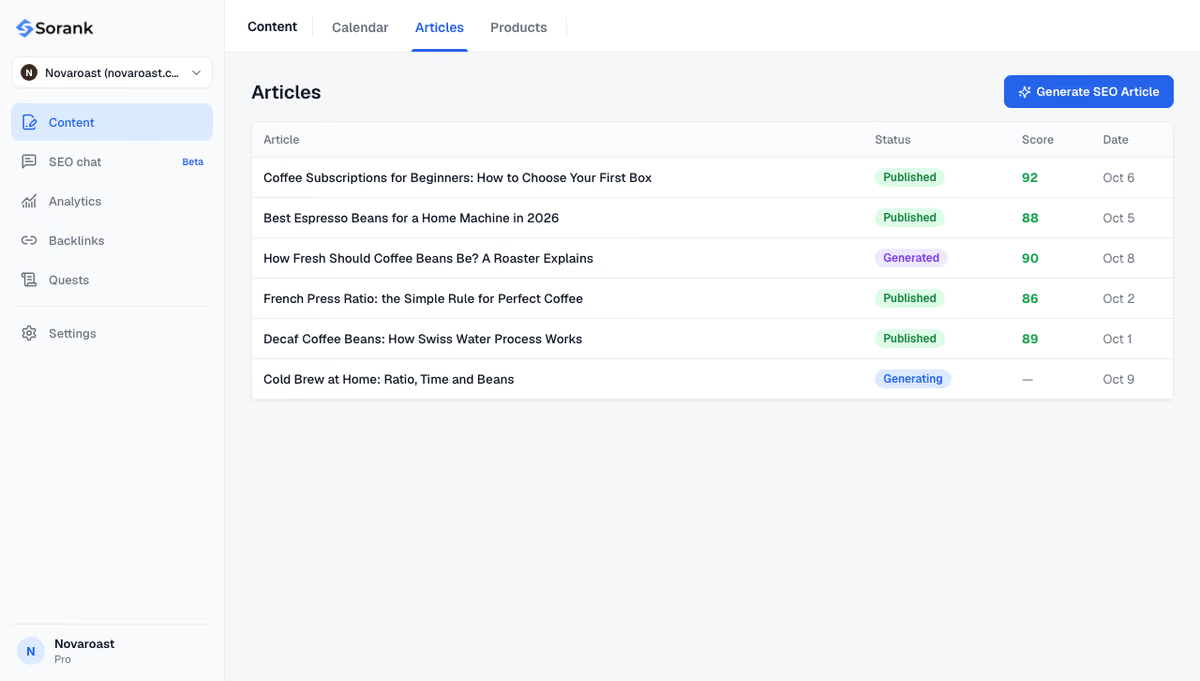
Blogging is not dead in 2026. The blogs that die are the ones that publish what an AI summary already says. A blog that adds original, expert and sourced answers on its own domain keeps earning clicks on Google and citations in AI answers. Publish fewer generic posts, more useful ones, and measure both channels. To keep that pace without hiring, see Sorank's plans: 3-day free trial, from $49 a month on annual billing.

Yes, if the blog serves a business, an expertise or a niche you know well. Buyers still research on Google and in AI assistants, and both rely on published pages. It is harder for broad informational topics monetized with display ads, because AI summaries answer those questions directly.
AI lowered the cost of writing, so generic posts multiplied and lost value. Google does not penalize content for being written with AI; it ranks content on usefulness. AI drafts work when someone adds first-hand experience, original data and a careful review before publishing.
Yes. AI assistants with web access cite their sources with links, and a blog post that answers a question clearly, with sourced figures, can be one of them. That traffic is smaller than Google's but often better qualified, so it is worth tracking which of your pages get cited.
We analyse your competitors, your website and your AI visibility to create a tailored content plan for free.
 AI Content Brief Generator
 FAQ Schema Generator
 AI Blog Post Ideas Generator
 Structured Data Validator (Schema Validator)
 Alt Text Checker
 Internal Link Analyzer
 Backlink Challenge
 AI Meta Description Generator
 AI Blog Title Generator
 Google Indexability Checker
 AI Blog Outline Generator
 UTM Link Builder
 Keyword Clustering Tool
 Canonical Tag Checker
 XML Sitemap Generator
 Broken Link Checker
 AI SEO Title Generator
 Headline Analyzer
 SERP Preview Tool
 Redirect Checker
 Hreflang Tag Generator
 Heading Structure Analyzer
 HTTP Headers Checker
 Favicon Extractor
 SERP CTR Calculator
 SEO vs Paid Search Savings Calculator
 SEO Share of Voice Calculator
 SEO ROI Calculator
 SEO Traffic and Revenue Forecast Calculator
 SEO Budget Calculator
 SEO Break-Even Calculator
 SaaS SEO ROI Calculator
 ROAS Calculator
 Reading Time Calculator
 Ranking Gain Simulator
 Organic Traffic Value Calculator
 Organic Traffic Estimator and Website Traffic Checker
 LTV to CAC Ratio Calculator
 Local SEO ROI Calculator
 Link Building Cost Calculator
 Keyword Value Calculator
 Keyword Opportunity Score Calculator
 Keyword Density Calculator
 GEO ROI Calculator
 GEO Content Investment Calculator
 Ecommerce SEO ROI Calculator
 Customer Lifetime Value Calculator
 Customer Acquisition Cost Calculator
 CTR Calculator
 Cost Per Article Calculator
 Conversion Rate Calculator
 Content Marketing ROI Calculator
 ChatGPT Referral Traffic Estimator
 Bounce Rate Calculator
 Backlink ROI Calculator
 AI Visibility Score Calculator
 AI Traffic Value Calculator
 AI Share of Voice Calculator
 Cost of AI Invisibility Calculator
 AI Citation Rate Calculator
 llms.txt Validator
 AI Overview Checker and AI Overviews Rank Checker
 Robots.txt Checker
 AI SEO Audit
 LLM Readability Checker
 SearchGPT Readiness Checker
 Structured Data LLM Audit
 Website Crawlability AI Audit
 Why ChatGPT Is Not Recommending My Website
 Gemini Ranking Tool
 Perplexity Ranking Checker
 LLM Citation Checker
 Answer Engine Optimization Audit
 GEO Audit
 AI Search Visibility Test
 ChatGPT Visibility Checker
 llms.txt Generator
 URL Extractor
 Webpage to Markdown
 Sitemap Checker
 SERP Volatility Sensor
 Page Size Checker
 Word Counter
 Slug Generator
 Schema Generator
 Robots Generator
 OG Preview
 Meta Tags Generator
 Image Compressor
 Favicon Generator
 On-Page SEO Audit: SEO Checker and SEO Analyzer
 Backlink Analysis Tool
 Keyword Research Tool
 Domain Authority Checker
THEY TRIED SORANK BEFORE YOU
 “I tested Sorank on a real client site and it's insane. It does everything an agency would bill you $1500 a month for. It's going into production on that client now.”

 Guillaume Guersanguersanguillaume.com“We are an Ads agency and we wanted to get our SEO back on track once and for all. Sorank gave us a clear view of our site, helped us prioritize optimizations, and properly structure our content. The tool is easy to use, well designed for a team, and very practical for centralizing tracking without having to juggle multiple platforms. A very solid foundation to start fresh with our SEO.”
 Gaspard MadouiAds Agency
 “I just let the Sorank software do its thing, and now my DR is 25 and my page is ranking higher.”
 Lucas Flandrefoundertrace.fr“I specialized in GEO thanks to Sorank. The GEO Leaderboard allows me to show my clients their position vs competitors on ChatGPT. It’s a real commercial differentiator.”
 MélanieSEO Freelance“Great service, works well for our website and helps us understand how to improve it to rank better on Google and elsewhere. Congrats, keep going, I recommend it.”
 Hugo T.E-commerce merchant