Preferences
Privacy is important to us, so you have the option of disabling certain types of storage that may not be necessary for the basic functioning of the website. Blocking categories may impact your experience on the website. More information

Privacy is important to us, so you have the option of disabling certain types of storage that may not be necessary for the basic functioning of the website. Blocking categories may impact your experience on the website. More information

Hosted blog or blog on your own site? Compare Medium, Substack, WordPress.com, a subdomain or a folder of your site for SEO, ownership, cost and effort.

Tools

In short
a hosted blog runs on a provider's infrastructure, such as Medium, Substack, Blogger or WordPress.com, so you publish without managing a server or a CMS. For SEO, the decisive point is the domain: articles on a platform's domain build that platform's authority, while articles on your own domain (a folder like yoursite.com/blog or a subdomain like blog.yoursite.com) build yours. The best setup for a business is a blog on its own domain, which can itself be hosted by a service so you avoid the technical work.
Want to go further? Ask
Quick quiz
How should you run your blog?
Sorank matches your answers


Test it for 3 days on your own site and see where you stand on Google, ChatGPT and the other AIs.
Start 3-day free trial3 days free, then stop whenever you want. 90-day results-or-refund guarantee.
A hosted blog is attractive when your website was built with a tool that has no blog, or when nobody on the team wants to maintain a CMS. The question is what you give up in exchange. This guide compares the main options on SEO, ownership, cost and effort, and shows how to get the convenience of hosting without losing the SEO benefit. For a broader view of tools, see our ranking of blogging platforms.
A hosted blog is a blog whose software, storage and security are managed by a provider: you write and publish, the provider runs everything else. A self-hosted blog runs on software you install on your own hosting, such as WordPress.org, so you manage updates, plugins and backups. The term also covers a middle option: a provider that hosts the blog but serves it on your own domain.
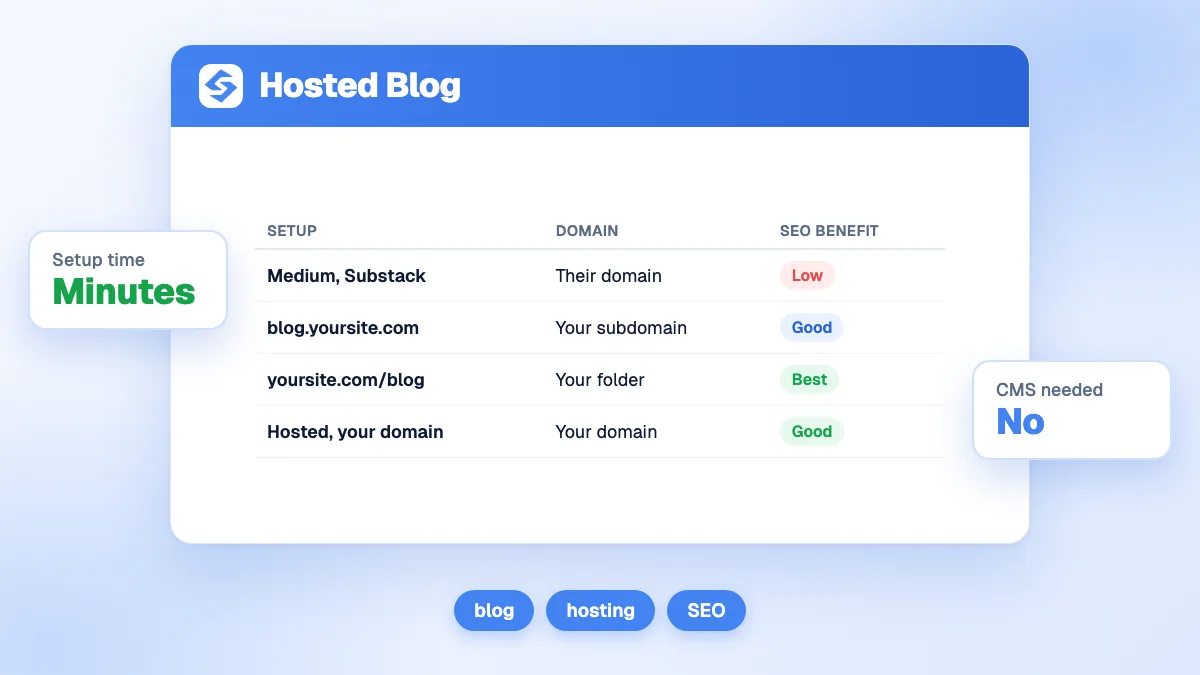
| Option | Domain | Who owns the audience and authority | Effort | SEO value for your business |
|---|---|---|---|---|
| Medium, LinkedIn articles, Substack on their domain | Platform's domain | Mostly the platform | Very low | Low: links and authority go to the platform |
| Blogger, WordPress.com free plan | Platform subdomain | Mostly the platform | Low | Low to medium |
| Hosted blog on your subdomain (blog.yoursite.com) | Your domain | You | Low | Good |
| Blog in a folder of your site (yoursite.com/blog) | Your domain | You | Low to high, depends on the setup | Very good |
| Self-hosted WordPress on your domain | Your domain | You | High (maintenance) | Very good |
Not by itself; the domain decides. Content on a third-party domain can rank and bring readers, but the links it earns and the authority it builds belong to that domain. When you stop publishing or the platform changes its rules, the traffic does not come with you. A blog on your own domain, hosted or not, adds every article to your site's authority and links readers straight to your offers.
Note
Republishing your own articles on Medium or LinkedIn can widen their reach. Publish on your site first and, where the platform allows it, point the copy to the original with a canonical link, as Google explains in its guide to consolidating duplicate URLs.
Both can work, and Google indexes both. A folder (yoursite.com/blog) keeps everything under one host, which simplifies internal linking and reporting; a subdomain (blog.yoursite.com) is easier to set up when your main site runs on a builder that cannot host a blog. Many SEO practitioners prefer folders for consolidation, but a well-linked subdomain on your own domain is far better than an external platform. Our guide to subdomain vs subfolder SEO details the trade-offs.
Tip
Whatever the setup, verify the blog in Google Search Console (a Domain property covers every subdomain and protocol, as described in Search Console Help) and link from the blog to your main pages, and back.
Sorank, SEO and GEO software that runs on autopilot, publishes articles directly to WordPress, Shopify, Webflow, Wix or any site through a webhook, and, for sites with no CMS (for example sites built with AI tools), hosts your blog for free on your own domain. It finds the keywords, writes and publishes optimized articles with sources, images and internal links through its article generator, and tracks your brand in AI answers with AI mention tracking.
Watch out
Avoid running the same articles on two of your own domains or subdomains without a canonical link. Duplicate copies split signals and make Google choose a version for you.
Host the blog wherever is easiest, but keep it on your own domain: that is where articles build lasting authority and traffic for your business. To start, read how to start a blog and blogging for SEO; to understand content systems, see what is a CMS. To publish without managing anything, see the Sorank plans, with a 3-day free trial.

A hosted blog runs on a provider's infrastructure, which handles software, storage and security. A self-hosted blog runs on software you install and maintain on your own hosting, such as WordPress.org. Hosted is easier; self-hosted gives full control. Both can live on your own domain.
Medium articles can rank because Medium is a strong domain, but the authority and links they earn stay with Medium. For a business, publish on your own site first and use Medium to republish selected articles with a canonical link to the original.
Yes. Several services host a blog on your subdomain at no cost, and Sorank hosts the blog for free for sites without a CMS when you use its software. You keep the domain, and the articles build your site's authority.
We analyse your competitors, your website and your AI visibility to create a tailored content plan for free.
 AI Content Brief Generator
 FAQ Schema Generator
 AI Blog Post Ideas Generator
 Structured Data Validator (Schema Validator)
 Alt Text Checker
 Internal Link Analyzer
 Backlink Challenge
 AI Meta Description Generator
 AI Blog Title Generator
 Google Indexability Checker
 AI Blog Outline Generator
 UTM Link Builder
 Keyword Clustering Tool
 Canonical Tag Checker
 XML Sitemap Generator
 Broken Link Checker
 AI SEO Title Generator
 Headline Analyzer
 SERP Preview Tool
 Redirect Checker
 Hreflang Tag Generator
 Heading Structure Analyzer
 HTTP Headers Checker
 Favicon Extractor
 SERP CTR Calculator
 SEO vs Paid Search Savings Calculator
 SEO Share of Voice Calculator
 SEO ROI Calculator
 SEO Traffic and Revenue Forecast Calculator
 SEO Budget Calculator
 SEO Break-Even Calculator
 SaaS SEO ROI Calculator
 ROAS Calculator
 Reading Time Calculator
 Ranking Gain Simulator
 Organic Traffic Value Calculator
 Organic Traffic Estimator and Website Traffic Checker
 LTV to CAC Ratio Calculator
 Local SEO ROI Calculator
 Link Building Cost Calculator
 Keyword Value Calculator
 Keyword Opportunity Score Calculator
 Keyword Density Calculator
 GEO ROI Calculator
 GEO Content Investment Calculator
 Ecommerce SEO ROI Calculator
 Customer Lifetime Value Calculator
 Customer Acquisition Cost Calculator
 CTR Calculator
 Cost Per Article Calculator
 Conversion Rate Calculator
 Content Marketing ROI Calculator
 ChatGPT Referral Traffic Estimator
 Bounce Rate Calculator
 Backlink ROI Calculator
 AI Visibility Score Calculator
 AI Traffic Value Calculator
 AI Share of Voice Calculator
 Cost of AI Invisibility Calculator
 AI Citation Rate Calculator
 llms.txt Validator
 AI Overview Checker and AI Overviews Rank Checker
 Robots.txt Checker
 AI SEO Audit
 LLM Readability Checker
 SearchGPT Readiness Checker
 Structured Data LLM Audit
 Website Crawlability AI Audit
 Why ChatGPT Is Not Recommending My Website
 Gemini Ranking Tool
 Perplexity Ranking Checker
 LLM Citation Checker
 Answer Engine Optimization Audit
 GEO Audit
 AI Search Visibility Test
 ChatGPT Visibility Checker
 llms.txt Generator
 URL Extractor
 Webpage to Markdown
 Sitemap Checker
 SERP Volatility Sensor
 Page Size Checker
 Word Counter
 Slug Generator
 Schema Generator
 Robots Generator
 OG Preview
 Meta Tags Generator
 Image Compressor
 Favicon Generator
 On-Page SEO Audit: SEO Checker and SEO Analyzer
 Backlink Analysis Tool
 Keyword Research Tool
 Domain Authority Checker
THEY TRIED SORANK BEFORE YOU
 “I tested Sorank on a real client site and it's insane. It does everything an agency would bill you $1500 a month for. It's going into production on that client now.”

 Guillaume Guersanguersanguillaume.com“We are an Ads agency and we wanted to get our SEO back on track once and for all. Sorank gave us a clear view of our site, helped us prioritize optimizations, and properly structure our content. The tool is easy to use, well designed for a team, and very practical for centralizing tracking without having to juggle multiple platforms. A very solid foundation to start fresh with our SEO.”
 Gaspard MadouiAds Agency
 “I just let the Sorank software do its thing, and now my DR is 25 and my page is ranking higher.”
 Lucas Flandrefoundertrace.fr“I specialized in GEO thanks to Sorank. The GEO Leaderboard allows me to show my clients their position vs competitors on ChatGPT. It’s a real commercial differentiator.”
 MélanieSEO Freelance“Great service, works well for our website and helps us understand how to improve it to rank better on Google and elsewhere. Congrats, keep going, I recommend it.”
 Hugo T.E-commerce merchant