Preferences
Privacy is important to us, so you have the option of disabling certain types of storage that may not be necessary for the basic functioning of the website. Blocking categories may impact your experience on the website. More information

Privacy is important to us, so you have the option of disabling certain types of storage that may not be necessary for the basic functioning of the website. Blocking categories may impact your experience on the website. More information

ChatGPT SEO explained: how to use ChatGPT for SEO tasks without the pitfalls, and how to get your brand found and cited when people ask ChatGPT for advice.
Tools


In short
ChatGPT SEO covers two different jobs. The first is using ChatGPT to do SEO work faster: keyword ideas, outlines, meta descriptions, schema, content briefs, always with human checks because it can invent facts. The second is getting your brand cited when people ask ChatGPT for advice, which depends on being crawlable by OpenAI, indexed in Bing, present on the sources it trusts, and clear enough to be quoted. Both matter, and the second is becoming a traffic channel of its own.
Want to go further? Ask
ChatGPT SEO is one of the most searched topics in marketing because ChatGPT now sits on both sides of the funnel: it helps marketers produce content, and it answers buyers directly. This guide covers the two sides, with a list of tasks where ChatGPT helps, the ones where it misleads, and the concrete steps that make your brand show up in its answers.
ChatGPT SEO means either using ChatGPT for SEO tasks or optimizing your site so that ChatGPT recommends it. The first is a productivity question. The second is a visibility question, close to what is called generative engine optimization (GEO) or LLM SEO.
The two are linked. Content written with ChatGPT but without original data, sources or a clear point of view tends to look like everything else, and that is precisely the kind of content ChatGPT has no reason to cite. Good use of the tool on one side helps you on the other.
ChatGPT is strong on language tasks and weak on anything that needs live data. Use it where the input is text you control and the output is easy to verify.
| SEO task | ChatGPT is useful for | Watch out for |
|---|---|---|
| Keyword research | Brainstorming seed topics, related questions, synonyms | No real search volumes; confirm with a keyword tool or Search Console |
| Content outlines | Structuring a guide from a list of questions | Generic structure; compare with what already ranks |
| Writing drafts | First drafts, rewording, simplifying jargon | Invented facts and sources; flat, interchangeable tone |
| Title tags and meta descriptions | Generating variants within a character limit | Check lengths and keep the main keyword |
| Schema markup | Drafting JSON-LD for FAQ, Article, Product | Validate with Google's Rich Results Test |
| Technical SEO | Explaining an error, writing regex or robots.txt rules | Test on a staging copy before production |
Three habits make the difference: give it context (your audience, your product, the page goal), paste your own data instead of asking it to guess, and fact-check every figure. Google's guidance on AI-generated content is clear on this point: what matters is whether content is helpful and reliable, not how it was produced, and mass-produced pages made mainly to manipulate rankings are treated as spam.
ChatGPT does not know your rankings, your traffic or today's search results unless you give them to it. Even with web search enabled, it samples a few pages; it does not replace Search Console, a rank tracker or a crawler.
ChatGPT cites pages it can retrieve at answer time and that answer the question clearly. When a prompt needs fresh or specific information, ChatGPT runs searches, reads a handful of results and builds its answer from them, linking the sources it used. OpenAI documents its crawlers publicly: OAI-SearchBot fetches pages for search, while GPTBot collects data for model training, and the two can be allowed or blocked separately in robots.txt (OpenAI crawler documentation).
For questions it answers from memory, ChatGPT relies on what it learned during training: brands that appear often and consistently across the web are more likely to be mentioned. That is why third-party mentions (reviews, comparisons, forums, media) weigh so much, as explained in our guide to LLM SEO.
Be accessible, be indexed, be quotable, and be mentioned elsewhere. The checklist below covers what you control.
Ask the questions your customers ask, regularly, and record who gets named. Answers vary from one session to the next, so a single test proves little; a stable list of prompts checked over weeks shows a trend.
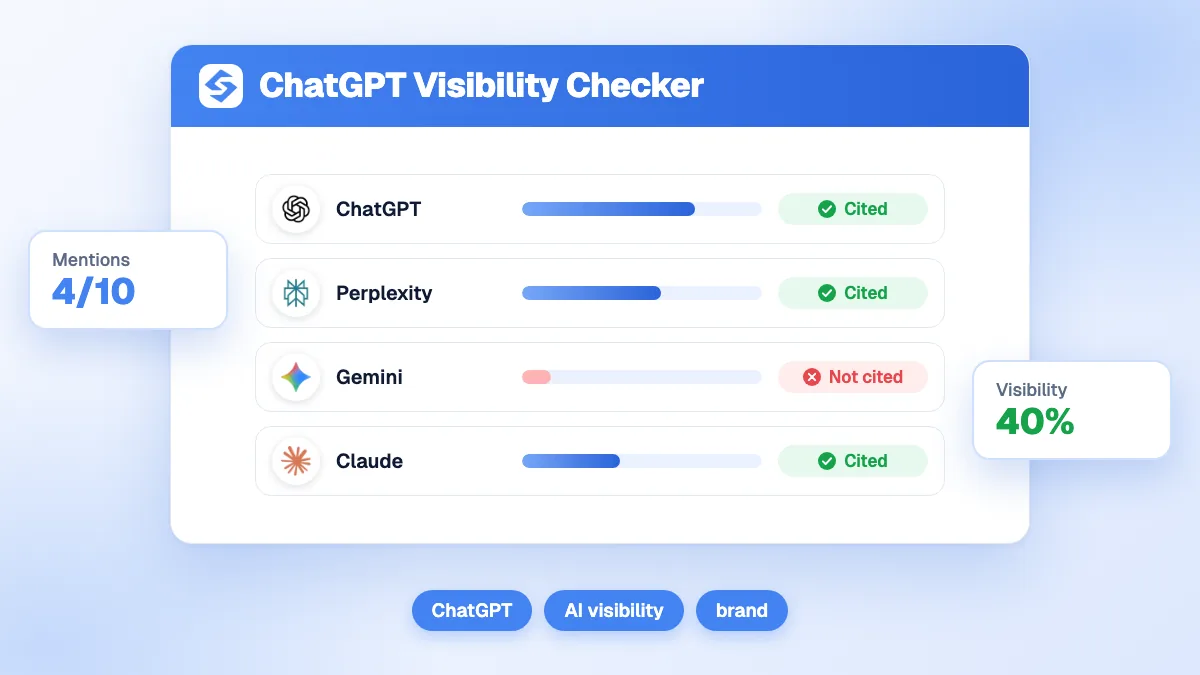
Start with a free check using our ChatGPT visibility checker. In Google Analytics, you can also watch referral sessions from chatgpt.com to see whether citations turn into visits. For ongoing monitoring across ChatGPT, Claude, Gemini, Perplexity and Grok, Sorank's ChatGPT rank tracker runs your prompts every week and shows which competitors are cited in your place.
Use ChatGPT as a fast assistant, and treat ChatGPT as a channel where your brand must earn its place. On the production side, give it context and check every fact. On the visibility side, open your site to OpenAI's crawler, get indexed in Bing, write answer-first pages with sources and build mentions on the sites the AIs trust.
Sorank handles both sides on autopilot: it tracks the prompts where ChatGPT and the other AIs answer your customers, then writes and publishes the articles that fill the gaps. See the plans and start a 3-day free trial.

ChatGPT can speed up many SEO tasks: brainstorming topics, drafting outlines, writing meta descriptions, generating schema markup or explaining a technical issue. It cannot see your real search data, check live rankings or publish for you, and it can state wrong facts with confidence. Use it as an assistant and verify every number and claim before publishing.
Make sure OpenAI's search crawler can access your pages, keep your site indexed in Bing, publish clear answers to the questions your customers ask, and earn mentions on the third-party sites ChatGPT tends to cite, such as reviews, comparisons and industry media. Then test the prompts your buyers use every month to see whether you appear.
When ChatGPT searches the web, it relies on its own crawler, OAI-SearchBot, and on third-party search providers, with Bing as a long-standing partner of OpenAI. In practice, pages that are well indexed in Bing and accessible to OpenAI's crawlers have the best chance of being retrieved and cited.
 AI Content Brief Generator
 FAQ Schema Generator
 AI Blog Post Ideas Generator
 Structured Data Validator
 Alt Text Checker
 Internal Link Analyzer
 Backlink Challenge
 AI Meta Description Generator
 AI Blog Title Generator
 Google Indexability Checker
 AI Blog Outline Generator
 UTM Link Builder
 Keyword Clustering Tool
 Canonical Tag Checker
 XML Sitemap Generator
 Broken Link Checker
 AI SEO Title Generator
 Headline Analyzer
 SERP Preview Tool
 Redirect Checker
 Hreflang Tag Generator
 Heading Structure Analyzer
 HTTP Headers Checker
 Favicon Extractor
 SERP CTR Calculator
 SEO vs Paid Search Savings Calculator
 SEO Share of Voice Calculator
 SEO ROI Calculator
 SEO Traffic and Revenue Forecast Calculator
 SEO Budget Calculator
 SEO Break-Even Calculator
 SaaS SEO ROI Calculator
 ROAS Calculator
 Reading Time Calculator
 Ranking Gain Simulator
 Organic Traffic Value Calculator
 Organic Traffic Estimator
 LTV to CAC Ratio Calculator
 Local SEO ROI Calculator
 Link Building Cost Calculator
 Keyword Value Calculator
 Keyword Opportunity Score Calculator
 Keyword Density Calculator
 GEO ROI Calculator
 GEO Content Investment Calculator
 Ecommerce SEO ROI Calculator
 Customer Lifetime Value Calculator
 Customer Acquisition Cost Calculator
 CTR Calculator
 Cost Per Article Calculator
 Conversion Rate Calculator
 Content Marketing ROI Calculator
 ChatGPT Referral Traffic Estimator
 Bounce Rate Calculator
 Backlink ROI Calculator
 AI Visibility Score Calculator
 AI Traffic Value Calculator
 AI Share of Voice Calculator
 Cost of AI Invisibility Calculator
 AI Citation Rate Calculator
 llms.txt Validator
 AI Overview Checker
 Robots.txt Checker
 AI SEO Audit
 LLM Readability Checker
 SearchGPT Readiness Checker
 Structured Data LLM Audit
 Website Crawlability AI Audit
 Why ChatGPT Is Not Recommending My Website
 Gemini Ranking Tool
 Perplexity Ranking Checker
 LLM Citation Checker
 Answer Engine Optimization Audit
 GEO Audit
 AI Search Visibility Test
 ChatGPT Visibility Checker
 llms.txt Generator
 URL Extractor
 Webpage to Markdown
 Sitemap Checker
 SERP Volatility Sensor
 Page Size Checker
 Word Counter
 Slug Generator
 Schema Generator
 Robots Generator
 OG Preview
 Meta Tags Generator
 Image Compressor
 Favicon Generator
 On-Page SEO Audit
 Backlink Analysis Tool
 Keyword Research Tool
 Domain Authority Checker
THEY TRIED SORANK BEFORE YOU
 “I tested Sorank on a real client site and it's insane. It does everything an agency would bill you $1500 a month for. It's going into production on that client now.”

 Guillaume Guersanguersanguillaume.com“We are an Ads agency and we wanted to get our SEO back on track once and for all. Sorank gave us a clear view of our site, helped us prioritize optimizations, and properly structure our content. The tool is easy to use, well designed for a team, and very practical for centralizing tracking without having to juggle multiple platforms. A very solid foundation to start fresh with our SEO.”
 Gaspard MadouiAds Agency
 “I just let the Sorank software do its thing, and now my DR is 25 and my page is ranking higher.”
 Lucas Flandrefoundertrace.fr“I specialized in GEO thanks to Sorank. The GEO Leaderboard allows me to show my clients their position vs competitors on ChatGPT. It’s a real commercial differentiator.”
 MélanieSEO Freelance“Great service, works well for our website and helps us understand how to improve it to rank better on Google and elsewhere. Congrats, keep going, I recommend it.”
 Hugo T.E-commerce merchant