Preferences
Privacy is important to us, so you have the option of disabling certain types of storage that may not be necessary for the basic functioning of the website. Blocking categories may impact your experience on the website. More information

Privacy is important to us, so you have the option of disabling certain types of storage that may not be necessary for the basic functioning of the website. Blocking categories may impact your experience on the website. More information

SEO for affiliate marketing: Google's rules on thin affiliate pages and reviews, how to tag affiliate links, keywords that convert, and visibility in AI answers.

Tools

In short
Affiliate SEO is the work of ranking content that earns a commission when readers buy through your links. Google does not penalize affiliate links, but it demotes pages that only copy merchant descriptions and rewards reviews that show first-hand testing, measurements and honest comparisons. Tag affiliate links with rel="sponsored", disclose them next to the recommendation, target buyer-intent queries such as "best X for Y" and "X vs Y", and build original evidence that AI assistants will also want to cite.
Want to go further? Ask
Quick quiz
How should you use affiliate marketing?
Sorank matches your answers


Test it for 3 days on your own site and see where you stand on Google, ChatGPT and the other AIs.
Start 3-day free trial3 days free, then stop whenever you want. 90-day results-or-refund guarantee.
SEO for affiliate marketing is one of the most competitive corners of search. Every "best" query is fought over by review sites, publishers and the merchants themselves, and Google has spent years tightening its rules for this kind of content. Its spam policies name "thin affiliation" explicitly, and its reviews guidance sets a high bar for evidence. This guide covers what Google expects, how to handle the links, which keywords convert, how to write pages that rank and what AI answers change for affiliates.
In affiliate marketing, a publisher recommends a product and earns a commission on each sale or lead made through a tracked link. Affiliate SEO is the organic side of that model: getting those recommendation pages to rank on Google so that buyers arrive without paid ads.
The appeal is compounding traffic. A comparison page that ranks keeps bringing visitors and commissions for months, while an ad stops the day the budget runs out. The risk is concentration: an affiliate site depends on a handful of high-intent pages, so one ranking update or one AI feature that answers the query directly can cut revenue overnight. Good affiliate SEO reduces that risk by building a site that deserves to rank on its own merits.
Google states plainly that affiliate links are acceptable. What it targets is affiliate content without added value. Its spam policies define thin affiliation as "publishing content with product affiliate links where the product descriptions and reviews are copied directly from the original merchant" without original content or added value. The same policy gives the counter-example: good affiliate pages offer "additional information about price, original product reviews", rigorous testing and ratings, or comparisons.
For review pages, Google's guide to writing high-quality reviews lists what it rewards, including:
Two other policies matter. Site reputation abuse covers third-party content, often coupon or affiliate sections, published on a host site mainly to exploit its ranking signals. And scaled content abuse covers pages produced in bulk mainly to manipulate rankings, whatever the method. The common thread is Google's helpful content principle: a page must exist for the reader first.
Google's documentation on outbound links asks you to mark advertisements and paid placements with rel="sponsored", and affiliate links fall into that category. The older nofollow value is still accepted, though Google says sponsored is preferred. Our guide to affiliate links covers the tracking side in detail.
| Link type | Recommended rel value | Why |
|---|---|---|
| Affiliate link to a merchant | sponsored (nofollow accepted) | You earn money from the click or sale |
| Paid placement or sponsored mention | sponsored | The link was bought |
| Link in comments or forum posts | ugc | Users wrote it, not you |
| Editorial link to a source or tool you did not get paid for | none (a normal link) | A genuine recommendation you vouch for |
Search rules are only half of it. Consumer protection rules require clear disclosure. The US Federal Trade Commission, in its Endorsement Guides FAQ, says the disclosure must be clear and conspicuous and that "the closer the disclosure is to your recommendation, the better"; it gives "I get commissions for purchases made through links in this post" as an example. European countries have similar rules on hidden advertising. Our article on sponsored content details disclosure formats.
Watch out
A disclosure buried in the footer or on a separate legal page is not enough for the FTC, and the words "affiliate link" alone may not be understood. Put a short plain sentence near the first link of each page.
Affiliate revenue comes from searchers close to a decision. Map your keywords by intent before writing anything:
| Keyword pattern | Example | Intent | Conversion potential | Competition |
|---|---|---|---|---|
| best X for Y | best running shoes for flat feet | Choosing between options | High | High on broad terms, lower on narrow ones |
| X vs Y | Kindle vs Kobo | Final comparison | High | Medium |
| X review | Dyson V15 review | Validating a choice | High | Medium to high |
| X alternatives | alternatives to Notion | Switching product | Medium to high | Medium |
| how to + task | how to clean a cast iron pan | Learning | Low, but feeds internal links | Variable |
A new affiliate site should start with narrow "best X for Y" and "X vs Y" queries where the current results are generic. Keyword research grouped by topic shows which product categories you can cover completely, which builds topical authority faster than scattered reviews across unrelated niches. Choose programs that pay for that category; our list of the best affiliate marketing programs is a starting point.
Explain how you tested: how long, in what conditions, against which criteria. Add your own photos, screenshots, measurements and scores. A short methodology section at the top of each review is the clearest signal of first-hand experience, the first E of E-E-A-T.
Tip
Keep a testing log for every product: date bought, hours of use, measurements, problems found. It feeds your reviews with specific details no competitor can copy, and it makes updates fast when a new model comes out.
Start with the verdict: the best choice overall, the best budget option and who should buy what. Then the details. Readers comparing products want the answer in seconds, and AI assistants extract the same block.
Name the limits of each product and say who it is not for. Pages that praise everything read like advertising, and Google's guidance asks for benefits and drawbacks based on your own research.
Prices, models and availability change. Review each money page at least every quarter, update the date only when the content changed, and remove products that are discontinued.
Review markup can earn star ratings in results when you review a product yourself. Our guide to review schema explains the eligibility rules, including the ban on marking up reviews of your own business.
Few sites link to a page whose main purpose is to earn commissions, so affiliate sites need assets that are worth citing on their own. What works: original test data and benchmarks, buying guides that explain how a product category works, free calculators or comparison tools, and expert quotes for journalists. Link those assets internally to your money pages, so the authority they earn flows to the reviews.
Avoid buying links on sites that sell posts to anyone: it is a direct violation of Google's link spam policy and leaves a visible footprint. Add an author page for each reviewer with real credentials, and keep the site focused on one theme: a site that reviews everything rarely becomes an authority on anything.
AI assistants now answer many "best X" questions directly, drawing on review sites, forums, marketplaces and video. Generic listicles that repeat manufacturer specs lose clicks first, because an AI summary can replace them. Pages with original data (test results, measured figures, a clear verdict with reasons) are the ones assistants cite as sources. Our study of Amazon citations in AI answers shows how often marketplaces compete with publishers for those mentions.
For an affiliate site, that means two goals: rank on Google for buyer-intent queries, and be one of the sources ChatGPT, Gemini or Perplexity cite when they recommend products in your niche. Both reward the same work: evidence, structure and a site that covers its topic in depth.
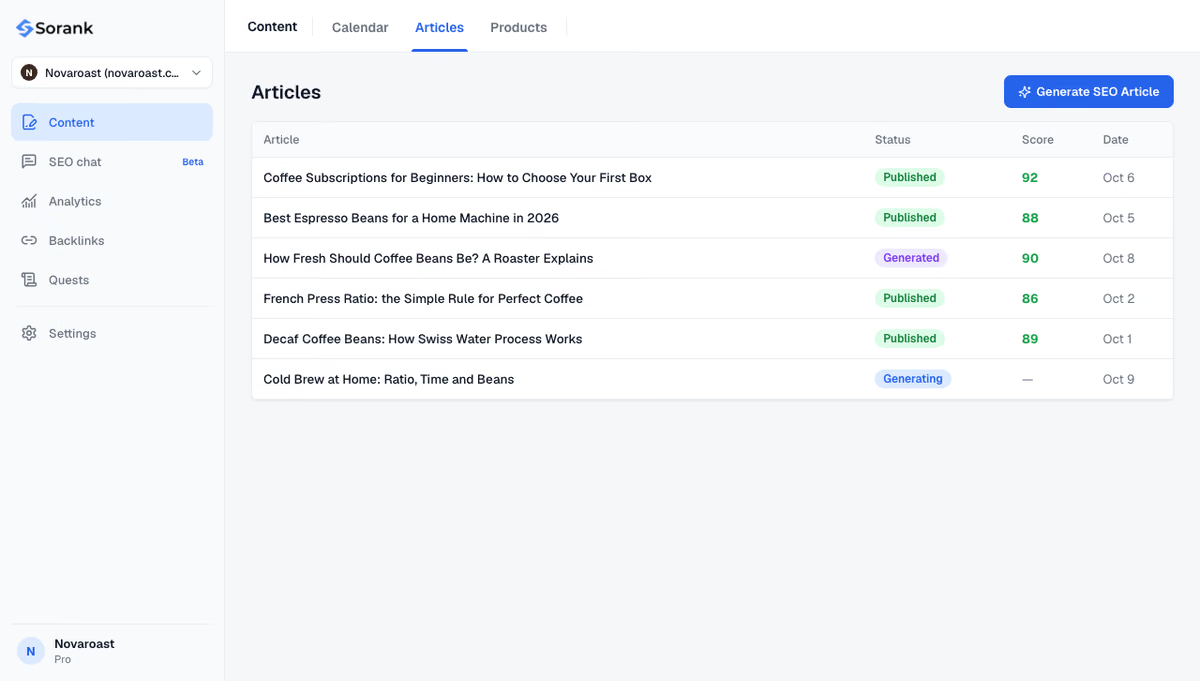
Sorank is our product, an autopilot SEO and GEO software that handles the publishing side of this work. It finds the keywords of your niche, and its blog article generator writes and publishes optimized articles with sources and internal links, as drafts if you want to add your own testing notes before they go live. AI mention tracking checks every month which brands and sites ChatGPT, Claude and Gemini cite for the questions you follow, and the software obtains natural backlinks automatically from the sites of its 5,000+ users.
The short version: affiliate links are fine, thin affiliate pages are not. Tag links as sponsored, disclose them near the recommendation, target decision queries you can cover in depth, and prove every claim with your own testing. That is what ranks on Google and what gets cited by AI. To publish that content at a steady pace, see Sorank's plans, from $49 per month with a 3-day free trial.

No. Google states that affiliate links are acceptable and do not cause a penalty by themselves. Problems come from pages that copy merchant content without adding value, or from affiliate links that are not marked with rel="sponsored" or nofollow, which Google can treat as an attempt to pass ranking signals through paid links.
Yes, if the result is useful and accurate. Google's guidance says appropriate use of AI or automation is not against its rules, while content generated in bulk mainly to manipulate rankings is. For affiliate reviews, use AI for structure and drafting, then add your own testing, photos, measurements and verdict, which no model can invent honestly.
Yes, in narrow niches where it can show more expertise than the current results. A new site should cover one product category completely, target specific comparison and "best X for Y" queries, publish original testing and earn links from relevant sites. Broad, high-volume "best" queries usually stay out of reach until the site has authority.
We analyse your competitors, your website and your AI visibility to create a tailored content plan for free.
 AI Content Brief Generator
 FAQ Schema Generator
 AI Blog Post Ideas Generator
 Structured Data Validator (Schema Validator)
 Alt Text Checker
 Internal Link Analyzer
 Backlink Challenge
 AI Meta Description Generator
 AI Blog Title Generator
 Google Indexability Checker
 AI Blog Outline Generator
 UTM Link Builder
 Keyword Clustering Tool
 Canonical Tag Checker
 XML Sitemap Generator
 Broken Link Checker
 AI SEO Title Generator
 Headline Analyzer
 SERP Preview Tool
 Redirect Checker
 Hreflang Tag Generator
 Heading Structure Analyzer
 HTTP Headers Checker
 Favicon Extractor
 SERP CTR Calculator
 SEO vs Paid Search Savings Calculator
 SEO Share of Voice Calculator
 SEO ROI Calculator
 SEO Traffic and Revenue Forecast Calculator
 SEO Budget Calculator
 SEO Break-Even Calculator
 SaaS SEO ROI Calculator
 ROAS Calculator
 Reading Time Calculator
 Ranking Gain Simulator
 Organic Traffic Value Calculator
 Organic Traffic Estimator and Website Traffic Checker
 LTV to CAC Ratio Calculator
 Local SEO ROI Calculator
 Link Building Cost Calculator
 Keyword Value Calculator
 Keyword Opportunity Score Calculator
 Keyword Density Calculator
 GEO ROI Calculator
 GEO Content Investment Calculator
 Ecommerce SEO ROI Calculator
 Customer Lifetime Value Calculator
 Customer Acquisition Cost Calculator
 CTR Calculator
 Cost Per Article Calculator
 Conversion Rate Calculator
 Content Marketing ROI Calculator
 ChatGPT Referral Traffic Estimator
 Bounce Rate Calculator
 Backlink ROI Calculator
 AI Visibility Score Calculator
 AI Traffic Value Calculator
 AI Share of Voice Calculator
 Cost of AI Invisibility Calculator
 AI Citation Rate Calculator
 llms.txt Validator
 AI Overview Checker and AI Overviews Rank Checker
 Robots.txt Checker
 AI SEO Audit
 LLM Readability Checker
 SearchGPT Readiness Checker
 Structured Data LLM Audit
 Website Crawlability AI Audit
 Why ChatGPT Is Not Recommending My Website
 Gemini Ranking Tool
 Perplexity Ranking Checker
 LLM Citation Checker
 Answer Engine Optimization Audit
 GEO Audit
 AI Search Visibility Test
 ChatGPT Visibility Checker
 llms.txt Generator
 URL Extractor
 Webpage to Markdown
 Sitemap Checker
 SERP Volatility Sensor
 Page Size Checker
 Word Counter
 Slug Generator
 Schema Generator
 Robots Generator
 OG Preview
 Meta Tags Generator
 Image Compressor
 Favicon Generator
 On-Page SEO Audit: SEO Checker and SEO Analyzer
 Backlink Analysis Tool
 Keyword Research Tool
 Domain Authority Checker
THEY TRIED SORANK BEFORE YOU
 “I tested Sorank on a real client site and it's insane. It does everything an agency would bill you $1500 a month for. It's going into production on that client now.”

 Guillaume Guersanguersanguillaume.com“We are an Ads agency and we wanted to get our SEO back on track once and for all. Sorank gave us a clear view of our site, helped us prioritize optimizations, and properly structure our content. The tool is easy to use, well designed for a team, and very practical for centralizing tracking without having to juggle multiple platforms. A very solid foundation to start fresh with our SEO.”
 Gaspard MadouiAds Agency
 “I just let the Sorank software do its thing, and now my DR is 25 and my page is ranking higher.”
 Lucas Flandrefoundertrace.fr“I specialized in GEO thanks to Sorank. The GEO Leaderboard allows me to show my clients their position vs competitors on ChatGPT. It’s a real commercial differentiator.”
 MélanieSEO Freelance“Great service, works well for our website and helps us understand how to improve it to rank better on Google and elsewhere. Congrats, keep going, I recommend it.”
 Hugo T.E-commerce merchant