Preferences
Privacy is important to us, so you have the option of disabling certain types of storage that may not be necessary for the basic functioning of the website. Blocking categories may impact your experience on the website. More information

Privacy is important to us, so you have the option of disabling certain types of storage that may not be necessary for the basic functioning of the website. Blocking categories may impact your experience on the website. More information

How to start an SEO business in 2026: pick a niche and a model, set prices, build a lean tool stack, win first clients and add AI visibility.

Tools

In short
to start an SEO business, build proof of results on sites you control, pick a niche and one clear offer, choose a model (freelance, agency, white label or reseller), set up your legal structure and pricing, then win your first clients with audits, referrals and outreach. Keep startup costs low with free tools, never promise rankings, and add AI visibility (being cited by ChatGPT, Gemini and Perplexity) to your offer, since clients now ask for it.
Want to go further? Ask
Quick quiz
Is SEO right for you, and how should you start?
Sorank matches your answers


Test it for 3 days on your own site and see where you stand on Google, ChatGPT and the other AIs.
Start 3-day free trial3 days free, then stop whenever you want. 90-day results-or-refund guarantee.
Demand is real, and so is competition. IBISWorld counts 362,753 SEO and internet marketing consulting businesses in the US in 2025, up 19.1% from 2024 (checked October 2026). In a market that crowded, the people who succeed when they start an SEO business combine a narrow offer, visible proof and a delivery process that does not eat all their time. This guide walks through each decision, in the order you will face it.
An SEO business sells more organic traffic and leads, delivered through a set of services. Google itself lists what an SEO provider can offer in its guide Do you need an SEO?: reviews of site content and structure, technical advice (hosting, redirects, error pages, JavaScript), content development, keyword research, SEO training, expertise in specific markets and now optimization for generative AI.
Most new SEO businesses package these services into four families:
A fifth family is growing fast: GEO (generative engine optimization), which aims to get a brand cited in AI answers. More on that below.
The model decides how much you earn per hour, how much risk you carry and how far you can grow without hiring. Compare them before you register anything.
| Model | Who delivers the work | Startup effort | Main limit |
|---|---|---|---|
| Freelance consultant | You, alone | Very low | Income capped by your hours |
| Niche agency | You, then contractors and employees | Medium | Payroll and management as you grow |
| White label agency | A provider, under your brand | Low | Margin depends on the provider's price and quality |
| Reseller | A provider, often under its own brand | Very low | Less control over the client relationship |
| Productized service | You, on a fixed scope and price | Low | Needs a tightly defined offer |
Many founders combine two: they deliver audits and strategy themselves and outsource repetitive production. The guide to SEO reselling details how the reseller and white label arrangements work, and Sorank's resources for agencies cover the day-to-day side of running client accounts.
Before selling, rank something. Your own site, a side project or a friend's business site gives you a before-and-after Search Console chart, which convinces prospects more than any certificate. Document what you did and how long it took: the case study becomes your first sales asset.
"SEO for everyone" competes with hundreds of thousands of providers. "SEO for dental clinics" or "SEO for Shopify stores selling furniture" competes with a handful. A niche lets you reuse the same keyword research, page templates and case studies from one client to the next, which is where margin comes from.
Tip
Choose a niche where you already know how customers buy. If you have worked in real estate, a law firm or e-commerce, you will write better pages and speak the client's language from the first call.
Use the table above. If you want to sell from month one without building a team, start with white label production and keep strategy in house. If you love the craft, start freelance and hire contractors only when you turn work away.
Register the business before signing your first client and open a separate bank account. The legal form decides your personal liability: as the US Small Business Administration (the federal agency that supports small businesses) explains in its guide to business structures, a sole proprietor is personally liable for business debts, while an LLC (limited liability company) generally protects personal assets. Every country has its own equivalents, so check with a local accountant. Add a simple contract template and professional liability insurance if your market requires it.
Start from your costs, not from competitors' rates. Add up the hours, tools and outsourced work one client requires each month, then set a price that leaves a healthy margin after all of it. The table below shows the usual formats.
| Pricing format | Best for | Watch out for |
|---|---|---|
| Fixed-price audit | First contact, small budgets | Audits that never turn into a retainer |
| Monthly retainer | Ongoing content and links | Churn if results are not explained month after month |
| Hourly consulting | Training, in-house teams | Income capped by your calendar |
| Per page or per article | Content-heavy clients | Clients comparing you with cheap writers |
For market benchmarks, see what businesses typically pay in our article on SEO cost.
You need four things: data from Google (Search Console and Google Analytics, both free), a crawler for technical audits, a keyword and backlink database (Semrush, Ahrefs or Moz are the usual suites) and a way to produce content at a steady pace. Pay for tools only once a client covers the cost.
A proposal should state the problem, the scope, the deliverables, the timeline and the price, in that order. Our SEO proposal guide includes a structure you can reuse. Say clearly that SEO takes months: on a site that already publishes useful content, first effects on Google often appear after 2 to 4 months.
The channels that work for new SEO businesses are the ones that show expertise before asking for money:
Clients often leave when they do not understand what they pay for. Send a monthly report that links the work delivered to clicks, leads and revenue. The guide to SEO reporting lists what it should contain, and white label SEO reports let you send them in your own brand without rebuilding spreadsheets each month.
Very little, compared with most businesses. There is no stock and no premises: a computer, a domain, a simple website and the free Google tools are enough to sign a first client. The real costs arrive with growth.
| Stage | What you pay for | When it is worth it |
|---|---|---|
| Launch | Registration, domain, website, free Google tools | From day one |
| First clients | One paid SEO suite, a crawler, contract and insurance | When the first retainer covers it |
| Growth | Outsourced production, contractors, reporting software | When you start turning work away |
The largest cost at the start is your time without income. Keep a few months of personal expenses in reserve, or start part time while you build the first case study.
Google is explicit: "No one can guarantee a #1 ranking on Google." Its guide for site owners lists the warning signs of a bad SEO provider: guaranteed rankings, claims of a special relationship with Google, secrecy about methods, and link schemes. Prospects read that page too, so build your offer around it.
Your methods also have to stay within Google's spam policies. Two of them catch many new agencies: link spam ("creating links to or from a site primarily for the purpose of manipulating search rankings") and scaled content abuse (many pages generated mainly to manipulate rankings). A penalty on a client site costs you the client, and often the referrals that came with them.
Watch out
Promise a process and measurable leading indicators (pages published, technical issues fixed, impressions, clicks), never a position. A guarantee, if you offer one, should cover your own deliverables and deadlines.
Clients now ask a new question: "Why does ChatGPT recommend my competitor and not me?" An SEO business that can answer it has an edge. The good news is that the foundations are the same. For its own AI features, Google states that there are no additional requirements to appear in AI Overviews or AI Mode: an indexed page eligible for a snippet, built on solid SEO, is the starting point.
What changes is measurement and content format. A GEO offer adds three things to a classic SEO retainer:
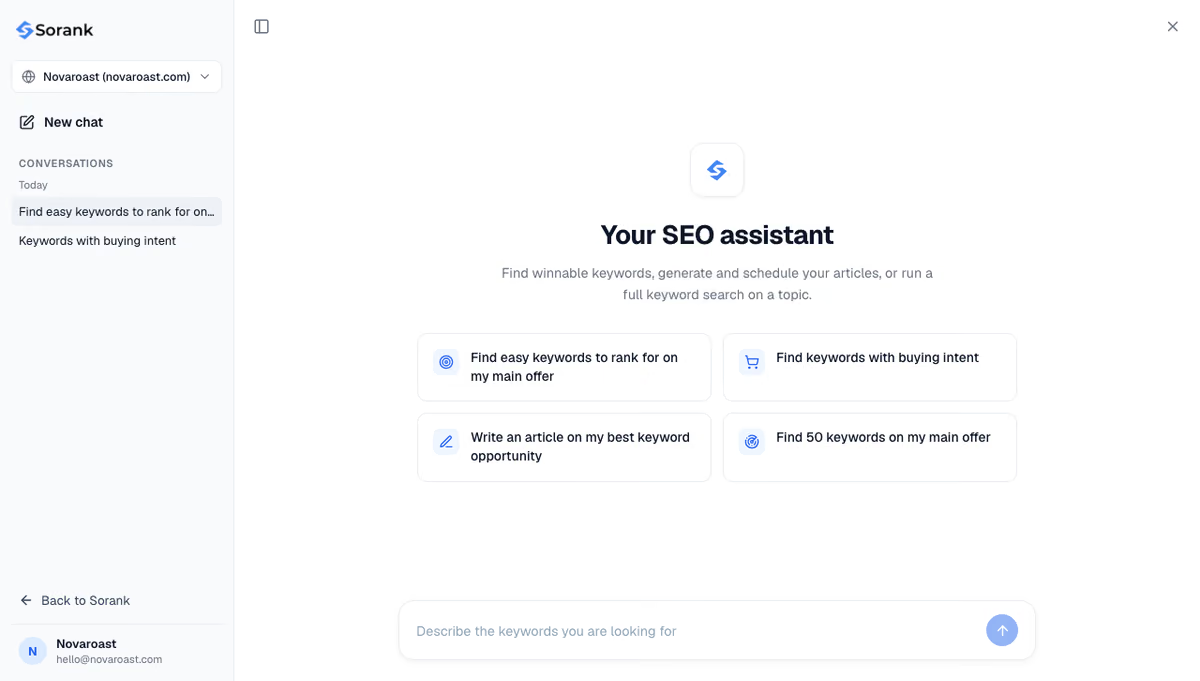
Sorank is our product: an SEO and GEO software that runs on autopilot. For an SEO business, its SEO Chat is a fast way to prepare client work: you ask in plain words for keywords, article ideas or a competitor check, it answers with real search data and turns the answer into scheduled actions after your confirmation.
Growth usually breaks on production: each new client adds articles to write, links to earn and reports to send. Three ways to scale without a payroll:
Whichever route you take, keep strategy, client communication and quality control in house: they are what clients pay you for, and what makes them stay.
Pick a niche, rank one site you control and write the offer on one page. Then run free audits for five businesses in that niche and turn the best one into your first proposal. An SEO business grows on proof, a narrow offer and delivery that scales without you. If you want production to scale from the first client, compare the plans on the Sorank pricing page, with a 3-day free trial and a 90-day money-back guarantee.

No. There is no official license or mandatory certification for SEO. Clients judge you on results, so a documented case study on a site you control carries more weight than a certificate. Free courses from Google and the major SEO suites are still useful to structure your knowledge.
It can be, because startup costs are low and most revenue comes from monthly retainers. Profitability depends on the time each client takes: a narrow niche, a repeatable process and outsourced production keep that time under control. Margins shrink quickly when every client gets a custom approach.
You can, but start by learning on your own site or a friend's site before taking paid work. Rank a few pages, document the results, then sell a small fixed-price audit before any retainer. White label production can cover delivery while your strategic skills catch up.
We analyse your competitors, your website and your AI visibility to create a tailored content plan for free.
 AI Content Brief Generator
 FAQ Schema Generator
 AI Blog Post Ideas Generator
 Structured Data Validator (Schema Validator)
 Alt Text Checker
 Internal Link Analyzer
 Backlink Challenge
 AI Meta Description Generator
 AI Blog Title Generator
 Google Indexability Checker
 AI Blog Outline Generator
 UTM Link Builder
 Keyword Clustering Tool
 Canonical Tag Checker
 XML Sitemap Generator
 Broken Link Checker
 AI SEO Title Generator
 Headline Analyzer
 SERP Preview Tool
 Redirect Checker
 Hreflang Tag Generator
 Heading Structure Analyzer
 HTTP Headers Checker
 Favicon Extractor
 SERP CTR Calculator
 SEO vs Paid Search Savings Calculator
 SEO Share of Voice Calculator
 SEO ROI Calculator
 SEO Traffic and Revenue Forecast Calculator
 SEO Budget Calculator
 SEO Break-Even Calculator
 SaaS SEO ROI Calculator
 ROAS Calculator
 Reading Time Calculator
 Ranking Gain Simulator
 Organic Traffic Value Calculator
 Organic Traffic Estimator and Website Traffic Checker
 LTV to CAC Ratio Calculator
 Local SEO ROI Calculator
 Link Building Cost Calculator
 Keyword Value Calculator
 Keyword Opportunity Score Calculator
 Keyword Density Calculator
 GEO ROI Calculator
 GEO Content Investment Calculator
 Ecommerce SEO ROI Calculator
 Customer Lifetime Value Calculator
 Customer Acquisition Cost Calculator
 CTR Calculator
 Cost Per Article Calculator
 Conversion Rate Calculator
 Content Marketing ROI Calculator
 ChatGPT Referral Traffic Estimator
 Bounce Rate Calculator
 Backlink ROI Calculator
 AI Visibility Score Calculator
 AI Traffic Value Calculator
 AI Share of Voice Calculator
 Cost of AI Invisibility Calculator
 AI Citation Rate Calculator
 llms.txt Validator
 AI Overview Checker and AI Overviews Rank Checker
 Robots.txt Checker
 AI SEO Audit
 LLM Readability Checker
 SearchGPT Readiness Checker
 Structured Data LLM Audit
 Website Crawlability AI Audit
 Why ChatGPT Is Not Recommending My Website
 Gemini Ranking Tool
 Perplexity Ranking Checker
 LLM Citation Checker
 Answer Engine Optimization Audit
 GEO Audit
 AI Search Visibility Test
 ChatGPT Visibility Checker
 llms.txt Generator
 URL Extractor
 Webpage to Markdown
 Sitemap Checker
 SERP Volatility Sensor
 Page Size Checker
 Word Counter
 Slug Generator
 Schema Generator
 Robots Generator
 OG Preview
 Meta Tags Generator
 Image Compressor
 Favicon Generator
 On-Page SEO Audit: SEO Checker and SEO Analyzer
 Backlink Analysis Tool
 Keyword Research Tool
 Domain Authority Checker
THEY TRIED SORANK BEFORE YOU
 “I tested Sorank on a real client site and it's insane. It does everything an agency would bill you $1500 a month for. It's going into production on that client now.”

 Guillaume Guersanguersanguillaume.com“We are an Ads agency and we wanted to get our SEO back on track once and for all. Sorank gave us a clear view of our site, helped us prioritize optimizations, and properly structure our content. The tool is easy to use, well designed for a team, and very practical for centralizing tracking without having to juggle multiple platforms. A very solid foundation to start fresh with our SEO.”
 Gaspard MadouiAds Agency
 “I just let the Sorank software do its thing, and now my DR is 25 and my page is ranking higher.”
 Lucas Flandrefoundertrace.fr“I specialized in GEO thanks to Sorank. The GEO Leaderboard allows me to show my clients their position vs competitors on ChatGPT. It’s a real commercial differentiator.”
 MélanieSEO Freelance“Great service, works well for our website and helps us understand how to improve it to rank better on Google and elsewhere. Congrats, keep going, I recommend it.”
 Hugo T.E-commerce merchant