Preferences
Privacy is important to us, so you have the option of disabling certain types of storage that may not be necessary for the basic functioning of the website. Blocking categories may impact your experience on the website. More information

Privacy is important to us, so you have the option of disabling certain types of storage that may not be necessary for the basic functioning of the website. Blocking categories may impact your experience on the website. More information

Shopify marketing guide: SEO, Google free listings, AI shopping, email, social and ads compared by cost and speed, plus a 90-day plan to grow a Shopify store.
Tools


In short
Shopify marketing means bringing qualified visitors to a Shopify store and turning them into repeat buyers. The channels that pay off for most stores are organic search (product, collection and blog pages), Google's free product listings, AI shopping assistants, email automations, social media and paid ads. Start with the free, compounding channels (SEO, product data, email flows), then add paid ads once you know which products and messages convert.
Want to go further? Ask
Quick quiz
Where should your online shop find its next customers?
4 quick questions to choose your main sales channel.
Our advice for you
Sorank is the right solution for you
You want customers who keep coming without paying for each click: optimised product and category pages, and buying guides. Sorank writes and publishes them on Shopify, WooCommerce and others.
Sorank matches your answers
Test it for 3 days on your own site, or start with a free audit to see where you stand.
3 days free, then stop whenever you want. 90-day money-back guarantee.
Shopify marketing is less about finding a secret channel than about stacking a few that reinforce each other. Shopify gives you the store, the checkout and a marketing section in the admin; Google, Meta, TikTok and now AI assistants give you the audiences. Google's own e-commerce documentation recommends two things that cost nothing: structured data on product pages and a product feed in Merchant Center. This guide compares every channel, then gives a 90-day plan.
For a Shopify store, marketing covers five jobs: getting found (search, AI assistants, marketplaces), getting chosen (product pages, reviews, offers), getting the first order (checkout, trust, shipping), getting the second order (email, SMS, loyalty) and measuring what works. Our guide to e-commerce marketing covers the general principles; this article focuses on what is specific to Shopify: its native tools, its app ecosystem and the sales channels it connects to.
In the Shopify admin, the Marketing section groups campaigns, automations and channel apps. Most external channels (Google & YouTube, Facebook & Instagram, TikTok, Pinterest) connect through official apps that sync your catalog, so a product created once appears everywhere.
| Channel | Cost | Time to results | Best for |
|---|---|---|---|
| SEO (products, collections, blog) | Time or content budget | 2 - 6 months, then compounding | Steady traffic without paying per click |
| Google free listings | Free | Days to weeks after feed approval | Visibility in the Shopping tab, Images and Lens |
| AI shopping (ChatGPT, Gemini, Copilot) | Free to enable | Depends on product data and reputation | Buyers who ask an assistant what to buy |
| Email and SMS automations | Low | Immediate on existing traffic | Recovering carts and repeat purchases |
| Social media and influencers | Time, products, fees | Weeks | Visual products and new brands |
| Paid ads (Google, Meta, TikTok) | Pay per click or impression | Same day | Testing offers and scaling proven products |
The order matters. Paid ads bring traffic the day you launch them and stop the day you stop paying; SEO, product data and email keep working after the effort is done.
Shopify handles the technical basics (hosting, HTTPS, sitemap, editable titles and descriptions), so SEO work is mostly about pages and content. Our Shopify SEO and GEO guide covers the platform in detail. The priorities:
Then share your catalog with Google. According to Google's Merchant Center help, free listings show products at no cost across Google Search, the Shopping tab, Images and Lens, YouTube, Maps and Gemini. The Google & YouTube app for Shopify connects your store to Merchant Center and syncs the feed.
Shoppers increasingly ask ChatGPT, Gemini or Copilot what to buy. On March 24, 2026, Shopify announced in its agentic commerce update that "millions of merchants can sell to ChatGPT users via Agentic Storefronts", with the same setup reaching Microsoft Copilot, AI Mode in Google Search and the Gemini app. Products from eligible stores become discoverable through Shopify Catalog by default, without a separate app.
Note
Since the channel is active by default on eligible stores, check its settings in your Shopify admin: which products are shared, and whether titles, prices, stock and shipping data are complete. An assistant can only recommend what it can read.
Being available is the first step; being recommended is the second. AI shopping assistants rely on complete product data and on what the web says about the brand: reviews, comparisons, guides and articles that mention your products. Our Shopify AI citation study looks at which stores AI assistants cite and why.
Email is usually the most profitable channel for an existing store because it reaches people who already know you. Shopify includes its own tool, now called Shopify Messaging: according to the Shopify Help Center, eligible stores get 10,000 free emails each month, then pay $1 per 1,000 additional emails up to 300,000 (checked October 2026). Dedicated platforms such as Klaviyo add advanced segmentation when the list grows.
Four automated flows cover most of the revenue:
Tip
Set up the abandoned checkout flow before any campaign. It works on traffic you already have, and Shopify includes a native version you can turn on in minutes.
Our guide to email marketing automation details the timing and content of each flow.
Social platforms create demand rather than capture it: people discover a product they were not searching for. Shopify's channel apps connect your catalog to Instagram and Facebook shops, TikTok Shop and Pinterest, so posts and videos can be tagged with products. Short videos that show the product in use work better than polished catalog shots; our guide to TikTok marketing explains the formats.
Influencer partnerships work best with micro-creators whose audience matches your customer, paid in products, a flat fee or a commission through an affiliate app. Our influencer marketing strategy guide covers selection and contracts.
Every channel above sends visitors to the same product page, and that page decides the sale. Reviews with photos, clear shipping costs and delivery times, a visible return policy and accessible contact details raise the conversion rate of all traffic at once, paid or free. They also feed discovery: review stars can appear in Google results through product structured data, and AI assistants weigh what customers and independent sites say about a brand before recommending it. Ask for a review in the post-purchase flow, answer negative reviews publicly, and show the total price, shipping included, before checkout.
Paid ads make sense once you know your margins, your best-selling products and a message that converts. Google Shopping and Performance Max campaigns use the same Merchant Center feed as free listings, so the product data work pays twice; our article on Google Shopping ads covers the setup. Meta and TikTok ads are better for products people do not search for yet. Track return on ad spend per campaign and stop what does not pay back.
Measure sessions, conversion rate, average order value and repeat purchase rate per channel, as listed in our guide to e-commerce KPIs.
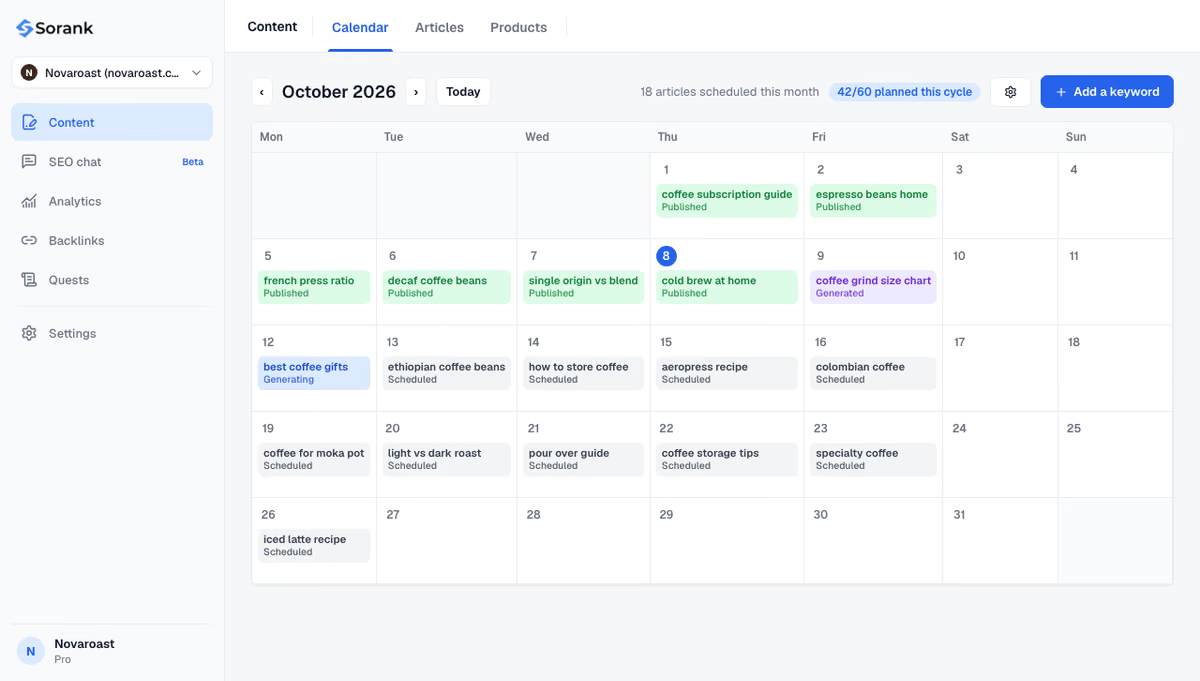
The step most stores drop is the blog: it needs keyword research, writing and regular publishing. Sorank, our product, is an autopilot SEO and GEO software that connects to Shopify in a few minutes, finds the keywords your buyers use, and its content planner schedules articles that it writes and publishes with sources, internal links to your collections and images (20, 60 or 120 per month depending on the plan).
The short version: make your products readable by Google and AI assistants, automate email, then add paid ads on what already sells. Organic channels compound; ads accelerate what works. To keep a Shopify blog publishing every week, see Sorank's plans, from $49 per month with a 3-day free trial.

Start with channels that cost little and keep working: complete product data, Google free listings, SEO on product and collection pages, and email automations such as the welcome series and abandoned checkout. Add social content to create demand, then test paid ads on your best-selling products once you know your margins and conversion rate.
No. Shopify provides tools: a marketing section in the admin, Shopify Messaging for email, automations, discount codes and sales channel apps for Google, Meta, TikTok and AI assistants. You still choose the channels, write the content and run the campaigns, or use apps and software that automate parts of the work.
There is no fixed rule; it depends on margins and growth goals. Many stores start with near-zero budget on organic channels and email, then allocate a share of revenue to paid ads once a campaign shows a positive return on ad spend. Track cost per acquisition against customer lifetime value before increasing any budget.
 AI Content Brief Generator
 FAQ Schema Generator
 AI Blog Post Ideas Generator
 Structured Data Validator
 Alt Text Checker
 Internal Link Analyzer
 Backlink Challenge
 AI Meta Description Generator
 AI Blog Title Generator
 Google Indexability Checker
 AI Blog Outline Generator
 UTM Link Builder
 Keyword Clustering Tool
 Canonical Tag Checker
 XML Sitemap Generator
 Broken Link Checker
 AI SEO Title Generator
 Headline Analyzer
 SERP Preview Tool
 Redirect Checker
 Hreflang Tag Generator
 Heading Structure Analyzer
 HTTP Headers Checker
 Favicon Extractor
 SERP CTR Calculator
 SEO vs Paid Search Savings Calculator
 SEO Share of Voice Calculator
 SEO ROI Calculator
 SEO Traffic and Revenue Forecast Calculator
 SEO Budget Calculator
 SEO Break-Even Calculator
 SaaS SEO ROI Calculator
 ROAS Calculator
 Reading Time Calculator
 Ranking Gain Simulator
 Organic Traffic Value Calculator
 Organic Traffic Estimator
 LTV to CAC Ratio Calculator
 Local SEO ROI Calculator
 Link Building Cost Calculator
 Keyword Value Calculator
 Keyword Opportunity Score Calculator
 Keyword Density Calculator
 GEO ROI Calculator
 GEO Content Investment Calculator
 Ecommerce SEO ROI Calculator
 Customer Lifetime Value Calculator
 Customer Acquisition Cost Calculator
 CTR Calculator
 Cost Per Article Calculator
 Conversion Rate Calculator
 Content Marketing ROI Calculator
 ChatGPT Referral Traffic Estimator
 Bounce Rate Calculator
 Backlink ROI Calculator
 AI Visibility Score Calculator
 AI Traffic Value Calculator
 AI Share of Voice Calculator
 Cost of AI Invisibility Calculator
 AI Citation Rate Calculator
 llms.txt Validator
 AI Overview Checker
 Robots.txt Checker
 AI SEO Audit
 LLM Readability Checker
 SearchGPT Readiness Checker
 Structured Data LLM Audit
 Website Crawlability AI Audit
 Why ChatGPT Is Not Recommending My Website
 Gemini Ranking Tool
 Perplexity Ranking Checker
 LLM Citation Checker
 Answer Engine Optimization Audit
 GEO Audit
 AI Search Visibility Test
 ChatGPT Visibility Checker
 llms.txt Generator
 URL Extractor
 Webpage to Markdown
 Sitemap Checker
 SERP Volatility Sensor
 Page Size Checker
 Word Counter
 Slug Generator
 Schema Generator
 Robots Generator
 OG Preview
 Meta Tags Generator
 Image Compressor
 Favicon Generator
 On-Page SEO Audit
 Backlink Analysis Tool
 Keyword Research Tool
 Domain Authority Checker
THEY TRIED SORANK BEFORE YOU
 “I tested Sorank on a real client site and it's insane. It does everything an agency would bill you $1500 a month for. It's going into production on that client now.”

 Guillaume Guersanguersanguillaume.com“We are an Ads agency and we wanted to get our SEO back on track once and for all. Sorank gave us a clear view of our site, helped us prioritize optimizations, and properly structure our content. The tool is easy to use, well designed for a team, and very practical for centralizing tracking without having to juggle multiple platforms. A very solid foundation to start fresh with our SEO.”
 Gaspard MadouiAds Agency
 “I just let the Sorank software do its thing, and now my DR is 25 and my page is ranking higher.”
 Lucas Flandrefoundertrace.fr“I specialized in GEO thanks to Sorank. The GEO Leaderboard allows me to show my clients their position vs competitors on ChatGPT. It’s a real commercial differentiator.”
 MélanieSEO Freelance“Great service, works well for our website and helps us understand how to improve it to rank better on Google and elsewhere. Congrats, keep going, I recommend it.”
 Hugo T.E-commerce merchant