
Preferences
Privacy is important to us, so you have the option of disabling certain types of storage that may not be necessary for the basic functioning of the website. Blocking categories may impact your experience on the website. More information

Privacy is important to us, so you have the option of disabling certain types of storage that may not be necessary for the basic functioning of the website. Blocking categories may impact your experience on the website. More information

SEO statistics for 2026, all sourced and dated: Google search volume, organic CTR, zero-click searches, AI Overviews, ChatGPT usage and content performance.
Tools


In short
The most useful SEO statistics in 2026 all point the same way: search demand is still enormous, but clicks are harder to win. Google handles more than 5 trillion searches a year (Google, 2025), yet 96.55% of pages get no Google traffic at all (Ahrefs, 2023), and AI Overviews correlate with a 58% lower click-through rate for the top result (Ahrefs, 2026). Meanwhile, ChatGPT passed 800 million weekly users (OpenAI, 2025). Every figure below comes with its source and year; we left out any number we could not trace to its original publisher.
Want to go further? Ask
Lists of SEO statistics often recycle figures that are ten years old, undated or impossible to trace. This page keeps only numbers published by the companies or researchers who produced them, each with its year and its scope. Use them to frame a strategy or a budget, but always check whether a study's sample matches your market before you quote it.
Google remains the largest gateway to the web, and its own figures show volume is still growing. The AI layer is growing on top of it rather than replacing it outright.
| Statistic | Source | Year |
|---|---|---|
| Google handles more than 5 trillion searches per year | 2025 | |
| About 15% of daily Google searches have never been seen before | Google (stated since 2013, repeated at the BERT launch) | 2019 |
| AI Overviews reach more than 2 billion monthly users in over 200 countries and territories | Alphabet, Q2 2025 earnings call | 2025 |
| AI Mode passed 100 million monthly active users in the US and India | Alphabet, Q2 2025 earnings call | 2025 |
| Organic search drove 53.3% of trackable website traffic, paid search about 15% | BrightEdge channel report | 2019 |
The 15% figure matters for content strategy: a large share of demand consists of new, specific questions that no keyword tool has measured yet, which is why long-tail coverage keeps paying off.
Position drives clicks, and the gap between the first and the second page is enormous. Backlinko's study of about 4 million Google results (page updated in 2025) remains the reference most often quoted.
| Statistic | Source | Year |
|---|---|---|
| The #1 organic result has an average CTR of 27.6% | Backlinko | 2025 update |
| The #1 result is 10 times more likely to be clicked than the #10 result | Backlinko | 2025 update |
| Only 0.63% of searchers clicked a result on the second page | Backlinko | 2025 update |
| Moving from #2 to #1 gives the largest relative CTR jump, about 74.5% | Backlinko | 2025 update |
These averages hide large differences between queries. Our SERP CTR calculator lets you estimate the traffic of a keyword at each position, and the impact of a gain of one or two places.
Most of them: more than half of Google searches end without a click to any website. The SparkToro study, based on Datos clickstream data from more than 1.6 million searches, gave the most cited figures.
On the queries where they appear, AI Overviews correlate with a sharp drop in clicks on organic results, and the measured impact grew between 2024 and 2026. Being cited inside the overview partly offsets the loss.
| Statistic | Source | Year |
|---|---|---|
| AI Overviews correlate with a 34.5% lower CTR for the top-ranking page (300,000 keywords) | Ahrefs | 2025 |
| The same analysis rerun on December 2025 data: 58% lower CTR for the top-ranking page | Ahrefs | 2026 |
| Organic CTR on informational queries with an AI Overview fell 61% between June 2024 and September 2025 | Seer Interactive (3,119 queries, 42 organizations) | 2025 |
| Brands cited in the AI Overview get about 35% higher organic CTR than uncited brands | Seer Interactive | 2025 |
| Only 38% of pages cited in AI Overviews also rank in the top 10 | Ahrefs (about 863,000 SERPs) | 2026 |
The last line is the most strategic one: ranking first is no longer the only path to visibility. Our glossary entry on Google AI Overviews explains how sources are selected, and our guide to SERP analysis shows how to read both layers of results.
AI assistants now have a mass audience, and research shows that the way a page is written changes how often they quote it. These are the figures behind generative engine optimization (GEO).
Measuring this visibility requires new indicators; our page on GEO performance metrics lists them, and the AI visibility tracker follows which brands the AIs cite on your prompts.
Publishing is easy, ranking is rare: the vast majority of pages never earn search traffic. Ahrefs' large-scale studies give the clearest picture.
| Statistic | Source | Year |
|---|---|---|
| 96.55% of pages get zero traffic from Google, 1.94% get 1 to 10 visits per month | Ahrefs (about 14 billion pages) | 2023 |
| Of about 20 million pages with no referring domains, only 2,997 get more than 1,000 monthly visits | Ahrefs | 2023 |
| Only 5.7% of new pages reached the top 10 for at least one keyword within a year | Ahrefs (2 million pages) | 2017 |
| Among those pages, most reached the top 10 in about 61 to 182 days | Ahrefs | 2017 |
Two lessons follow. Links still separate pages that get traffic from pages that do not, and results take months: plan in quarters, not in weeks.
As orders of magnitude for decisions, never as promises for a specific site. Each study has its own sample, country and method.
The SEO statistics of 2026 describe a market where demand keeps growing while clicks concentrate on fewer results and part of the attention moves to AI answers. The response is the same in both worlds: answer questions clearly, cite your sources, earn links and mentions, and measure your visibility in Google and in the AIs.
Sorank does this work in autopilot: it publishes one optimized article per day with fact-checking, FAQ and structured data, helps you obtain natural, one-way backlinks automatically, placed in real articles of sites in the same topic, and tracks each week whether the AIs cite your brand. You can try it with a 3-day free trial.
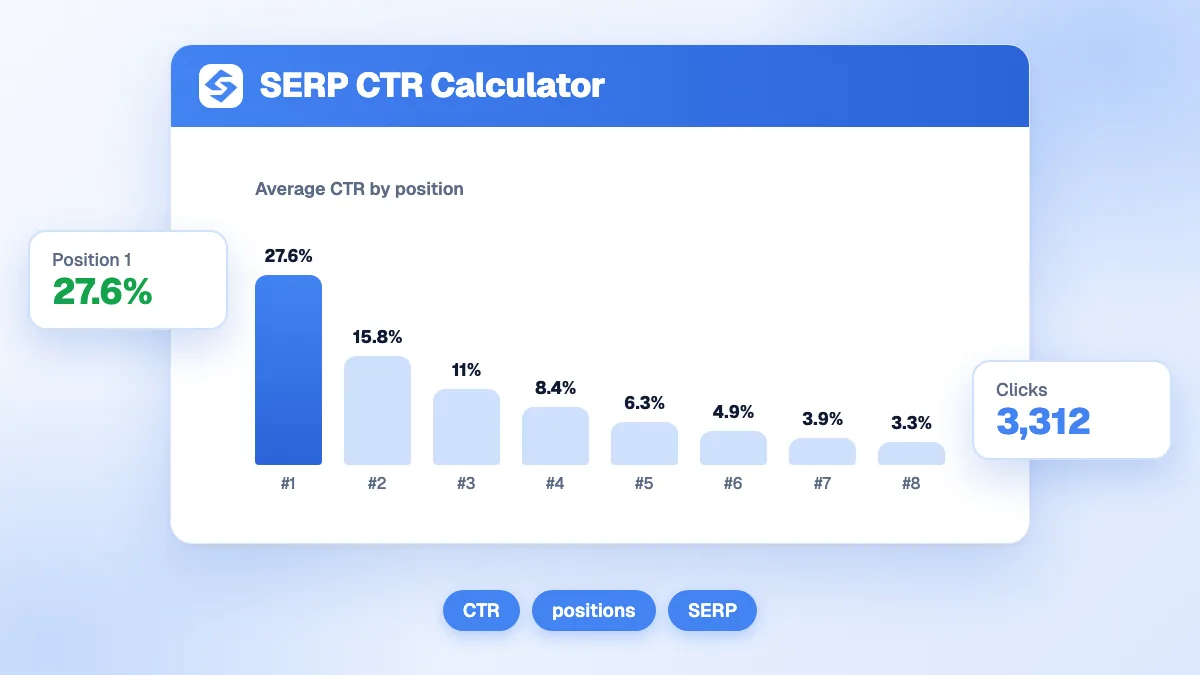

According to Backlinko's analysis of about 4 million Google results, the first organic result receives an average click-through rate of 27.6%, and it is about 10 times more likely to be clicked than the result in tenth position. These figures predate the spread of AI Overviews, which reduce clicks on queries where they appear.
Google said in March 2025 that it handles more than 5 trillion searches per year, the first official volume figure it had shared since 2016. Google has also stated repeatedly that about 15% of the searches it sees every day have never been searched before.
Several independent measurements say yes on the queries where they appear. Ahrefs found a 58% lower average click-through rate for the top-ranking page on keywords with an AI Overview (December 2025 data), and Pew Research Center observed that users clicked a traditional result in 8% of visits with an AI summary versus 15% without one.
 AI Content Brief Generator
 FAQ Schema GeneratorAI Blog Post Ideas GeneratorStructured Data Validator
 Alt Text Checker
 Internal Link AnalyzerBacklink ChallengeAI Meta Description GeneratorAI Blog Title Generator
 Google Indexability CheckerAI Blog Outline GeneratorUTM Link BuilderKeyword Clustering ToolCanonical Tag Checker
 XML Sitemap GeneratorBroken Link CheckerAI SEO Title GeneratorHeadline AnalyzerSERP Preview ToolRedirect Checker
 Hreflang Tag GeneratorHeading Structure AnalyzerHTTP Headers CheckerFavicon Extractor
 SERP CTR Calculator
 SEO vs Paid Search Savings Calculator
 SEO Share of Voice Calculator
 SEO ROI Calculator
 SEO Traffic and Revenue Forecast Calculator
 SEO Budget Calculator
 SEO Break-Even Calculator
 SaaS SEO ROI Calculator
 ROAS Calculator
 Reading Time Calculator
 Ranking Gain Simulator
 Organic Traffic Value Calculator
 Organic Traffic Estimator
 LTV to CAC Ratio Calculator
 Local SEO ROI Calculator
 Link Building Cost Calculator
 Keyword Value Calculator
 Keyword Opportunity Score Calculator
 Keyword Density Calculator
 GEO ROI Calculator
 GEO Content Investment Calculator
 Ecommerce SEO ROI Calculator
 Customer Lifetime Value Calculator
 Customer Acquisition Cost Calculator
 CTR Calculator
 Cost Per Article Calculator
 Conversion Rate Calculator
 Content Marketing ROI Calculator
 ChatGPT Referral Traffic Estimator
 Bounce Rate Calculator
 Backlink ROI Calculator
 AI Visibility Score Calculator
 AI Traffic Value Calculator
 AI Share of Voice Calculator
 Cost of AI Invisibility Calculator
 AI Citation Rate Calculatorllms.txt ValidatorAI Overview CheckerRobots.txt CheckerAI SEO AuditLLM Readability CheckerSearchGPT Readiness Checker
 Structured Data LLM AuditWebsite Crawlability AI AuditWhy ChatGPT Is Not Recommending My Website
 Gemini Ranking ToolPerplexity Ranking CheckerLLM Citation CheckerAnswer Engine Optimization AuditGEO AuditAI Search Visibility TestChatGPT Visibility Checkerllms.txt Generator
 URL ExtractorWebpage to MarkdownSitemap CheckerSERP Volatility SensorPage Size Checker
 Word Counter
 Slug GeneratorSchema GeneratorRobots Generator
 OG PreviewMeta Tags Generator
 Image CompressorFavicon Generator
 On-Page SEO Audit
 Backlink Analysis Tool
 Keyword Research Tool
 Domain Authority Checker
THEY TRIED SORANK BEFORE YOU
 “I tested Sorank on a real client site and it's insane. It does everything an agency would bill you $1500 a month for. It's going into production on that client now.”

 Guillaume Guersanguersanguillaume.com“We are an Ads agency and we wanted to get our SEO back on track once and for all. Sorank gave us a clear view of our site, helped us prioritize optimizations, and properly structure our content. The tool is easy to use, well designed for a team, and very practical for centralizing tracking without having to juggle multiple platforms. A very solid foundation to start fresh with our SEO.”
 Gaspard MadouiAds Agency
 “I just let the Sorank software do its thing, and now my DR is 25 and my page is ranking higher.”
 Lucas Flandrefoundertrace.fr“I specialized in GEO thanks to Sorank. The GEO Leaderboard allows me to show my clients their position vs competitors on ChatGPT. It’s a real commercial differentiator.”
 MélanieSEO Freelance“Great service, works well for our website and helps us understand how to improve it to rank better on Google and elsewhere. Congrats, keep going, I recommend it.”
 Hugo T.E-commerce merchant























