









Outrank, run by a company based in Paris, promises to grow organic traffic on autopilot. Once a site is connected, it analyses the niche, the competitors and the audience, picks keywords with traffic and little competition, plans one key phrase per day and publishes a finished article every day. It also places links to your site in articles on other blogs, so the content gains authority without outreach.
The offer is aimed at busy founders, Shopify stores and agencies that run several sites and want volume at a fixed price. Outrank still sells a single plan, now called Organic Growth, with annual billing, automatic discounts for multiple sites, paid add-ons (more articles, backlink credits, human editing) and tools for AI agents: a REST API, a command line tool and an MCP server.
What Outrank does
The features visible on its website in October 2026 are:
- Automatic keyword research and a 30-day content plan built from your niche, competitors and audience, plus a chat to brainstorm keywords with live search data.
- Daily SEO articles with internal and external links, written in your brand voice from your published pieces, in more than 150 languages.
- AI images in chosen styles and brand colours, used in the text and as featured images, plus relevant YouTube videos.
- E-commerce content built around real products, with product photos turned into lifestyle images.
- Publishing to WordPress, WordPress.com, Webflow, Shopify, Framer, Wix, Notion, Ghost and a Next.js blog, or anywhere through a webhook, plus a free hosted blog on your own domain.
- Automated backlinks: links placed inside relevant articles on other blogs, each one checked after it goes live, with a view of links received and Domain Rating.
- Detection of underperforming articles to schedule a rewrite, unlimited AI rewrites, manual editing and a preview up to 7 days before publication.
- Multi-site management with unlimited team members, a REST API, a CLI for AI agents, an MCP server and free tools such as an SEO audit, a competitor analysis and title or meta description generators.
Outrank pricing in 2027
Outrank sells one plan, checked on its pricing page in October 2026, in US dollars. Organic Growth costs $99 per month (shown next to a crossed-out $199) or $999 per year, which works out at about $83.25 per month. It includes 30 articles per month for one site, keyword research, backlink building, AI images, unlimited users and every publishing integration. Each extra site joins the same subscription, with automatic discounts of 10% for 2 to 4 sites, 15% for 5 to 19 sites and 20% for 20 to 25 sites.
Add-ons are billed on top: $85 per month for 60 articles per site, $160 per month for 90 articles, $49 per month for premium images, $99 per month for the Free Tools Builder, backlink plans at $199, $899 and $1,899 per month, a Human Curated service with human editors at $1,399 per month and a one-time directory submission at $500. A free trial is offered, cancellation is possible at any time and Outrank runs a public affiliate program.
Outrank pros and cons
Pros
- One clear plan with 30 articles, backlinks and unlimited users for $99 per month.
- Publishing to about ten platforms, plus a webhook and a free hosted blog for sites without one.
- Link placement inside relevant articles on other blogs, with each link verified.
- Articles in more than 150 languages, with brand voice, images and videos.
- REST API, CLI and MCP server for teams that work with AI agents.
Cons
- No tracking of brand mentions or citations in ChatGPT, Gemini or other AI answers.
- No rank tracking and no dashboard that joins Search Console data with AI data.
- Going beyond 30 articles or the included backlink credits means add-ons that can cost more than the plan itself.
- Human review of articles is sold separately at $1,399 per month.
- No white label shown for agencies.
Outrank review: what to check before you pay
A fair Outrank review comes down to three checks: whether the articles need little editing, whether the backlinks come from sites you would want to be linked from, and whether you can measure results outside Outrank. Run all three during the free trial, before you add a paid add-on or commit to annual billing.
Read three articles as an editor
Pick three articles from the first week and read them as if a client had sent them to you. Check every factual claim against a primary source, cut the generic sentences that could fit any niche, and confirm that each internal link points to a page that exists on your site. Google says that AI content is not a violation on its own, but that pages made at scale without added value may breach its spam policy, and that AI output needs manual fact checking before publication (Google Search Central, undated guidance).
If most articles need heavy rewrites, the 30 monthly articles cost you review time, and the plan price does not show that cost. Also compare the brand voice with your own pages. The voice is learned from your published content, so a large gap tells you how much setup the tool needs.
Audit the backlinks it places
Outrank places links inside articles on other blogs and checks each one once it is live. Ask for the list of linking sites and review it before you rely on the links. For each site, check the topic match, whether the article is indexed, and whether the link sits in a sentence a reader would find useful. Links on unrelated or thin sites add little. Google calls link exchanges meant to manipulate rankings a link scheme, so read the backlink exchange guide before you judge the network. Repeat the check every few months with a backlink audit.
Measure outside the tool
The cons above already note that Outrank does not track brand mentions in AI answers, so set a baseline before the first article goes live. Write down 10 to 20 questions your buyers ask, run them in ChatGPT, Gemini and Perplexity once a week, and record which brands each answer names. Keep these answers in the same sheet as your Search Console clicks so that traffic and AI mentions can be compared month by month. The AI visibility audit guide walks through how to check your brand in each tool.
Tip
Write your pass mark before the trial starts. For example, if fewer than half of the first ten articles need only light edits, the monthly plan costs more in your time than it saves.
The best Outrank alternatives
1.  Sorank
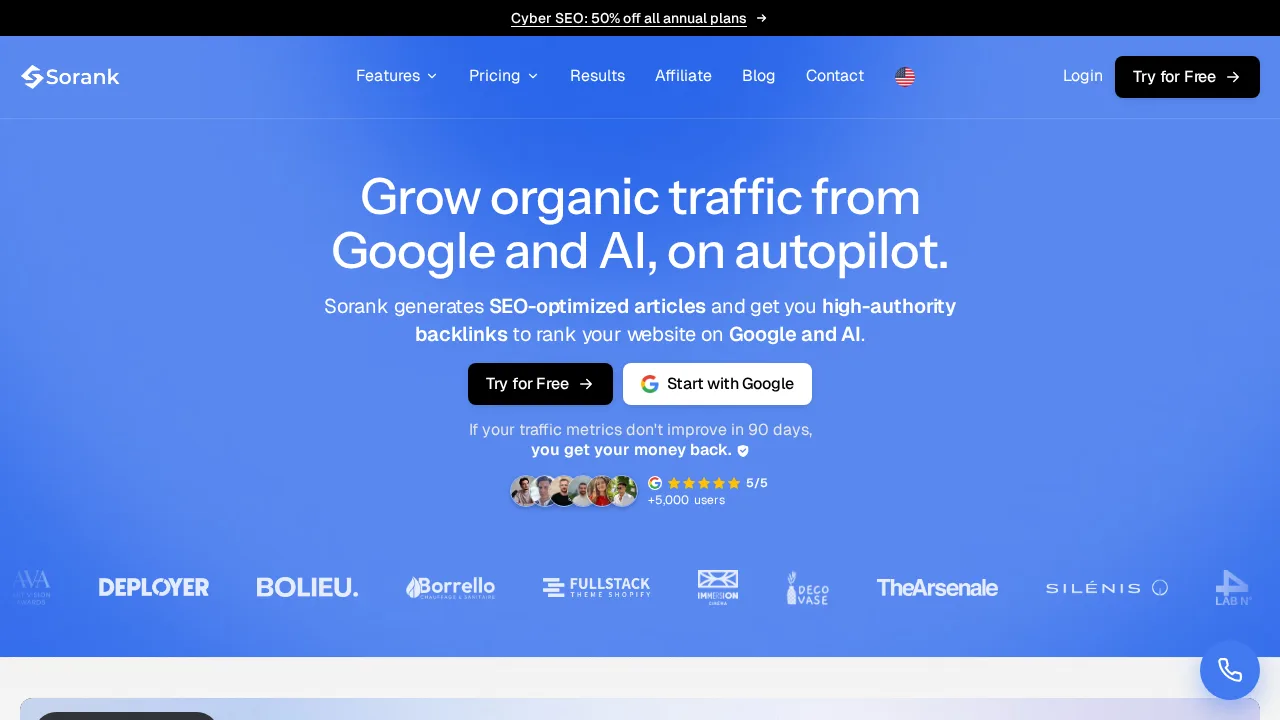
Sorank is an SEO and GEO autopilot software built for the same job as Outrank: it finds the keywords, builds topic clusters, then writes, illustrates and publishes the articles on your CMS (more than 10 CMS, including WordPress, Shopify and Webflow), with internal linking, anti-cannibalization and fact checking. The gap with Outrank is measurement in AI answers. Each month, Sorank asks the AI the questions your customers ask (10 prompts on ChatGPT, Claude and Gemini with Essential, 20 prompts with Grok added on Pro, 50 on Business) and shows whether your brand is mentioned, which brands are cited in its place and which sources the AI use.
For authority, Sorank places direct, one-way links between the sites of more than 5,000 users, based on credits: you earn them by hosting links and spend them to receive links (100 credits per month on Pro, 300 on Business). It also reads what up to 5 chosen competitors publish each week, ranks the domains cited by AI, breaks down AI queries (query fan-out) and brings Search Console, Analytics and AI traffic into one dashboard. Agencies get a white label, the MCP connector lets you drive Sorank from Claude or ChatGPT, and the free SEO tools and Chrome extension cover quick checks. Plans cost $99, $249 and $499 per month (20, 60 and 120 articles), or $49, $129 and $249 per month billed annually, with a 3-day free trial and a 90-day results-or-refund guarantee.
2.  RankYak
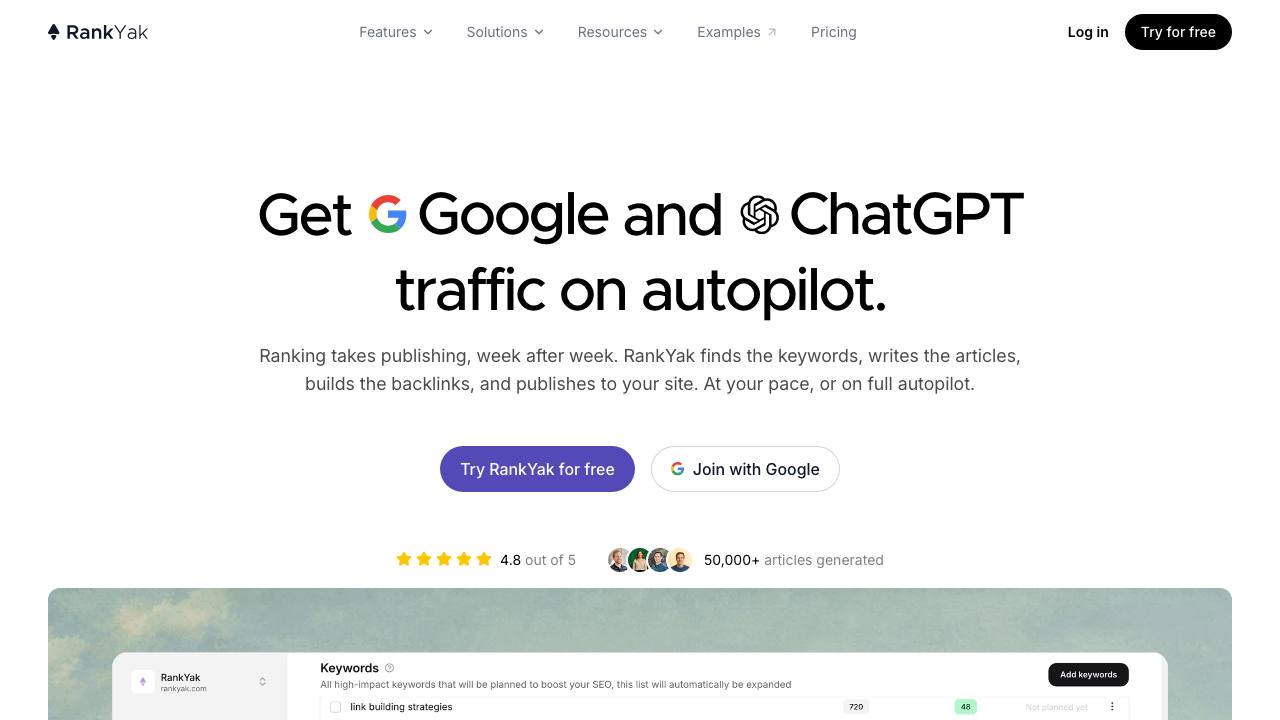
RankYak follows a very similar model: one plan per site, one article per publishing day, CMS publishing and backlink acquisition between member sites. It also offers a copilot and an MCP server.
3.  SEO Bot
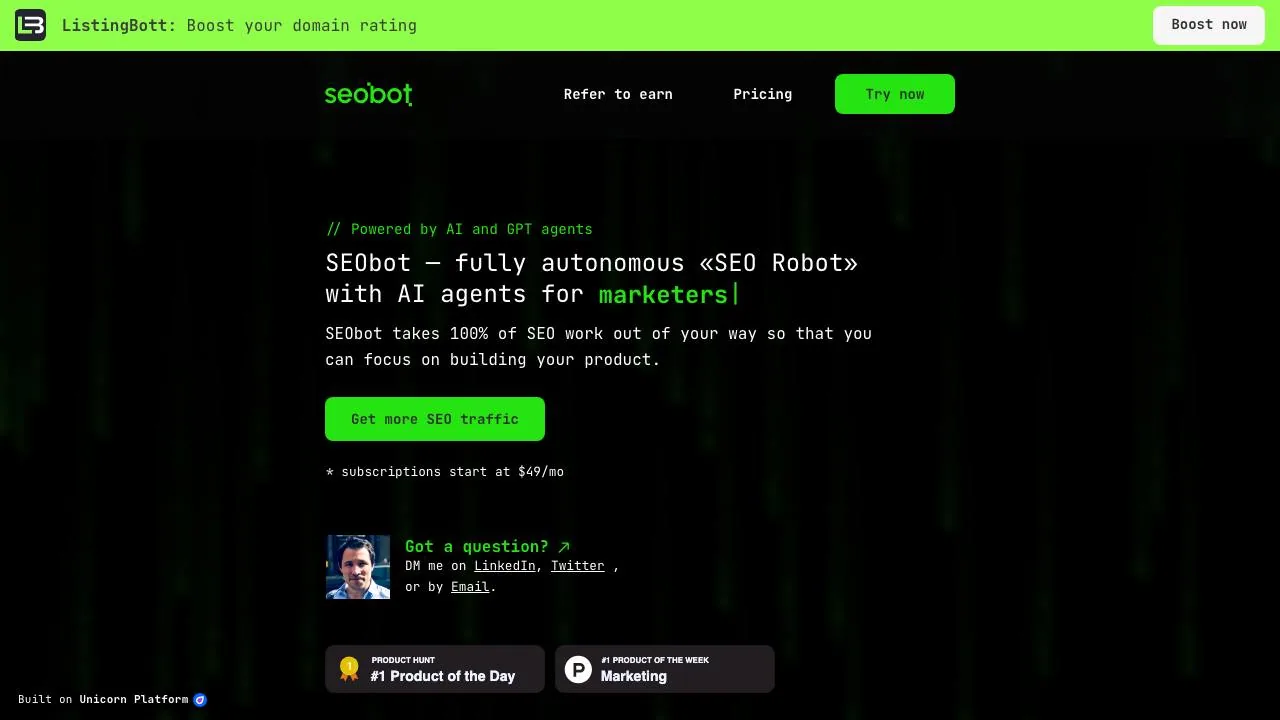
SEO Bot presents itself as a fully autonomous SEO robot for busy founders. It suits teams that want content produced with almost no setup.
4.  Babylovegrowth
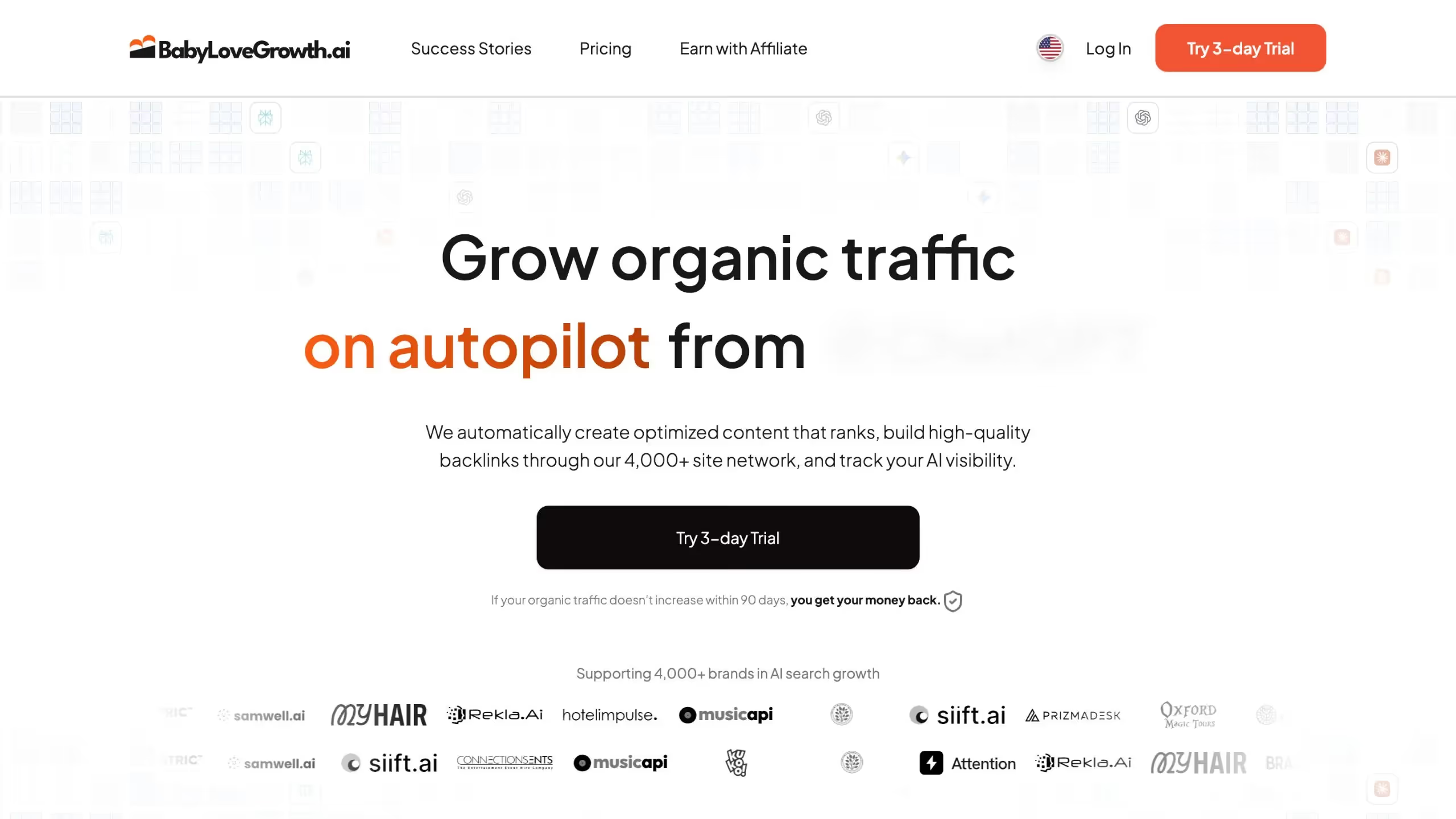
Babylovegrowth targets traffic from Google and ChatGPT with automated daily articles. It is aimed at small businesses that want a steady publishing rhythm.
5.  Rankpill
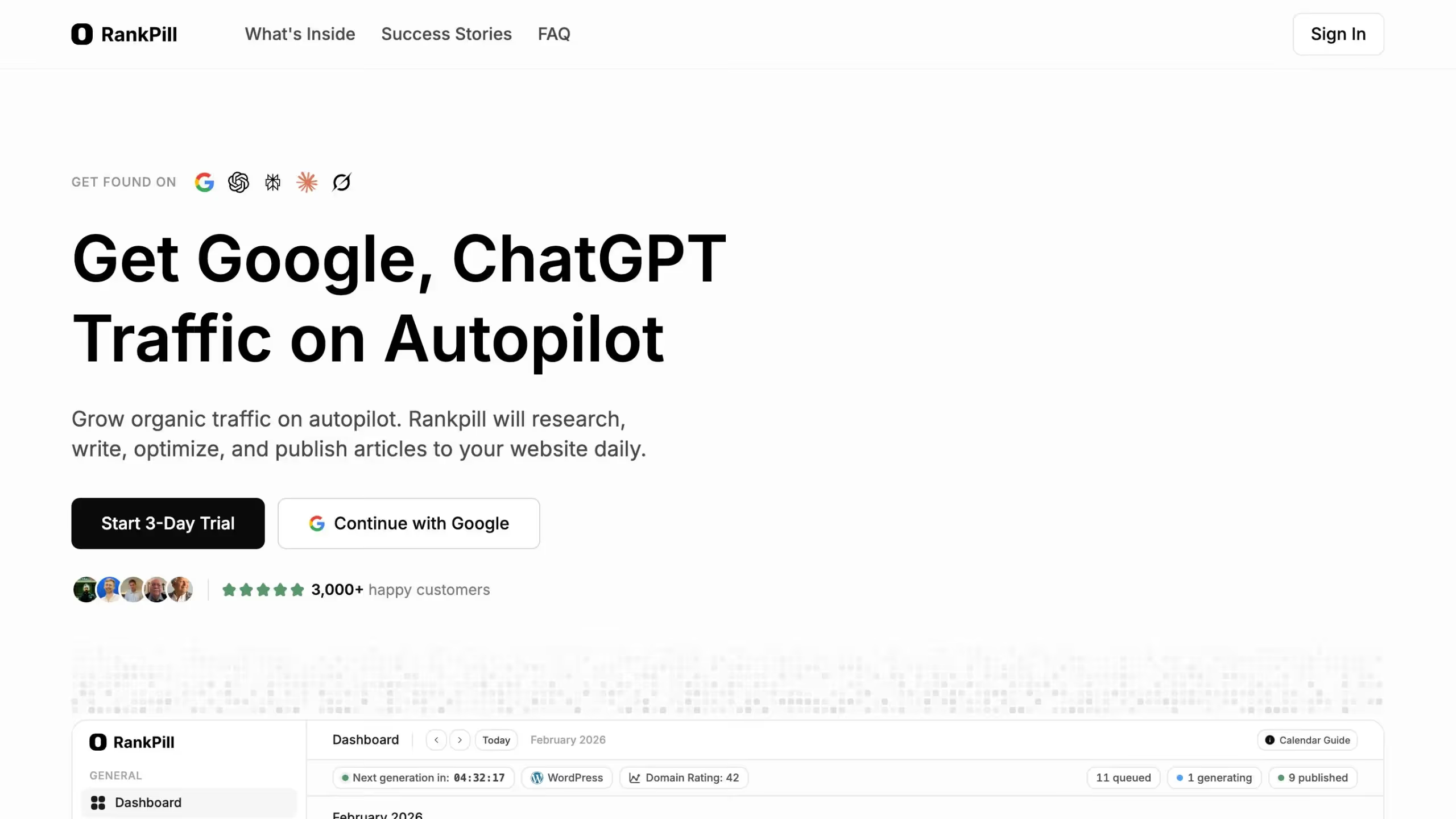
Rankpill also promises Google and ChatGPT traffic on autopilot, with automated article generation and publishing. It is an option for founders comparing several daily publishing tools.
6.  Arvow
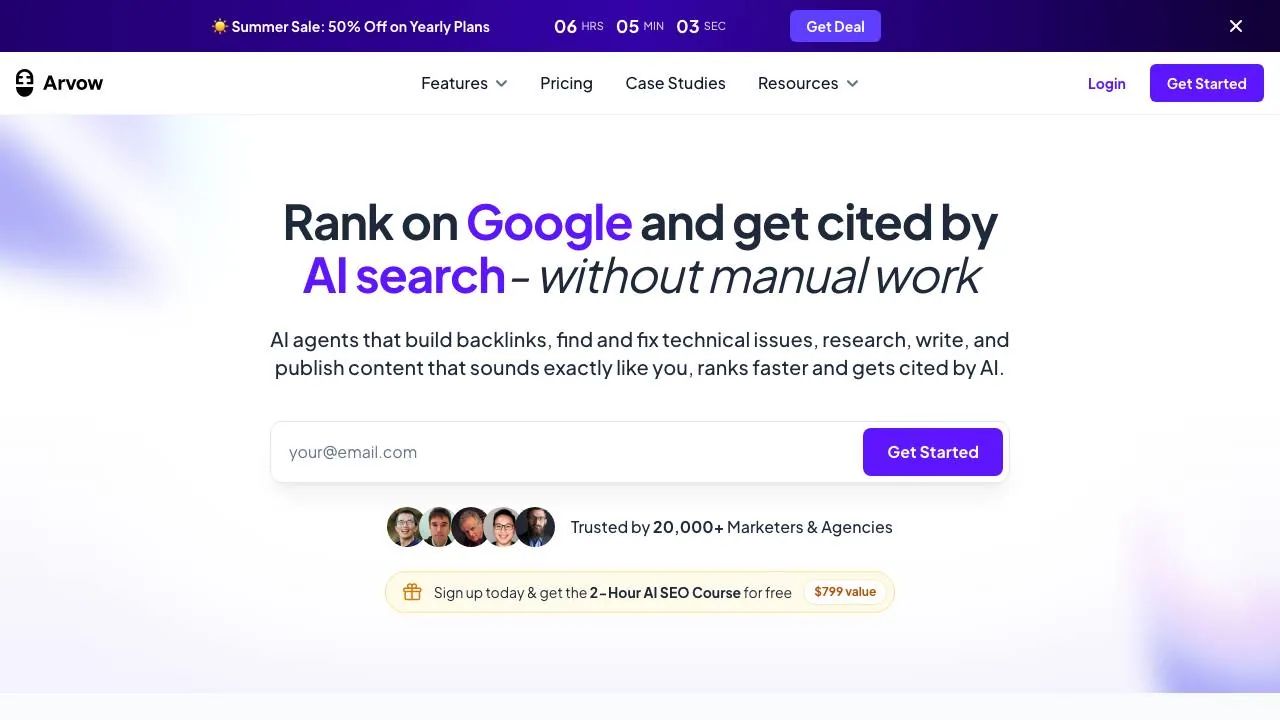
Arvow automates the production and publishing of SEO articles to content platforms. It fits sites that want regular volume with little configuration.
How to choose between  Outrank and Sorank
Outrank fits founders, e-commerce stores and agencies that want the most articles for a fixed price and are happy to measure success through Google traffic and Domain Rating. If you manage several sites, the volume discounts and unlimited users help, and the API, CLI and MCP server suit teams that already automate with AI agents. Budget for add-ons if you need more links or output.
Sorank fits companies and agencies that want autopilot content and a clear view of how AI answers talk about them, in the same tool. If you need to know whether ChatGPT, Claude and Gemini name your brand, which competitors they cite and which sources they trust, then act on it with articles, one-way backlinks and competitor monitoring, Sorank covers that from $99 per month ($49 billed annually). Results usually show within 2 to 4 months.