










Copy.ai was one of the first AI writing tools for marketing copy. In 2026 it describes itself as the first AI-native GTM platform: instead of a writing assistant, it sells a system that codifies a company's sales and marketing processes into AI workflows, connected to the CRM and the other tools a revenue team uses. The company claims 17 million users.
The product now targets sales, marketing and revenue operations teams in mid-size companies and enterprises, many of them on guided implementations. That shift matters if you are comparing SEO tools: Copy.ai still produces content, including SEO articles, but it does not research keywords, track Google rankings or AI visibility, or publish to a CMS. It is a GTM automation platform that can also feed a content team.
What Copy.ai does
The platform is built from components that teams combine into workflows for each use case.
- Workflows that turn processes and best practices into repeatable AI sequences across teams.
- Actions, the building blocks of workflows, and Agents that automate targeted tasks with guardrails.
- Tables, a queryable data layer that unifies data from several sources and triggers workflows when data changes.
- Chat for one-off tasks, with access to OpenAI, Anthropic and Gemini models.
- Infobase for company knowledge and Brand Voice for consistent tone.
- Prospecting Cockpit to research accounts and contacts and draft sales outreach.
- Inbound lead processing, lead and account intelligence and CRM enrichment.
- Account-based marketing assets, deal coaching and forecasting from sales transcripts.
- Content creation (SEO articles, thought leadership, use cases, social posts) and translation and localization.
- More than 2,000 integrations, API access and bulk workflow runs on Enterprise.
Copy.ai pricing in 2027
Prices below were read on the Copy.ai pricing page in October 2026, in US dollars. Yearly billing on Chat saves 20%. The higher self-serve plans are shown as monthly amounts billed once a year.
- Chat: $29 per month, or $24 per month billed yearly ($288 per year). 5 seats, unlimited words and projects in Chat, access to OpenAI, Anthropic and Gemini models.
- Growth: $1,000 per month billed yearly ($12,000 per year). 75 seats, unlimited Chat words, 20,000 workflow credits per month.
- Expansion: $2,000 per month billed yearly ($24,000 per year). 150 seats and 45,000 workflow credits per month.
- Scale: $3,000 per month billed yearly ($36,000 per year). 200 seats and 75,000 workflow credits per month.
- Enterprise: custom pricing with guided implementation, API access, bulk workflow runs, unlimited workflows and a dedicated team.
Copy.ai offers a Try for free entry, and Expansion and Scale are sold through the accounts team.
Copy.ai pros and cons
Pros
- One platform for many go-to-market tasks, from prospecting to content.
- More than 2,000 integrations with sales and marketing systems.
- Choice of language models from OpenAI, Anthropic and Google.
- Unlimited Chat words and 5 seats on the entry plan.
- Tables and Infobase keep company data and knowledge in one place for AI.
Cons
- No keyword research, Google rank tracking or site audit.
- No tracking of brand mentions in ChatGPT or other AI.
- No automatic publishing to WordPress, Shopify or other CMS.
- Workflow plans start at $12,000 per year, billed annually.
- API access and bulk runs are reserved for Enterprise.
The best Copy.ai alternatives
1.  Sorank
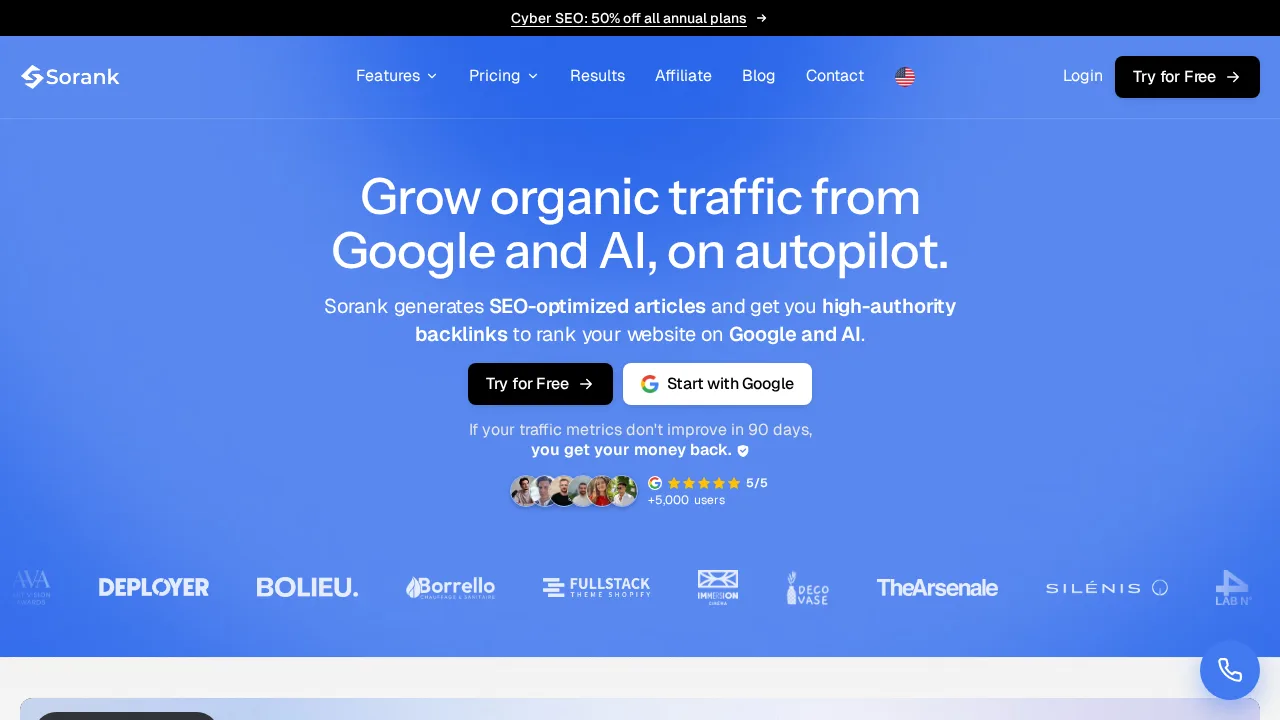
Sorank is SEO and GEO software on autopilot, a better match if your goal with Copy.ai was organic traffic. It finds the keywords, builds the topic clusters, then writes, illustrates and publishes the articles on your CMS (more than 10 platforms, including WordPress, Shopify and Webflow) with internal linking, anti-cannibalization and fact-checking. It draws on data from thousands of sites and hundreds of millions of keywords, with search intent, query fan-out, a GEO ranking of the domains AI cites and a weekly read of what up to 5 chosen competitors publish. A unified dashboard brings Search Console, Analytics and AI traffic together.
Each month Sorank asks AI your customers' questions (10 prompts on ChatGPT, Claude and Gemini with Essential, 20 prompts with Grok added on Pro, 50 on Business) and shows whether your brand is mentioned, which brands are cited instead and which sources AI uses. Backlinks come from direct, one-way links between the sites of more than 5,000 Sorank users, with credits (100 per month on Pro, 300 on Business). Plans are Essential at $99 per month (20 articles), Pro at $249 (60 articles) and Business at $499 (120 articles), or $49, $129 and $249 per month billed yearly, with a 3-day free trial and a 90-day results-or-refund guarantee (see pricing). Agencies can use the white label, and the MCP connector lets you drive Sorank from Claude or ChatGPT.
2.  Jasper
Jasper puts AI agents to work for marketing teams, with brand context shared across content. It suits marketing departments that want an AI content platform without the sales side.
3.  Writesonic
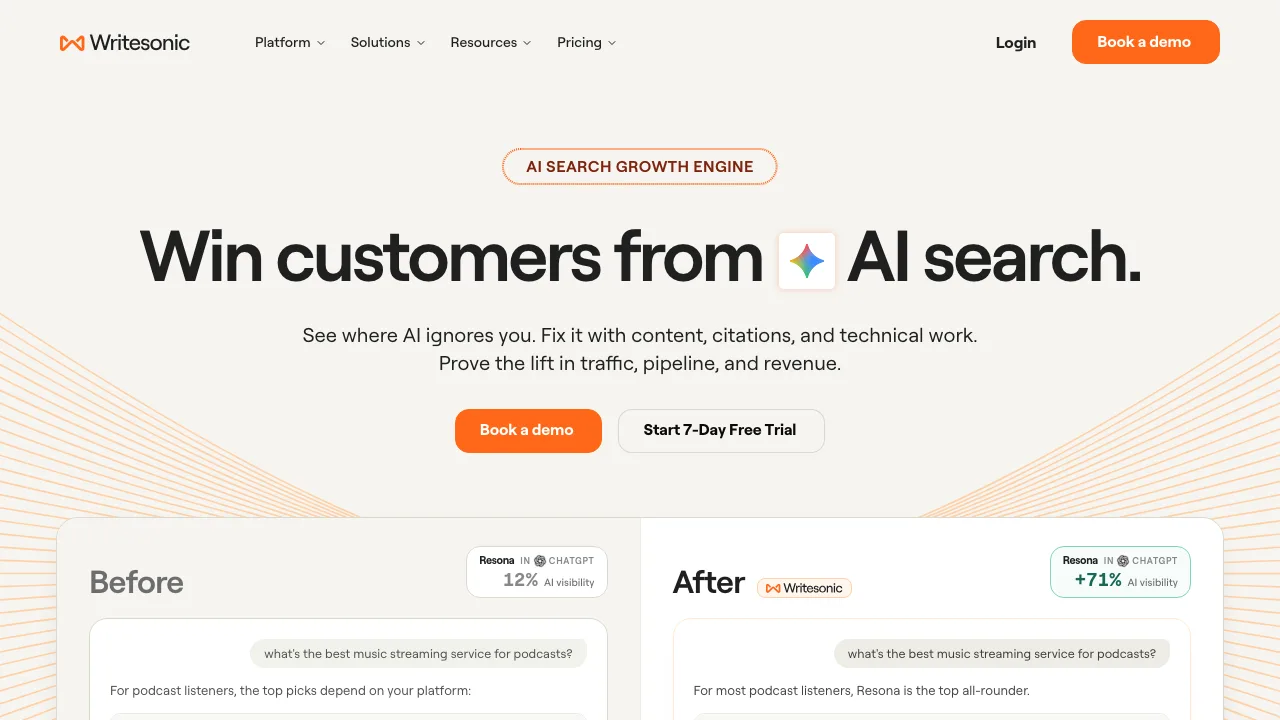
Writesonic combines AI writing with GEO features and AI visibility tracking. It fits marketers who want content and search in one tool.
4.  AirOps
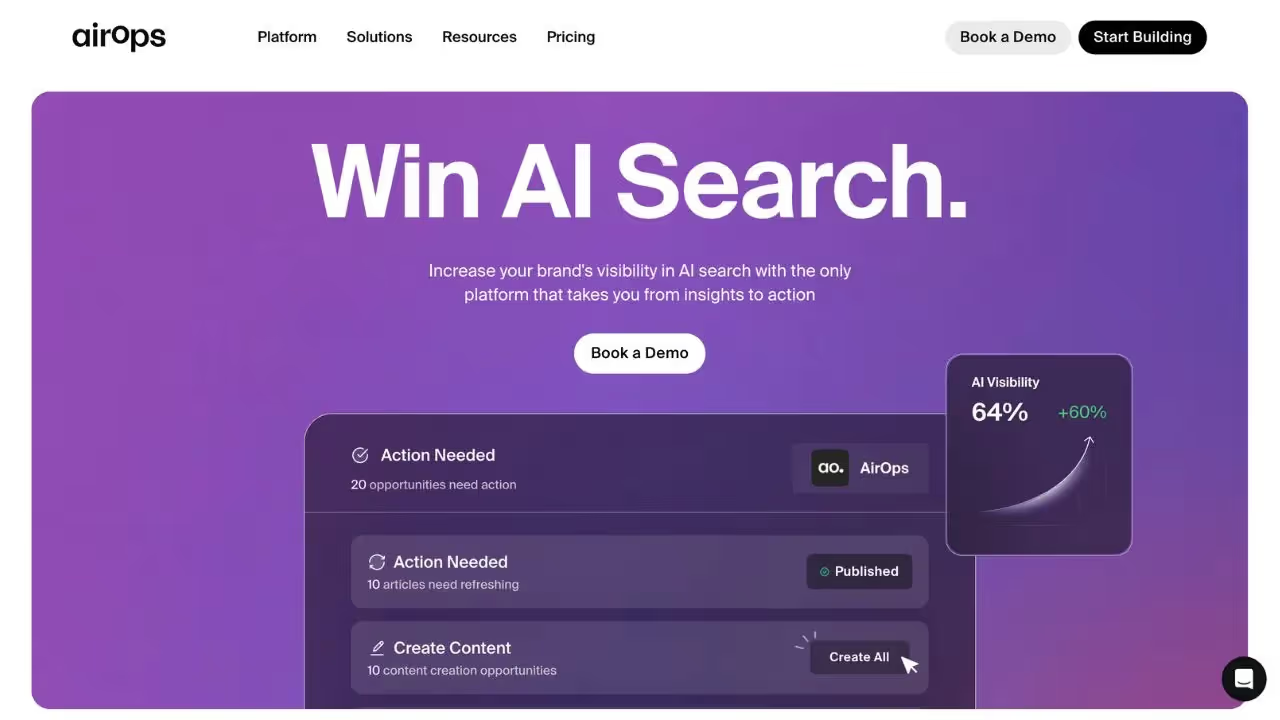
AirOps helps content teams build workflows aimed at AI discovery and search. It is close to Copy.ai's workflow logic, with a content and search focus.
5.  Rytr
Rytr is a simple, low-cost AI writing assistant with a Chrome extension. It suits individuals who only need quick copy.
6.  Koala AI
Koala AI writes long SEO articles for Google and AI answers. It fits bloggers and affiliate sites that need articles more than GTM automation.
How to choose between  Copy.ai and Sorank
Copy.ai fits a revenue organization that wants to automate prospecting, lead handling, account-based marketing and sales coaching across a large team, with content as one use case among many. If your priority is to connect AI to your CRM and sales processes, its Growth plan and above are built for that, with budgets to match.
Sorank fits a business whose goal is to be found on Google and cited by AI: keyword discovery, topic clusters, 20 to 120 published articles per month, one-way backlinks from other users' sites and monthly AI tracking on 10 to 50 prompts. The two tools answer different needs, so the question is whether your bottleneck is sales operations or organic visibility. Results with Sorank usually show within 2 to 4 months, and you can start with the 3-day free trial, the free SEO tools or the free Chrome extension for on-page audits.