


העדפות

הפרטיות חשובה לנו, ולכן יש לך אפשרות להשבית סוגים מסוימים של אחסון שייתכן שאינם נחוצים לתפקוד הבסיסי של האתר. חסימת קטגוריות עלולה להשפיע על חווית השימוש שלך באתר. מידע נוסף

קבל את כל קובצי ה-Cookie

Perplexity Ranking Checker: Is Your Brand Cited in Perplexity Answers?

Check whether and how your brand is cited in Perplexity AI answers and learn how to become a trusted source in AI-powered search.

תיבו בסון-מגדלן, מייסד סורנק

אודות המחבר

תיבו בסון-מגדלן

מייסד סורנק, עם למעלה מ-5 שנות ניסיון ב-SEO, חובב GEO.

Learn everything to know on Perplexity Ranking Checker !

נוצר ב-
24/6/26
עדכון אחרון:
24/6/26
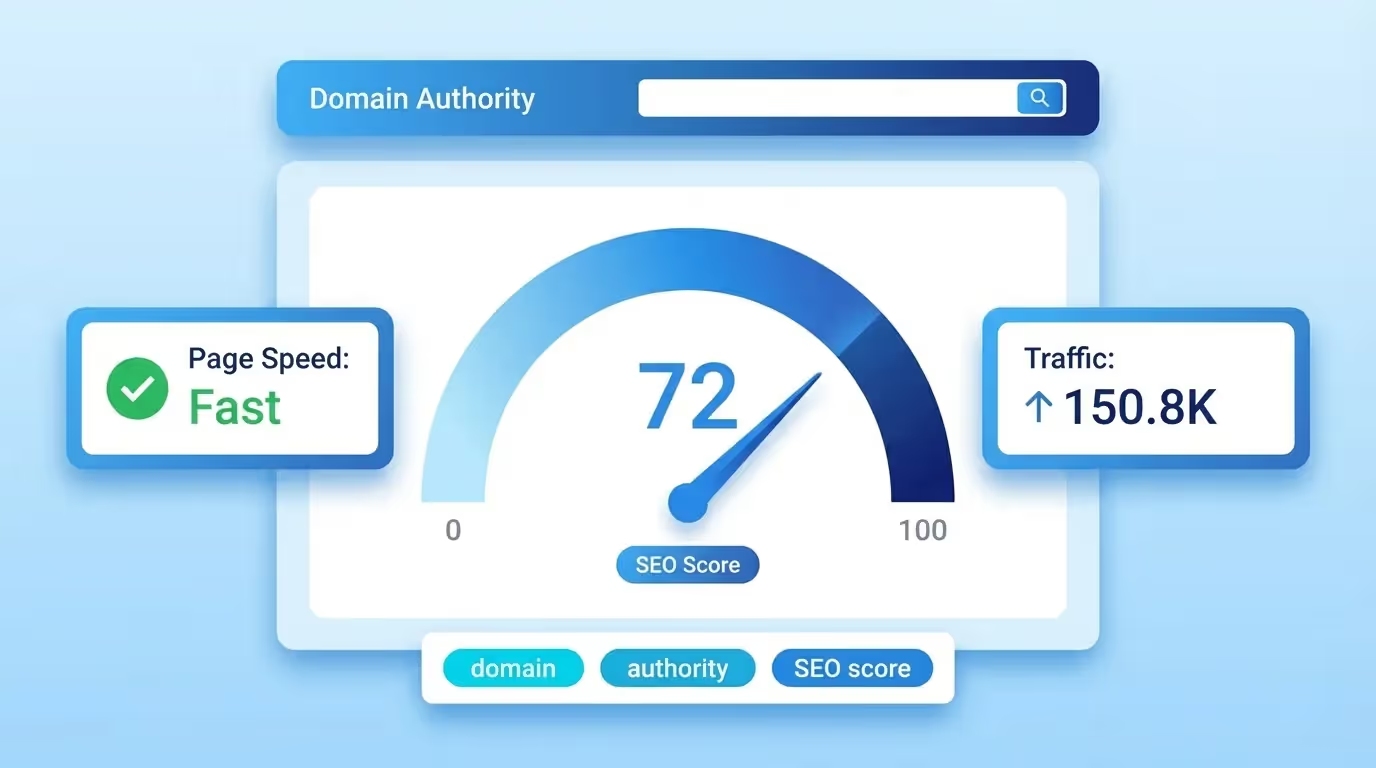
Screenshot of the Perplexity Ranking Checker tool showing a domain citation score with source quality indicators

Perplexity AI has established itself as one of the fastest-growing AI search engines, delivering sourced answers with visible citations for each claim. Being cited in a Perplexity answer places your brand directly in the answer itself, alongside a numbered source link that users can verify. That is a fundamentally different kind of visibility from a blue link at position three. The tool above checks whether your domain appears as a cited source in Perplexity answers and identifies the factors holding it back if it does not.

Enter your domain or brand name in the field above to run the check.

How Perplexity sources its citations

Perplexity operates a live retrieval system: for each query it runs a real-time web search, selects a handful of sources, reads them, and synthesises a response with inline citations. The selection process favours:

  • Crawl accessibility. PerplexityBot must be able to access your pages. If your robots.txt includes a rule blocking all bots or if PerplexityBot specifically is denied, you will not appear as a source regardless of your content quality.
  • Content specificity and depth. Perplexity favours pages that provide a direct, detailed answer to a specific question. A 1 500-word article that comprehensively answers one query beats a 5 000-word guide that covers ten topics shallowly.
  • Source credibility signals. Perplexity uses signals similar to those of a search engine: domain authority, external links pointing to the page, and whether the domain is recognised as a credible publisher in its niche. Academic, journalistic, and data-rich sources tend to score higher.
  • Freshness. For time-sensitive queries Perplexity strongly prefers recent content. Keeping key pages updated -- adding a last-reviewed date and refreshing statistics -- improves the probability of being selected for live queries.
  • Structured formatting. Paragraphs with clear topic sentences, numbered lists for step-by-step content, and concise definitions at the start of key sections all make it easier for Perplexity's retrieval layer to extract and attribute a quote to your page.

How to improve your Perplexity presence

Once the tool above identifies the specific gaps for your domain, here is the recommended course of action for each scenario:

  • PerplexityBot blocked. Locate the relevant rule in your robots.txt and update it to allow PerplexityBot. Test the fix immediately with a robots.txt validator before re-running this checker.
  • Low domain authority. A sustained link-building strategy -- press features, resource pages, data studies that earn natural links -- raises the baseline credibility that Perplexity's retrieval layer rewards. Aim for backlinks from domain-relevant, editorially controlled sources rather than directories.
  • Unfocused content. Audit your most important pages and narrow the scope. Each page should target one primary question or intent. Remove or condense sections that dilute the focus.
  • Missing freshness signals. Add a published and last-updated date to every article. Update statistics annually at minimum. Create a changelog or update log if you maintain long-lived resource pages.
  • No direct answer in the first paragraph. Rewrite the introduction so it contains a concise, standalone answer to the page's primary question. This is the section Perplexity is most likely to quote verbatim as a citation.

Why Perplexity traffic is worth prioritising

Traffic originating from AI answer engines like Perplexity converts at roughly 7% on average according to 2025 data, compared with 2.6% for typical organic search traffic. The conversion premium exists because users who follow a Perplexity citation arrive with high intent: they have already read an AI-synthesised answer that mentioned your brand by name. Investing in Perplexity visibility is therefore directly tied to bottom-of-funnel impact.

For continuous tracking of your brand's citation rate across Perplexity, ChatGPT, and Gemini, Sorank monitors AI citations automatically so you always know where you stand.

שאלות נפוצות

Does Perplexity use real-time search or a fixed training dataset?

Perplexity primarily uses real-time retrieval: it runs a live web search for each query and selects sources from current results. This makes it responsive to recent content updates and technical fixes much faster than models that rely on a fixed training corpus.

Can I request Perplexity to include my site as a source?

Perplexity does not offer a manual submission programme. The path to being cited is earning it: ensure PerplexityBot can crawl your site, publish credible and specific content that directly answers target queries, and build domain authority through legitimate link-building.

What is a healthy citation rate and how do I measure it?

There is no universal benchmark, but a practical method is to run 20 to 30 target queries in Perplexity and count how many responses cite your domain. Tracking this share of voice over time -- ideally with a tool that automates the monitoring -- reveals whether your optimisation efforts are working.

כלי SEO חינמיים נוספים