
Preferences
Privacy is important to us, so you have the option of disabling certain types of storage that may not be necessary for the basic functioning of the website. Blocking categories may impact your experience on the website. More information
Privacy is important to us, so you have the option of disabling certain types of storage that may not be necessary for the basic functioning of the website. Blocking categories may impact your experience on the website. More information

The crawl-to-referral ratio compares AI bot crawls with the visits AI sends back. Learn the formula, real Cloudflare figures and the limits of the metric.








Founder Sorank, 7+ years in SEO.
Summary
The crawl-to-referral ratio is the number of pages an AI platform's bots crawl on a site divided by the number of visits that platform sends back. A ratio of 1000:1 means 1000 crawls for one referred visit. It shows how much content an AI takes compared with the traffic it returns.
Want to go further? Ask
The crawl-to-referral ratio (Cloudflare calls it the crawl-to-refer ratio, Microsoft Clarity the scrape-to-referral ratio) puts two numbers side by side: what AI crawlers such as GPTBot and ClaudeBot read on your site, and what their platforms give back in clicks. Search engines have always crawled in exchange for traffic. AI assistants answer the question directly, so the exchange is no longer balanced, and this ratio measures by how much.
You divide the crawl requests from one platform's bots by the visits that arrive from that platform, over the same period. Cloudflare, which introduced the metric, counts only HTML pages: its Radar methodology divides HTML requests from the platform's crawler user agents by HTML requests whose Referer header contains a hostname of that platform.
crawl-to-referral ratio = crawl requests from platform X bots
                          / referred visits from platform X

Same site, same period, same pages (HTML only)
Three choices define the result:
The result is written as "N:1", the number of crawls for one referred visit. The bot is identified by its user agent string, the visit by its referrer: two different signals, which explains most of the measurement problems described below.
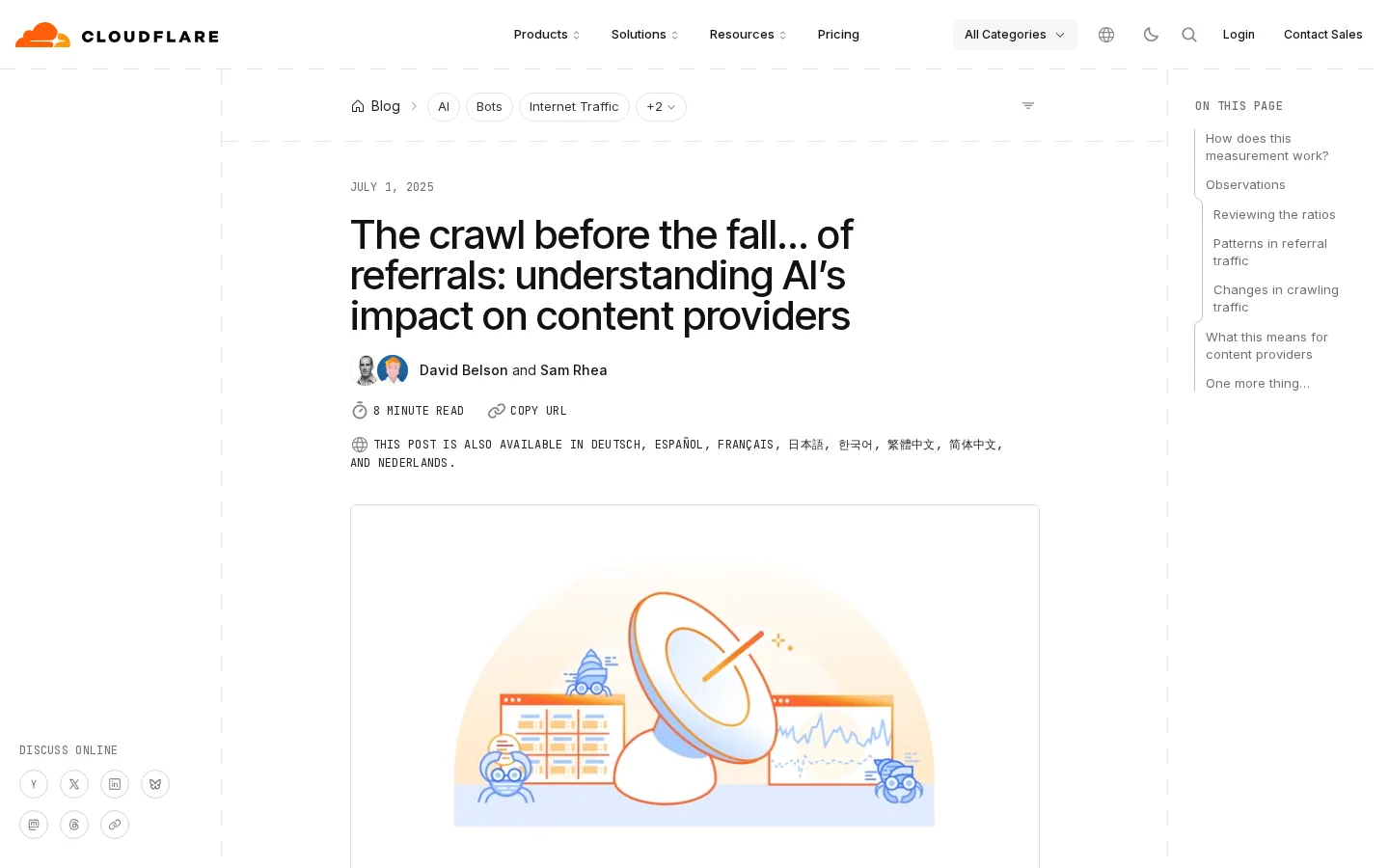
Published ratios range from below 1 to several hundred thousand, depending on the platform and the period. The most cited figures come from Cloudflare, which sees a large share of web traffic.
For the week of June 19 to 26, 2025, Cloudflare measured about 70900 HTML crawls per referral for Anthropic, and 0.1:1 for Mistral, which means about 10 referrals for each crawl request. In its August 2025 analysis of the crawl-to-click gap, Cloudflare compared January and July 2025:
| Platform | January 2025 | July 2025 | Change |
|---|---|---|---|
| Anthropic | 286930.1:1 | 38065.7:1 | -86.7% |
| OpenAI | 1217.4:1 | 1091.4:1 | -10.4% |
| Perplexity | 54.6:1 | 194.8:1 | +256.7% |
| 3.8:1 | 5.4:1 | +43% |
Two lessons stand out. Google, a search engine, stays in single digits most of the time (it peaked at 22.5 in April 2025). AI platforms sit far higher. And the numbers move fast: Cloudflare links Anthropic's drop partly to Claude adding web search with clickable citations in 2025. Our guide to reading Perplexity statistics shows how the same ratio gets quoted out of context.
A high ratio means a platform reads a lot and sends few visitors; a low ratio means the exchange is closer to classic search. Read it per platform, never as a single site-wide score.
The purpose of the crawl explains a lot. Cloudflare estimates that 79% of AI crawling in July 2025 was for training, 17% for search and 3.2% for user actions. Training crawls never produce a referral, so a platform that trains heavily will show a high ratio whatever your content is worth. If you want to know which OpenAI bot does what, see our page on GPTBot, OAI-SearchBot and ChatGPT-User.
Note
A falling ratio does not prove that a platform sends more visits. Cloudflare points out that the ratio is relative: it can drop because the bot crawls less, not because more people click.
The same idea exists under three names, with different data behind each one.
| Name | Who measures it | Scope | How a referral is counted |
|---|---|---|---|
| Crawl-to-refer ratio (Radar) | Cloudflare Radar | Whole Cloudflare network, per platform | Referer header, HTML pages only |
| Crawl-to-refer ratio (Business Insights) | Cloudflare dashboard | Your own zone, per bot operator and site-wide | Referral links tracked with UTM parameters |
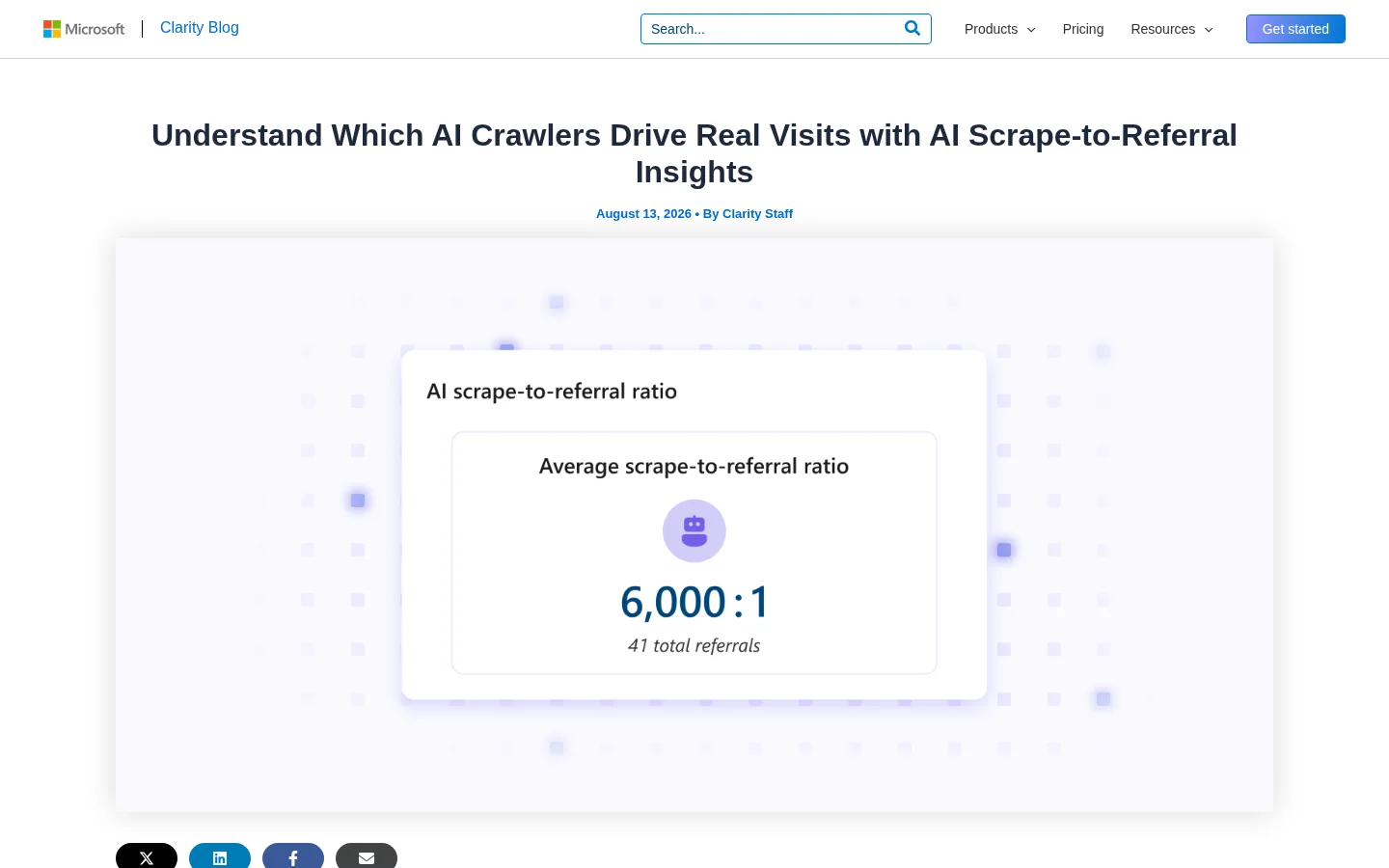
| AI Scrape-to-Referral Ratio | Microsoft Clarity | Your own domains | Referral analytics from Clarity |
On a single site, Cloudflare's Business Insights documentation describes the metric as the average ratio of crawls a company sends to the visitors arriving through its referral links, averaged over the last 24 hours, 7 days or 30 days; it is available to Enterprise Bot Management customers. Microsoft Clarity shows its version as a card in Bot Analytics, inside the AI Visibility dashboard, and its August 2026 announcement states that ratios are calculated only across correctly mapped domains.
You need two counts for the same pages and the same period: bot hits from your logs, and AI visits from your analytics.
Measure your crawl-to-referral ratio in 4 steps
For the crawl side, our definition of AI crawler logs shows what to look for, and the guide to server log file analysis explains how to filter them. For the referral side, read our page on tracking visits from AI search. In Sorank, the GEO / SEO dashboard reads Google Analytics and shows the visits sent by ChatGPT, Claude, Gemini, Perplexity and Grok, per page, which gives you the denominator without manual filtering.
The ratio is useful for spotting trends, but the referral side is undercounted and the crawl side mixes different bots. Keep four limits in mind:
Most errors come from treating the ratio as a fixed property of a platform.
It turns a vague worry ("AI takes my content") into a number you can follow per platform. For SEO, it shows where crawl resources go and which bots behave like search engines. For GEO, it shows which assistants actually send visitors once they cite you, and where your effort to get cited is rewarded by traffic.
It also frames the access decision. Blocking every AI crawler lowers the crawl side to zero but also removes you from the answers that do send clicks. A ratio read per bot helps you keep the search and user bots open while you decide on training bots. Before you change anything, check that the bots you want can reach your pages with the free AI crawlability audit.
The crawl-to-referral ratio divides what an AI platform crawls by the visits it sends back. Published values go from 0.1:1 to over 286000:1 depending on the platform and the period, so a ratio only means something with its window, its bot grouping and its data source. Measure it on your own site, per platform, month over month, and read it next to your AI visibility rather than alone.
Sources
There is no official target: the right level depends on your site and what you expect from AI platforms. Search engines such as Google usually stay in single digits in Cloudflare's data, while AI platforms are much higher. Compare your own ratio per platform month over month rather than against a single benchmark.
They measure the same idea: bot activity divided by visits sent back. Crawl-to-refer is Cloudflare's name, used on Radar and in its Business Insights dashboard; scrape-to-referral is Microsoft Clarity's name for its card in Bot Analytics. The data sources and the way referrals are counted differ, so the figures are not directly comparable.
Not automatically. A company's ratio often mixes a training bot, which never sends clicks, with a search bot that cites your pages. Split the ratio by user agent and decide bot by bot in robots.txt, so you keep the bots that bring visibility and visits.
 “I tested Sorank on a real client site and it's insane. It does everything an agency would bill you $1500 a month for. It's going into production on that client now.”

 Guillaume Guersanguersanguillaume.com“We are an Ads agency and we wanted to get our SEO back on track once and for all. Sorank gave us a clear view of our site, helped us prioritize optimizations, and properly structure our content. The tool is easy to use, well designed for a team, and very practical for centralizing tracking without having to juggle multiple platforms. A very solid foundation to start fresh with our SEO.”
 Gaspard MadouiAds Agency
 “I just let the Sorank software do its thing, and now my DR is 25 and my page is ranking higher.”
 Lucas Flandrefoundertrace.fr“I specialized in GEO thanks to Sorank. The GEO Leaderboard allows me to show my clients their position vs competitors on ChatGPT. It’s a real commercial differentiator.”
 MélanieSEO Freelance“Great service, works well for our website and helps us understand how to improve it to rank better on Google and elsewhere. Congrats, keep going, I recommend it.”
 Hugo T.E-commerce merchant



















