
Preferences
Privacy is important to us, so you have the option of disabling certain types of storage that may not be necessary for the basic functioning of the website. Blocking categories may impact your experience on the website. More information
Privacy is important to us, so you have the option of disabling certain types of storage that may not be necessary for the basic functioning of the website. Blocking categories may impact your experience on the website. More information

AI CMO: an AI system that runs marketing, or a CMO role rebuilt around AI. Learn how each works, the skills needed and the mistakes to avoid.








Founder Sorank, 7+ years in SEO.
Summary
AI CMO is a term with two meanings. It is either an AI system that plans, runs and measures marketing work (content, SEO, ads, AI visibility) under human goals, or a chief marketing officer whose job is rebuilt around AI: data, agents, new skills and governance. Both share one idea: AI executes, people decide.
Want to go further? Ask
The term AI CMO shows up in two very different places. Software vendors use it to name a product: a set of autonomous AI agents that does the daily work of a marketing department. Consultants and boards use it to describe a person: the chief marketing officer who leads with AI, sometimes called the "AI-first CMO". This page explains both meanings, how they connect, and what each one means for your traffic from Google and from AI assistants.
AI CMO means either a marketing system run by AI or a human CMO who runs marketing with AI. You can tell which one is meant from the context: a pricing page talks about the system, a leadership study talks about the role.
| AI CMO as a system | AI CMO as a role | |
|---|---|---|
| What it is | Software made of coordinated AI agents | A chief marketing officer whose job is reshaped by AI |
| Main job | Executes: research, content, publishing, ads, reporting | Decides: strategy, budget, brand, team, guardrails |
| Who uses the term | Marketing software vendors, founders, lean teams | Consulting firms, CEOs, boards, recruiters |
| Main risk | Off-brand or low-quality output at scale | Talking about AI without changing how the team works |
The two meanings fit together. The system takes the execution layer; the human role moves up to direction, quality and accountability.
An AI CMO system is software that turns business goals into marketing actions without a person doing each task by hand. It is a step beyond classic marketing automation workflows: a workflow follows rules you wrote, while an AI CMO system chooses the next task itself, inside the limits you set.
Most systems sold under this name run the same loop:
This is the same family as agentic marketing, applied to the whole marketing function instead of one task. The difference with a chatbot is simple: a chatbot answers when you ask, an AI CMO system acts on a schedule and reports back.
An AI CMO system handles the repetitive, high-volume work that a small team cannot keep up with. The usual scope covers:
The scope is often narrower than the name suggests. Many products called "AI CMO" are strong on one or two channels and weak elsewhere, so read the feature list before you trust the title.
Example
LV3D, a French 3D printing specialist, let Sorank publish dozens of articles a month on autopilot. In 5 months its organic traffic was multiplied by 4, daily Google clicks rose from about 240 to over 1000, and ChatGPT now recommends LV3D first for a CPF-funded 3D printing course. The full figures are in the LV3D case study.
The CMO role is moving from running campaigns to designing the system that runs them. The leadership studies that rank for this term agree on three shifts: data and technology, people, and governance.
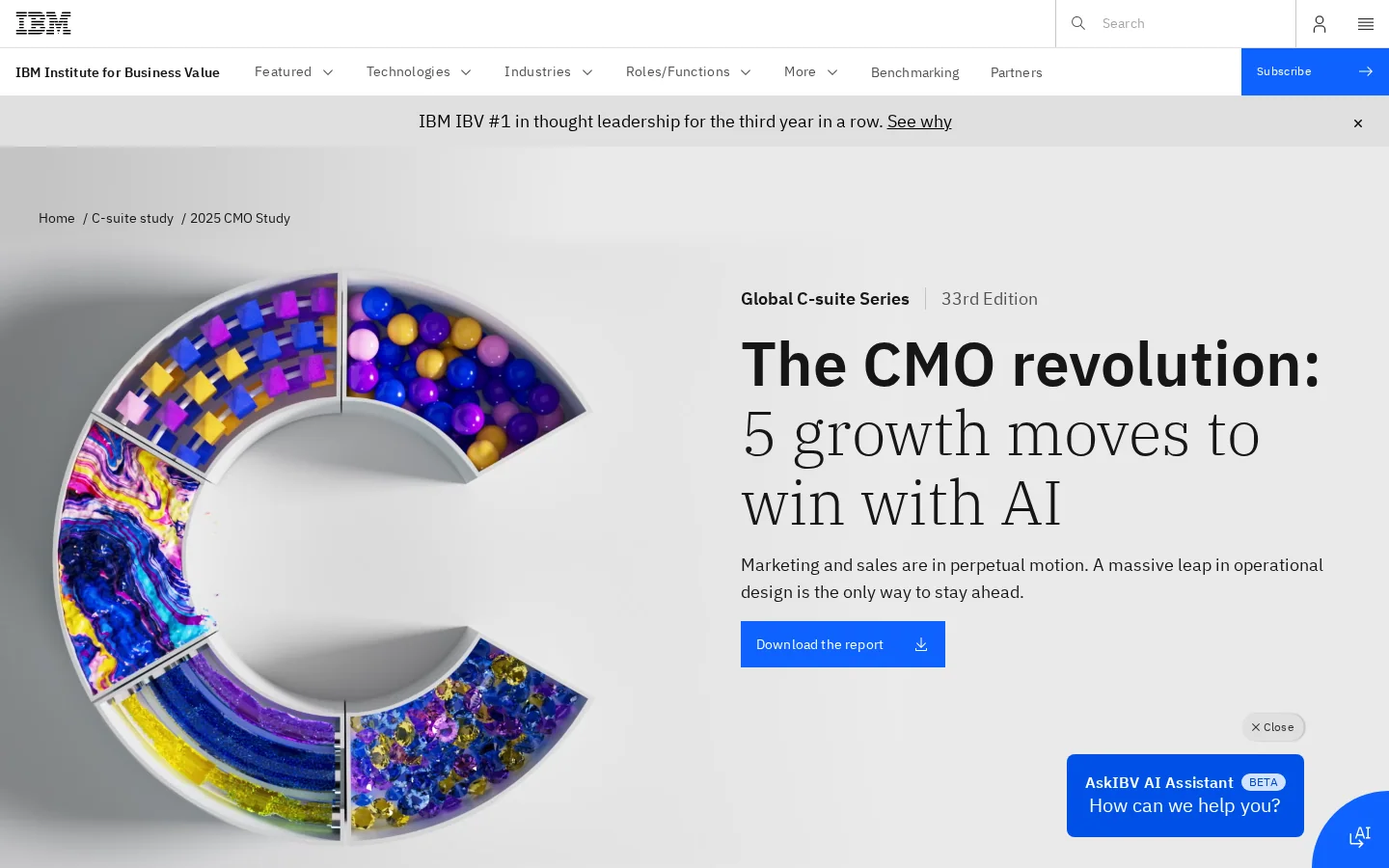
The IBM Institute for Business Value 2025 CMO Study, run with Oxford Economics, shows the gap between ambition and readiness: 71% of CMOs say the success of AI depends more on people's buy-in than on the technology, only 21% believe they have the talent to reach their goals for the next two years, and only 17% strongly believe their function is ready to integrate agentic AI into its processes.
Boston Consulting Group gives the role a new name. In its November 2025 article on the AI-first CMO, it calls this leader a "chief growth architect" who connects marketing data and demand signals to the company's growth agenda, builds the AI and data backbone of the martech stack with the CTO, and protects human-driven creativity.
An AI-first CMO needs to understand how data flows and how AI work is checked, not to write code. In practice, the job asks for:
No: an AI CMO system replaces part of the execution, not the leadership. Even vendors of these systems present them as an execution layer working under human goals.
Software can pick keywords, write and publish, but it cannot own a budget trade-off, defend a brand position in front of a board, or take responsibility when a message goes wrong. What changes is the size of the team needed to execute. A small company can now run a steady SEO and content program without hiring a full team, while the founder or marketing lead keeps the CMO decisions.
For a marketing team, this is where Sorank for marketing teams fits: it runs keyword research, article writing and publishing, backlinks and AI visibility tracking on autopilot, while your team sets the direction and approves what it wants.
Judge an AI CMO platform on what it publishes and measures, not on how many agents it lists. Use these criteria:
Tip
Run a 30-day test on one section of your site. Compare the pages the system published with what a good writer on your team would produce, then decide on the autonomy level.
Most failures come from treating the AI CMO label as a strategy. Here are the frequent ones.
AI CMO matters for SEO and GEO because organic growth is exactly the kind of work these systems do best: regular publishing, many pages, constant measurement. An SEO autopilot is in practice the organic channel of an AI CMO system.
It also changes what you measure. Buyers now ask AI assistants which provider to choose, so generative engine optimization becomes part of the CMO's scorecard, next to rankings and clicks. Content that gets cited by AI is precise, sourced and clearly structured, which is the standard any AI CMO system should be held to. To see where your brand stands today, AI mention tracking sends your market's questions to the AIs and shows who they recommend.
AI CMO names two things that work as one: a system that executes marketing and a leader who designs and governs it. Use the system for volume and consistency, keep humans on strategy, brand and accountability, and judge the result on traffic from Google and mentions in AI answers. The studies from IBM, BCG and Deloitte all point the same way: the hard part is data, people and rules, not the software.
Sources
An AI CMO is either an AI system that plans, executes and measures marketing work under human goals, or a chief marketing officer whose role is rebuilt around AI. In both cases, AI handles execution while people keep strategy, brand and accountability.
No. An AI CMO system can take over research, content, publishing and reporting, but it cannot own budget trade-offs, brand positioning or responsibility for results. It reduces the team needed to execute, not the need for a marketing leader.
An AI-first CMO designs the data, tools and rules that let AI do marketing work safely. BCG describes this leader as a chief growth architect who builds the martech stack with the CTO, trains the team and protects human creativity.
 “I tested Sorank on a real client site and it's insane. It does everything an agency would bill you $1500 a month for. It's going into production on that client now.”

 Guillaume Guersanguersanguillaume.com“We are an Ads agency and we wanted to get our SEO back on track once and for all. Sorank gave us a clear view of our site, helped us prioritize optimizations, and properly structure our content. The tool is easy to use, well designed for a team, and very practical for centralizing tracking without having to juggle multiple platforms. A very solid foundation to start fresh with our SEO.”
 Gaspard MadouiAds Agency
 “I just let the Sorank software do its thing, and now my DR is 25 and my page is ranking higher.”
 Lucas Flandrefoundertrace.fr“I specialized in GEO thanks to Sorank. The GEO Leaderboard allows me to show my clients their position vs competitors on ChatGPT. It’s a real commercial differentiator.”
 MélanieSEO Freelance“Great service, works well for our website and helps us understand how to improve it to rank better on Google and elsewhere. Congrats, keep going, I recommend it.”
 Hugo T.E-commerce merchant



















