
Preferences
Privacy is important to us, so you have the option of disabling certain types of storage that may not be necessary for the basic functioning of the website. Blocking categories may impact your experience on the website. More information
Privacy is important to us, so you have the option of disabling certain types of storage that may not be necessary for the basic functioning of the website. Blocking categories may impact your experience on the website. More information

Agent experience (AX) is how easily AI agents find, use and recover with your product or site. Learn how it differs from UX and DX and how to improve it.








Founder Sorank, 7+ years in SEO.
Summary
Agent experience (AX) is the experience AI agents have when they discover, choose and use a product, website or API on behalf of a human: how easily they find what it does, call it reliably and recover from errors. In customer service, the same term means the daily working experience of human support agents.
Want to go further? Ask
Agent experience is a design discipline for a new kind of user. When you ask ChatGPT, Claude or a coding assistant to book, compare, deploy or buy something, the agent reads pages, calls APIs and fills forms for you. If your site or product is hard for that agent to understand, the task fails or the agent picks a competitor. AX is the work of making sure that does not happen.
Agent experience has two meanings, and you need to know which one a page is talking about before you read it.
The two meanings share a word and an idea: the person (or program) who does the work deserves a smooth path. This page focuses on the AI meaning, because it is the one that affects your visibility, and covers the customer service meaning in its own section below.
Mathias Biilmann, CEO and co-founder of Netlify, coined AX in his post Introducing AX: Why Agent Experience Matters, published on January 28, 2025. He defined it as "the holistic experience AI agents will have as the user of a product or platform."
His argument is simple: products that agents struggle to use will feel less capable, while agent-friendly tools will win adoption. He gave a concrete case: thanks to Netlify's ChatGPT integration, more than 1000 sites were being created on Netlify directly from ChatGPT every day. He asked companies to check whether their APIs are clean and well described, and whether machine-ready documentation exists.
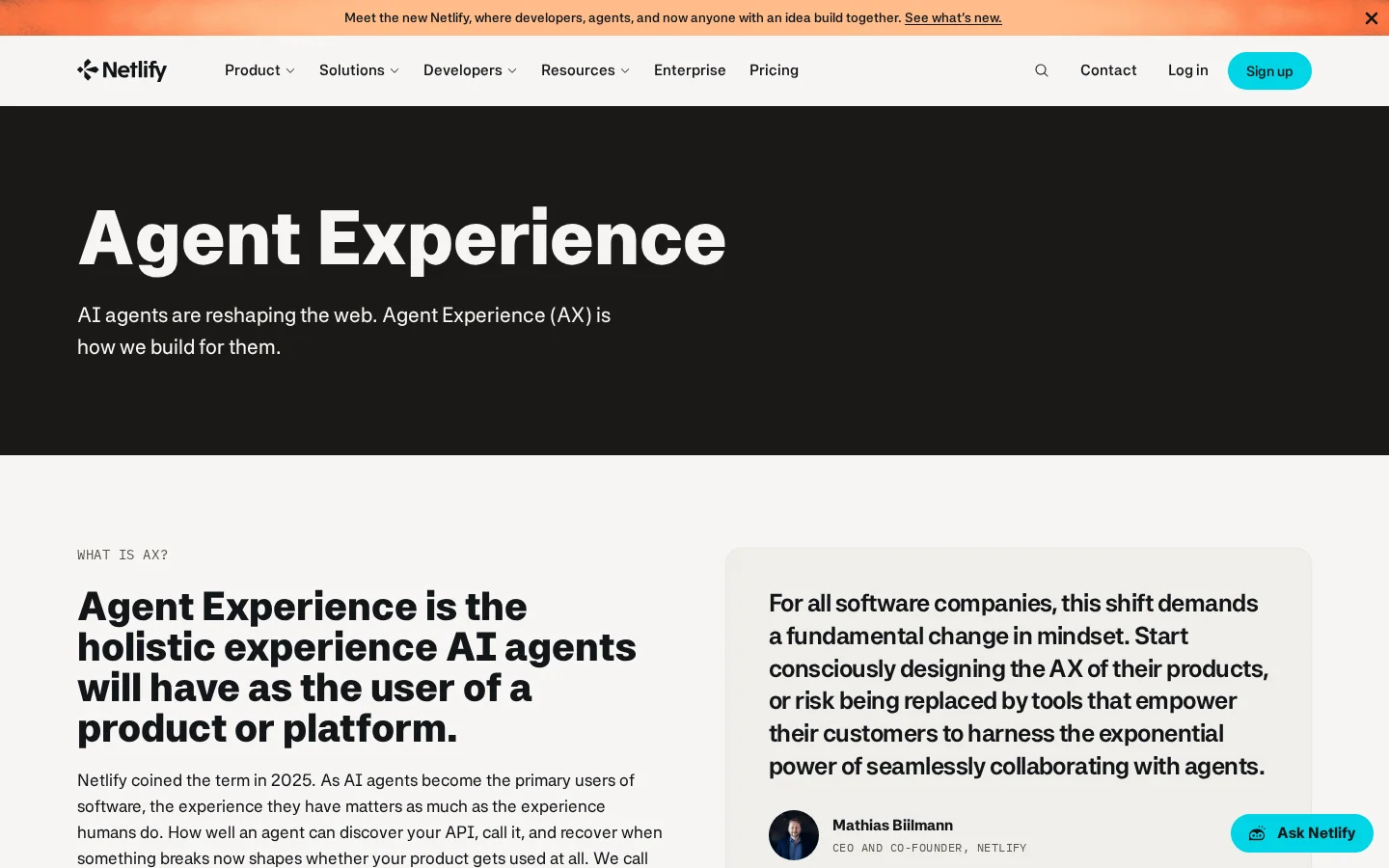
Netlify now keeps a hub page on the topic, which opens with "AI agents are reshaping the web. Agent Experience (AX) is how we build for them."
Since then, the term has spread to developer platforms and large vendors. Microsoft's developer blog, for example, defines AX as "the experience AI agents have when discovering, choosing, and using your technology."
UX, DX and AX describe the same goal (making a product easy to use) for three different users: people, developers and AI agents. In his original post, Biilmann places AX as the third layer, after UX (a term he credits to Don Norman in 1993) and DX (credited to Jeremiah Lee in 2011).
| User experience (UX) | Developer experience (DX) | Agent experience (AX) | |
|---|---|---|---|
| Who is the user? | A person using the product | A developer building on the product | An AI agent acting for a person |
| What they read | Visual pages, buttons, images | Docs, SDKs, code samples | Raw text, structured data, API schemas, error messages |
| How they handle ambiguity | Guess, ask, explore | Read the source, ask a colleague | Often fail or pick another tool |
| Typical failure | Confusing navigation | Missing or outdated docs | Content hidden in JavaScript, vague errors, blocked access |
| Good signal | Task done with no frustration | Fast first integration | Agent finds, chooses and completes the task correctly |
AX does not replace the other two. Netlify's agent experience FAQ puts it this way: "DX optimizes for the humans building on your platform" and "the two overlap but serve different users." A clear page helps a human reader (see our definition of user experience and its effect on rankings), and the same clarity helps an agent. The difference is that an agent cannot ask a colleague when something is unclear.
A good agent experience lets an agent do three things without help: discover what you offer, use it reliably and recover when something breaks.
You measure agent experience by running real agents on real tasks and checking two things: whether they pick your product, and whether they use it correctly. Microsoft's developer blog calls these two measures propensity and efficacy, and scores both on the quality of the output and the cost of the task.
The same article recommends treating published best practices as hypotheses: test each change against a bare baseline and keep it only if it helps. Its point is that agents are easier to test than humans, because you can rerun the same task under identical conditions. Netlify built an open source scoring framework, AXIS, for this purpose: it runs agents against scenarios and scores the results.
Tip
For a website, a simple test works: ask ChatGPT, Claude and Gemini to complete a task that needs your site (find your price, compare your plans, find your opening hours). Note when they fail, cite a competitor or invent an answer. Each failure points to an AX gap.
You improve the agent experience of a website by removing every obstacle between an agent and your facts. Work through these steps in order.
A minimal llms.txt file looks like this:
# Example Store
> Example Store sells refurbished laptops in Europe, with a 2-year warranty.

## Key pages
- [Pricing](https://example.com/pricing): plans and delivery costs
- [Warranty](https://example.com/warranty): what is covered and how to claim
The article Agentic SEO: AI agents that do SEO, and sites built for AI agents goes further on the second half of this topic, and our free llms.txt generator writes the file for you.
In customer service, agent experience is the overall quality of working as a support agent. Kustomer's glossary defines it as "the overall quality of what it feels like to work as a customer support agent" and lists six dimensions:
Teams track it with measures such as tool switching frequency, time spent searching for information versus answering customers, and agent attrition. The logic is that a frustrated agent rarely gives customers a good experience. The two meanings now meet: many support teams use AI agents next to human agents, and both need clear knowledge bases and well-defined workflows.
Agent experience matters for SEO and GEO because AI agents are now a channel between your site and your customers. When an assistant answers a question or completes a purchase, it only uses the sources it can reach and understand. A site with poor AX is skipped, even if it ranks well on Google, and the agent recommends a competitor instead. This is the core of generative engine optimization and of agentic search.
Good AX and good SEO also reinforce each other: crawlable HTML, clear headings, structured data and fast pages help Googlebot and AI agents alike. To check the result, Sorank's AI mention tracking shows when ChatGPT, Gemini and Claude cite or recommend your brand, so you can see whether your AX work turns into visibility.
Agent experience is the user experience of AI agents: how easily they discover, use and recover with your product or website. In customer service, the same words describe the working life of support agents. For your visibility, the AI meaning is the one to act on now: open access to AI agents, put your facts in clear HTML, document what agents can do, and test the result with real tasks.
Sources
AX stands for agent experience: the experience AI agents have when they discover, choose and use a product, website or API on behalf of a person. Netlify CEO Mathias Biilmann coined the term in January 2025.
Developer experience (DX) serves the humans who build on a platform, while agent experience (AX) serves the AI agents those humans send to use it. The two overlap, but an agent cannot guess or ask a colleague when docs, pages or error messages are unclear.
In customer service, agent experience is what it feels like to work as a support agent: tools, workflows, workload, coaching, culture and autonomy. Teams improve it because frustrated agents rarely give customers a good experience.
 “I tested Sorank on a real client site and it's insane. It does everything an agency would bill you $1500 a month for. It's going into production on that client now.”

 Guillaume Guersanguersanguillaume.com“We are an Ads agency and we wanted to get our SEO back on track once and for all. Sorank gave us a clear view of our site, helped us prioritize optimizations, and properly structure our content. The tool is easy to use, well designed for a team, and very practical for centralizing tracking without having to juggle multiple platforms. A very solid foundation to start fresh with our SEO.”
 Gaspard MadouiAds Agency
 “I just let the Sorank software do its thing, and now my DR is 25 and my page is ranking higher.”
 Lucas Flandrefoundertrace.fr“I specialized in GEO thanks to Sorank. The GEO Leaderboard allows me to show my clients their position vs competitors on ChatGPT. It’s a real commercial differentiator.”
 MélanieSEO Freelance“Great service, works well for our website and helps us understand how to improve it to rank better on Google and elsewhere. Congrats, keep going, I recommend it.”
 Hugo T.E-commerce merchant



















