
Preferences
Privacy is important to us, so you have the option of disabling certain types of storage that may not be necessary for the basic functioning of the website. Blocking categories may impact your experience on the website. More information
Privacy is important to us, so you have the option of disabling certain types of storage that may not be necessary for the basic functioning of the website. Blocking categories may impact your experience on the website. More information

Google SMITH is a research model for long documents. Learn what it does, how it differs from BERT, and whether Google uses it in ranking.








Founder Sorank, 7+ years in SEO.
Summary
The Google SMITH algorithm is a research model for long documents, built on the same transformer design as BERT, that reads up to 2048 tokens (word pieces) at once, where BERT stops at 512. Google has said it did not launch SMITH in Google Search.
Want to go further? Ask
Google SMITH is a model that Google researchers published in 2020. SMITH stands for Siamese Multi-depth Transformer-based Hierarchical encoder. Its job is to measure how close two long documents are in meaning. The paper names uses such as news recommendation, related article suggestions and document clustering. The name often appears in SEO articles because it sounds like the next step after BERT, but a research model is not the same as a ranking system.
SMITH solves the length limit of BERT. The authors say BERT-based models remain limited to short text, such as a few sentences or one paragraph. The reason is the cost of self-attention, which grows with the length of the input. Long articles must be cut into pieces, so the model can miss how the end of a text relates to its start. SMITH raises the input limit from 512 tokens to 2048, which gives it a longer reading window for each document.
SMITH reads a document in layers. It first encodes the sentences inside each block of text, then combines those blocks into one representation of the whole document. "Siamese" means both documents go through the same network, and the model compares the two results.
Like BERT, it hides words during training. It also hides whole sentence blocks, which teaches it how sentences connect inside a long text. The transformer design behind it is explained in our transformer architecture entry.
In practice, SMITH outputs a measure of how similar two documents are. It does not output a ranking. A ranking needs many other inputs, such as the query, the page and the site.
SMITH is built for long documents, while BERT is limited to short text. Both rely on the transformer design, which is why the two are often compared. BERT helps a search engine read a query in context. SMITH tries to read a whole section of text as one meaning, which is harder. For the model Google did put into Search, read our BERT algorithm entry.
Yes. In October 2019, Google said it applied BERT models to both ranking and featured snippets in Search. At launch, it said BERT would help with 1 in 10 searches in the U.S. in English. Google's own description says the change matters most for longer, conversational queries, where small words such as "for" and "to" change the meaning. The Google's October 2019 BERT announcement is the best source for this, so it is the model you can point to when someone asks what runs in Search.
Google has said no. In January 2021, Danny Sullivan of Google said on Twitter that SMITH was not launched in production, answering "No. We did not", as Search Engine Roundtable reported. He added: "We publish a lot of papers about things not used in Search." In our check, we found no later Google statement that says otherwise, so treat any claim that SMITH ranks pages as unproven.
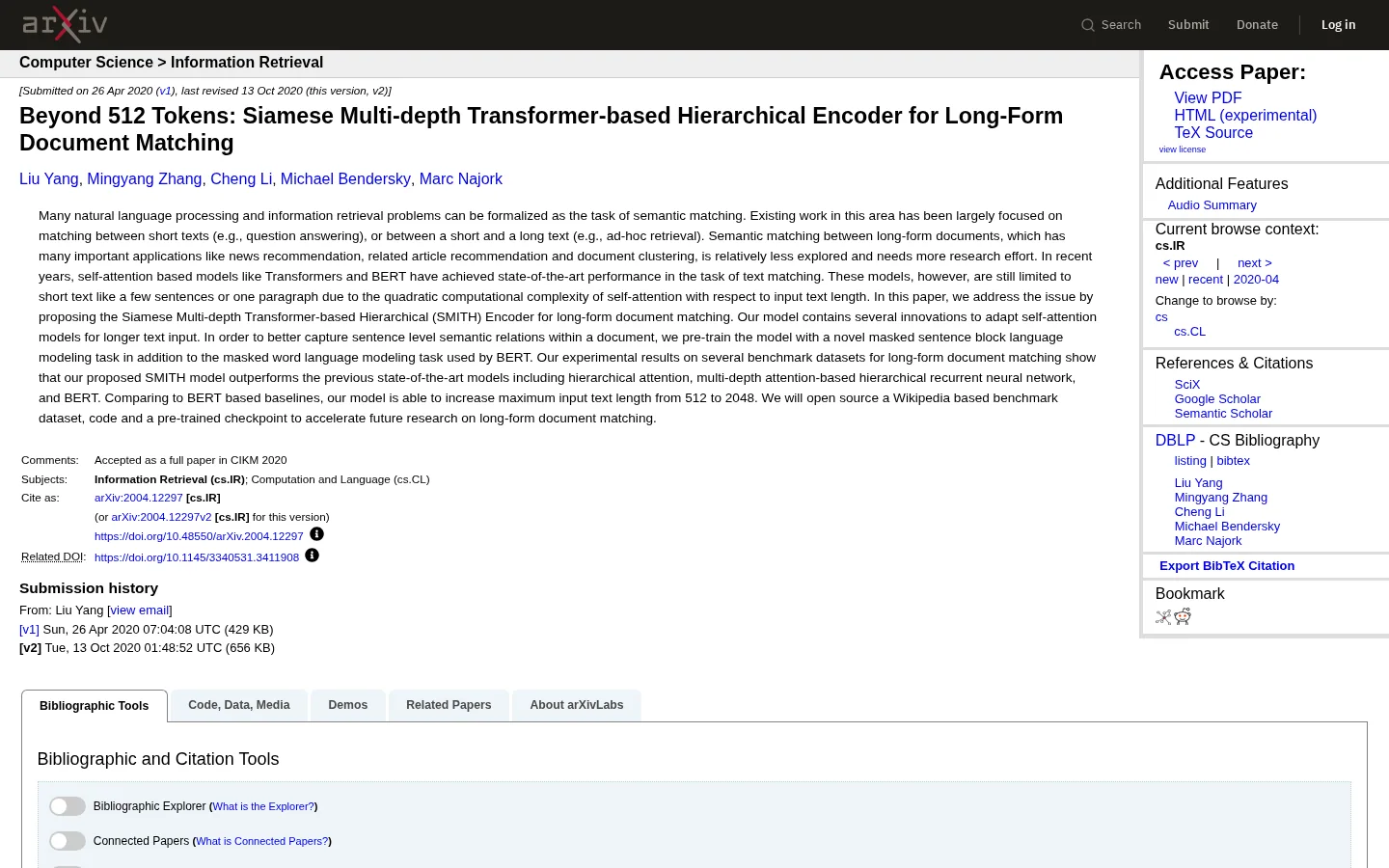
Google published a research paper, not a product change. The paper is on the Google Research page and on arXiv, the open archive where researchers share papers. It was published at CIKM 2020, a conference on information and knowledge management. Some SEO articles at the time asked whether the December 2020 core update used SMITH. Google has not said that it did.
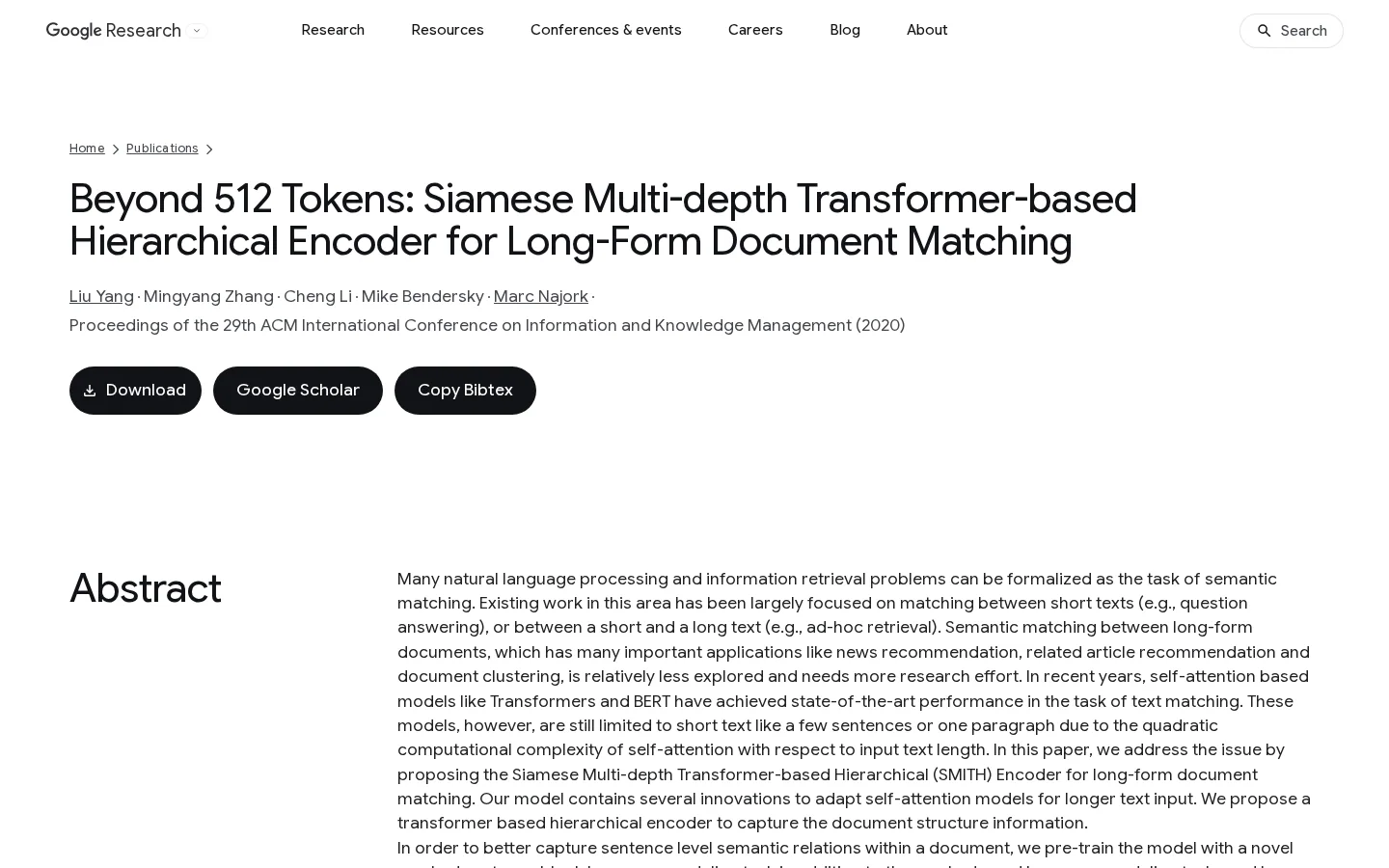
The arXiv version has the same abstract, and that is where the 512 to 2048 token claim appears.
No. Optimizing for SMITH means optimizing for a model that Google has said it did not launch in Search. Instead, write for the meaning of each page. The same work helps with semantic search and with RankBrain.
Warning
Anyone who sells a "SMITH optimization" method is selling a guess. Ask them for the Google statement that supports it.
Start with the structure, not with a model name. Each section should answer its own question in the first sentence. Google's passage ranking shows that a single section of a page can be surfaced for a query, so a section that stands alone has a better chance. You can score a page for this with the free LLM Readability Checker. Sorank offers that check as a free tool. To see why AI answers change over time, read our AI search volatility article.
Three errors come up again and again. Each one is easy to fix.
SMITH matters because it shows where Google research was heading: from short queries toward whole documents. It helps you understand the research behind ranking, but it does not give you a setting to change. For GEO, the same lesson holds for AI answers. A page that explains one topic clearly, section by section, is easier for an AI model to quote and easier for a reader to trust.
The Google SMITH algorithm is a real research model for long documents. Google has said it did not launch it in Google Search, so there is no SMITH setting to optimize. Focus on clear answers, complete sections and one clear topic per page. To see when Google changes its ranking, use the free SERP Volatility Sensor.
Sources
Google has said it did not launch SMITH in Google Search. Google published the SMITH research in 2020, and the paper focuses on matching long documents, not on ranking pages.
BERT is limited to short text, such as a few sentences or one paragraph. SMITH was designed to read up to 2048 tokens by working through the sentences of a document in layers.
No. Google has said SMITH was not launched in Search, so no SMITH-specific format will help your rankings. Write clear sections that answer each question in the first sentence.
 “I tested Sorank on a real client site and it's insane. It does everything an agency would bill you $1500 a month for. It's going into production on that client now.”

 Guillaume Guersanguersanguillaume.com“We are an Ads agency and we wanted to get our SEO back on track once and for all. Sorank gave us a clear view of our site, helped us prioritize optimizations, and properly structure our content. The tool is easy to use, well designed for a team, and very practical for centralizing tracking without having to juggle multiple platforms. A very solid foundation to start fresh with our SEO.”
 Gaspard MadouiAds Agency
 “I just let the Sorank software do its thing, and now my DR is 25 and my page is ranking higher.”
 Lucas Flandrefoundertrace.fr“I specialized in GEO thanks to Sorank. The GEO Leaderboard allows me to show my clients their position vs competitors on ChatGPT. It’s a real commercial differentiator.”
 MélanieSEO Freelance“Great service, works well for our website and helps us understand how to improve it to rank better on Google and elsewhere. Congrats, keep going, I recommend it.”
 Hugo T.E-commerce merchant



















