
Preferences
Privacy is important to us, so you have the option of disabling certain types of storage that may not be necessary for the basic functioning of the website. Blocking categories may impact your experience on the website. More information
Privacy is important to us, so you have the option of disabling certain types of storage that may not be necessary for the basic functioning of the website. Blocking categories may impact your experience on the website. More information

AI search intent optimization structures content around the real goal behind a prompt so AI assistants retrieve, understand and cite your passages in 2026.








Founder Sorank, 7+ years in SEO.
Summary
AI search intent optimization is the practice of structuring your content around the real goal behind a prompt, so AI assistants such as ChatGPT, Perplexity and Gemini can understand the question, retrieve the right passage and cite your page inside their answer.
Want to go further? Ask
AI search intent optimization means writing for the goal behind a prompt instead of the exact words typed. A person who asks an assistant how to lower a bill, compare two tools or choose a supplier wants an outcome. The assistant reads that outcome from meaning, context and modifiers, so your page earns citations when it answers the outcome clearly enough that one self-contained passage can be lifted into the answer.
This is a shift from classic optimization. Classic work aimed at a ranked list of links. In AI search, the unit that counts is a passage inside a generated answer, and that answer is often built from several sources at once. The question behind the query is still the target, but success is measured by whether the assistant reuses your words.
It is the process of identifying the purpose behind a prompt, whether informational, commercial, transactional or navigational, and then structuring content so an AI can recognize that purpose and pull the most useful answer. The starting point is the same as in classic work, explained in the entry on search intent. What changes is the output, because the assistant assembles a response instead of showing a page.
That assembly makes extractability part of the job. A section that depends on the paragraphs before it, or that hides its answer in the middle of a long block, is hard for an engine to reuse. Optimizing for intent therefore means making the goal easy to detect and the answer easy to lift.
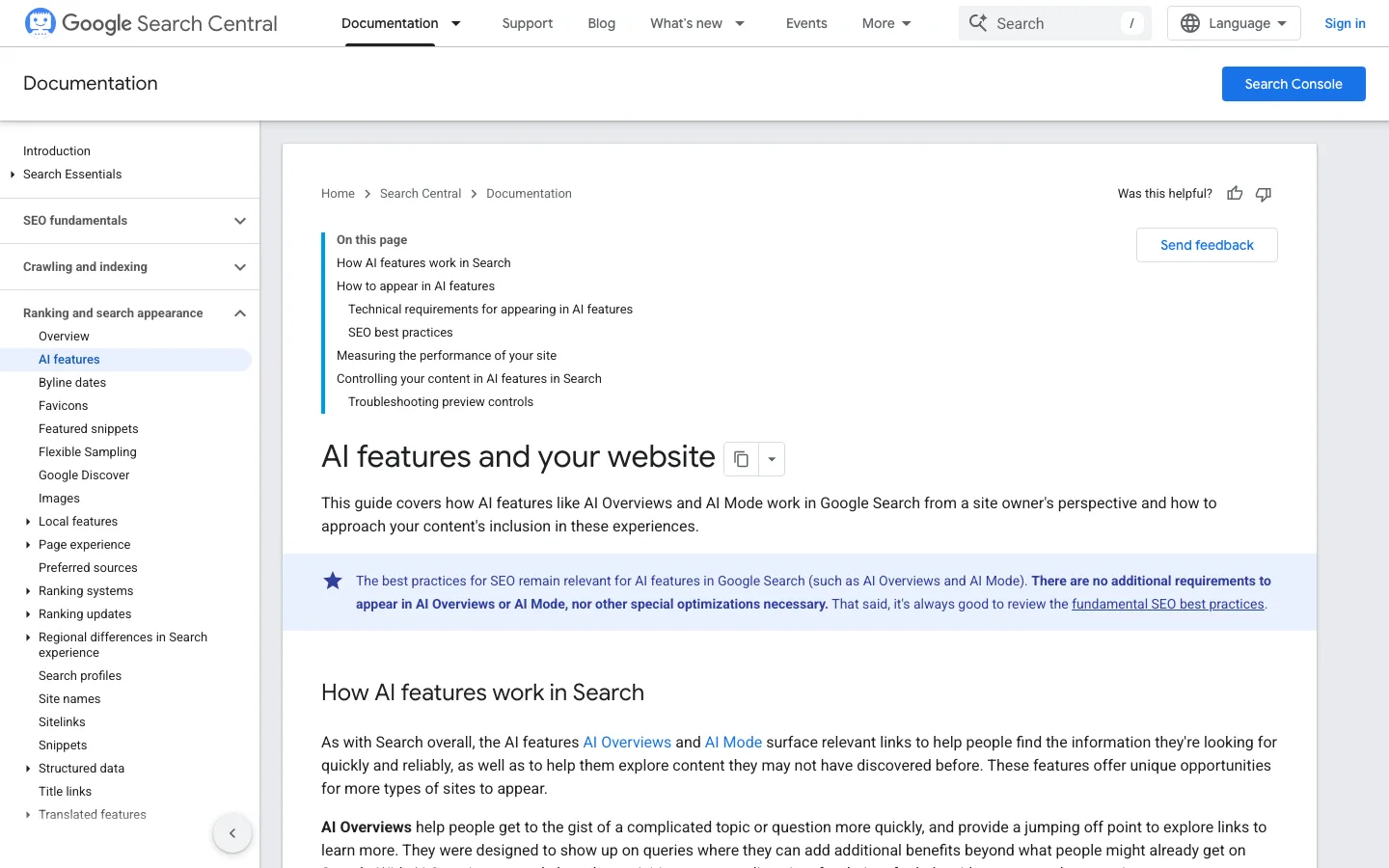
AI assistants first convert the prompt into a semantic representation, then look for content that is conceptually similar rather than lexically identical. This is why a page can be retrieved for a question it never repeats word for word. Google describes a related technique in its guide to AI features in Search: its systems may use "query fan-out", "issuing multiple related searches across subtopics and data sources". One prompt can therefore become several searches before any answer is written.
Context modifiers matter as well. A request for the best tool "for a small business" can surface different providers than the unqualified version of the same question. The engine reads the constraint, not only the keywords. The expansion step is covered in the entry on query fanout, and the way assistants pick their sources is explained in how AI assistants choose their sources.
The familiar intent categories still apply, but they arrive as full questions rather than terse keywords. Informational prompts seek understanding. Commercial prompts compare options before a decision. Transactional prompts aim to complete an action, and navigational prompts look for a specific brand or resource.
In conversational search these intents often blend within one session. A user may start by learning how a concept works, move to comparing providers, and finish by choosing one. Mapping each page to a stage, and tagging it with search intent classification, lets an assistant cite you at whichever step the user is on. Many prompts also carry a need that the user never types, which is the idea behind latent intent.
Begin by answering the question directly and early. Lead each section with a clear, self-contained statement that still makes sense when read alone. Avoid back-references such as "as mentioned above", because they break when a passage is extracted. Keep one idea per paragraph so that a single passage answers a single sub-question.
Take questions from support tickets, sales calls, forums and community threads, and use them as H2 headings. Each heading should promise exactly the answer that follows it. Google's helpful content guidance asks a similar question of every page: will a reader leave feeling they have learned enough about the topic to reach their goal? Clear headings that match real questions make that outcome easier to reach.
Because assistants expand a prompt into related sub-queries, answer the neighbours of the main question as well: pricing, alternatives, setup, limits and common objections. A single headline answer rarely covers them. Sorank's AI query fan-out tracker logs the hidden sub-queries that ChatGPT, Claude, Gemini and Grok run for your tracked prompts, so you can see which ones your page leaves unanswered.
Ranking first for a keyword no longer guarantees a place in an AI answer, and being cited does not always require the top position. Intent connects the two. A page that answers a core need clearly tends to be retrieved for many phrasings of that need, which is the logic behind generative engine optimization and behind your AI search visibility.
Sorank's own LV3D case study gives one documented example. The page reports that daily Google clicks rose from about 240 to over 1000 after Sorank identified buyer keywords and published articles around them. The page does not provide a control group, so treat it as one observed case rather than a guaranteed result.
The most common mistake is optimizing for phrasing instead of purpose. The result is a keyword dense page that never answers the question behind the words. Another is burying the answer in the middle of a long section, where an engine struggles to extract it cleanly. Both reduce the odds of a citation even when the page is topically relevant.
Intent is also hard to measure directly, because no one sees every sub-query an engine runs. The practical response is to monitor which prompts cite you, test variations of the same question and refine the passages that underperform. Treat intent optimization as an ongoing loop rather than a one-time fix.
AI search intent optimization reframes content around the goal behind a prompt instead of the words in it. Because AI systems match meaning, expand queries and cite specific passages, the pages that win answer real questions directly, cover the adjacent sub-questions and stay easy to extract. Start with your buyers' questions, then check the sub-queries with Sorank's keyword research tool before you write.
Sources
The core idea is the same: understand the goal behind a query. The execution differs because the AIs match meaning rather than exact keywords and cite specific passages instead of ranking whole pages. You optimize so a self-contained passage answers the underlying intent, which an assistant can then extract and reuse in its response.
They convert the prompt into a semantic representation and retrieve content that is conceptually similar, not just lexically identical. They also expand a single prompt into several related sub-queries through query fan-out. Small modifiers like a target audience or a constraint can change which sources get cited, so the engine reads context, not only keywords.
Lead each section with a direct, self-contained answer to a real question, and keep one idea per paragraph so passages extract cleanly. Use genuine conversational questions from support tickets and forums as headings. Add quotable, sourced statements where relevant, then monitor which prompts cite you and refine the passages that underperform.
 “I tested Sorank on a real client site and it's insane. It does everything an agency would bill you $1500 a month for. It's going into production on that client now.”

 Guillaume Guersanguersanguillaume.com“We are an Ads agency and we wanted to get our SEO back on track once and for all. Sorank gave us a clear view of our site, helped us prioritize optimizations, and properly structure our content. The tool is easy to use, well designed for a team, and very practical for centralizing tracking without having to juggle multiple platforms. A very solid foundation to start fresh with our SEO.”
 Gaspard MadouiAds Agency
 “I just let the Sorank software do its thing, and now my DR is 25 and my page is ranking higher.”
 Lucas Flandrefoundertrace.fr“I specialized in GEO thanks to Sorank. The GEO Leaderboard allows me to show my clients their position vs competitors on ChatGPT. It’s a real commercial differentiator.”
 MélanieSEO Freelance“Great service, works well for our website and helps us understand how to improve it to rank better on Google and elsewhere. Congrats, keep going, I recommend it.”
 Hugo T.E-commerce merchant



















