
Preferences
Privacy is important to us, so you have the option of disabling certain types of storage that may not be necessary for the basic functioning of the website. Blocking categories may impact your experience on the website. More information
Privacy is important to us, so you have the option of disabling certain types of storage that may not be necessary for the basic functioning of the website. Blocking categories may impact your experience on the website. More information

AI agent frameworks give developers memory, tool integration, and orchestration to build autonomous agents. Compare LangGraph, Semantic Kernel, and CrewAI.







Founder Sorank, 7+ years in SEO.
Summary
AI Agent Frameworks are software toolkits that give developers ready-made building blocks for autonomous AI agents, such as orchestration, memory, tool integration, and multi-agent coordination, so they do not have to build that plumbing from scratch. Well-known examples include LangGraph, Semantic Kernel, and CrewAI.
Want to go further? Ask
AI agent frameworks give teams a shared foundation for software that reasons over several steps, calls external tools, and sometimes works as a team of specialized agents. Instead of wiring memory, tool calls, and control flow by hand, a developer starts from pre-built components and focuses on the agent's goals and rules. Marketers need to understand them too, because the framework behind an assistant decides how it finds, weighs, and quotes sources. For background on the agents themselves, see AI agents.
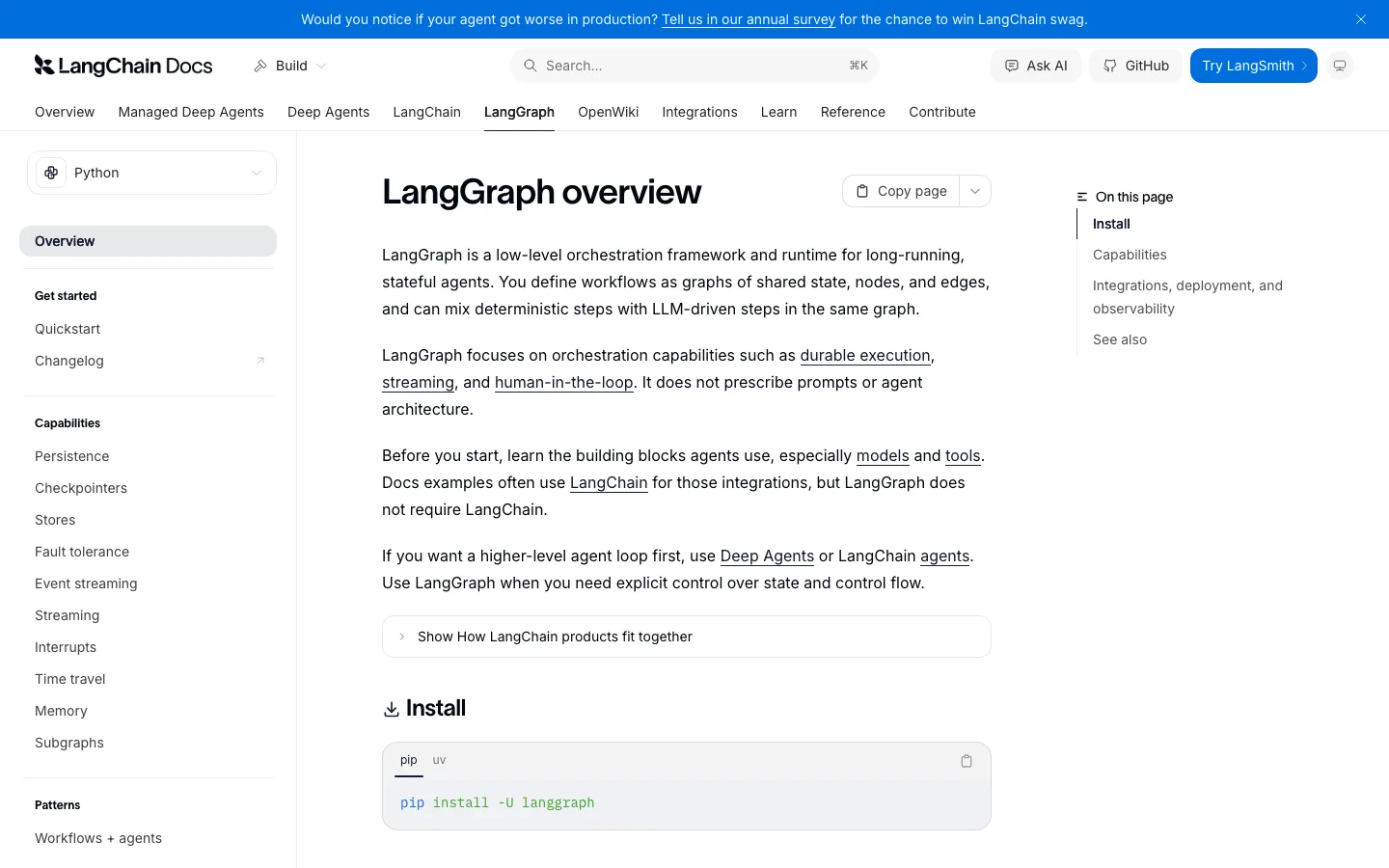
An AI agent framework is a development toolkit for building applications in which a language model holds a goal, decides on actions, calls tools, and keeps track of what happened. The LangGraph overview page describes the framework as "a low-level orchestration framework and runtime for long-running, stateful agents". That captures the core idea: the framework supplies the runtime, and the developer supplies the logic.
Without a framework, each team rebuilds the same parts for every project: prompt orchestration, tool calling, memory, retries, and error handling. Frameworks package these parts as composable modules. The developer still decides what the agent should do, but the repetitive infrastructure is already in place. This is what turns the idea of agentic workflows into software a team can actually ship.
Most frameworks offer the same building blocks, even when they name them differently. Orchestration manages multi-step execution, often as a graph of steps. Memory and state keep context between steps and sessions, so the agent does not start from zero each time. Tool integration gives the model a standard way to reach external systems, a pattern built on function calling. Many frameworks also rely on retrieval augmented generation, so agents can ground their answers in private or live data.
Some frameworks add more, such as observability, guardrails, and human review. The Semantic Kernel documentation presents the project as a lightweight, open-source development kit for C#, Python, and Java, with telemetry support and hooks and filters for responsible AI controls. The exact feature list matters less than whether the framework fits the languages, deployment, and oversight your team needs.
Single-agent setups build one capable loop that reasons, calls tools, and returns a result. They suit tasks where one reasoning loop with a few tools is enough. Multi-agent setups split the work between several agents that communicate, delegate, and check each other. The CrewAI documentation describes its platform as a way to design agents, orchestrate crews, and automate flows, with guardrails, memory, knowledge, and observability built in. A team model like this suits research, writing, and verification pipelines, but it adds coordination overhead and can be harder to debug, so it pays off mainly on complex, multi-part tasks.
The table below summarizes the frameworks named in this entry, using only what their own documentation says.
| Framework | Maker | Best known for |
|---|---|---|
| LangGraph | LangChain | Long-running, stateful agents with checkpoints and human review |
| Semantic Kernel | Microsoft | An open-source SDK for C#, Python, and Java with plugins and enterprise controls |
| CrewAI | CrewAI | Crews of agents that collaborate on a shared set of tasks |
| AutoGen | Microsoft | Archived, with Microsoft Agent Framework recommended for new projects |
LangGraph is the one to read first when your agent has to pause, resume, and keep state. Its overview says it can checkpoint state and resume after failures or pauses, and that a person can pause execution, inspect or edit state, then continue. The overview page is shown below.
AutoGen needs a caveat. The Microsoft AutoGen documentation now states that the project is archived, with no new features or security fixes, and recommends Microsoft Agent Framework to new users. Older guides that recommend AutoGen for a new project are out of date, so check the maintenance status of any framework before you commit to it.
Start from the shape of the project. Complex, stateful workflows that need explicit control over branching, retries, and rollback favor graph-based options. Applications that depend on retrieval quality favor retrieval-first tooling. Enterprise teams usually also weigh SDK support for their languages, security controls, and how easily they could move away later. Agents that keep long histories also run into the limits of the context window, so memory design matters as much as the choice of tools.
Keep the framework separate from your data. The context and data layer underneath an agent often matters more than the framework itself, and it is the hardest part to replace later. Before adopting a framework, test it on a real task from your business rather than on a demo, and measure whether the agent's answers are correct and traceable.
The most common mistake is adding agents before a single-agent version works. Multi-agent systems multiply failure points, so each added agent needs a clear role and a measurable output. A second mistake is picking the most talked-about framework without checking whether it is still maintained, as the AutoGen change shows. A third is skipping guardrails. Frameworks reduce boilerplate, but they do not remove responsibility: security, permission scoping, and human review remain the builder's job.
The framework an assistant runs on determines how it retrieves and weighs sources. When an agent researches a topic across many steps, your content competes to be the source it reads, trusts, and cites at each step. This connects directly to AI citation optimization. Retrieval-based frameworks reward pages with clean structure, direct answers, and consistent facts, because those are easy to parse and reuse. The goal is to become a source that agents return to across many queries, not a page that ranks once for one keyword. The guide on how AI agents run and reshape SEO covers the workflow side in more detail.
AI Agent Frameworks are the toolkits that make autonomous agents practical. They supply memory, tool integration, planning, and orchestration, so teams build instead of reinventing plumbing. They range from graph-based runtimes to SDKs and role-based crews, and each suits a different shape of problem. For marketers, knowing how these systems retrieve and weigh sources explains why structured, citable content wins. To go deeper, read about the AI agent model and how agentic search changes what gets found. At Sorank, our GEO optimization tools help your content become a source that AI assistants can cite.
Sources
An AI agent is the autonomous system that reasons, calls tools, and acts to reach a goal. An AI agent framework is the software toolkit a developer uses to build that agent, providing memory, tool integration, planning, and orchestration out of the box. The framework is the construction kit; the agent is what you build with it.
There is no single best framework, only the best fit for a project. LangGraph suits long-running, stateful agents that need checkpoints and human review, Semantic Kernel suits teams building in C#, Python, or Java, and CrewAI suits crews of agents that collaborate on tasks. Check each project's maintenance status before you commit, because Microsoft has archived AutoGen.
Indirectly, yes. Many frameworks rely on retrieval to ground agent answers, so they favor pages with clean structure, direct answers, and consistent facts that are easy to parse and reuse. Optimizing content for these retrieval patterns is the heart of generative engine optimization and improves your chances of being cited across many agent queries.
 “I tested Sorank on a real client site and it's insane. It does everything an agency would bill you $1500 a month for. It's going into production on that client now.”

 Guillaume Guersanguersanguillaume.com“We are an Ads agency and we wanted to get our SEO back on track once and for all. Sorank gave us a clear view of our site, helped us prioritize optimizations, and properly structure our content. The tool is easy to use, well designed for a team, and very practical for centralizing tracking without having to juggle multiple platforms. A very solid foundation to start fresh with our SEO.”
 Gaspard MadouiAds Agency
 “I just let the Sorank software do its thing, and now my DR is 25 and my page is ranking higher.”
 Lucas Flandrefoundertrace.fr“I specialized in GEO thanks to Sorank. The GEO Leaderboard allows me to show my clients their position vs competitors on ChatGPT. It’s a real commercial differentiator.”
 MélanieSEO Freelance“Great service, works well for our website and helps us understand how to improve it to rank better on Google and elsewhere. Congrats, keep going, I recommend it.”
 Hugo T.E-commerce merchant



















