
Preferences
Privacy is important to us, so you have the option of disabling certain types of storage that may not be necessary for the basic functioning of the website. Blocking categories may impact your experience on the website. More information
Privacy is important to us, so you have the option of disabling certain types of storage that may not be necessary for the basic functioning of the website. Blocking categories may impact your experience on the website. More information

Google Panda targeted thin, duplicate and copied pages. Learn what it checked, whether it still runs and how to fix weak pages today.








Founder Sorank, 7+ years in SEO.
Summary
Google Panda is a Google ranking system, announced in 2011, designed to make sure high-quality and original content appears in search results. Google's ranking systems guide now lists it as a retired system that became part of the core ranking systems in 2015.
Want to go further? Ask
Google Panda is the quality update that Google announced in 2011 to reward original, useful pages. It targeted pages that offer little value, such as thin, copied or mass-produced content. The questions below show what Google looked for, how Panda relates to today's updates, and how to check and fix your own pages.
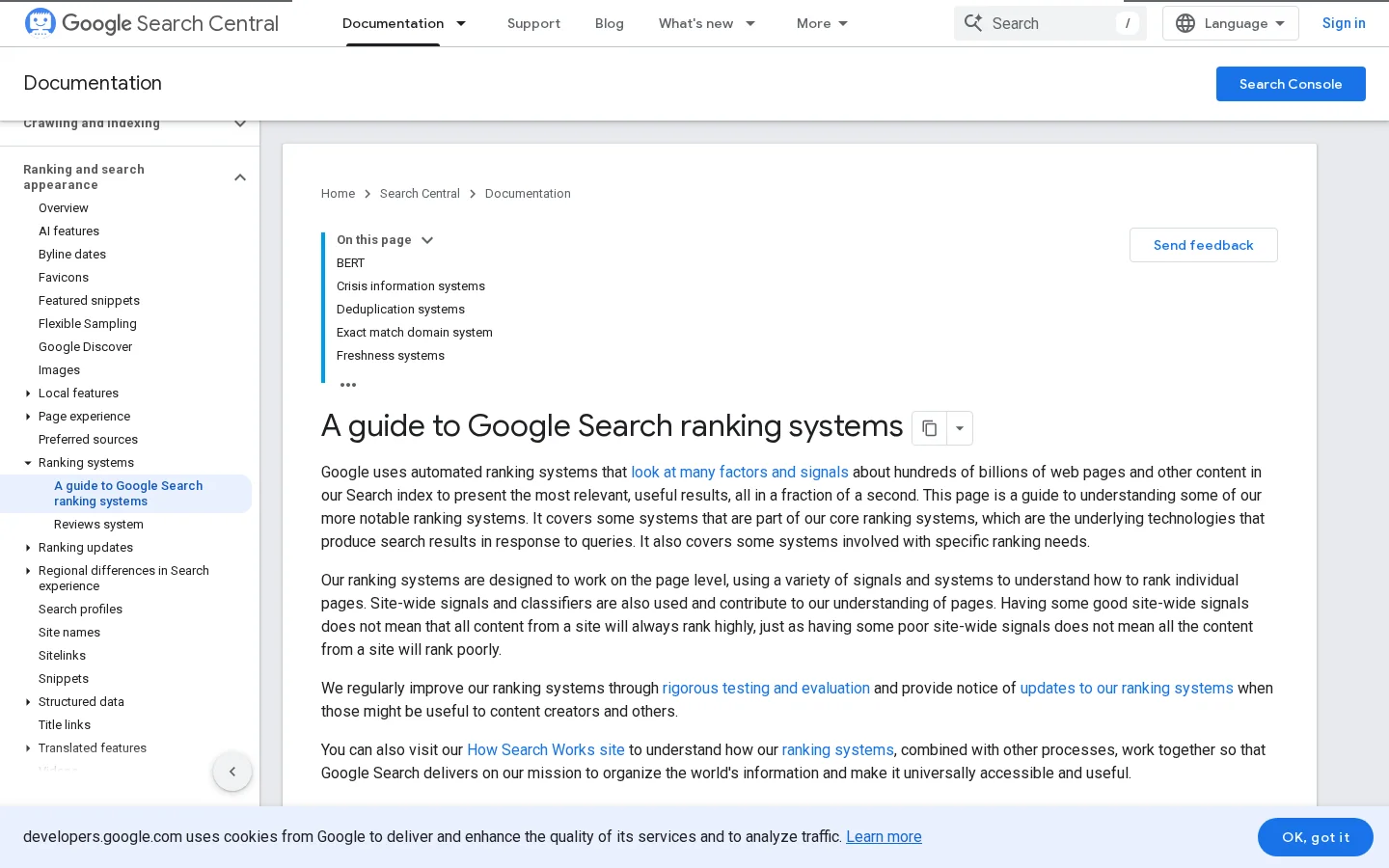
Google's ranking systems guide describes Panda as "designed to better ensure high-quality and original content was appearing in our search results." It also says the system "evolved and became part of our core ranking systems in 2015." The guide lists Panda under retired systems, so there is no separate Panda rollout to prepare for. What matters is the goal behind it: pages that add little should not outrank pages that add something.
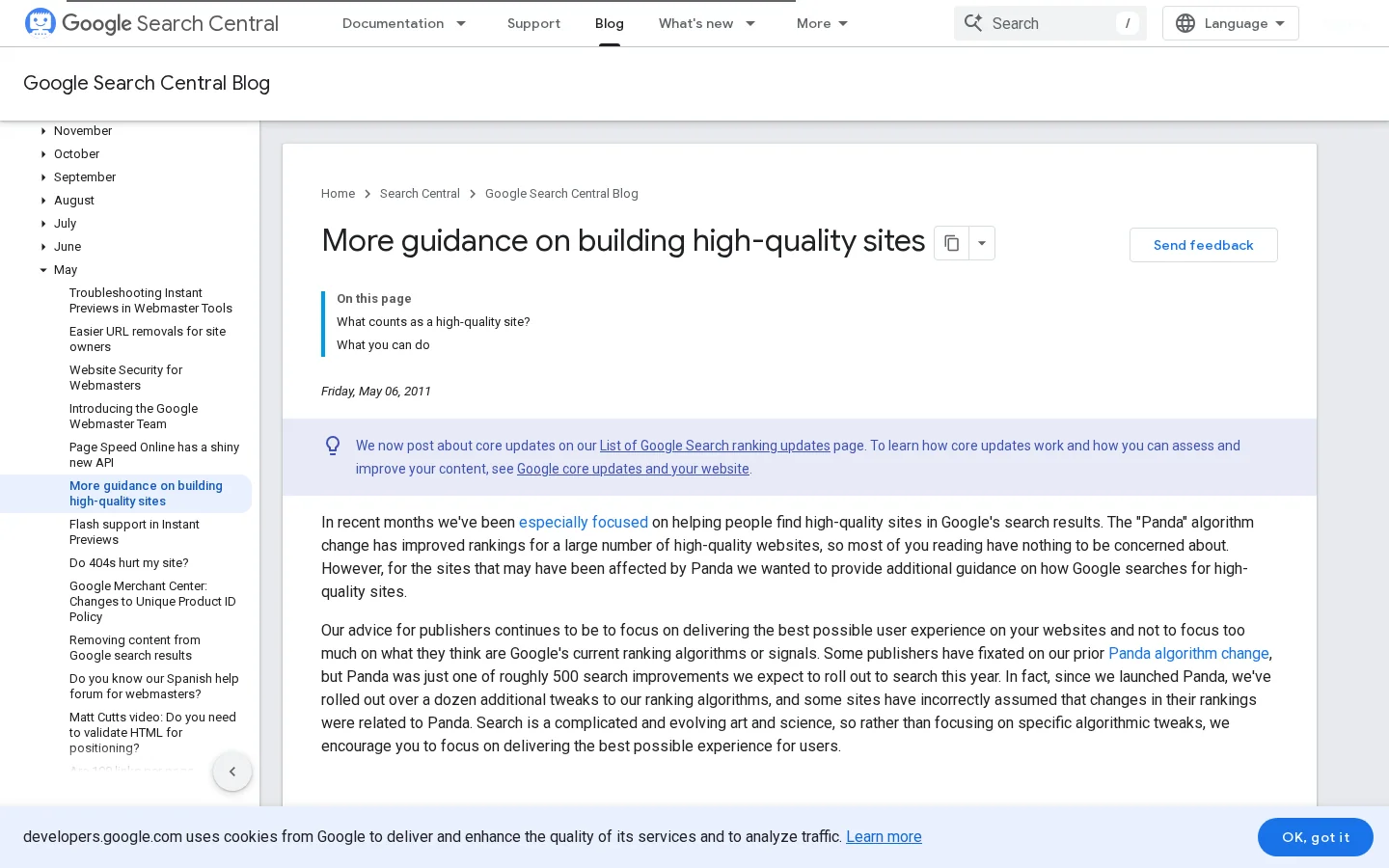
The clearest list of Panda's targets comes from a May 2011 post by Amit Singhal, Google Fellow. In Google's post on building high-quality sites, he gave webmasters questions to ask about their content. Two of them make a good test for your own pages: "Does the article provide original content or information, original reporting, original research, or original analysis?" and "Are the articles short, unsubstantial, or otherwise lacking in helpful specifics?"
Pages that say little are what we call thin content. Pages that repeat other pages are duplicate content. The same post asks whether a site has "duplicate, overlapping, or redundant articles on the same or similar topics," and whether content is "mass-produced by or outsourced to a large number of creators." Both checks describe the pattern most people link to Panda.
Google also asks whether a site is "a recognized authority on its topic." For how Google frames that kind of trust, see E-E-A-T.
There is no separate Panda update to track. The ranking systems guide says the system became part of the core ranking systems, so quality problems now show up inside broader changes. If your traffic dropped after a Google core update, check the same questions on your weakest pages. To separate an algorithmic drop from a manual action, read how to tell manual actions from algorithmic drops.
Start in Google Search Console. Open the performance report, compare clicks by page for the weeks before and after your traffic fell, and look for a pattern. If the losses sit on short, repetitive or near-identical pages, you have your list. Run a free on-page SEO audit on those pages to review the basics before you change anything.
Start by checking whether you are doing what Google's helpful content guidance warns about: "producing lots of content on many different topics in hopes that some of it might perform well in search results." If you are, stop adding pages and fix the ones you have. Ask yourself too: "Are you mainly summarizing what others have to say without adding much value?"
Then work through the pages in this order. Merge duplicate pages into one complete page, and send the old addresses to it with a 301 redirect. Rewrite thin pages with specifics you can stand behind, such as steps, examples or your own data. For a page you must keep online but do not want in search results, add a noindex tag to its head section:
<meta name="robots" content="noindex">If you have many weak pages, Sorank's content optimization module can audit them, rewrite weak pages at the same address, and merge pages on the same topic. The module is in beta, so review each full rewrite before it goes live.
These four errors match Panda's targets most often. For each one, check how it looks on your site, then apply the fix.
What it is: dozens of pages that target small variations of one keyword, with the same paragraphs and only a city or product name changed. How to spot it: put two of the pages side by side and count the sentences that match. How to fix it: merge them into one complete page, then redirect the others to it.
What it is: text taken from a competitor, supplier or directory with a few words swapped. How to spot it: search for a full sentence in quotation marks and see whether other sites show the same wording. How to fix it: replace the copied parts with your own data, examples or experience, and link to the original source for any fact you keep.
What it is: bulk drafts sent live with no human check. How to spot it: generic introductions, repeated phrasing and no specific detail. Google's 2011 list asks whether an article "was edited well, or does it appear sloppy or hastily produced?" How to fix it: edit each draft, add a fact, example or step that only you can supply, and check it before you publish.
What it is: pages where ads or affiliate boxes push the useful text down. How to spot it: open the page on a phone and count how many screens pass before the main content. Google's 2011 list asks: "Does this article have an excessive amount of ads that distract from or interfere with the main content?" How to fix it: move the answer to the top of the page and remove the ad blocks that sit between your paragraphs.
Panda is still a useful checklist for your pages. Google's helpful content guidance asks: "After reading your content, will someone leave feeling they've learned enough about a topic to help achieve their goal?" This is our reading, not a Google rule: an AI answer needs a complete passage it can quote, and a thin or copied page gives it nothing that stands on its own.
Google Panda began in 2011 as a push for original, high-quality results, and Google's guide says it became part of the core ranking systems in 2015. Keep your pages unique, complete and edited. Merge the ones that repeat each other, then measure the result in Search Console.
Sources
Google's ranking systems guide lists Panda as a retired system that became part of the core ranking systems in 2015. There is no separate Panda update to wait for, so quality problems now show up in broader updates such as core updates.
Google's 2011 questions point at thin, duplicated, mass-produced and ad-heavy pages. If your pages repeat other sites or say little, they match the pattern Google asked about.
Google has no Panda fix to submit. Merge duplicate pages, rewrite thin pages with specific detail, and noindex pages that must stay online but serve no search purpose. Then measure the result in Search Console.
 “I tested Sorank on a real client site and it's insane. It does everything an agency would bill you $1500 a month for. It's going into production on that client now.”

 Guillaume Guersanguersanguillaume.com“We are an Ads agency and we wanted to get our SEO back on track once and for all. Sorank gave us a clear view of our site, helped us prioritize optimizations, and properly structure our content. The tool is easy to use, well designed for a team, and very practical for centralizing tracking without having to juggle multiple platforms. A very solid foundation to start fresh with our SEO.”
 Gaspard MadouiAds Agency
 “I just let the Sorank software do its thing, and now my DR is 25 and my page is ranking higher.”
 Lucas Flandrefoundertrace.fr“I specialized in GEO thanks to Sorank. The GEO Leaderboard allows me to show my clients their position vs competitors on ChatGPT. It’s a real commercial differentiator.”
 MélanieSEO Freelance“Great service, works well for our website and helps us understand how to improve it to rank better on Google and elsewhere. Congrats, keep going, I recommend it.”
 Hugo T.E-commerce merchant



















