
Preferences
Privacy is important to us, so you have the option of disabling certain types of storage that may not be necessary for the basic functioning of the website. Blocking categories may impact your experience on the website. More information
Privacy is important to us, so you have the option of disabling certain types of storage that may not be necessary for the basic functioning of the website. Blocking categories may impact your experience on the website. More information

Google Dance is the SEO term for temporary ranking swings in Google results. Learn where the name comes from, if it still happens and what to do.







Founder Sorank, 7+ years in SEO.
Summary
Google Dance is the SEO term for temporary ranking swings in Google results, caused by changes to Google's index or ranking systems. The name dates back to the early 2000s, when Google refreshed its index in visible waves. Today Google changes its systems all the time, so the term is less common.
Want to go further? Ask
Google Dance is the name SEOs use for the period when rankings move up and down while Google processes a change. You see it as a sudden shuffle of results for the same search, often over several days. The term describes that movement. It is not a penalty. Here we explain where the name came from, why it almost disappeared, and what to do when your rankings move today.
During a Google Dance, different results can show for the same search depending on the day or the stage of the update. A page can jump ten positions, drop out of the top 10, then come back. When the change finishes, the results settle. Nothing on your page has to change for this to happen.
Google first has to store and sort pages in its search index. When that data is rebuilt, the order of the search results page can shift for a while. The shift is visible to everyone who searches, which is why SEOs talk about it so much.
The term comes from the early years of Google. In those years, the search engine refreshed its index in visible waves, and each wave reshuffled the results. Before 2003, SEOs used the phrase for these waves, and the name stuck to the period. The named waves of 2003 show how the pattern looked from the outside.
The named Google Dances of 2003
The gaps between these waves are long and uneven. Some months had no named dance at all. The dates come from the Search Engine Roundtable archive of 2003 Google Dance threads, which lists each wave as the webmasters of the time reported it. That is why the term belongs to a specific period of Google's history.
Google stopped rebuilding its results in big, scheduled waves and moved to constant change. Its ranking systems now improve all the time. Google says it regularly improves its ranking systems through testing and evaluation, and it folds older systems into its core. Systems such as Google Panda and Penguin are no longer separate updates you wait for. Google has integrated them into its core systems.
Because changes now arrive all the time, a ranking swing is hard to tie to one date. The term still appears in SEO glossaries, but it no longer describes a fixed schedule. Read it as an old name for the same kind of movement that search engines produce today.
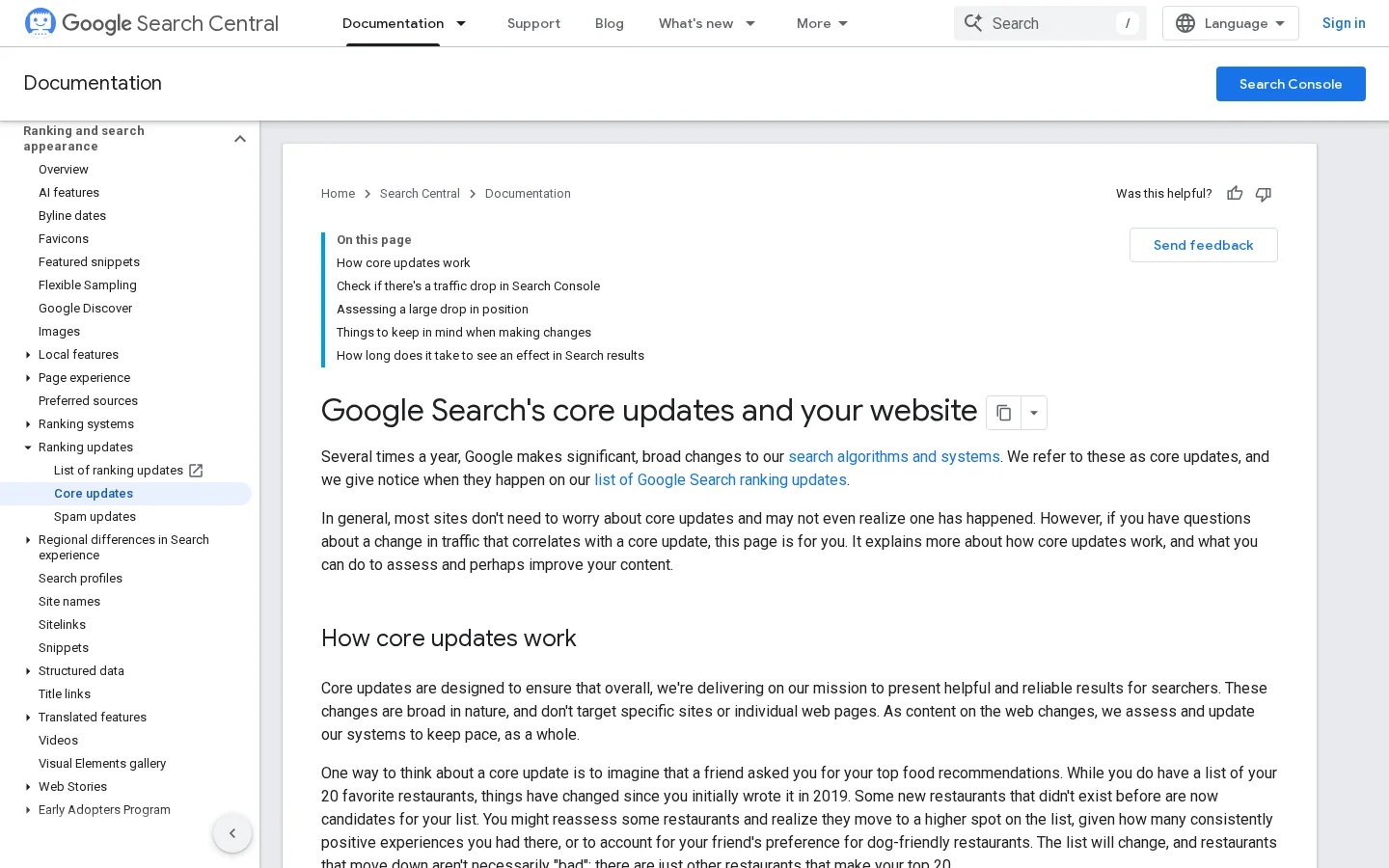
Yes, but not as a fixed monthly wave. The closest thing today is a Google core update. Google's guide says that "These changes are broad in nature, and don't target specific sites or individual web pages." It also says core updates arrive "Several times a year," so you should expect rankings to move more than once in a year.
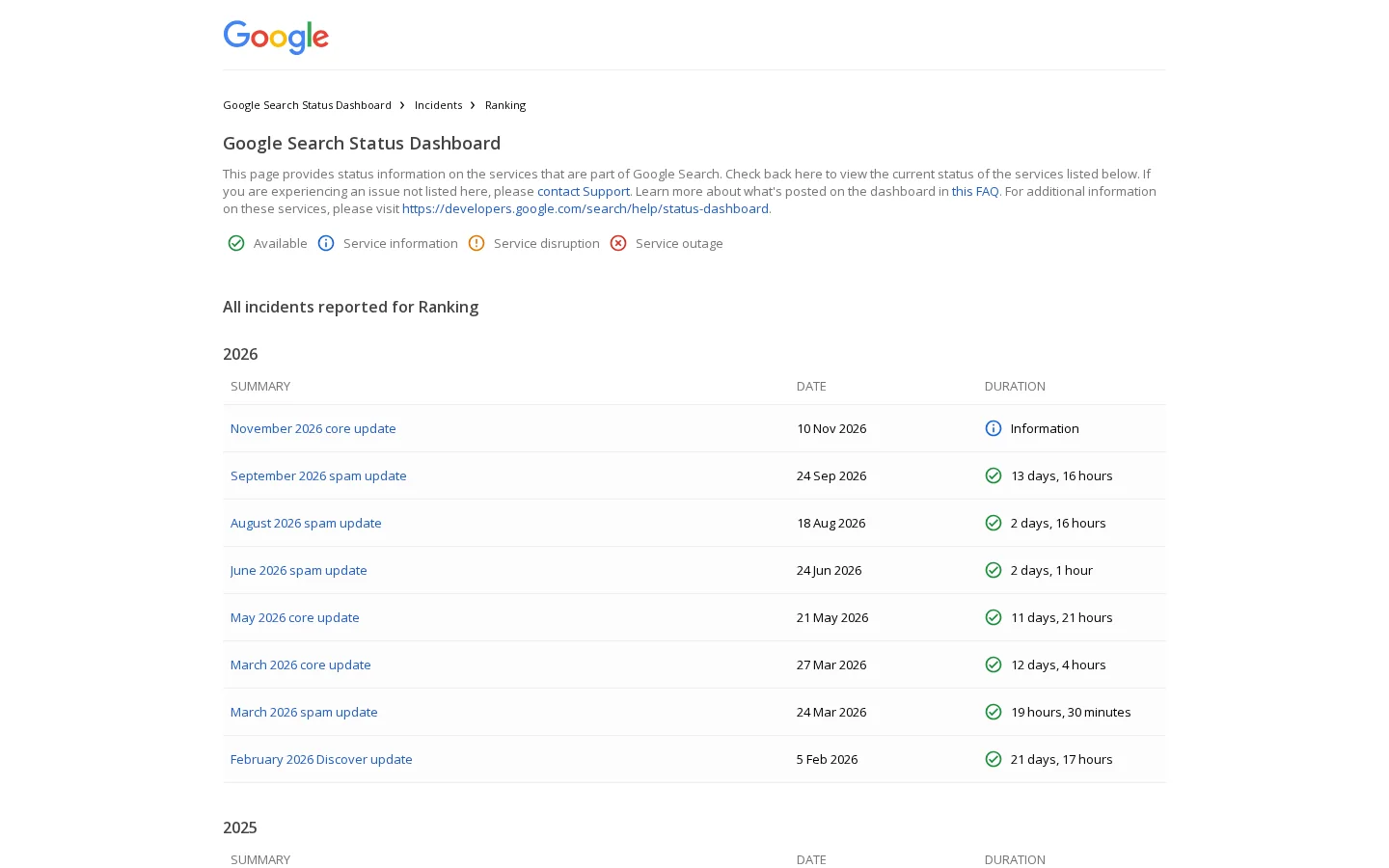
Our fiche on algorithm updates covers how search changes in general. This page covers the old name for these moves and what the name tells you now. The Google Search Status Dashboard lists each rollout with its start date, end date and duration. Its history for ranking includes a November 2026 core update, and the March 2024 core update lasted 45 days.
Follow a fixed order before you change anything. Google's guide to core updates gives the same basic advice, and it is the best place to check each step against the source.
What to do after a ranking change
Give rollouts time. Google says the effects can show within days, but they can also take several months. If nothing changes after a few months, Google suggests waiting for the next core update. Avoid quick fixes, such as small edits to every page. Google treats deleting content as a last resort, to be considered only when the content cannot be saved.
To see whether a drop lines up with a wider shift in the results, use our free SERP Volatility Sensor. It detects Google algorithm updates in real time, so you do not have to check the rankings by hand every day.
Tip
Write down the date your traffic moved before you change any page. It is the easiest way to match a drop with an update later.
This mistake means you edit your pages as soon as rankings move, often within hours. You can spot it in your change log: several edits in the first few days, and rankings that return to normal anyway. To fix it, record every change with its date, and wait for the rollout to finish before you test a new change.
This mistake means you assume Google punished your site. You can spot it when the drop hits many sites in your niche at the same time, and when Search Console shows no manual action. To fix it, check the manual actions report first. If it is empty, read the drop as a ranking change and follow the steps above.
This mistake means you judge the whole site by one keyword that fell. You can spot it when only a few queries or pages moved in your data. To fix it, compare many pages and queries across a full week after the update, then decide what to do. A single search result is not a trend.
The old dance is a reminder that ranking changes come from outside your site as well as from your own work. The same logic applies to AI answers. AI answers also shift as models and sources change, as our fiche on AI search volatility explains. A page that holds its place in Google can still lose a citation in an AI answer, and the reverse is true too.
Sorank tracks your visibility in ChatGPT, Gemini and Claude. Its GEO / SEO dashboard shows Google and AI traffic in one view, so you can see whether a drop in one channel matches a change in the other. For the wider picture of how these systems fit together, read our guide to the Google algorithm.
Google Dance is an old name for temporary ranking swings. It comes from the early 2000s, when Google rebuilt its index in visible waves. Today the moves come from core updates and constant system changes. The useful question is not whether a dance is happening, but whether the drop lasts. Check the dates, wait for the rollout to finish, and act only on a clear, lasting change.
Sources
Yes, but not in its old form. Google no longer rebuilds its results in the monthly waves of the early 2000s. It still changes its ranking systems, and it announces core updates several times a year, which can move rankings for weeks.
It depends on the update. Google's status dashboard shows that the March 2024 core update lasted 45 days. Wait until the rollout has finished before you judge your results.
Not right away. Google says a small drop needs no drastic action, and pages that already perform well should be left alone. After the rollout ends, wait at least a full week, then check Search Console and decide with the data.
 “I tested Sorank on a real client site and it's insane. It does everything an agency would bill you $1500 a month for. It's going into production on that client now.”

 Guillaume Guersanguersanguillaume.com“We are an Ads agency and we wanted to get our SEO back on track once and for all. Sorank gave us a clear view of our site, helped us prioritize optimizations, and properly structure our content. The tool is easy to use, well designed for a team, and very practical for centralizing tracking without having to juggle multiple platforms. A very solid foundation to start fresh with our SEO.”
 Gaspard MadouiAds Agency
 “I just let the Sorank software do its thing, and now my DR is 25 and my page is ranking higher.”
 Lucas Flandrefoundertrace.fr“I specialized in GEO thanks to Sorank. The GEO Leaderboard allows me to show my clients their position vs competitors on ChatGPT. It’s a real commercial differentiator.”
 MélanieSEO Freelance“Great service, works well for our website and helps us understand how to improve it to rank better on Google and elsewhere. Congrats, keep going, I recommend it.”
 Hugo T.E-commerce merchant



















