
Preferences
Privacy is important to us, so you have the option of disabling certain types of storage that may not be necessary for the basic functioning of the website. Blocking categories may impact your experience on the website. More information
Privacy is important to us, so you have the option of disabling certain types of storage that may not be necessary for the basic functioning of the website. Blocking categories may impact your experience on the website. More information

AI search insights turn AI search data into intent, prompts and competitor gaps. Learn what they reveal, which sources feed them and how to act on them.








Founder Sorank, 7+ years in SEO.
Summary
AI search insights are the actionable conclusions drawn from AI search data, including the prompts people type, the intent behind them, their buyer journey stage, and the gaps against competitors, that show whether you appear in AI answers and what to do next.
Want to go further? Ask
AI search insights are the interpretation layer on top of AI search measurement. Raw data tells you how often your brand is mentioned or cited. Insights explain which questions produced those mentions, who asked them, and what to change next. They turn a list of prompts and numbers into decisions about what to create and where to compete.
This matters because people ask AI tools different questions than they type into a classic search box. Their prompts are longer, more conversational and more specific, and they often ask the tool to do something, such as compare options or draft a plan, rather than to list links. Teams that read those patterns can build content around what buyers really want, instead of guessing from old keyword lists.
AI search insights are the conclusions you draw from how AI tools answer questions about your market. They combine three inputs: the prompts buyers use, the intent those prompts express, and the position of your brand and competitors in the answers. The output is a short list of findings you can act on, such as a missing topic, a weak persona or a competitor that owns a key question.
Insights sit one level above measurement. AI search analytics supplies the counts. Insights answer the harder questions: which audiences you reach, which you miss, and which content gaps to close first. They connect the numbers to strategy and to your AI share of voice, so you can see where your share grows and where it does not.
The difference is interpretation. A metric says that your brand was cited a certain number of times this week. An insight says that those citations came from early research prompts, while competitors own the prompts that come before a purchase. Metrics measure volume. Insights measure relevance, meaning whether you are visible to the right people at the right stage.
This shift changes how teams work. Volume-based tactics chase every mention. Value-based strategy asks which prompts lead to pipeline, then focuses effort on those. That is the main reason insights are worth the time: they show which of the many possible gaps deserves attention this month.
Good insights expose several things at once. They surface the exact questions buyers ask AI tools, which is far more concrete than a keyword list, because a prompt often carries the full context of a problem. They show where each question sits in the buyer journey, from awareness to decision. And they show which personas ask which questions, so you know who is searching and why.
Competitive reality is part of the picture too. An insight can show that a rival is cited for every comparison prompt while your brand only appears for definitions. That gap is more useful than a total share figure, because it points to a specific page or argument you can build.
Insights need two sources: the AI answers themselves, and your own search data. Google's guide to AI features and your website explains that AI Overviews and AI Mode may use a "query fan-out" technique, issuing multiple related searches across subtopics and data sources to build an answer. Query fan-out explains why a single question can pull in pages that cover related subtopics. A page that answers one sub-question well can therefore be cited for prompts you never targeted directly.
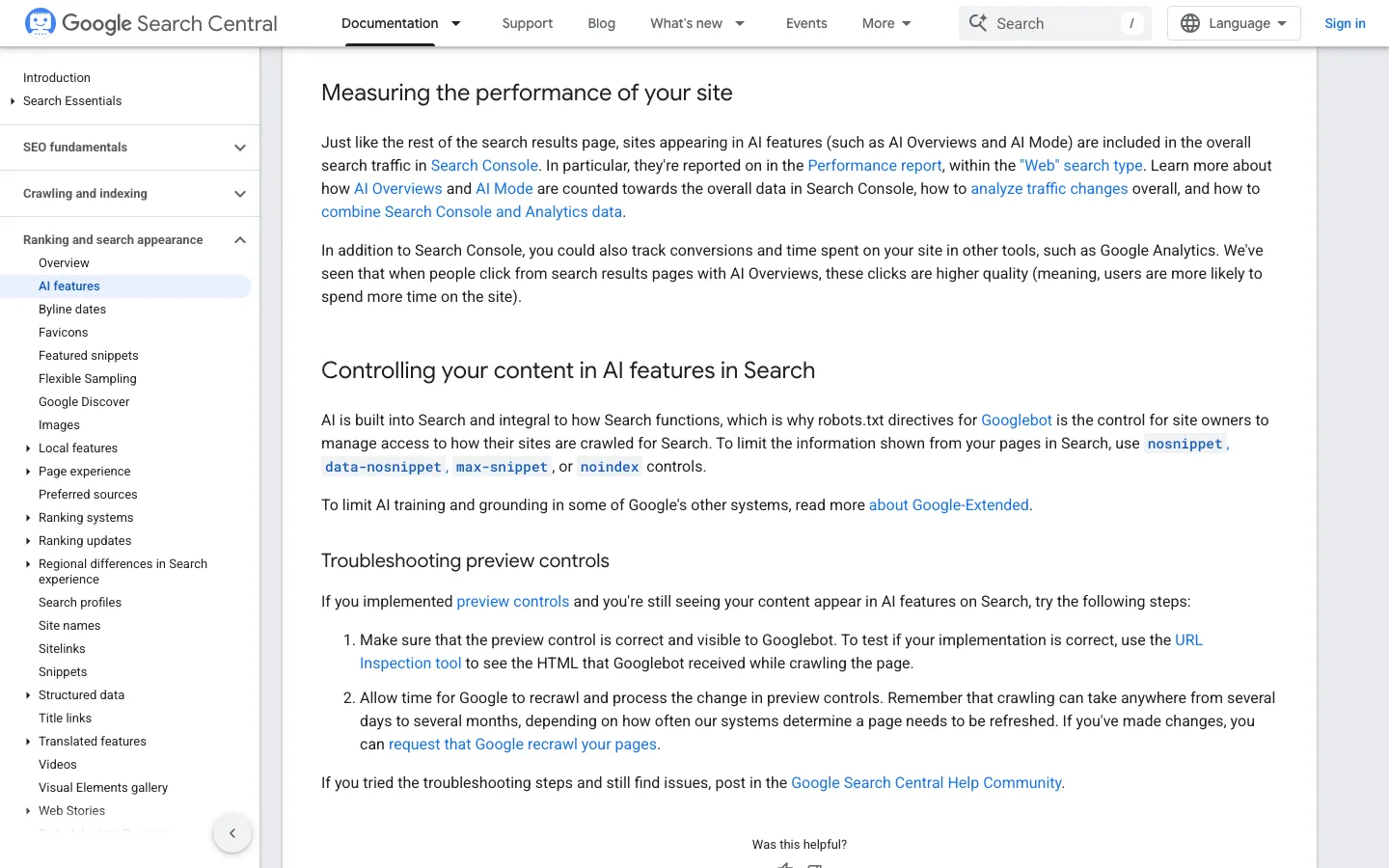
Search Console is the second source. Google states that sites appearing in AI features are included in the overall search traffic, reported in the Search Console Performance report within the "Web" search type. That lets you read clicks and impressions from AI features next to classic results, instead of guessing at their share.
Intent is the core of any insight. Classic intent groups are informational, navigational, transactional, commercial and local. AI prompts add a further pattern: users often ask the tool to produce something, such as a draft, a table or a plan. Reading that correctly tells you whether a prompt wants a definition, a comparison or a finished deliverable, and each of those needs a different page. Your search intent analysis should therefore cover the full AI prompt, not only the typed keyword.
Journey stage is the second layer. A prompt about what a metric means belongs to research. A prompt asking for a shortlist of vendors belongs to consideration. A prompt about how to set something up is close to a decision. Mapping prompts to stages shows which stage you neglect, so you can fill that gap instead of publishing more of the same content.
Insights are only useful when they change what you publish. Start by listing your key personas and the prompts they probably use. Then map each prompt to a journey stage and check where you and your competitors appear. Look for three patterns: stages with no content, personas you miss, and questions where rivals dominate. Treat these as a ranked list of opportunities, and build for the highest value first.
Tone and depth follow the persona. A technical buyer needs precise definitions and proof, while a busy founder needs a direct answer in the first lines. Sorank's AI prompt research feature is one place to gather them. An AI content strategy then turns the findings into a plan you can run each month.
The first mistake is treating a single check of AI answers as an insight. One answer on one day tells you little, because AI results change with wording, location and time. Track a fixed panel of prompts over several weeks before you draw a conclusion. For the keyword side of this work, see keyword research for AI search.
The second is counting mentions without reading the context. A brand can be mentioned as a warning or as a bad example. Read the sentence around each citation, and classify it as recommended, compared or cited for a fact.
The third is ignoring the prompts you cannot win yet. Insights often reveal gaps that need months of work, such as authority or proof, not a single article. Set realistic goals and separate quick fixes from long projects.
The fourth is measuring only AI referrals. Google's AI features guide reports that clicks from search results with AI Overviews tend to be of higher quality, with users more likely to spend more time on the site. Judge results by engagement and conversions, not by click volume alone.
Insights close the loop between visibility and value. Being present in an AI answer is not enough. You need to know whether you appear for the right prompts, for the right people, at the right moment. That is the difference between a brand that merely shows up in AI search and one that grows from it.
They also make optimization efficient. Instead of trying to win every prompt, you focus on high-intent questions where a citation can lead to a visit or a sale. Sorank's LV3D case study shows one published result from a 3D printing site that published dozens of articles each month: organic traffic was multiplied by 4 in 5 months, and daily clicks rose from about 240 to over 1000. It is one case, not a guarantee.
AI search insights turn raw AI search data and user prompts into strategy. They show who is asking what, at which journey stage, and where competitors win. They differ from analytics by measuring relevance rather than volume, and they depend on reading intent correctly, including the generative intent that AI tools bring. Used well, they help you focus on the prompts that drive value instead of chasing every mention.
Sources
AI search analytics counts what happens, such as mentions, citations and share of voice. AI search insights explain why it matters, using the prompts and intent behind those numbers, and what to do next.
It comes from two places: the AI answers that mention or cite your brand, and your own search data. Google states that AI Overviews and AI Mode traffic is included in the Search Console Performance report, under the Web search type.
They show which buyer personas ask which questions, at which journey stage, and where competitors dominate. That tells you which content to create first and for whom, so you earn citations on the prompts that drive results.
 “I tested Sorank on a real client site and it's insane. It does everything an agency would bill you $1500 a month for. It's going into production on that client now.”

 Guillaume Guersanguersanguillaume.com“We are an Ads agency and we wanted to get our SEO back on track once and for all. Sorank gave us a clear view of our site, helped us prioritize optimizations, and properly structure our content. The tool is easy to use, well designed for a team, and very practical for centralizing tracking without having to juggle multiple platforms. A very solid foundation to start fresh with our SEO.”
 Gaspard MadouiAds Agency
 “I just let the Sorank software do its thing, and now my DR is 25 and my page is ranking higher.”
 Lucas Flandrefoundertrace.fr“I specialized in GEO thanks to Sorank. The GEO Leaderboard allows me to show my clients their position vs competitors on ChatGPT. It’s a real commercial differentiator.”
 MélanieSEO Freelance“Great service, works well for our website and helps us understand how to improve it to rank better on Google and elsewhere. Congrats, keep going, I recommend it.”
 Hugo T.E-commerce merchant



















