
Preferences
Privacy is important to us, so you have the option of disabling certain types of storage that may not be necessary for the basic functioning of the website. Blocking categories may impact your experience on the website. More information
Privacy is important to us, so you have the option of disabling certain types of storage that may not be necessary for the basic functioning of the website. Blocking categories may impact your experience on the website. More information

SEO rich text is the formatted content and structured data of a web page. Learn the elements to set up, how JSON-LD works and what it does for rankings.







Founder Sorank, 7+ years in SEO.
Summary
SEO rich text is the formatted content of a web page, with real headings, lists, links, tables and image alt text, plus the structured data (usually JSON-LD) that describes the page. It can make your result eligible for rich results, but it does not raise your ranking on its own.
Want to go further? Ask
SEO rich text is a term that people use for two different things. The first is the markup that lets Google show extra details in a search result, such as review stars or a price. The second is the body of your page, written in a content editor, that search engines read as HTML. Both matter, and they do different jobs.
SEO rich text means rich results and rich text content. Rich results are the extra details in a search listing, and they come from structured data. Rich text content is the HTML of your page body, saved by your content management system (CMS). Keep the two apart when you plan your work, because you fix them in different places.
| Meaning | What it is | What it does for SEO |
|---|---|---|
| Rich results | Extra details in a search listing, such as stars or a price | Makes your result eligible to show those details |
| Rich text content | Headings, lists, links, tables and images in the page body | Lets search engines read the structure and meaning of the page |
Use real HTML elements, not visual tricks. A bold line that looks like a heading is still just a line of text to a search engine. The structure you choose in the editor is what gets saved, so set it up once and keep it consistent on every page. Follow these rules:
Alt text is the short description attached to an image. Google's image guidance calls alt text "the most important attribute when it comes to providing more metadata for an image." The same page warns against filling alt attributes with keywords. Write what the image shows in plain words, and use a keyword only when it fits the picture. The W3C decision tree says an image that conveys meaning needs a brief description, while a purely decorative image gets an empty alt attribute. For a chart, put the figures in the text next to it, because a short alt text cannot hold all the data.
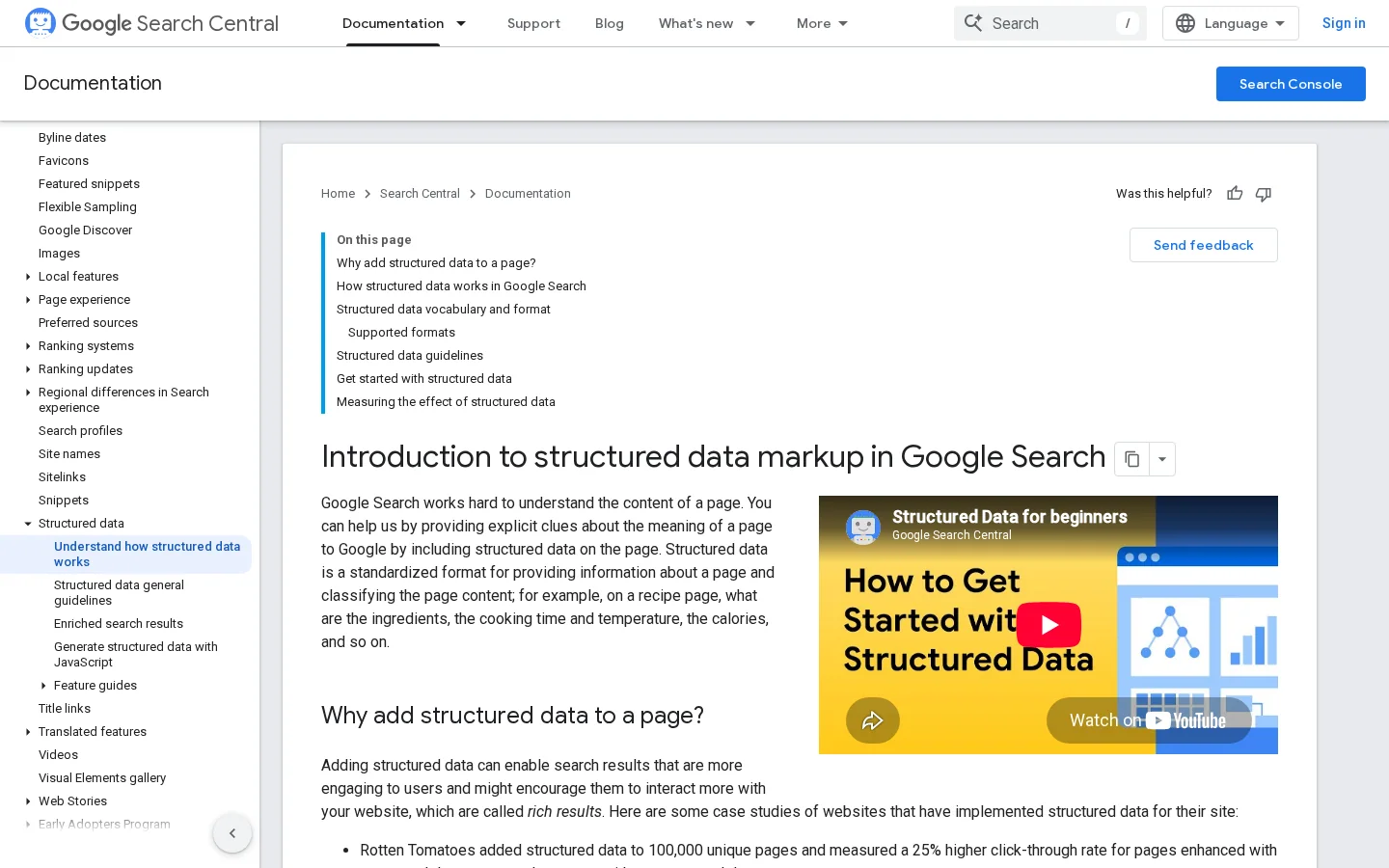
Structured data is a block of code that labels what your page is about, using the shared vocabulary of schema.org. Google recommends JSON-LD for most sites, because it sits in one script block and is easy to maintain. The markup must describe what the visitor can see. Google's structured data documentation says it should not describe information that is not visible to the user, even if that information is accurate. The same page says that adding structured data can enable search results that are more engaging to users, which it calls rich results.
<script type="application/ld+json">
{
  "@context": "https://schema.org",
  "@type": "Article",
  "headline": "SEO Rich Text: What It Is and How to Set It Up",
  "author": {
    "@type": "Person",
    "name": "Jane Doe"
  }
}
</script>
This example is short and does not list every required field. Check the fields for each type before you publish. Our schema markup entry explains the vocabulary, and the rich snippets entry shows how the extra details look in results.
No, not on its own. Structured data helps Google understand your page and makes it eligible for rich results, but the markup alone does not move your position. Clean rich text in the body helps search engines read your content, which supports the rest of your SEO work. Expect the gain to come from clearer pages and from the extra details shown in results, not from a line of code. For a deeper look at what helps and what does not, read Structured Data for AI Search: What Helps, What Does Not.
Check the HTML of your page, not only how it looks on screen. Look for a single H1, ordered headings, real lists, descriptive links, and an alt text on each meaningful image. Then test the JSON-LD on the page. The free structured data validator tests the JSON-LD of any page or code. If you manage many pages, Sorank's content optimization can review and rewrite older pages on autopilot, so the same rules apply across the whole site.
Most problems come from markup that does not match the page. Watch for these five errors, and fix each one in the editor before you publish.
Clear structure makes your facts easier for search engines and AI tools to find and quote. A page with real headings, labeled images and accurate markup gives both the same clean reading. That matters for search, where the extra details can make your result stand out, and for AI answers, where a clear structured content base makes it easier to be cited. The work is the same in both cases: write for the reader, then make the structure easy to read.
SEO rich text is the clean HTML of your page plus the structured data that describes it. Start with the page body: real headings, lists, links, tables and alt text. Then add JSON-LD for the types you need, and check it before you publish. Expect clearer pages and eligibility for rich results, not a direct jump in rankings.
Sources
Not directly. Google uses structured data to understand a page and to show rich results, but the markup alone does not change your position.
Google recommends JSON-LD for most sites. Use it to describe only what visitors can see on the page, then check the result with a validator.
Alt text describes an image for people who cannot see it and tells search engines what the image shows. A title tag names the whole page in search results. Write both for readers first.
 “I tested Sorank on a real client site and it's insane. It does everything an agency would bill you $1500 a month for. It's going into production on that client now.”

 Guillaume Guersanguersanguillaume.com“We are an Ads agency and we wanted to get our SEO back on track once and for all. Sorank gave us a clear view of our site, helped us prioritize optimizations, and properly structure our content. The tool is easy to use, well designed for a team, and very practical for centralizing tracking without having to juggle multiple platforms. A very solid foundation to start fresh with our SEO.”
 Gaspard MadouiAds Agency
 “I just let the Sorank software do its thing, and now my DR is 25 and my page is ranking higher.”
 Lucas Flandrefoundertrace.fr“I specialized in GEO thanks to Sorank. The GEO Leaderboard allows me to show my clients their position vs competitors on ChatGPT. It’s a real commercial differentiator.”
 MélanieSEO Freelance“Great service, works well for our website and helps us understand how to improve it to rank better on Google and elsewhere. Congrats, keep going, I recommend it.”
 Hugo T.E-commerce merchant



















