
Preferences
Privacy is important to us, so you have the option of disabling certain types of storage that may not be necessary for the basic functioning of the website. Blocking categories may impact your experience on the website. More information
Privacy is important to us, so you have the option of disabling certain types of storage that may not be necessary for the basic functioning of the website. Blocking categories may impact your experience on the website. More information

The Hilltop algorithm ranked pages by the links they received from expert pages on one topic. Learn how it worked and what still matters for links.








Founder Sorank, 7+ years in SEO.
Summary
The Hilltop algorithm is a ranking method that finds the most authoritative pages for a query by counting links from expert pages, which are directories of links to independent sources on one topic. It was published in 2001, and Google's current ranking systems guide does not name it.
Want to go further? Ask
The Hilltop algorithm is a link-based ranking method. It was built by Krishna Bharat and George A. Mihaila, and the paper describes it as a way to find authoritative pages for popular queries. Many people call it Google's old algorithm, but Google's public documents do not present it as a live system today. The sections below explain how it worked, what it meant for links and what is left for you.
The Hilltop algorithm answers one question: which pages are the most trusted on a topic? Its authors wanted results that were right for popular queries, even if the index covered fewer pages. The paper states the trade-off directly, and it shapes everything else about the method.
The core idea is simple. A page gains authority when independent topic guides link to it, and the anchor text of those links says what the page is about. Hilltop does not rank a result by looking at the whole web first. It looks at a special index of expert pages, then reads the links those experts send.
An expert page is a page about one topic that links to many non-affiliated pages on that topic. Think of a curated resource list, a directory or a guide that points to several sites run by different people. The paper's key sentence reads: "We define an expert page as a page that is about a certain topic and has links to many non-affiliated pages on that topic." You can read the full method in the 2001 WWW10 paper "When Experts Agree".
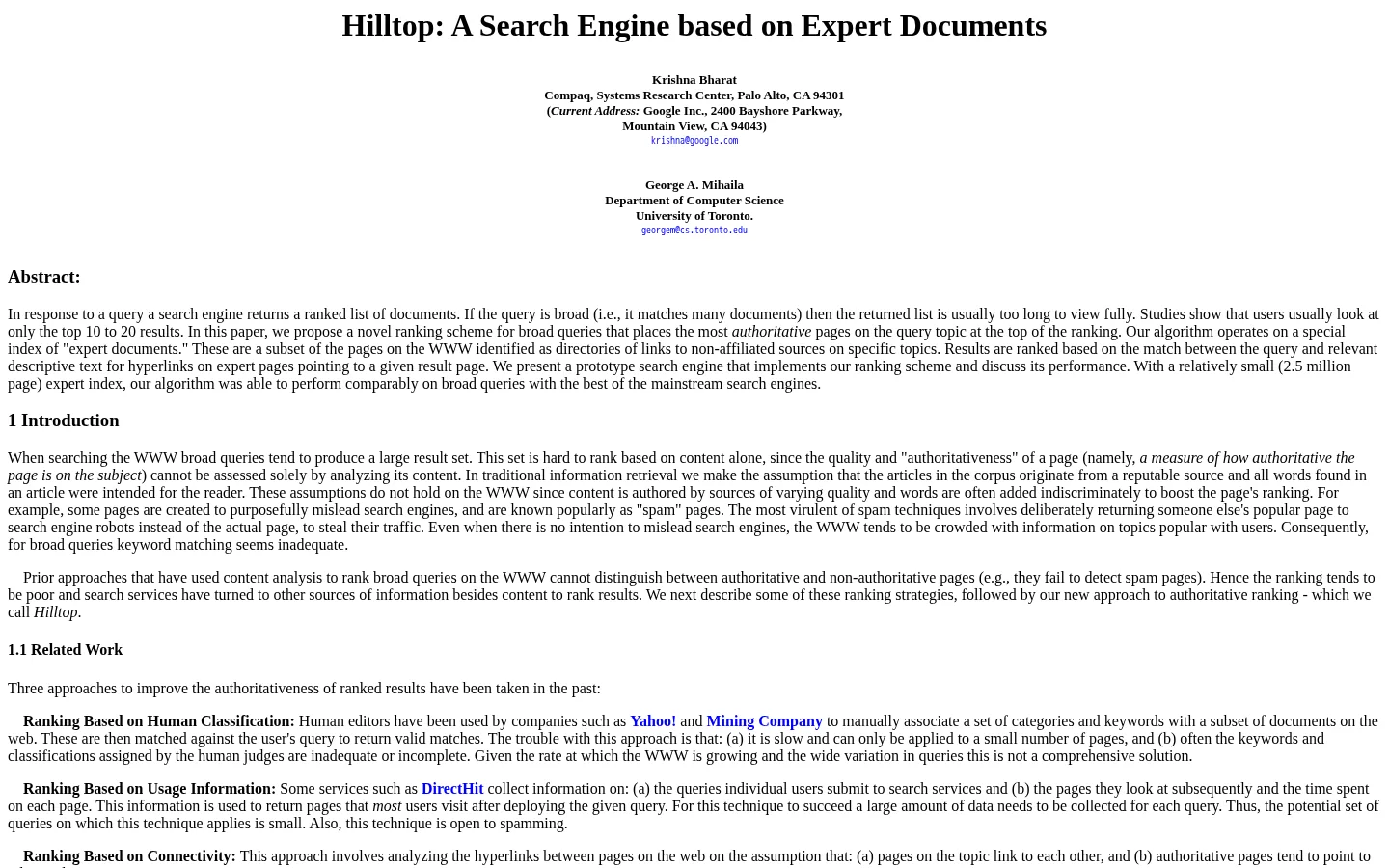
Hilltop kept a separate index of these expert pages. The prototype used about 2.5 million expert pages, out of roughly 140 million pages in the AltaVista index at the time. The method depends on that pool. When the pool does not cover a query, the paper says that "Hilltop provides no results." That is a real limit: a topic with few expert pages gets no answer from this method at all.
Hilltop starts with the query. It finds the expert pages that best match the query, using key phrases such as titles, headings and anchor text. It then follows the relevant links from the top 200 experts. A target page only counts if at least two non-affiliated experts link to it. Its score is the sum of the scores of the expert links pointing to it.
Imagine a query about the Hilltop algorithm. Expert page A is a resource list on search history that links to your page with the words "Hilltop algorithm paper". Expert page B is an SEO guide run by another owner that links to the same page. Both experts match the query, so the page gets two votes and a score. If only one expert linked to it, the page would get nothing.
Anchor text is part of this, but the paper ranks the parts of a link. It says that title text is more useful than heading text, and that heading text is more useful than anchor text. For your own work, the lesson is that the page linking to you should be clearly about your topic, and the words around the link should say so. Read more on anchor text to keep link wording natural.
Two hosts are affiliated when they share the first three numbers of their IP address, or the same distinctive part of their domain name. Hilltop treats affiliated sites as one voice. If two affiliated experts link to the same target, only the higher-scoring link is kept. That rule stops one owner from building a score out of many of its own sites.
The goal is to resist self-promotion. A page's score depends on several unrelated sources that point to it, not on one owner linking to its own pages. The authors also tested result quality. In a study of 24 organization home pages, Hilltop put the desired page first about 87% of the time, against 80% for the best commercial engine tested. On 25 broad queries, its precision at rank 1 matched the best commercial engine at 0.92.
The PageRank glossary entry describes a method that weighs links across the whole web. Hilltop asks a narrower question: which experts on this topic link to the page? A link from a large general site can help a page under PageRank. Under Hilltop, the link has to come from a page about the topic, and that page has to be independent of the other sources that link in.
Both methods treat links as votes. They differ on who gets a vote. For more on how topic focus builds authority, read the topical authority guide.
You do not need Hilltop's index to use its logic. You can check it by hand in four steps.
Then look for pages that would link to you anyway, such as a study, a tool or a guide that answers a question they already cover. Those are the links that match the Hilltop idea.
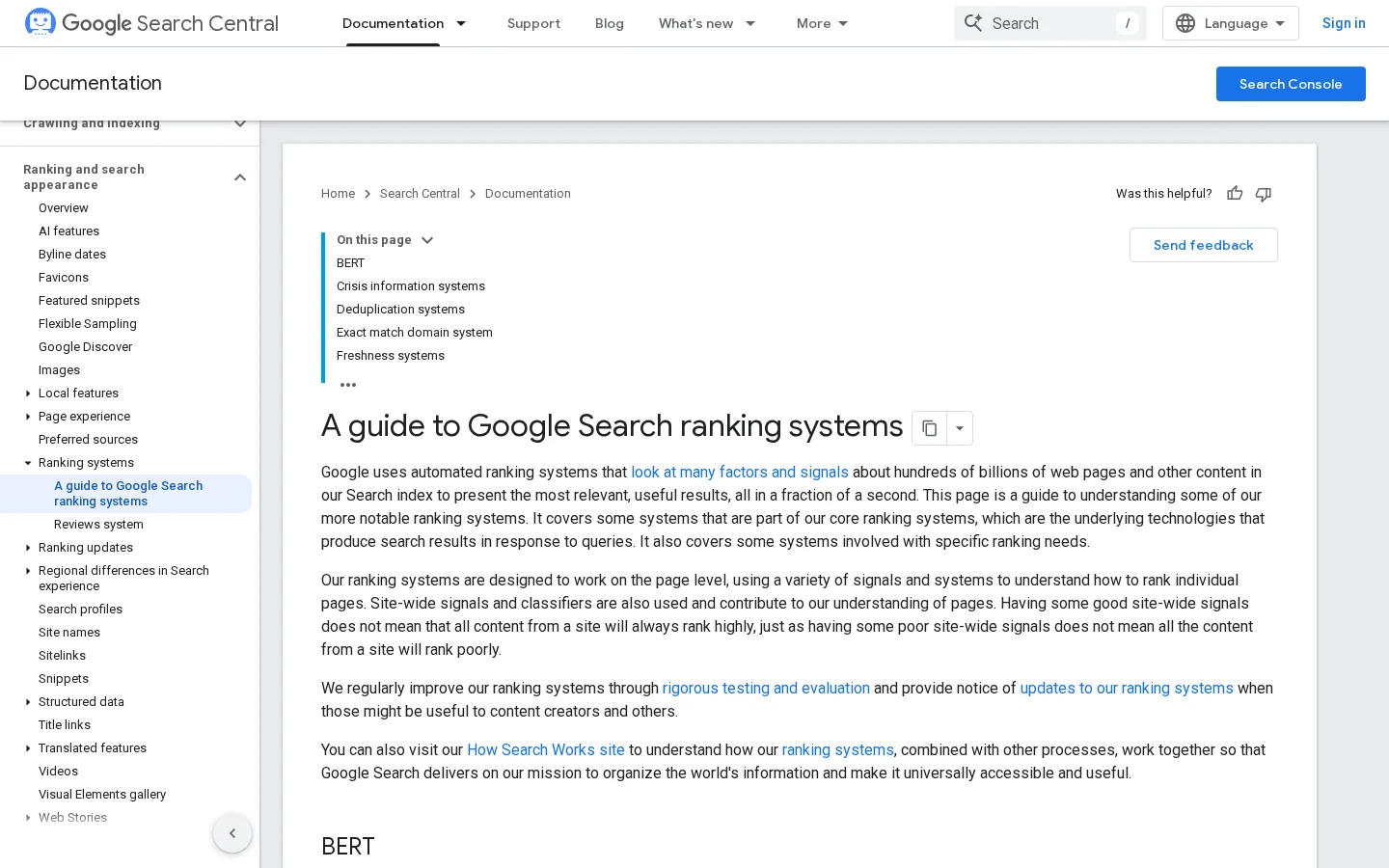
The public record is short. Google's ranking systems guide says that "We have various systems that understand how pages link to each other," and it names PageRank among its ranking systems. The guide does not name Hilltop, LocalRank or expert documents. So treat Hilltop as a research method that shaped how people think about links, not as a setting you can tune.
The idea that survives is that independent votes on your topic count for more than a network voting for itself. Google does not say which method it uses today, but its spam policies show it treats manipulated links as a problem. The policies define link spam as "the practice of creating links to or from a site primarily for the purpose of manipulating search rankings," and they list buying or selling links for ranking, and excessive link exchanges, as examples. For the safe alternative, read the backlink exchange guide.
Most of these mistakes come from reading an old research method as a current lever. These four are the ones to avoid.
Hilltop matters because it shows where the meaning of a link comes from. A link is stronger when it comes from a page about the same thing, and when the source has no stake in the result. The same questions show up in the E-E-A-T framework, which asks whether a site is trusted on its topic.
For GEO, the lesson is the same, but the proof is different. Hilltop never said how AI models choose their sources, so do not claim that it does. You can still ask the useful question: do independent sites on your topic talk about your brand and link to it? Tools that report domain authority give a number. Count the links behind the number, not the number itself. Sorank's natural backlink acquisition page covers contextual links from sites in your niche, which is the closest modern practice to earning expert links.
The Hilltop algorithm was a method from 2001 that ranked pages by links from expert pages on one topic. It was built for accuracy, and it returned nothing when the expert pool did not cover a query. Google's ranking systems guide does not name it today. Keep the lesson, not the method: earn links from independent sites that cover your topic, and do not build links that only exist to rank.
Sources
Google's ranking systems guide does not name Hilltop. The method comes from a research paper published in 2001, and nothing in Google's public documents says it runs today. Do not build a plan around it.
An expert page is about one topic and links to many sites that are not affiliated with each other. Resource lists and curated directories often fit. Hilltop gave weight to the links these pages sent.
Earn links from independent sites that cover your topic, and avoid bought or swapped links. Google's spam policies treat buying links for ranking and excessive link exchanges as link spam.
 “I tested Sorank on a real client site and it's insane. It does everything an agency would bill you $1500 a month for. It's going into production on that client now.”

 Guillaume Guersanguersanguillaume.com“We are an Ads agency and we wanted to get our SEO back on track once and for all. Sorank gave us a clear view of our site, helped us prioritize optimizations, and properly structure our content. The tool is easy to use, well designed for a team, and very practical for centralizing tracking without having to juggle multiple platforms. A very solid foundation to start fresh with our SEO.”
 Gaspard MadouiAds Agency
 “I just let the Sorank software do its thing, and now my DR is 25 and my page is ranking higher.”
 Lucas Flandrefoundertrace.fr“I specialized in GEO thanks to Sorank. The GEO Leaderboard allows me to show my clients their position vs competitors on ChatGPT. It’s a real commercial differentiator.”
 MélanieSEO Freelance“Great service, works well for our website and helps us understand how to improve it to rank better on Google and elsewhere. Congrats, keep going, I recommend it.”
 Hugo T.E-commerce merchant



















