Preferences
Privacy is important to us, so you have the option of disabling certain types of storage that may not be necessary for the basic functioning of the website. Blocking categories may impact your experience on the website. More information
Privacy is important to us, so you have the option of disabling certain types of storage that may not be necessary for the basic functioning of the website. Blocking categories may impact your experience on the website. More information

Google Hummingbird explained: the search update that reads whole questions, not just keywords, and what it means for your pages.







Founder Sorank, 7+ years in SEO.
Summary
Google Hummingbird is a major overhaul of Google's search algorithm, announced on September 26, 2013, that looks at the whole query and its meaning, not only at isolated keywords. It helps Google answer long, conversational questions, the kind people now type into a search box.
Want to go further? Ask
Google Hummingbird is the update that changed how Google interprets the questions people type. According to The Register's report on the announcement, Google said people were asking more complex, conversational queries and moving away from short, directed terms, so the engine had to understand the whole question. Hummingbird sits inside the wider field of semantic search, which is about matching meaning rather than words.
It changed the step where Google works out what a query means. According to a Google spokesperson quoted by The Register, Hummingbird pays more attention to every word in a query, so the whole query is taken into account. A page that matches one phrase but misses the rest of the question is less likely to be the best answer.
In practice, this means a query is read as one request. A search such as "best cordless vacuum for pet hair in a small flat" carries a product type, a use case, a space and an implied budget. The engine weighs all of these together. That links directly to the search intent behind the query: what the person wants to do after reading the result.
Google announced Hummingbird on September 26, 2013. The Register reported that the algorithm had been deployed for several weeks by then, so it was already live when the news came out. PBS NewsHour covered the announcement the next day and described the update as designed to make results more relevant and helpful, particularly when users ask complex questions.
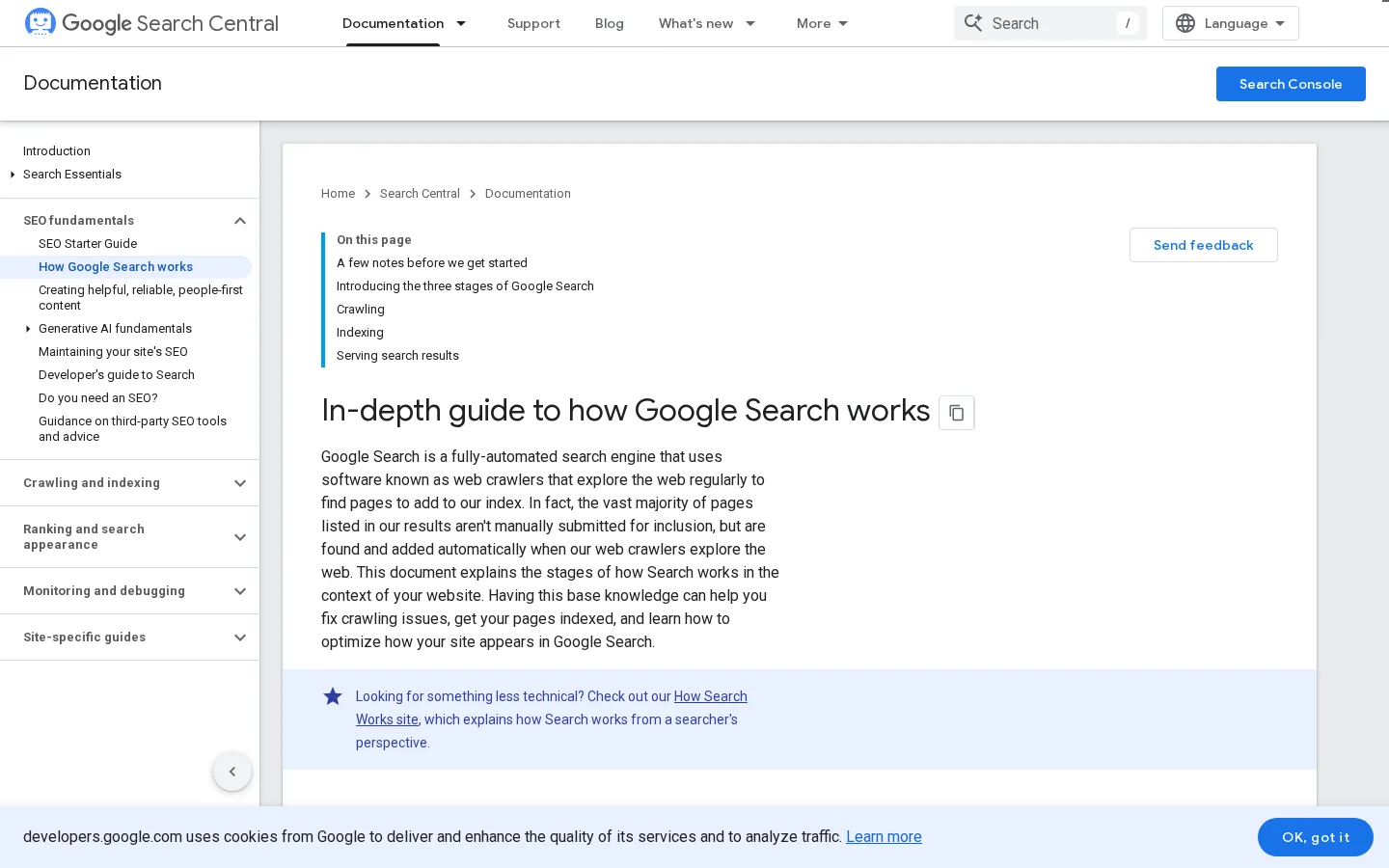
Hummingbird did not add a ranking factor you can target directly. It changed how Google reads queries, and the ranking of a page still depends on many signals. Google Search Central's guide to how search works says that relevancy is determined by hundreds of factors, including location, language and device. When someone enters a query, Google's systems search the index for matching pages.
The Register also reported that the algorithm was involved in about 90% of queries, but it attributed that figure to its own understanding, not to Google. Treat that number as a press estimate, not an official count.
Long questions are where word matching breaks down. People phrase them the way they would ask a person, with context and conditions attached. The more a query reads like a sentence, the more the engine has to treat it as one unit. Google later added other systems that work on the same problem, such as RankBrain, so Hummingbird is best seen as one step in a longer change.
You can run a simple test yourself. Type the full question into a search box and compare the top results with the keyword you planned to target. If the results answer the whole question, the engine is reading the sentence. If they only share the keyword, your page probably needs a clearer answer, not more repetitions of the keyword.
The two are often mixed up. The Knowledge Graph is a database of entities, such as people, places and organizations, and the links between them. Hummingbird is a change to how queries are interpreted. They work on different parts of search, but both reward pages that name their subject clearly, which is the core idea of entity SEO.
Write for the question, not for the phrase. Follow these steps for each page:
Use this table to check a draft:
| Check | Keyword-first page | Question-first page |
|---|---|---|
| Main focus | One phrase repeated across the text | One real question answered in full |
| Opening | A general introduction | A direct answer in the first two sentences |
| Related needs | Left out | Covered in the same place |
| Read-aloud test | Sounds stiff and repetitive | Sounds like an answer to a spoken question |
Tip
Write the question down in one sentence before you draft. If you cannot state it that way, the page is probably trying to answer two questions at once.
Most problems come from treating the update as a keyword rule. Three mistakes come up often.
This is keyword stuffing under a new name. The same phrase appears in every paragraph, and the text sounds unnatural when read aloud. To spot it, read the page out loud, or count how often the exact phrase appears in 500 words. To fix it, keep the phrase in the title, the first paragraph and one or two headings, and replace the rest with the related terms people actually use.
Several pages answer the same question with small wording changes, so none of them is clearly the best match. To spot it, search your own site for the question and see which pages appear. To fix it, merge them into one complete page, or give each one a different intent. This problem has a name, keyword cannibalization, and our semantic SEO audit guide shows how to check topics and intents across a site.
The page covers the topic in general, but the query asks for a specific answer, such as a price, a step or a comparison. To spot it, check whether the answer appears on the first screen of the page. To fix it, move the answer up, then add the context below it. Compare the page against the intent behind the query before you rewrite anything.
For SEO, Hummingbird made the match between a question and a page the thing to get right, not the number of times a term appears. For GEO, AI assistants also answer questions in natural language, so a page with a clear answer to a clear question is easier to quote. Start with the pages that already get impressions but few clicks, because those pages often match part of a query without answering the full question.
Sorank's topic cluster generator includes built-in anti-cannibalization, which helps keep one question from being split across several pages.
Google Hummingbird moved search from matching words to understanding questions. Write each page around one real question, answer it first, and cover the related needs in the same place. That habit helps with classic rankings and with AI answers, which also work from whole questions.
Sources
Google Hummingbird is an update to Google's search algorithm that Google announced on September 26, 2013. It changed how Google interprets a query, so the engine looks at the whole question and its meaning, not only at separate keywords. It is not a separate ranking factor you can target directly.
Hummingbird did not add a ranking factor you can optimize for directly. Its effect is on how Google reads queries, so pages that answer the real question clearly are better placed to be matched. Rankings still depend on many signals.
Start from the question a person actually asks, and answer it in the first two sentences of the section. Then cover the related needs, such as cost, use case or comparison, in the same piece. Avoid splitting one question across several near-identical pages.
 “I tested Sorank on a real client site and it's insane. It does everything an agency would bill you $1500 a month for. It's going into production on that client now.”

 Guillaume Guersanguersanguillaume.com
 “I just let the Sorank software do its thing, and now my DR is 25 and my page is ranking higher.”
 Lucas Flandrefoundertrace.fr“We are an Ads agency and we wanted to get our SEO back on track once and for all. Sorank gave us a clear view of our site, helped us prioritize optimizations, and properly structure our content. The tool is easy to use, well designed for a team, and very practical for centralizing tracking without having to juggle multiple platforms. A very solid foundation to start fresh with our SEO.”
 Gaspard MadouiAds Agency“I specialized in GEO thanks to Sorank. The GEO Leaderboard allows me to show my clients their position vs competitors on ChatGPT. It’s a real commercial differentiator.”
 MélanieSEO Freelance