
Preferences
Privacy is important to us, so you have the option of disabling certain types of storage that may not be necessary for the basic functioning of the website. Blocking categories may impact your experience on the website. More information
Privacy is important to us, so you have the option of disabling certain types of storage that may not be necessary for the basic functioning of the website. Blocking categories may impact your experience on the website. More information

A Google bomb is a campaign that links a phrase to one page until Google ranks it first. Learn its origin, famous examples and how Google fixed it.







Founder Sorank, 7+ years in SEO.
Summary
A Google bomb is a campaign that makes a web page rank first for an odd or misleading search phrase. People get there by linking that phrase to the page, often with the same anchor text. The term dates from 2001. In 2007, Google changed its algorithm to reduce the effect of the best-known bombs.
Want to go further? Ask
A Google bomb is an attempt to change what Google shows for a search phrase. Many sites link to one page using the same words, until Google connects those words with that page. Searchers then see a strange result at the top, often one that mocks the target or argues against it. The practice is also called Google bombing.
Google treats links as votes. A link from one site to another suggests that the target page matters. The anchor text, which is the words someone clicks, suggests what the target is about. When enough links use the same anchor text, the page can rank for that phrase, even if the page never uses those words.
A Google bomb needs three things: many links, the same anchor text, and sites that pass some value to the target. The campaign can run through blogs, forums, or a set of sites built for the job. Bombs are rarely about the page itself. They are about the links around it, which is why the same page can rank for a phrase one week and lose it the next. To understand the signals involved, read our guides on PageRank and anchor text.
Adam Mathes first used the term in April 2001, in an online article called "Filler Friday: Google Bombing". An academic article on the topic records this date and the title. The idea was simple: a group of links, all using the same words, could move a result that nobody had planned to move.
The term stuck because the effect was easy to see. Anyone could type the phrase, click the top result, and see the joke. That visibility is also why the practice drew attention from search engines, journalists and researchers.
The best-known example is "miserable failure". In January 2004, a Google search for that phrase returned the official George W. Bush biography on the White House website, as ClickZ reported on January 14, 2004. The result showed that links, not the words on the page, can decide what Google shows for a phrase.
Google's own 2007 post names "talentless hack" as one of the earliest Google bombs. It shows the early pattern: one phrase linked to one target, with the joke aimed at a person or a brand.
Google did not hand-edit the results. On January 26, 2007, Google said it had improved its analysis of the link structure of the web, and that this reduced the impact of many Google bombs. Instead of the manipulated page, the results often return commentary, discussions and articles about the Google bomb itself.
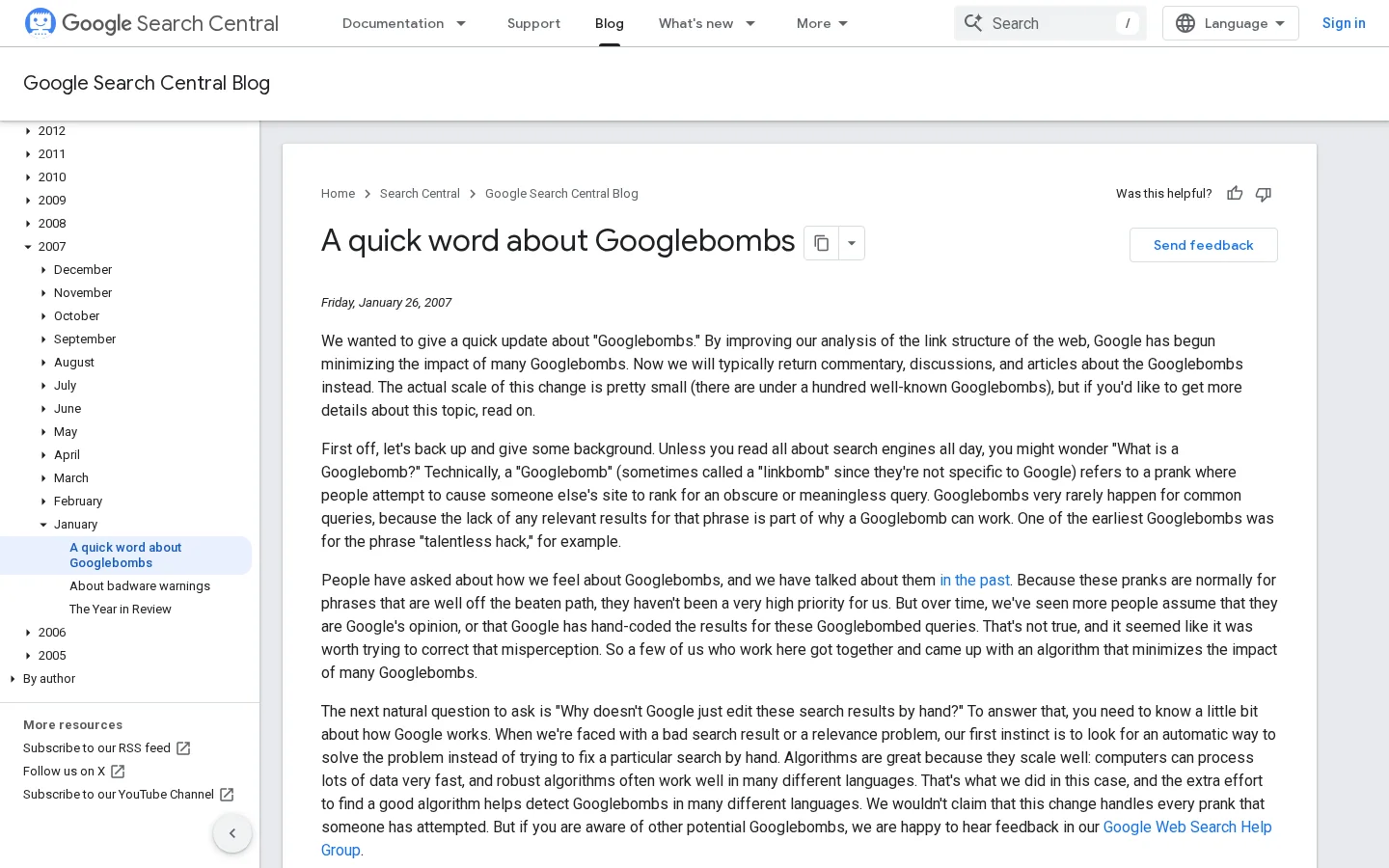
Google also said the fix is algorithmic, which lets it scale and detect bombs across many languages. Google did not claim that the change stops every prank. For you, the lesson is that Google changes its ranking systems often, as explained in our guide to algorithm updates.
You can check a phrase in four steps. Each step takes a few minutes and needs no special software.
Results can change with location and search history, so test from more than one place before you draw a conclusion.
They overlap, but they are not the same. A Google bomb targets one search phrase. Google calls the wider abuse link spam. Google's spam policies define it this way: "Link spam is the practice of creating links to or from a site primarily for the purpose of manipulating search rankings." Buying or selling links for ranking, and excessive link exchanges, are both listed as examples.
Links marked nofollow or sponsored are an exception, because they do not pass ranking signals in the same way. Google detects violations with automated systems and, when needed, human review. A human review can result in a manual action, and Google tells you about it in the Manual actions report and the Search Console message center.
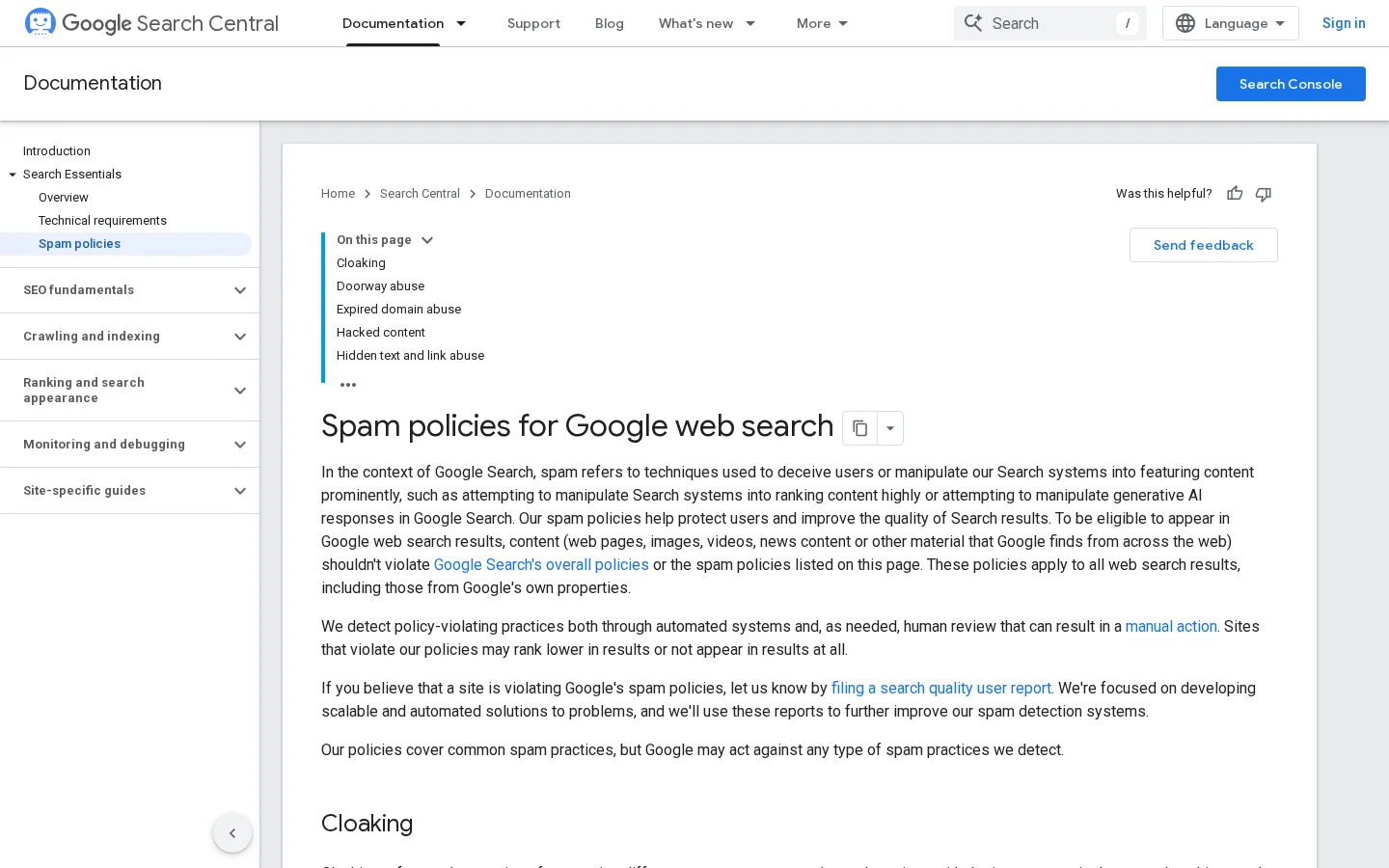
Manual actions and algorithm drops look alike from the outside. Our guide to Google penalties shows how to tell them apart before you change anything.
What it is: you add many links to your own page in a short time, often with the exact phrase as anchor text. How to spot it: your link report shows a sudden spike, and the top result still does not move. How to fix it: build links slowly, from sites related to your topic, and vary the anchor text.
What it is: every link to your site uses the same keyword phrase. How to spot it: your anchor text report shows that one phrase covers most of your links. How to fix it: mix exact, partial, brand and descriptive anchors. The anchor text optimization guide shows how to audit and balance them.
What it is: you trade links with sites that only want a link back, often under a "link to me and I will link to you" offer. How to spot it: your new links come from pages with long lists of unrelated links. How to fix it: stop the trades, keep only links from relevant sites, and read the guide on backlink exchange to see why Google treats this as spam.
For SEO, a Google bomb shows that anchor text and link patterns can move a result, which is why Google watches them. It also shows why a ranking can change without any change on the page itself. For GEO, the question is the same: if a misleading phrase about your brand ranks, the wrong page can reach the people who search, and AI models that read the web may repeat what they find. Read our guide to AI brand safety to see how to protect your name in both places.
Sorank helps you notice this early. AI mention tracking shows when ChatGPT cites your brand, so you can spot an unwanted answer as soon as it appears.
A Google bomb is a campaign that uses links and anchor text to push one page up for a phrase. It became known in 2001, and Google changed its ranking in 2007 to reduce the effect of the best-known cases. The practical lesson is to check your link profile, vary your anchor text and stay away from link schemes. Start with our backlink guide to see how links shape your results.
Sources
A Google bomb is an attempt to make one page rank first for an odd or misleading search phrase. It works by linking that phrase to the page, often with the same anchor text.
Adam Mathes first used the term in April 2001, in an online article called Filler Friday: Google Bombing. Academic work on the topic records the same date.
In January 2007, Google said it had improved how it reads the link structure of the web. Many bombs now return articles about the bomb itself instead of the target page.
 “I tested Sorank on a real client site and it's insane. It does everything an agency would bill you $1500 a month for. It's going into production on that client now.”

 Guillaume Guersanguersanguillaume.com“We are an Ads agency and we wanted to get our SEO back on track once and for all. Sorank gave us a clear view of our site, helped us prioritize optimizations, and properly structure our content. The tool is easy to use, well designed for a team, and very practical for centralizing tracking without having to juggle multiple platforms. A very solid foundation to start fresh with our SEO.”
 Gaspard MadouiAds Agency
 “I just let the Sorank software do its thing, and now my DR is 25 and my page is ranking higher.”
 Lucas Flandrefoundertrace.fr“I specialized in GEO thanks to Sorank. The GEO Leaderboard allows me to show my clients their position vs competitors on ChatGPT. It’s a real commercial differentiator.”
 MélanieSEO Freelance“Great service, works well for our website and helps us understand how to improve it to rank better on Google and elsewhere. Congrats, keep going, I recommend it.”
 Hugo T.E-commerce merchant



















