
Preferences
Privacy is important to us, so you have the option of disabling certain types of storage that may not be necessary for the basic functioning of the website. Blocking categories may impact your experience on the website. More information
Privacy is important to us, so you have the option of disabling certain types of storage that may not be necessary for the basic functioning of the website. Blocking categories may impact your experience on the website. More information

Click economy is a business model where each click earns money, through ads and sales. Learn how it works, with examples and how to value a click.







Founder Sorank, 7+ years in SEO.
Summary
Click economy is a business model where each click brings in money. Advertisers pay a platform every time someone clicks their ad, so the platform earns from visits. Clicks are the unit of value, so the business grows with the number of clicks and with what each click is worth.
Want to go further? Ask
Click economy describes an online market where attention is sold one click at a time. A person clicks a link, an ad or a product, and the business behind it earns money from that visit. The model is common in search ads, social ads, content sites and affiliate programs. The term is also used for the older search pattern, where a user types a query and clicks one of ten blue links. This page covers the business model.
The click economy has three parts: a visitor, a click and a payer. The visitor clicks a link or an ad. The site or platform that shows it gets paid by someone who wants that visit, usually an advertiser, a seller or a partner. The more visits a site sends to the right buyers, the more it can charge for each one.
This model works because clicks can be counted. A platform can record every click on an ad, bill the advertiser for it, and show the advertiser exactly how many people came. That is why the model fits online business so well: each visit has a price and a record.
The model also has a limit. Buyers pay for attention, so they compare every visit with what it costs. When a platform sends fewer clicks or prices rise, advertisers move their budget elsewhere. Sites that depend on one source of clicks feel this first, which is why many businesses mix paid clicks with organic visits and direct traffic.
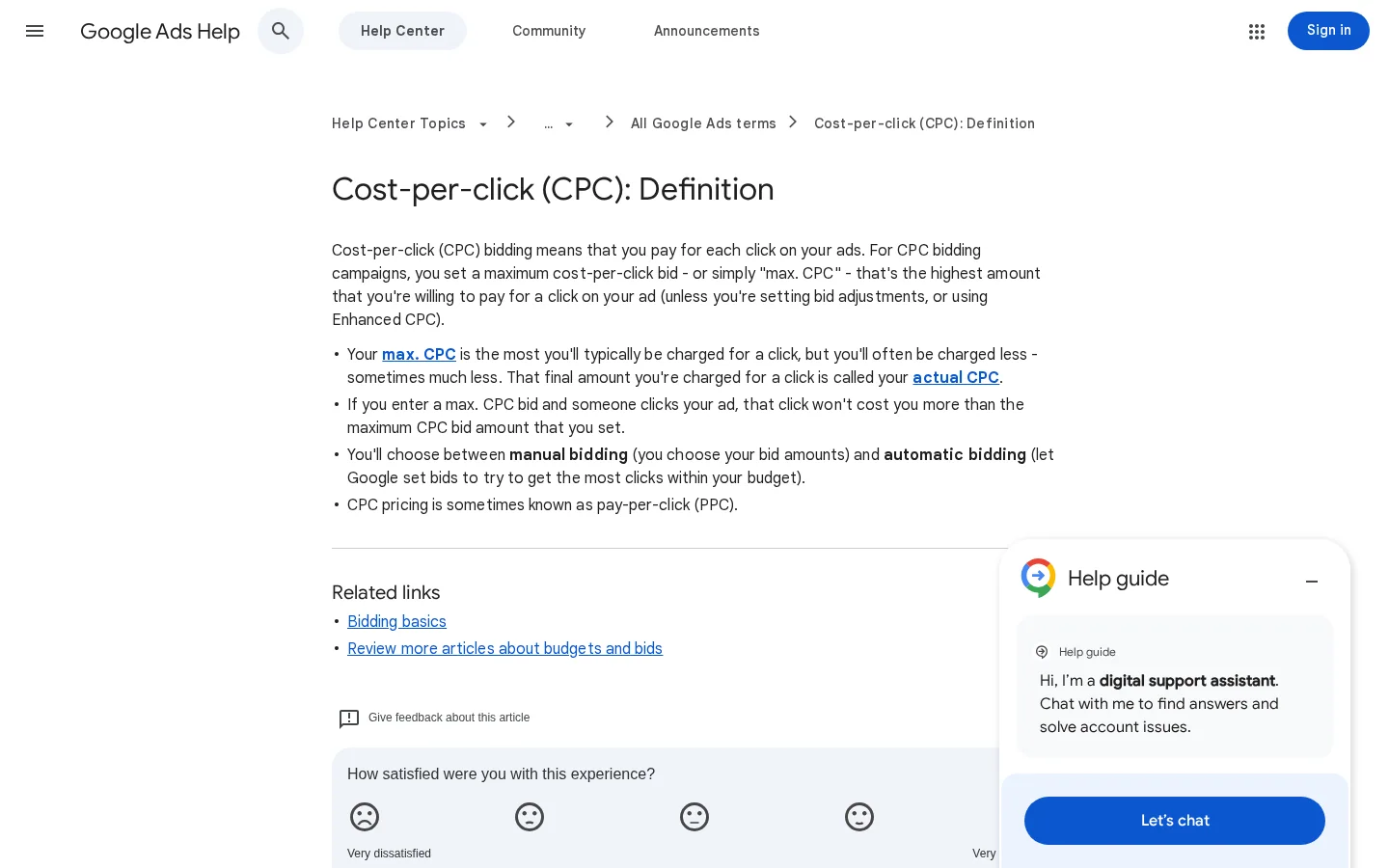
In pay-per-click (PPC) advertising, the advertiser pays only when someone clicks. Google Ads, for example, uses cost-per-click bidding. Google's help center states it plainly: "Cost-per-click (CPC) bidding means that you pay for each click on your ads." Views that bring no click cost nothing. The cost per click (CPC) is the price of one click, and it is set in an auction.
You set a maximum bid, the most you will pay for one click. Google also says that your actual cost per click is the final amount you are charged, and that you will often be charged less than your maximum bid, sometimes much less. The price is usually set by the minimum needed to beat the advertiser just below you. For the budget side of this, read what Google Ads costs in practice.
A click costs more when more advertisers want the same visitor. A keyword that buyers search for with a clear intent to purchase usually attracts more bids, so its clicks cost more. A keyword that few businesses target usually costs less per click.
Ad quality also changes the price. The platform scores how relevant an ad and its landing page are to the search. A relevant ad can win a good position for a lower price, which is why the Google Ads quality score matters to the click economy as much as the bid.
Four models show the click economy in daily use. Each one turns a visit into revenue, but in a different way.
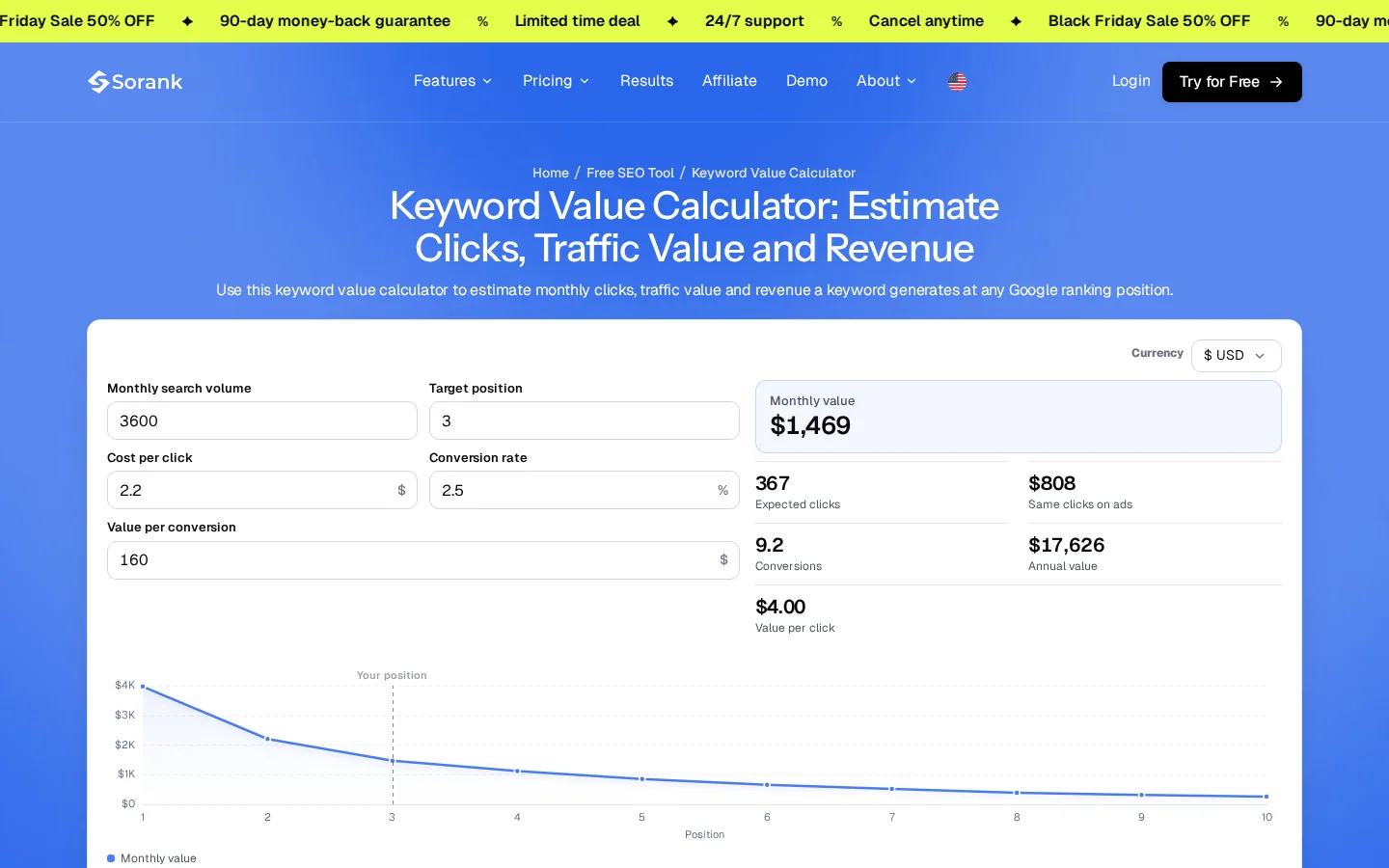
To value a click, multiply how often a click becomes a sale by the profit of that sale. The result is a rough estimate, but it tells you whether a paid click or a free visit is worth more to you. Sorank's keyword value calculator estimates clicks, traffic value and revenue for a keyword, so you can test the number before you spend.
Value per click = conversion rate x profit per sale
Example: 0.02 x 50 = 1 per click
In this example, 2 out of 100 visitors buy, and each sale brings a profit of 50. So each click is worth 1. If the paid click costs more than 1, you lose money on each visit. If it costs less, the click pays off.
Not every online payment is based on clicks. The table below shows the main models and what triggers the payment, so you can see which ones depend on a visit.
| Model | Who pays | When the payment happens |
|---|---|---|
| Pay per click (PPC) | Advertiser | Each click on the ad |
| Pay per 1000 impressions (CPM) | Advertiser | Each 1000 times the ad is shown, click or not |
| Affiliate commission | Seller | Each sale that a tracked click leads to |
| Pay per lead | Advertiser | Each form, sign-up or call |
Only the first two models depend on the ad itself. The last two depend on what the visitor does next. For a business, the question is whether the click or the action is the thing you pay for.
Most mistakes come from measuring the wrong number. Here are the three most common ones, with what each one is, how to spot it and how to fix it.
What it is: counting visits as income. A high number of clicks can look like success even when nobody buys.
How to spot it: your reports show many clicks but few sales or leads.
How to fix it: track what each click leads to, and compare the cost of the click with the value of the sale.
What it is: mixing up a count with a share. Clicks are a number. The share of people who click after seeing a result is a rate.
How to spot it: a page has a good rate but few clicks because it gets few views, or the reverse.
How to fix it: read both numbers together, and check the views behind each rate before you act on it.
What it is: paying for clicks from bots, repeat clicks or rivals who click an ad to drain its budget. This is called click fraud.
How to spot it: traffic rises with no sales, and visits are very short.
How to fix it: check the click reports, exclude the sources that do not convert, and set a daily budget limit.
Organic clicks from search are free to receive, but they are not guaranteed. When results show answers on the page, fewer people click through, even at the same position. These searches that end without a click are now a large part of search, so a page can rank well and still bring few visits.
For generative engine optimization (GEO), the goal changes. You want AI models to name your brand and cite your pages, even when the user does not click. Sorank's AI mention tracking shows when ChatGPT cites your brand, so you can see that visibility even when it does not produce a click. Paid visits from paid traffic can fill the gap while your organic visibility grows.
Click economy means each click brings money, through ads, sales or partner payments. Know what a click is worth to you before you buy one or chase one. Count the sales a click leads to, not only the visits.
Sources
A search ad is a common example. The advertiser bids on a keyword and pays the search engine only when someone clicks the ad. Affiliate links work in a similar way, but the payment usually depends on a sale.
It depends on the keyword, the competition and the auction. In Google Ads, you set a maximum bid, and the actual cost per click is often lower than that maximum.
No. Click-through rate is the share of people who click after seeing a result or an ad. Click economy is the business model that puts a price on each click.
 “I tested Sorank on a real client site and it's insane. It does everything an agency would bill you $1500 a month for. It's going into production on that client now.”

 Guillaume Guersanguersanguillaume.com“We are an Ads agency and we wanted to get our SEO back on track once and for all. Sorank gave us a clear view of our site, helped us prioritize optimizations, and properly structure our content. The tool is easy to use, well designed for a team, and very practical for centralizing tracking without having to juggle multiple platforms. A very solid foundation to start fresh with our SEO.”
 Gaspard MadouiAds Agency
 “I just let the Sorank software do its thing, and now my DR is 25 and my page is ranking higher.”
 Lucas Flandrefoundertrace.fr“I specialized in GEO thanks to Sorank. The GEO Leaderboard allows me to show my clients their position vs competitors on ChatGPT. It’s a real commercial differentiator.”
 MélanieSEO Freelance“Great service, works well for our website and helps us understand how to improve it to rank better on Google and elsewhere. Congrats, keep going, I recommend it.”
 Hugo T.E-commerce merchant



















