
Preferences
Privacy is important to us, so you have the option of disabling certain types of storage that may not be necessary for the basic functioning of the website. Blocking categories may impact your experience on the website. More information
Privacy is important to us, so you have the option of disabling certain types of storage that may not be necessary for the basic functioning of the website. Blocking categories may impact your experience on the website. More information

AI response optimization is writing content that AI tools can quote and cite. What Google says about AI Overviews and AI Mode, and how to apply it.








Founder Sorank, 7+ years in SEO.
Summary
AI response optimization is the practice of writing and structuring content so that AI tools in search, such as Google AI Overviews and AI Mode, can find, quote and cite your passages inside their answers. The goal shifts from a ranking position to being one of the sources shown next to the answer.
Want to go further? Ask
AI response optimization makes a page easier for AI systems to use when they answer a question. Instead of competing only for a place in a list of links, your content competes to supply the passage the answer is built from. Google describes the foundations in its guide to AI features in Search, and the same foundations apply whether you target AI Overviews, AI Mode or classic results.
AI response optimization is the set of editorial and technical choices that increase the chance your content appears in an AI generated answer. It works at the passage level. AI systems read a page as blocks of text, select the blocks that answer the question, and show a few links next to the answer. A passage that is clear, complete and self-contained is easier to reuse than one that depends on the paragraphs around it.
The practice overlaps with answer engine optimization and generative engine optimization. Many AI tools build answers with retrieval augmented generation, which means the system first retrieves candidate pages, then reads them to write the answer. Your job is to make both steps easy.
Google says AI Overviews and AI Mode show links to supporting websites. A page can only be used this way if it is indexed and eligible to be shown in Google Search with a snippet. Both features may run several related searches, which Google describes as a query fan-out technique, to cover the subtopics of one question. That is why a single question can surface pages that rank for different sub-questions.
Google also states that AI Overviews only appear when its systems judge them additional to classic search, so they do not show on every query. The practical consequence is simple: optimize for the sub-questions your buyers ask, not only for the main term.
No. Google states that there are no additional requirements to appear in AI Overviews or AI Mode, and that no special optimizations are necessary. You do not need to create machine readable files, AI text files or special markup for these features. The foundations still count: the page must be indexed, its important content must be available as text, and its structured data must match what visitors see on the page.
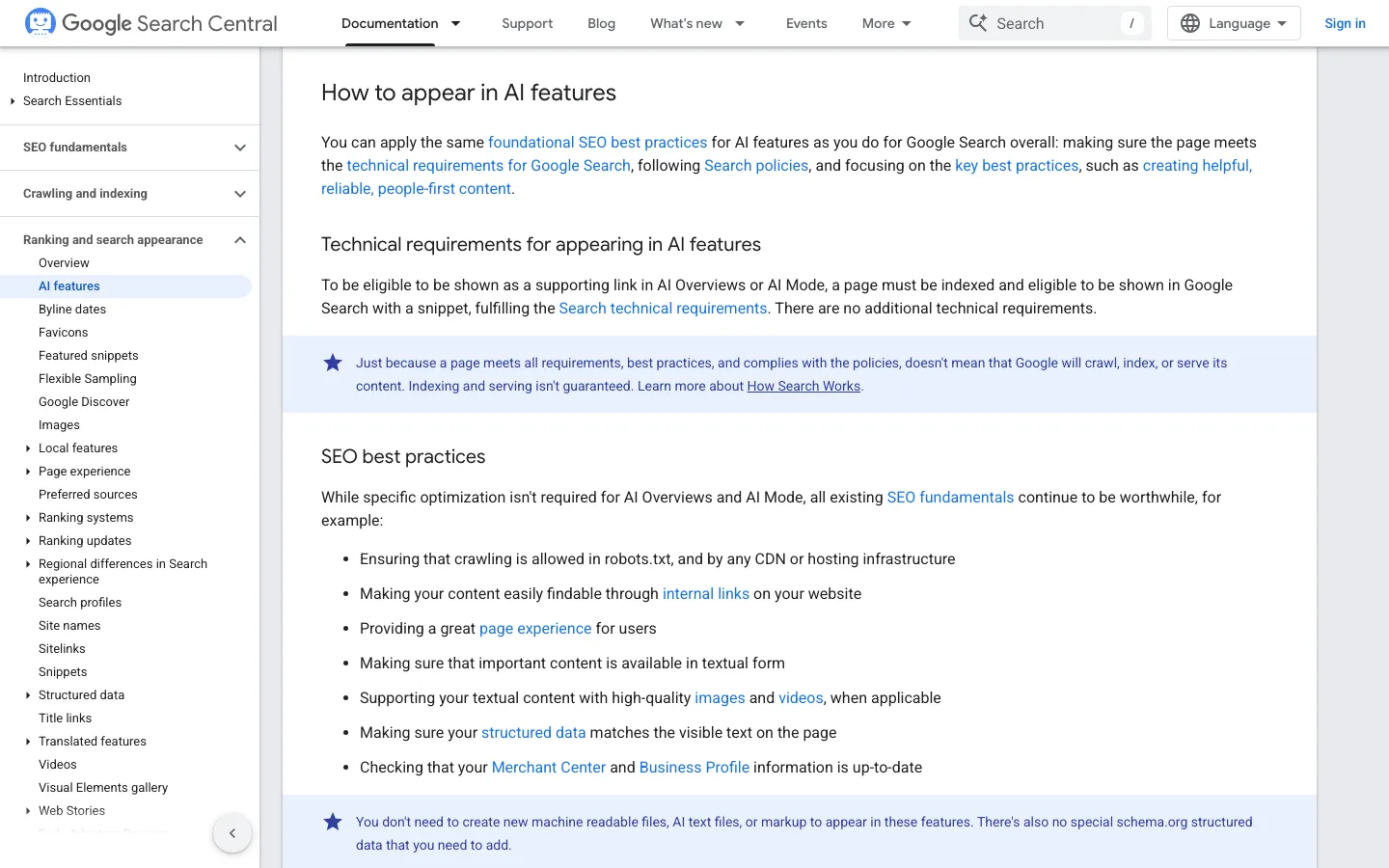
The screenshot shows the section of Google's guide that lists these requirements. Treat any offer that sells an AI-only file as a claim to check, since Google does not ask for one.
Start each section with the answer. Lead with a complete statement in the first two or three sentences, then develop it with evidence. A reader, or a model, who stops after the opening should still leave with the answer. Google's guidance on helpful content asks for the same thing: content written for people first, with the main answer easy to find.
Then make each block self-contained. Name the subject in the sentence instead of writing "it" or "this", keep one idea per paragraph, and use headings that say what the section covers. The method is close to content chunking, which splits long pages into units that can be read and reused on their own.
Comparison tables, numbered steps and short definitions are easy to lift without distortion, because each one has clear boundaries. Use them where the subject calls for them, not as decoration. A table with unclear columns is no better than a paragraph with unclear sentences.
| Passage type | Why it can be reused | Example |
|---|---|---|
| Definition | Answers "what is" in one sentence | "AI response optimization is ..." |
| Comparison table | Each row is a complete fact | Traditional SEO compared with AI response optimization |
| Numbered steps | Each step stands alone | How to add a passage to a page |
A claim is easier to reuse when it names its source. Link to official documentation, a dated public study or the primary data behind a number, and place the link in the sentence that uses the information. Figures without a source add doubt for both the reader and the system. Use your own Search Console data or a public case study, and say where each figure comes from.
A real example comes from Sorank's work with LV3D, a French 3D printing specialist. Its organic traffic was multiplied by 4 in 5 months, on a base that was already strong, and ChatGPT now recommends LV3D first when people ask about a 3D printing training course funded by the CPF, the French personal training account. The lesson is the same as above: cover each buying question with a page that answers it directly.
Tracking tells you whether the work pays off, because AI answers change from one query to the next. Build a list of real prompts your buyers type, run them regularly, and record which sources each answer links to. Sorank's AI mention tracking does this prompt by prompt, so you can see when your brand appears and which competitors are named in its place.
For SEO, the work overlaps with the basics Google already asks for: crawlable pages, clear headings, useful content and structured data that matches the page. For GEO, it adds the discipline of writing passages that stand alone and of checking which sources AI answers actually use. The two goals reinforce each other, because a page that is clear enough for a person is usually clear enough for a model. Pair this with AI search visibility to measure the result, and with the differences between AEO, SEO and GEO to decide where to start.
AI response optimization is the practice of writing content that AI tools can find, quote and cite inside their answers. It works at the passage level, so each section should answer its question first, stand on its own and name its sources. Google says no special file or markup is required, which leaves the basics as the real lever: indexable pages, text that matches what visitors see, and clear answers to the questions your buyers ask.
Sources
Traditional SEO aims to rank a whole page in a list of links. AI response optimization aims to get specific passages of your content used inside an AI generated answer. Google's AI features rely on the same foundations, so the two overlap, but the unit you optimize becomes the passage.
No. Google states that there are no additional requirements to appear in AI Overviews or AI Mode, and that you do not need to create machine readable files, AI text files or special markup. Indexing and eligibility still apply.
No. Google says the same foundational SEO best practices apply to AI features as to Search overall, so technical health, helpful content and clear text remain the base. AI response optimization adds a focus on passages that stand alone.
 “I tested Sorank on a real client site and it's insane. It does everything an agency would bill you $1500 a month for. It's going into production on that client now.”

 Guillaume Guersanguersanguillaume.com“We are an Ads agency and we wanted to get our SEO back on track once and for all. Sorank gave us a clear view of our site, helped us prioritize optimizations, and properly structure our content. The tool is easy to use, well designed for a team, and very practical for centralizing tracking without having to juggle multiple platforms. A very solid foundation to start fresh with our SEO.”
 Gaspard MadouiAds Agency
 “I just let the Sorank software do its thing, and now my DR is 25 and my page is ranking higher.”
 Lucas Flandrefoundertrace.fr“I specialized in GEO thanks to Sorank. The GEO Leaderboard allows me to show my clients their position vs competitors on ChatGPT. It’s a real commercial differentiator.”
 MélanieSEO Freelance“Great service, works well for our website and helps us understand how to improve it to rank better on Google and elsewhere. Congrats, keep going, I recommend it.”
 Hugo T.E-commerce merchant



















