
Preferences
Privacy is important to us, so you have the option of disabling certain types of storage that may not be necessary for the basic functioning of the website. Blocking categories may impact your experience on the website. More information
Privacy is important to us, so you have the option of disabling certain types of storage that may not be necessary for the basic functioning of the website. Blocking categories may impact your experience on the website. More information

Topic modeling for SEO finds the hidden themes in top pages, so you know which subtopics to cover and which gaps to fill.








Founder Sorank, 7+ years in SEO.
Summary
Topic modeling is a method that uses machine learning to find the hidden themes in a set of texts, such as the pages that rank for a query. In SEO, you use it to see which subtopics top pages cover, which ones your content is missing, and which pages should be grouped together before you write or update anything.
Want to go further? Ask
Topic modeling reads many texts at once and groups the words that tend to appear together. Each group is a topic. A topic is a short list of words, such as "keyword", "ranking" and "backlink" for a set of pages about SEO. The result tells you what the texts are about, without you reading each one line by line.
The method is old and well studied. The paper that introduced Latent Dirichlet Allocation (LDA), the most common topic model, says that "each item of a collection is modeled as a finite mixture over an underlying set of topics" (Blei, Ng and Jordan, 2003). In plain words, a page is a mix of several themes, and the model finds those themes for you.
In SEO, topic modeling is the analysis you run on the text of the pages that rank for a query, and on your own pages, to find the subtopics behind a subject. It answers two questions. Which concepts does a good answer contain? Which of them are missing from your page? It looks past single keywords to the ideas around them.
Google asks a similar question about your content. Does it give a "substantial, complete, or comprehensive description of the topic" (Google Search Central, helpful content guidance)? Topic modeling is one way to check that before you publish.
The model reads a set of documents and counts which words appear together across them. It then sorts those words into topics. Each topic gets a weight for each word, and the words with the highest weights say the most about that topic. You choose the number of topics before the model runs.
The free Gensim library in Python shows this clearly. Its LDA tutorial trains on about 1740 conference papers and prints the topics as ranked word lists. One topic is led by "matrix", "gradient" and "solution". The model does not name the topic. You read the list, then name it yourself.
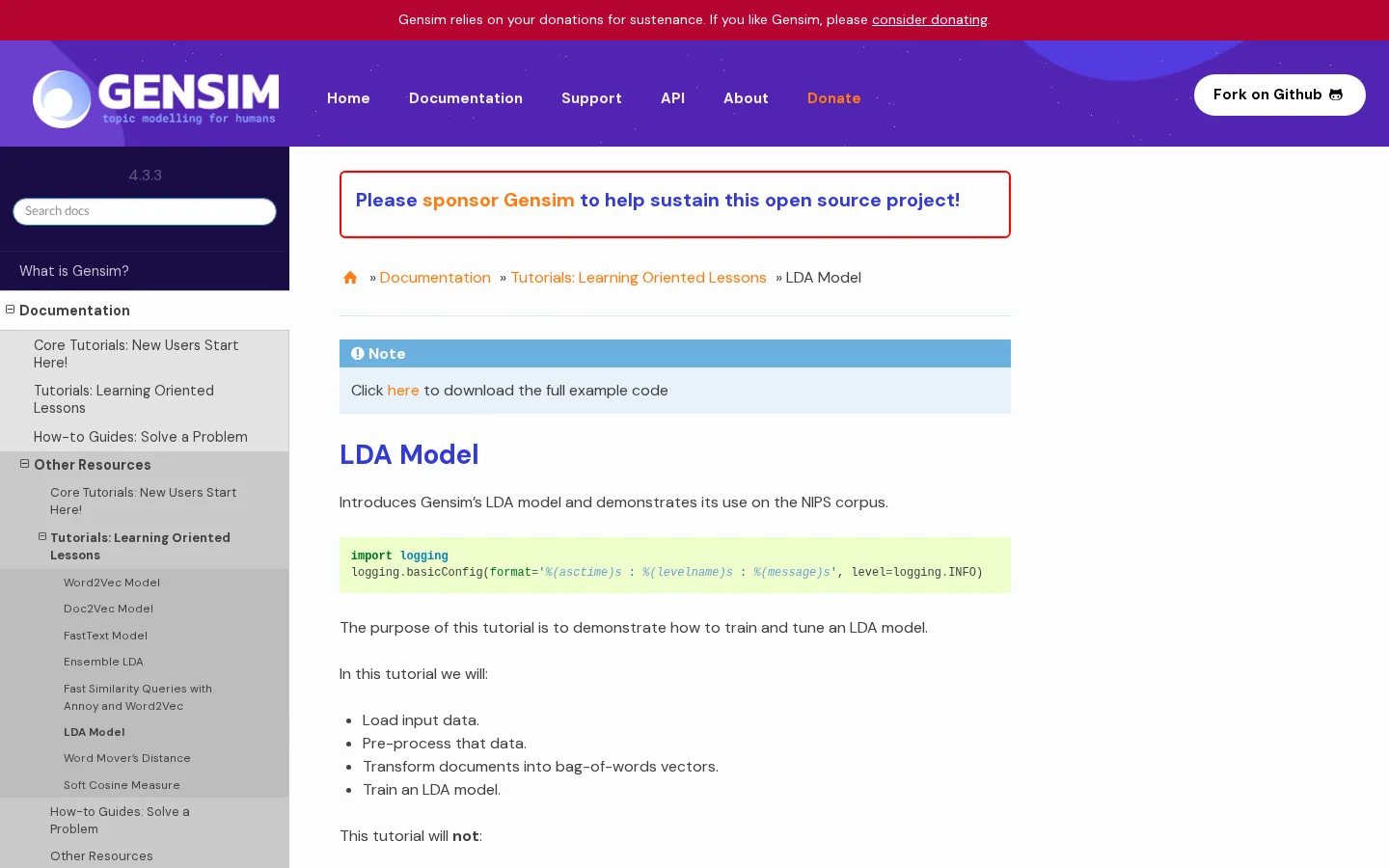
A minimal script looks like this. The variable texts is a list of documents, and each document is a list of cleaned words.
from gensim.corpora import Dictionary
from gensim.models import LdaModel

dictionary = Dictionary(texts)
corpus = [dictionary.doc2bow(text) for text in texts]
lda = LdaModel(corpus=corpus, id2word=dictionary, num_topics=10)
for topic in lda.print_topics():
print(topic)Keyword research starts from what people type. Topic modeling starts from what the texts say. Both are useful, and they answer different questions.
| Keyword research | Topic modeling | |
|---|---|---|
| Starting point | A seed keyword | A set of texts, such as top pages |
| Output | Queries with their search data | Themes and the words that define them |
| Question answered | What do people search for? | What does a complete answer cover? |
| Use in your work | Choose the target queries | Plan the subtopics and find the gaps |
Use keyword research first to pick the query. Then use topic modeling to decide what the page must cover to compete for it.
Run the analysis on one target query at a time. These steps work with any tool that lets you export text, or with a script.
Tip
Save each run. When you run it again in a few months, compare the topics. You will see which subtopics are new in the top results.
A content gap is a topic that the top pages cover and your page does not, or covers in less depth. There are two kinds. A page-level gap is a page that covers the same topic more fully than yours. A domain-level gap is a whole area your site has no page for. Read the full method in content gap analysis.
Check the intent too. If every top result is a how-to guide and you only have a product page, the gap is the format, not the words. A new guide may close it.
When the missing topic deserves its own page, group it with the pages around it. That is the logic of topic clusters and pillar pages. Topic modeling finds the themes. The cluster is the site structure you build from them.
Gensim is free and open source, but it needs Python and some data work. Many SEO platforms run a similar analysis behind a button. Some call it "topics" or "semantic" analysis without showing the method. Ask what the tool measures before you pay, and test it on a query you know well.
Sorank covers the grouping step. Its free Keyword Clustering Tool groups keywords into pages, and the topical cluster generator plans related pages so they do not compete with each other.
What it is: You pick a number of topics and keep the first result. How to spot it: Some topics mix unrelated words, or two topics say the same thing. How to fix it: Run the model with a few different counts and keep the one where each topic has a clear name.
What it is: You analyze your site alone, so every topic matches a page you already have. How to spot it: The output shows nothing new. How to fix it: Add the top results for the same query to the analysis, then compare.
What it is: Navigation, cookie notices and footers reach the model. How to spot it: Topics named "cookies", "menu" or "privacy". How to fix it: Remove page furniture before the analysis and filter common words.
What it is: You add every topic word to the text to look complete. How to spot it: Sections that list words but never answer a question. How to fix it: Write one section per subtopic that answers a real question. Google asks whether the reader would find the content useful "if they came to the site directly" (Google Search Central).
What it is: You run the analysis once and never repeat it. How to spot it: Your page is still based on results that have changed. How to fix it: Run the same query again every few months and update the sections that fell behind.
Search engines and AI models read pages for meaning. A page that covers the expected subtopics gives them more context to match it to a query. An AI model that answers a question needs a source that covers the parts of that question. A page with the right subtopics gives it those parts.
This idea sits behind semantic SEO, and it builds topical authority over time. For the keyword side of the work, read the keyword clustering guide.
Topic modeling shows you the themes behind the pages that already rank. Start with one query. Find the subtopics your page lacks, write one section for each, and run the analysis again later to see what changed.
Sources
Not always. Free libraries such as Gensim need Python. Many SEO platforms run a similar analysis behind a button, so check which method they use before you pay.
There is no fixed answer. Start with a small number, read the topics it gives, and try a few other values. Keep the setting where each topic has a clear meaning you can name.
No. Topic modeling finds the themes in a set of texts. A topic cluster is a site structure, with one pillar page linked to related pages. Use topic modeling first, then build the cluster.
 “I tested Sorank on a real client site and it's insane. It does everything an agency would bill you $1500 a month for. It's going into production on that client now.”

 Guillaume Guersanguersanguillaume.com“We are an Ads agency and we wanted to get our SEO back on track once and for all. Sorank gave us a clear view of our site, helped us prioritize optimizations, and properly structure our content. The tool is easy to use, well designed for a team, and very practical for centralizing tracking without having to juggle multiple platforms. A very solid foundation to start fresh with our SEO.”
 Gaspard MadouiAds Agency
 “I just let the Sorank software do its thing, and now my DR is 25 and my page is ranking higher.”
 Lucas Flandrefoundertrace.fr“I specialized in GEO thanks to Sorank. The GEO Leaderboard allows me to show my clients their position vs competitors on ChatGPT. It’s a real commercial differentiator.”
 MélanieSEO Freelance“Great service, works well for our website and helps us understand how to improve it to rank better on Google and elsewhere. Congrats, keep going, I recommend it.”
 Hugo T.E-commerce merchant



















