
Preferences
Privacy is important to us, so you have the option of disabling certain types of storage that may not be necessary for the basic functioning of the website. Blocking categories may impact your experience on the website. More information
Privacy is important to us, so you have the option of disabling certain types of storage that may not be necessary for the basic functioning of the website. Blocking categories may impact your experience on the website. More information

The reasonable surfer model weights each link by its chance of being clicked. Learn the Google patent, the link factors and what it means for your links.








Founder Sorank, 7+ years in SEO.
Summary
The reasonable surfer model is a Google link-ranking method, patented in 2010, that weights each link by the probability that a real user would click it. Instead of splitting PageRank equally across all links on a page, it gives more value to prominent, relevant links in the main content and less to footer, boilerplate or advertising links.
Want to go further? Ask
The reasonable surfer model answers a simple question: if a person lands on this page, which links will they actually click? A link in the first paragraph, with a clear anchor, is more likely to be clicked than a "Terms of Service" link in the footer, so the model passes more value through it. For you, this changes how you place links, both on your own site and when you earn links from other sites.
The reasonable surfer model comes from a Google patent titled "Ranking documents based on user behavior and/or feature data", US7716225B1, filed on June 17, 2004 and granted on May 11, 2010. Its inventors are Jeffrey A. Dean, Corin Anderson and Alexis Battle. The patent states that "not all of the links associated with a document are equally likely to be followed", and it describes the rank of a page as "the probability that a reasonable surfer will access the document".
Google later filed continuation patents with the same title, which kept the same idea and put even more weight on anchor text in the claims. SEOs started calling the whole family "the reasonable surfer patent".
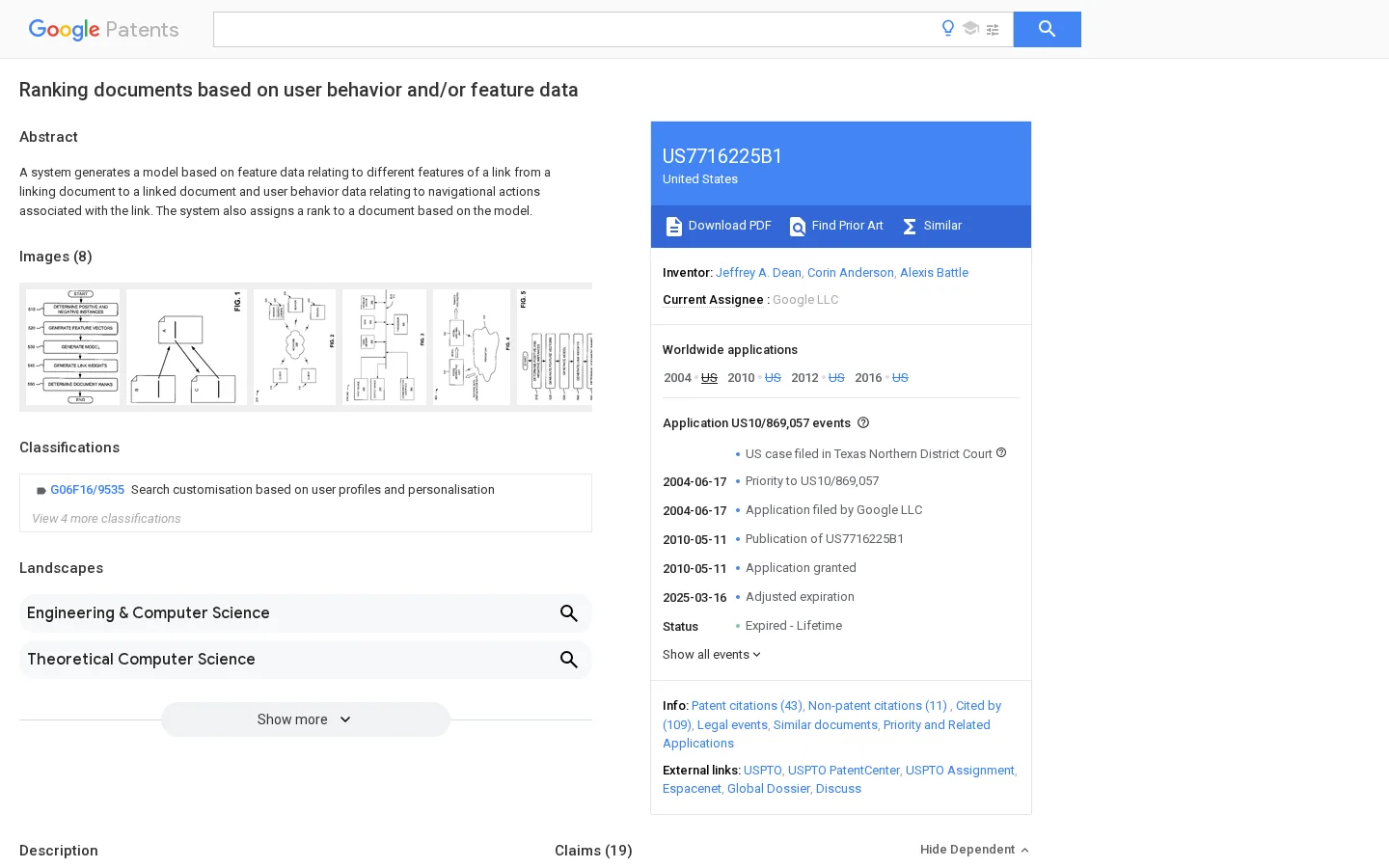
The random surfer clicks any link on a page with the same chance; the reasonable surfer clicks some links much more than others. The random surfer is the user model behind the original PageRank algorithm. In Larry Page's patent, "Method for node ranking in a linked database" (US6285999B1), the importance of a page is "the steady-state probability that a random web surfer ends up at the page after following a large number of links". A damping value models the moment when the surfer gets bored and jumps to a random page; the patent gives a typical value of about 0.1 to 0.15.
Here is a simplified view of both models:
Random surfer (PageRank, US6285999B1)
  r(A) = a/N + (1 - a) * sum over pages B linking to A of r(B) / |B|
  |B| = number of links on page B: every link gets the same share

Reasonable surfer (US7716225B1)
  each link from B to A gets its own weight w(B, A)
w(B, A) = probability that a user on page B selects the link to A| Point | Random surfer | Reasonable surfer |
|---|---|---|
| User behavior | Picks any link at random | Picks the links a real person would choose |
| Value per link | Page value divided equally among its links | Each link weighted by its click probability |
| Footer and ad links | Same share as a link in the text | Low share |
| Data used | The link graph only | Link graph, link features and user behavior data |
| Source | US6285999B1 (filed 1998) | US7716225B1 (filed 2004) |
The reasonable surfer does not replace PageRank. It refines it: the ranking still flows through links, but each link carries a different share.
The patent lists features of the link itself, of the page that holds it and of the page it points to. A model combines them to predict the chance of a click. The main ones are:
The patent also gives examples of links people rarely follow: "Terms of Service" links, banner ads and links unrelated to the page. These are the links that lose most of their weight.
According to the patent, Google trains the model on user behavior data: when a user clicks a link, that link counts as a positive example, and the other links on the same page count as negative examples. Each link also gets a vector of features (position, font, anchor and so on). A learning method such as naive Bayes, a decision tree or logistic regression then finds which features predict a click.
The patent calls it a dynamic model, "built from data that changes over time", so link weights are updated as behavior changes. It can learn general rules that apply to all pages, so it does not need clicks on your exact page to judge a footer link as weak.
Nobody outside Google knows, and you should treat any precise claim with caution. A patent shows what Google invented and protected, not what runs in its ranking today. Google Patents lists US7716225B1 as expired. What Google does confirm, in its guide to its ranking systems, is that PageRank "has evolved a lot" since launch and "continues to be part of our core ranking systems".
Warning
Many articles give exact figures such as "footer links pass X% less value". No public Google document gives such numbers. Use the model as a way of thinking about link placement, not as a formula you can calculate.
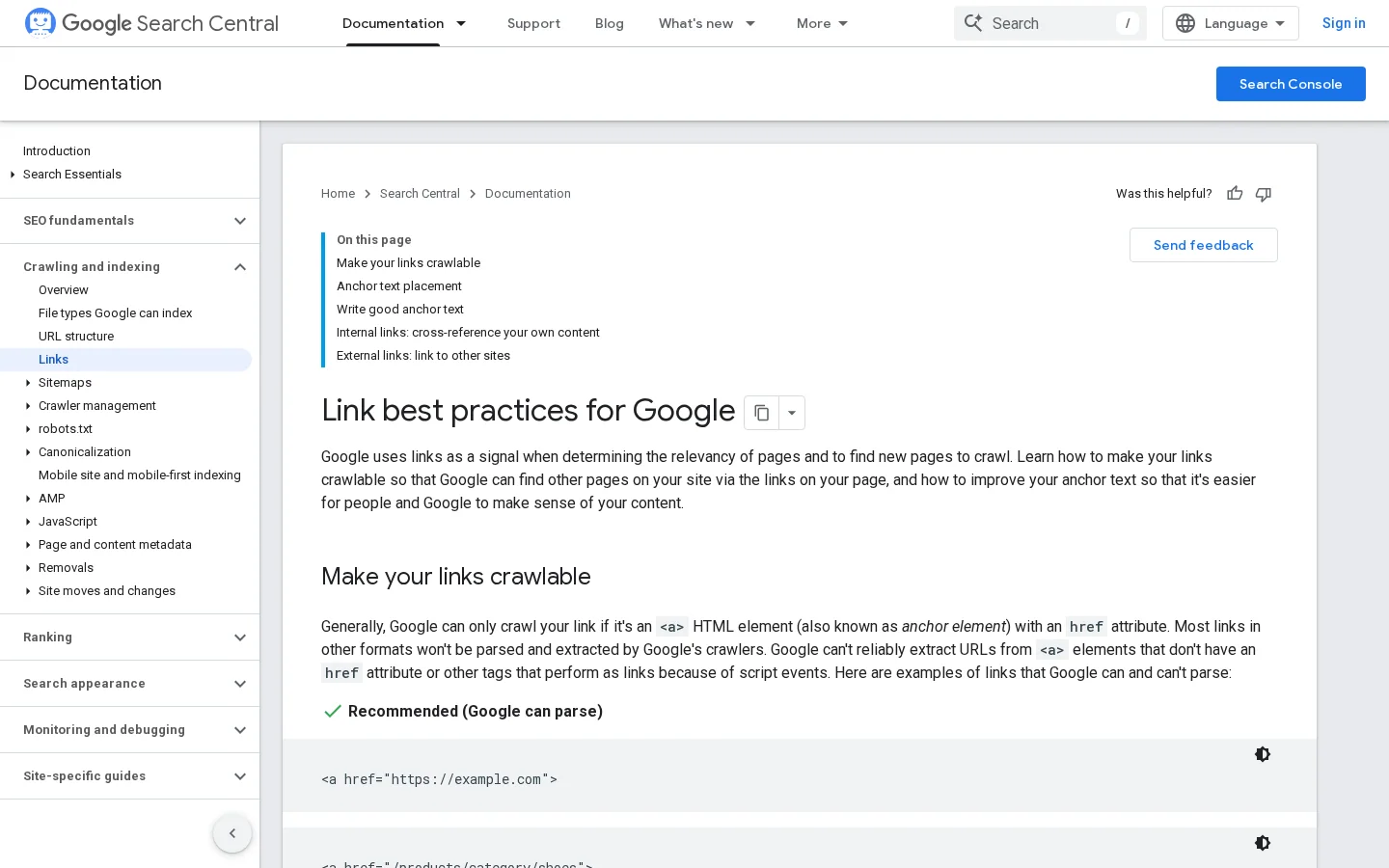
The direction of the model matches Google's public advice, which is enough to act on. Its link best practices say Google "uses links as a signal when determining the relevancy of pages" and ask for anchor text that is "descriptive, reasonably concise, and relevant".
It means your most important internal links belong in the main content, high on the page, with a clear anchor. Menus and footers still help crawling, but they repeat on every page and say little about the target. Apply the model to your internal links this way:
To check this on a real page, the free Sorank internal link analyzer separates the links placed in the content from those in the menus and footer, and flags empty or generic anchors. For a full plan by page type, read our expert internal linking strategy.
It means the place of a link on the linking page matters as much as the site it comes from. A backlink inside the body of a relevant article, with a natural anchor, matches what a reasonable surfer would click. A sitewide footer link, a blogroll entry or a link in an "our partners" block matches the low-probability examples of the patent.
When you evaluate a link opportunity, ask three questions: is the link in the main text, is it near the top, and would a reader of this page want to click it? Our checklist of criteria for a quality backlink adds the other factors to check.
For SEO, it explains why two links to the same page do not carry the same value: the one people would click counts more. It gives you a clear rule for placing internal links and for judging backlinks, and that rule matches Google's public advice on descriptive anchors and links in context.
For GEO, the same habits help. AI crawlers follow links to find your pages, and a link in a useful sentence, with an anchor that names the topic, tells any reader, human or machine, what the target page covers. Boilerplate links say little.
The reasonable surfer model, patented by Google in 2010, weights each link by the chance that a real user clicks it, instead of giving every link the same share of PageRank. Position, font size, anchor text and context all change that chance. Google has never confirmed how it applies the model today, so treat it as a guide, not a formula: put your key links in the text, high on the page, with descriptive anchors, and earn backlinks that readers would actually click. To get those links inside relevant articles in your niche, see how Sorank handles contextual backlink acquisition.
Sources
The random surfer of the original PageRank patent follows any link on a page with the same chance, so every link gets an equal share of the page's value. The reasonable surfer model gives each link its own weight, based on the probability that a real user would click it. Prominent links in the main content get more weight than footer or ad links.
Google has never confirmed how or whether it applies this patent today, and a patent only shows what Google invented. Google does say that PageRank has evolved and remains part of its core ranking systems. Treat the model as a guide for link placement, not as a proven formula.
The patent cites footer position as a feature and gives "Terms of Service" links and banner ads as examples of links people rarely follow, so such links likely carry less weight. No public Google document gives an exact figure. Put the links to your key pages in the main text as well as in the footer.
 “I tested Sorank on a real client site and it's insane. It does everything an agency would bill you $1500 a month for. It's going into production on that client now.”

 Guillaume Guersanguersanguillaume.com“We are an Ads agency and we wanted to get our SEO back on track once and for all. Sorank gave us a clear view of our site, helped us prioritize optimizations, and properly structure our content. The tool is easy to use, well designed for a team, and very practical for centralizing tracking without having to juggle multiple platforms. A very solid foundation to start fresh with our SEO.”
 Gaspard MadouiAds Agency
 “I just let the Sorank software do its thing, and now my DR is 25 and my page is ranking higher.”
 Lucas Flandrefoundertrace.fr“I specialized in GEO thanks to Sorank. The GEO Leaderboard allows me to show my clients their position vs competitors on ChatGPT. It’s a real commercial differentiator.”
 MélanieSEO Freelance“Great service, works well for our website and helps us understand how to improve it to rank better on Google and elsewhere. Congrats, keep going, I recommend it.”
 Hugo T.E-commerce merchant



















